
Concept
ChristologyThe Lamb
From Abraham's "God will provide himself a lamb" to the Lamb standing as slain in heaven: the Bible's longest single image.
#typology#sacrifice
- 19passages
- 114original words
- 240cross-references
- 1thread through it
The words behind it
Hebrew and Greek standing in the 18 passages listed below, not a lexicon of "the lamb" itself. The number on each word is how often it occurs in those passages; the connecting words the languages use everywhere are set aside so the words that carry meaning can be seen.
Hebrew70
60 more hebrew words ▾
Greek44
34 more greek words ▾
The passages
The first 18 of 19 passages this site attaches to the concept, in canon order. Each row says where it came from.
Old Testament14
- Genesis 22:7listed key text
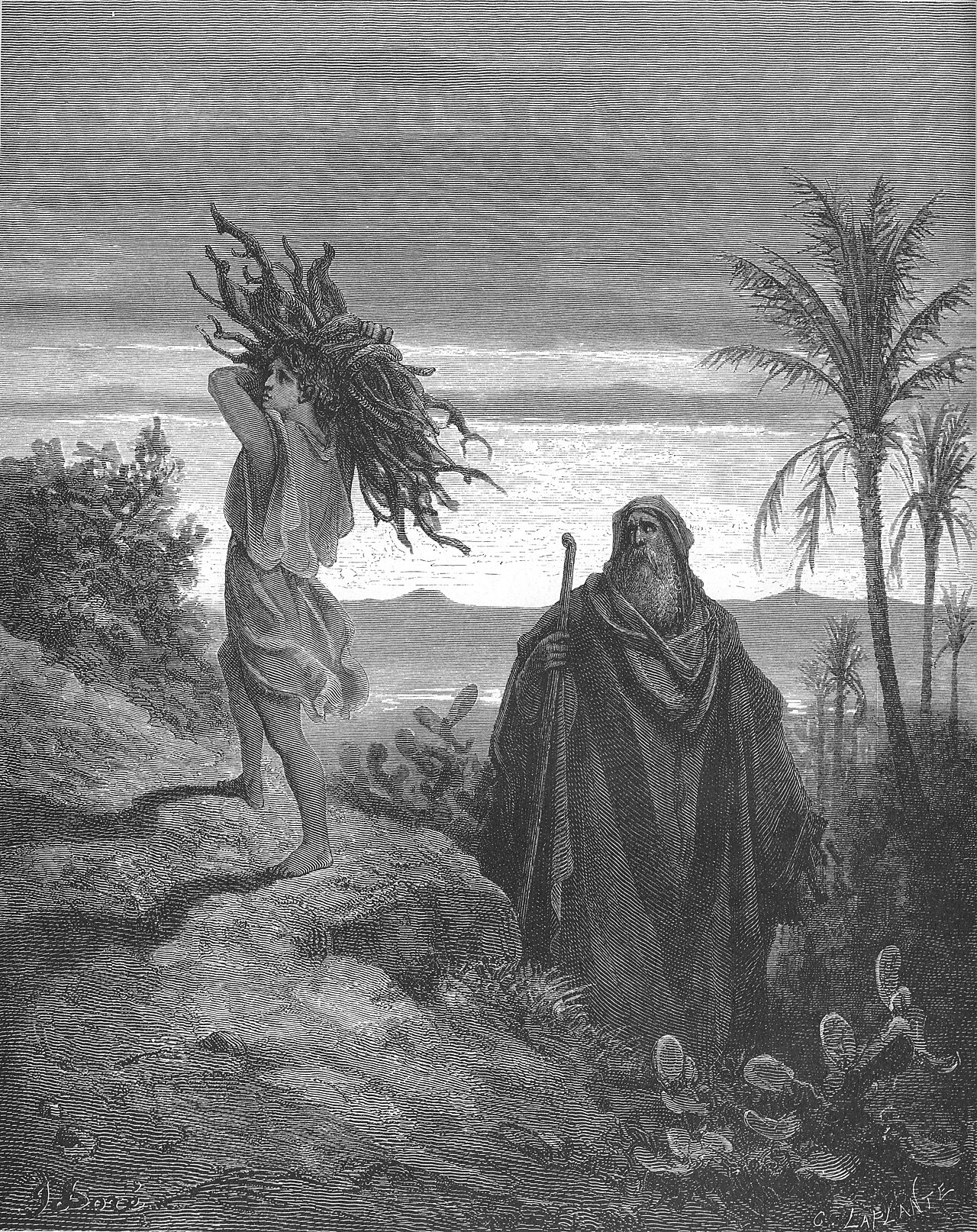
Then Isaac said to his father Abraham, “My father!” “Here I am, my son,” he replied. “The fire and the wood are here,” said Isaac, “but where is the lamb for the burnt offering?”(opening verse of the passage)
Commentary on Genesis 22:72 voices
Behold the fire and the wood: but where is the lamb - Nothing can be conceived more tender, affectionate, and affecting, than the question of the son and the reply of the father on this occasion. A paraphrase would spoil it; nothing can be added without injuring those expressions of affectionate submission on the one hand, and dignified tenderness and simplicity on the other.
Adam Clarke· Commentary on the BibleEvangelical
Therefore he brings his well-beloved son to be sacrificed, and offered promptly him whom he had received late; nor is he restrained by being called by the name of father, when his son called him "Father," and he replied, "My son." Dear pledges of love are these names, but the commands of God are loved still more. And so although their hearts felt for each other, their purpose remained firm.
Ambrose of Milan· On the Decease of His Brother Satyrus, Book 2, Section 97Patristic
- Exodus 12:3listed key text
Tell the whole congregation of Israel that on the tenth day of this month each man must select a lamb for his family, one per household.(opening verse of the passage)
Commentary on Exodus 12:31 voice
A lamb - The Hebrew word is general, meaning either a sheep or a goat - male or female - and of any age; the age and sex are therefore epecially defined in the following verse. The direction to select the lamb on the tenth day, the fourth day before it was offered, was intended to secure due care in the preparation for the great national festival. The custom certainly fell into desuetude at a later period, but probably not before the destruction of the temple.
Albert Barnes· Notes, Explanatory and Practical, on the Old and New Testaments (1832-1869)Evangelical
- Exodus 23:19topical floor
Bring the best of the firstfruits of your soil to the house of the LORD your God. You must not cook a young goat in its mother’s milk.
Commentary on Exodus 23:192 voices
Our physical nature rebels against the thought of making the nourishment of the living a garnish for the dead or the cause of life an accessory to the death of the body.
Clement of Alexandria· The Stromata Book 2Patristic
The first of the firstfruits of thy land - The “best,” or “chief” of the firstfruits, that is, the two wave loaves described Lev 23:17. As the preceding precept appears to refer to the Passover, so it is likely that this refers to Pentecost. They are called in Leviticus, “the firstfruits unto the Load;” and it is reasonable that they should here be designated the “chief” of the firstfruits. If, with some, we suppose the precept to relate to the offerings of firstfruits in general, the command is a repetition of Exo 22:
Albert Barnes· Notes, Explanatory and Practical, on the Old and New Testaments (1832-1869)Evangelical
- Exodus 29:38thread stop
This is what you are to offer regularly on the altar, each day: two lambs that are a year old.(opening verse of the passage)
Commentary on Exodus 29:381 voice
Exo 29:38 The continual burnt-offering - The primary purpose of the national altar is here set forth. The victim slain every morning and every evening was an acknowledgment that the life of the people belonged to Yahweh; the offering of meal was an acknowledgment that all their works rightly done were His due (see Lev. 2); while the incense symbolized their daily prayers. Exo 29:39 At even - See Exo 12:6. Exo 29:40 A tenth deal - i. e. the tenth part of an Ephah; it is sometimes called an Omer (Exo 16:36; see Lev 23:13).
Albert Barnes· Notes, Explanatory and Practical, on the Old and New Testaments (1832-1869)Evangelical
- Leviticus 3:7topical floor
If he is presenting a lamb for his offering, he must present it before the LORD.
Commentary on Leviticus 3:71 voice
If he offer a lamb for his offering,.... Which was of the flock, and must be of the first year; this is a rule laid down by Maimonides (i), that where ever this word is used in the law, it signifies one of the first year: then shall he offer it before the Lord; bring it into the court, and present it to the priest. (i) Maaseh Hakorbanot, c. 1. sect. 14.
John Gill· Exposition of the Old Testament (1748-1763)Reformed
- Leviticus 4:32topical floor
If, however, he brings a lamb as a sin offering, he must bring an unblemished female.
Commentary on Leviticus 4:322 voices
And if he bring a lamb for a sin offering,.... As he might if he would; the Jews observe, that in all places a lamb is put before a goat, as being more excellent in its kind; but here it is mentioned after, which shows, they say, that they are equally alike (p): he shall bring it a female without blemish; typical of Christ the Lamb of God, without spot and without blemish, 1Pe 1:19. (p) T. Bab. Pesachim, fol. 57. 2. & Ceritot, fol. 28. 2.
John Gill· Exposition of the Old Testament (1748-1763)Reformed
A lamb - A sheep. See Lev 3:7 note. Three points are to be observed in regard to the victims for sin-offerings. (a) The common people had to offer a female, as the less valuable animaI; they might present either a sheep or a goat to suit their convenience: (b) the rulers had always to offer a male-goat: (c) the goat was preferred to the sheep, unlike the victim for a peace-offering or burnt-offering. The sin-offerings were not accompanied by meat-offerings or drink-offerings. See Num 15:3-11.
Albert Barnes· Notes, Explanatory and Practical, on the Old and New Testaments (1832-1869)Evangelical
- Leviticus 5:6topical floor
and he must bring his guilt offering to the LORD for the sin he has committed: a female lamb or goat from the flock as a sin offering. And the priest will make atonement for him concerning his sin.
- Leviticus 22:23topical floor
You may present as a freewill offering an ox or sheep that has a deformed or stunted limb, but it is not acceptable in fulfillment of a vow.
Commentary on Leviticus 22:231 voice
That hath anything superfluous or lacking - The term שרוע sarua signifies any thing extended beyond the usual size, and the term קלוט kalut signifies any thing unusually contracted; and both mean any monstrosity, whether in redundance or defect.
Adam Clarke· Commentary on the BibleEvangelical
- Leviticus 23:12topical floor
On the day you wave the sheaf, you shall offer a year-old lamb without blemish as a burnt offering to the LORD,
Commentary on Leviticus 23:121 voice
And ye shall offer that day, when ye wave the sheaf,.... Besides the daily sacrifice of the morning and evening, and the additional offerings made on everyone of the seven days of the feast of unleavened bread: an he lamb without blemish of the first year, for a burnt offering unto the Lord; typical of the perfect and immaculate Lamb of God, whose sufferings are fitly signified by a burnt offering; and which were endured at the time he became the firstfruits of his people, and sanctified them.
John Gill· Exposition of the Old Testament (1748-1763)Reformed
- Numbers 6:12topical floor
He must rededicate his time of separation to the LORD and bring a year-old male lamb as a guilt offering. But the preceding days shall not be counted, because his separation was defiled.
- Numbers 7:15topical floor
one young bull, one ram, and one male lamb a year old for a burnt offering;
Commentary on Numbers 7:151 voice
One young bullock,.... Of three years old, as the Targums of Jonathan and Jerusalem: one ram; of two years old, as the same Targums: one lamb of the first year, for a burnt offering; of which see Lev 1:3.
John Gill· Exposition of the Old Testament (1748-1763)Reformed
- Numbers 7:21topical floor
one young bull, one ram, and one male lamb a year old for a burnt offering;
- Numbers 28:3topical floor
And tell them that this is the offering made by fire you are to present to the LORD as a regular burnt offering each day: two unblemished year-old male lambs.(opening verse of the passage)
- Isaiah 53:7listed key text
He was oppressed and afflicted, yet He did not open His mouth. He was led like a lamb to the slaughter, and as a sheep before her shearers is silent, so He did not open His mouth.(opening verse of the passage)
Commentary on Isaiah 53:72 voices
Like a lamb that is led to the slaughter, and like a sheep before its shearers is silent, so he did not open his mouth. This testimony is about the Ethiopian eunuch, who was riding in a chariot of Queen Candace while reading the book of Acts (Chapter 8 and following). He did not understand what he was reading, but with the help of Philip, he came to understand the passion and the name of the Savior. He was immediately baptized in the blood of the Lamb that he had been reading about and deserved to be called a man.
Jerome· Commentary on IsaiahPatristic
He was oppressed - (נגשׂ niggas'). Lowth renders this, ‘It was exacted.’ Hengstenberg, ‘He was abased.’ Jerome (the Vulgate), ‘He was offered because he was willing.’ The Septuagint ‘He, on account of his affliction, opened not his mouth,’ implying that his silence arose from the extremity of his sorrows.
Albert Barnes· Notes, Explanatory and Practical, on the Old and New Testaments (1832-1869)Evangelical
New Testament4
- John 1:29listed key text
The next day John saw Jesus coming toward him and said, “Look, the Lamb of God, who takes away the sin of the world!(opening verse of the passage)
Commentary on John 1:292 voices
Abel knew how to divide when he offered a sacrifice from "the firstlings of his flock," teaching that the gifts of the earth, which had degenerated in the sinner, will not please God. But those in which the grace of the divine mystery shone forth will please him. And so he prophesied that we were to be redeemed from fault through the passion of the Lord, of whom it is written: "Here is the lamb of God who takes away the sin of the world." Thus, too, he made an offering from the firstlings, that he might signify the firstborn.
Ambrose of Milan· On the Sacrament of the Incarnation of the Lord 1.4Patristic
The next day - The day after the Jews made inquiry whether he was the Christ. Behold the Lamb of God - A “lamb,” among the Jews, was killed and eaten at the Passover to commemorate their deliverance from Egypt, Exo 12:3-11. A lamb was offered in the tabernacle, and afterward in the temple, every morning and evening, as a part of the daily worship, Exo 29:38-39. The Messiah was predicted as a lamb led to the slaughter, to show his patience in his sufferings, and readiness to die for man, Isa 53:
Albert Barnes· Notes, Explanatory and Practical, on the Old and New Testaments (1832-1869)Evangelical
- 1 Corinthians 5:7thread stop
Get rid of the old leaven, that you may be a new unleavened batch, as you really are. For Christ, our Passover lamb, has been sacrificed.
Commentary on 1 Corinthians 5:71 voice
Purge out therefore the old leaven,.... Meaning either the incestuous person, whose crime might well be compared to sour "leaven", and be called old because of his long continuance in it; whom the apostle would have removed from them; this is properly the act of excommunication, which that church was to perform, as a quite distinct thing from what the apostle himself determined to do.
John Gill· Exposition of the New Testament (1746-1748)Reformed
- 1 Peter 1:19listed key text
but with the precious blood of Christ, a lamb without blemish or spot.(opening verse of the passage)
- Revelation 5:6listed key text
Then I saw a Lamb who appeared to have been slain, standing in the center of the throne, encircled by the four living creatures and the elders. The Lamb had seven horns and seven eyes, which represent the seven Spirits of God sent out into all the earth.(opening verse of the passage)
Commentary on Revelation 5:61 voice
Stood a Lamb - Christ, so called because he was a sacrificial offering; αρνιον signifies a little or delicate lamb. As it had been slain - As if now in the act of being offered. This is very remarkable; so important is the sacrificial offering of Christ in the sight of God that he is still represented as being in the very act of pouring out his blood for the offenses of man. This gives great advantage to faith: when any soul comes to the throne of grace, he finds a sacrifice there provided for him to offer to God.
Adam Clarke· Commentary on the BibleEvangelical
Voices on these passages
Commentary matched to the verses above, each named with its source: the full pool sits on each verse page.
Behold the fire and the wood: but where is the lamb - Nothing can be conceived more tender, affectionate, and affecting, than the question of the son and the reply of the father on this occasion. A paraphrase would spoil it; nothing can be added without injuring those expressions of affectionate submission on the one hand, and dignified tenderness and simplicity on the other.
Adam Clarke· Commentary on the BibleEvangelical
Genesis 22:7
A lamb - The Hebrew word is general, meaning either a sheep or a goat - male or female - and of any age; the age and sex are therefore epecially defined in the following verse. The direction to select the lamb on the tenth day, the fourth day before it was offered, was intended to secure due care in the preparation for the great national festival. The custom certainly fell into desuetude at a later period, but probably not before the destruction of the temple.
Albert Barnes· Notes, Explanatory and Practical, on the Old and New Testaments (1832-1869)Evangelical
Exodus 12:3
Our physical nature rebels against the thought of making the nourishment of the living a garnish for the dead or the cause of life an accessory to the death of the body.
Clement of Alexandria· The Stromata Book 2Patristic
Exodus 23:19
Study it deeper
6 moves a student can make from here. Every one opens a tool on this site.
Trace one word to every place it stands
A word page lists every verse that word occurs in, with its definition and its range of meaning. Start with the roots that occur most under the passages above.
Walk out from the passages
The passages above carry 240 cross-references between them, links from the Treasury of Scripture Knowledge, the great 1830s reference work, together with the reader-voted index at OpenBible.info. The most-linked destinations:
Read it in both testaments
Set the earliest passage beside the New Testament one and ask what changed and what did not, the shape of the lamb before Christ and after him.
Read the whole chapter around it
A verse quoted alone can mean almost anything. Open Genesis 22 in the reader, where the Hebrew or Greek sits under every line.
See everywhere else it appears
The search page is a doorway: it returns verses, word studies, people, places and studies for one term at once.
Walk it stop by stop
A thread takes the passages in order and stops at each one with commentary, so the idea unfolds instead of arriving all at once.
Where this comes from
Isaac's question on Moriah: "where is the lamb?" is answered four times: by a ram in the thicket, by the Passover lamb in Egypt, by the daily sacrifice in the tabernacle, and finally by John the Baptist pointing at a Man (John 1:29).
Revelation keeps the title after the resurrection: the One on the throne is still "a Lamb as it had been slain." The wounds are permanent; the image never gets traded up.