
2 Kings 10:17
in 2 Kings 10When Jehu came to Samaria, he struck down everyone belonging to Ahab who remained there, until he had destroyed them, according to the word that the LORD had spoken to Elijah.
BSB
The same verse in ASV and KJV ▾
ASV
And when he came to Samaria, he smote all that remained unto Ahab in Samaria, till he had destroyed him, according to the word of Jehovah, which he spake to Elijah.
KJV
And when he came to Samaria, he slew all that remained unto Ahab in Samaria, till he had destroyed him, according to the saying of the Lord, which he spake to Elijah.
⋯
This verse in 2 Kings 10
Commentary
6 notes on this verseA commentator
Albert Barnes1798–1870
Notes, Explanatory and Practical, on the Old and New Testaments (1832-1869)
Compare 2Ki 10:11. Thus was finally completed the political revolution which transferred the throne from the house of Omri to that of Nimshi, the fifth of the royal families of Israel. According to the saying of the Lord - This emphatic reiteration (compare 2Ki 10:10) marks, first, how in the mind of the writer all this history is viewed as deriving its special interest from its being so full and complete an accomplishment of Elijah’s prophecies; and, secondly, how at the time Jehu carefully put forward the plea that what he did had this object.
This site's exposition
according to the saying of the Lord
Samaria receives the same treatment Jezreel already received, every survivor connected to Ahab's house put to death. The narrator repeats the phrase from verse ten almost exactly, according to the saying of the Lord, which he spake to Elijah, tying the whole campaign back to the sentence pronounced in the vineyard at Naboth's death. The dynasty of Omri that began with a purchased hill in chapter sixteen ends with a purchased throne handed to Nimshi's grandson.
The record, by era
The Puritans and the Awakening3 voices
This was bloody work, and is not now, in any case, to be drawn into a precedent. Let the guilty suffer, but not the guiltless for their sakes. Perhaps such terrible destructions as these were intended as types of the final destruction of all the ungodly.
And when he came to Samaria, he slew all that remained unto Ahab in Samaria,.... All that were in any connection with him, as related to his family, or as ministers of his in civil or religious things: till he had destroyed him; his whole house, as he was ordered: according to the word of the Lord, which he spake to Elijah; which is observed, to show the exact fulfilment of prophecy, see 1Ki 21:21.
Contriving the destruction of all the worshippers of Baal. The service of Baal was the crying sin of the house of Ahab: that root of this idolatry was plucked up, but multitudes yet remained that were infected with it, and would be in danger of infecting others.
The Nineteenth Century1 voice
A commentator
Jamieson, Fausset & Brown1802–1910
Commentary Critical and Explanatory on the Whole Bible (1871)
Jehonadab the son of Rechab--(See 1Ch 2:55). A person who, from his piety and simple primitive manner of life (Jer 35:1-19), was highly esteemed, and possessed great influence in the country.
The words behind it
16 Hebrew wordsEvery Hebrew word of this verse in the order it stands, with what it means and the door to its own study. The last column counts the times a word stands in the whole Bible: the rarer the word, the more the places it appears belong together.
| Hebrew | Sound | Meaning | Word study | In the Bible |
|---|---|---|---|---|
| וַיָּבֹא֙ | vaiyavo' | and he came | H935 → | 2568 times |
| שֹֽׁמְר֔וֹן | shomeron | Samaria | H8111 → | 109 times |
| וַ֠יַּךְ | vaiyakh | and he struck down | H5221 → | 499 times |
| אֶת־ | ʾet- | <obj.> | H853 → | 10935 times |
| כָּל־ | kol- | all | H3605 → | 5413 times |
| הַנִּשְׁאָרִ֧ים | hanisharim | those [who] remained | H7604 → | 133 times |
| לְאַחְאָ֛ב | leachav | of Ahab | H256 → | 92 times |
| בְּשֹׁמְר֖וֹן | beshomeron | in Samaria | H8111 → | 109 times |
| עַד־ | ʾad- | until | H5704 → | 1261 times |
| הִשְׁמִיד֑וֹ | hishmido | he had destroyed him | H8045 → | 90 times |
| כִּדְבַ֣ר | kidvar | according to [the] word of | H1697 → | 1440 times |
| יְהוָ֔ה | yahweh | Yahweh | H3068 → | 6520 times |
| אֲשֶׁ֥ר | ʾasher | which | H834 → | 5497 times |
| דִּבֶּ֖ר | diber | he had spoken | H1696 → | 1141 times |
| אֶל־ | ʾel- | to | H413 → | 5510 times |
| אֵלִיָּֽהוּ׃ פ | ʾeliyahu | Elijah | H452 → | 71 times |
וַיָּבֹא֙and he came
vaiyavo'H935 →2568 times
שֹֽׁמְר֔וֹןSamaria
shomeronH8111 →109 times
וַ֠יַּךְand he struck down
vaiyakhH5221 →499 times
אֶת־<obj.>
ʾet-H853 →10935 times
כָּל־all
kol-H3605 →5413 times
הַנִּשְׁאָרִ֧יםthose [who] remained
hanisharimH7604 →133 times
לְאַחְאָ֛בof Ahab
leachavH256 →92 times
בְּשֹׁמְר֖וֹןin Samaria
beshomeronH8111 →109 times
עַד־until
ʾad-H5704 →1261 times
הִשְׁמִיד֑וֹhe had destroyed him
hishmidoH8045 →90 times
כִּדְבַ֣רaccording to [the] word of
kidvarH1697 →1440 times
יְהוָ֔הYahweh
yahwehH3068 →6520 times
אֲשֶׁ֥רwhich
ʾasherH834 →5497 times
דִּבֶּ֖רhe had spoken
diberH1696 →1141 times
אֶל־to
ʾel-H413 →5510 times
אֵלִיָּֽהוּ׃ פElijah
ʾeliyahuH452 →71 times
A shaded row is a word that stands 400 times or fewer in the Bible.
The walk
8 stopsEach card is a verse this one points to, and under it the verses that one points to in turn. Where several paths arrive at the same place, that place is listed first: the text keeps returning to it.
Through
2 Kings 9:8The whole house of Ahab will perish, and I will cut off from Ahab every male, both slave and free, in Israel.
it leads to
- 2 Kings 14:26
For the LORD saw that the affliction of the Israelites, both slave and free, was very bitter. There was no one to help Israel,
Reached by 2 separate paths from here.
- 1 Samuel 25:22
May God punish David, and ever so severely, if I let one of Nabal’s men survive until morning.”
- Deuteronomy 32:36
For the LORD will vindicate His people and have compassion on His servants when He sees that their strength is gone and no one remains, slave or free.
- 2 Kings 14:26
Through
1 Kings 21:21This is what the LORD says: ‘I will bring calamity on you and consume your descendants; I will cut off from Ahab every male in Israel, both slave and free.
it leads to
- 1 Kings 14:10
Because of all this, behold, I am bringing disaster on the house of Jeroboam: I will cut off from Jeroboam every male, both slave and free, in Israel; I will burn up the house…
- 2 Kings 10:1–7
Now Ahab had seventy sons in Samaria. So Jehu wrote letters and sent them to Samaria to the officials of Jezreel, to the elders, and to the guardians of the sons of Ahab, saying:
- 2 Kings 10:30
Nevertheless, the LORD said to Jehu, “Because you have done well in carrying out what is right in My sight and have done to the house of Ahab all that was in My heart,…
- 1 Samuel 25:34
Otherwise, as surely as the LORD, the God of Israel, lives, who has restrained me from harming you, if you had not come quickly to meet me, then surely no male belonging to Nabal…
- 1 Kings 14:10
Through
2 Chronicles 22:8So while Jehu was executing judgment on the house of Ahab, he found the rulers of Judah and the sons of Ahaziah’s brothers who were serving Ahaziah, and he killed them.
it leads to
- 2 Kings 10:10–14
Know, then, that not a word the LORD has spoken against the house of Ahab will fail, for the LORD has done what He promised through His servant Elijah.”
- 2 Kings 10:10–14
Where this verse is studied
On this page
About 2 Kings
Who and where
4 names in this verse with a page on the site.
- PersonDivided kingdomElijahThe Tishbite who shut heaven for three years and a half, called down fire on Carmel, heard the still small voice at Horeb, and wen…
- PersonDivided kingdomAhabSeventh king of the northern kingdom, son of Omri, who "did evil above all that were before him"; Elijah's chief antagonist, conde…
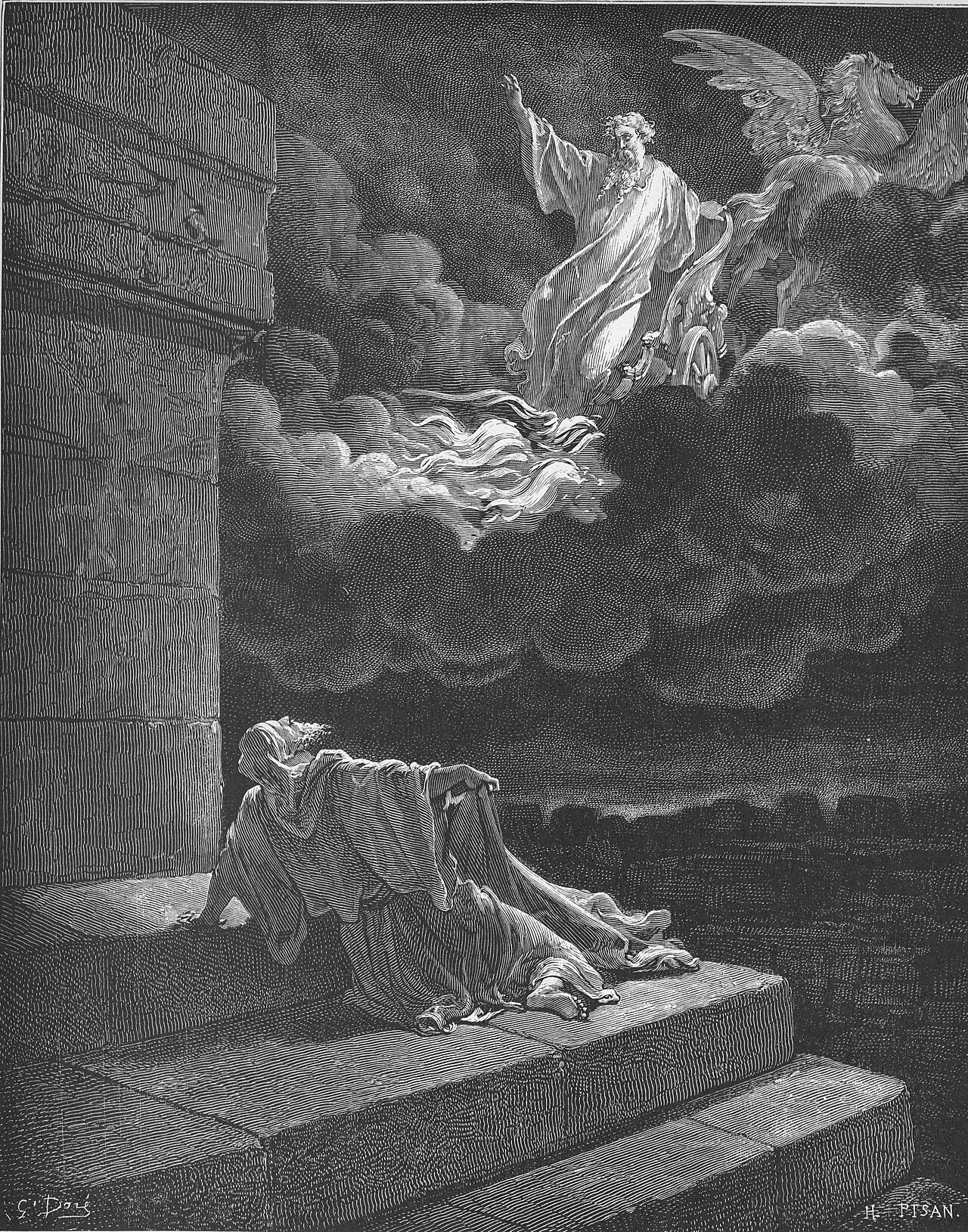
- PersonDivided kingdomJehuThe furious-driving commander anointed at Elisha's order who purged the house of Ahab and Baal from Israel — zealous for the LORD,…
- PlaceThe northern hill countrySamariaThe hill Omri bought and built his capital on, where Ahab raised a temple to Baal, where the four lepers found the Aramean camp em…
This page draws on Albert Barnes, Notes, Explanatory and Practical, on the Old and New Testaments (1832-1869); Albert Barnes, Notes on the Old Testament; Jamieson, Fausset & Brown, Commentary Critical and Explanatory on the Whole Bible; John Gill, Exposition of the Old Testament; John Gill, Exposition of the Old Testament (1748-1763) and Matthew Henry, Commentary on the Whole Bible.