
1 Samuel 2:25
in 1 Samuel 2If a man sins against another man, God can intercede for him; but if a man sins against the LORD, who can intercede for him?” But they would not listen to their father, since the LORD intended to put them to death.
BSB
The same verse in ASV and KJV ▾
ASV
If one man sin against another, God shall judge him; but if a man sin against Jehovah, who shall entreat for him? Notwithstanding, they hearkened not unto the voice of their father, because Jehovah was minded to slay them.
KJV
If one man sin against another, the judge shall judge him: but if a man sin against the Lord, who shall intreat for him? Notwithstanding they hearkened not unto the voice of their father, because the Lord would slay them.
⋯
This verse in 1 Samuel 2
Commentary
15 notes on this verseThe law prohibits priests in the case of certain sins from offering a sacrifice to gain people forgiveness for the transgressions for which sacrifices are made. For though the priest has authority to make an offering for certain inadvertent sins or transgressions, nevertheless he does not offer a burnt offering and a sin offering for adultery, deliberate murder, or any other graver fault.
This site's exposition
Now Eli was very old
on 1 Samuel 2:22-25
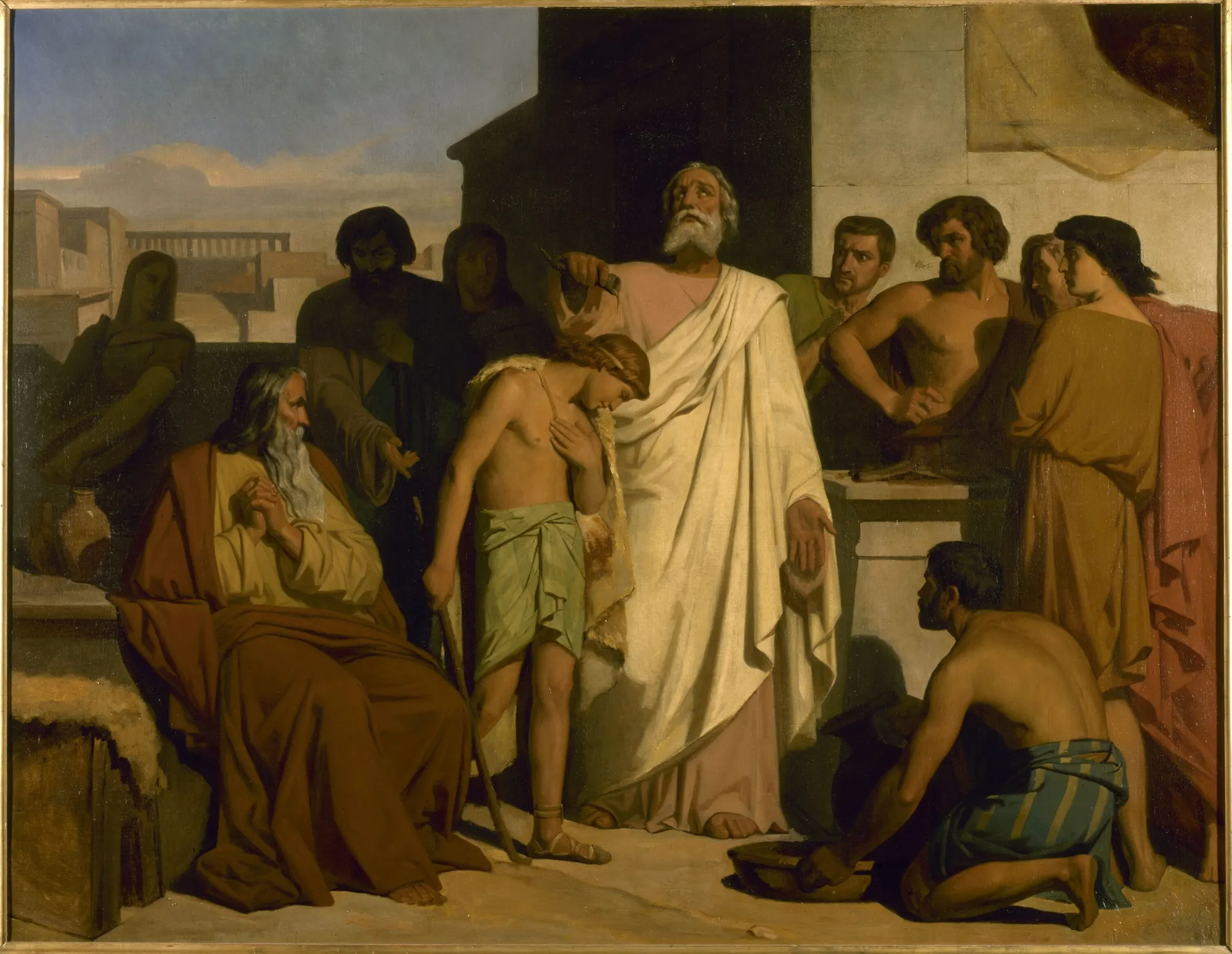
Eli hears that his sons “were sleeping with the women who served at the entrance to the Tent of Meeting”. He rebukes them in words and takes no other step, and his own question, “who can intercede for him”, states the law's limit for a sin against the LORD. The narrator closes with the verdict, “the LORD intended to put them to death”, judgment settled before it falls.
This site's exposition
If a man sins against another man
Albert Barnes explains the first case as a wrong between two men that a judge can settle, and the second as a sin with no higher arbiter to plead it. Hophni and Phinehas sinned at the LORD's own altar. Jamieson, Fausset & Brown hold that their stubborn disobedience brought the death the verse names.
The record, by era
The Church Fathers3 voices
Because their father [Eli] did not chastise them with enough severity … he moved the forbearance of God to wrath so great that foreign peoples rose up against them and killed those sons of his in war in one day. His entire nation, furthermore, was vanquished, and a considerable number of his people fell.
The sin of one who blasphemes against the Holy Spirit is unpardonable. Compare with this judgment what is said in the book of Kings [Samuel]: "If one man shall sin against the Lord, who shall pray for him?" Thus, it is one and the same …
"Eli the priest," thou sayest, "speaketh, saying, If one man sin against another, they shall pray for him: but if a man sin against the Lord, who shall intreat for him? In like manner John, If any man see his brother sin a sin which …
The Medieval Church2 voices
A commentator
Gregory the DialogistCommentary on 1 Kings, Book 2, Chapter 2 · Written before 604.
proposed
19. For a man to sin against a man is for one human to do perverse things against another human. What then does it mean when he says, "God can be appeased for him," unless that such sins were light in comparison with those which the Jews were planning to commit against the Son of God? For they were sinning against God, because he whom they were plotting to kill had shown himself to be God by the most manifest light of miracles. For the Lord showed this through himself, saying: "If I had not done among them the works that no one else has done, they would have no sin" (John 15:24). And to show the implacability of God the Father, he adds, saying: "But now they have no excuse for their sin, because they have seen and hated both me and my Father" (ibid.). It is therefore as if he were saying: By whose prayer is that sin pardoned which is committed against the very one who pardons? Who beseeches the almighty Father on behalf of the one who condemns the coeternal Only-begotten to death? For he would say nothing more plainly if he were to declare openly, saying: This one whom you persecute as a mere man is also God. The law of reason therefore demands that he who persecutes the Creator be deprived of pardon. But divine mercy surpasses the strictness of reason; for he showed the equity of the law, but did not maintain the force of the pronounced declaration in the execution of the promulgated judgment. For by the rigor of equity it was decreed that no prayer would attain the obtaining of pardon; but for those for whom no prayer of man sufficed, the mercy of the Redeemer did not fail. Every man who might pray for the transgressions is removed; but for those for whom no man was sufficient, God himself became man, a merciful intercessor. For hanging on the cross he prayed, saying: "Father, forgive them, for they know not what they do" (Luke 23:34). […]
A commentator
Gregory the DialogistCommentary on 1 Kings, Book 2, Chapter 3 · Written before 604.
proposed
For a man to sin against a man is for people to harm one another in matters of passing things. But to sin against God is to take away from Him those things which He established for eternity. Therefore whoever draws either his own or another faithful person's soul into sinning is convicted of sinning against God, because he strives to take away from Him what is properly His. This is shown to be a sin all the more grave, inasmuch as one who might stand as a worthy intercessor for its absolution is more rarely found. For under the question "Who will pray for him?" it is not said that the remedies of repentance are denied even to such persons, but that the deeper wounds of sins are healed with greater difficulty. However, this can be understood to have been said because the priests are being rebuked. For a man sins against a man when he offends whose fault looks to the judgment of a superior person for correction. Therefore, since the sins of the subject people, which pertain to the priests, are wiped away by the prayers of those same priests, when the priest falls into fault, there is no superior person by whose prayers he may be expiated. And the Truth Himself intimates this, saying: "If the salt has lost its savor, with what shall it be salted?" (Matt. 5:13). Let him therefore say: "Who will pray for him?" As if to say, who remains as intercessor for him, when the one who was ordained to intercede for others casts himself down by transgressing? By this indeed the magnitude of the guilt is shown, because many of them are cast by the Lord into the darkness of an impenitent heart, and they do not come to their senses by any human exhortation....
7 more voices on this verse
The Medieval Church1 voice
If a man sins against a man, etc. Both refer to the sons of Eli. For he sinned against a man when the priest violated the wife of another man under the pretext of religion; but this could be dismissed with appropriate penance by God. …
The Puritans and the Awakening3 voices
Who shall compound that difference? None can or dare do it, and therefore he must be left to the dreadful, but righteous judgment of God. They had now sinned away their day of grace.
If one man sin against another, the judge shall judge him, &c.
Sins against the remedy, the atonement itself, are most dangerous, treading under foot the blood of the covenant, for then there remains no more sacrifice, Heb. x. (2.) It was too mild and gentle.
The Nineteenth Century3 voices
A commentator
Jamieson, Fausset & Brown1802–1910
Commentary Critical and Explanatory on the Whole Bible (1871)
proposed
they hearkened not unto the voice of their father, because--it should be therefore. the Lord would slay them--It was not God's preordination, but their own wilful and impenitent disobedience which was the cause of their destruction. A PROPHECY AGAINST ELI'S HOUSE.
quarantine:debris (2026-07-29) — starts-lowercase
If one man sin against another - All differences between man and man may be settled by the proper judge; but if a man sin against the Supreme Judge, God himself, who shall reconcile him to his Maker? Your sin is immediately against God himself, and is the highest insult that can be offered, because it is in the matter of his own worship, therefore ye may expect his heaviest judgments. But if a man sin against the Lord, who shall entreat for him? - This was a question of the most solemn importance under the old covenant, especially after the death of Moses, the mediator. The law had determined what sins should be punished with death; and it was supposed that there was not any appeal from the decision there pronounced. 1Jn 2:1 is an answer to this question; but it is an answer which the Gospel alone can give: My little children, these things write I unto you, that ye sin not; but if any man sin, we have an Advocate with the Father, Jesus Christ the righteous. Because the Lord would slay them - The particle כי ki, which we translate because, and thus make their continuance in sin the effect of God’s determination to destroy them, should be translated therefore, as it means in many parts of the sacred writings. See Noldius’s Particles, where the very text in question is introduced: Sed non auscultarunt, etc., Ideo voluit Jehova eos interficere; “But they would not hearken, etc.; Therefore God purposed to destroy them.” It was their not hearkening that induced the Lord to will their destruction.
A commentator
Albert Barnes1798–1870
Notes, Explanatory and Practical, on the Old and New Testaments (1832-1869)
proposed
The sense seems to be, If one man sin against another, the judge shall amerce him in the due penalty, and then he shall be free; but if he sin against the Lord, who shall act the part of judge and arbiter for him? His guilt must remain to the great day of judgment.
The words behind it
21 Hebrew wordsEvery Hebrew word of this verse in the order it stands, with what it means and the door to its own study. The last column counts the times a word stands in the whole Bible: the rarer the word, the more the places it appears belong together.
| Hebrew | Sound | Meaning | Word study | In the Bible |
|---|---|---|---|---|
| אִם־ | ʾim- | if | H518 → | 1069 times |
| יֶחֱטָ֨א | yecheta' | he will sin | H2398 → | 238 times |
| אִ֤ישׁ | ʾish | a person | H376 → | 1663 times |
| לְאִישׁ֙ | leish | to a person | H376 → | 1663 times |
| וּפִֽלְל֣וֹ | ufilo | and he will mediate for him | H6419 → | 84 times |
| אֱלֹהִ֔ים | ʾelohim | God | H430 → | 2601 times |
| וְאִ֤ם | veim | and if | H518 → | 1069 times |
| לַֽיהוָה֙ | layahweh | to Yahweh | H3068 → | 6520 times |
| יֶֽחֱטָא־ | yecheta'- | he will sin | H2398 → | 238 times |
| אִ֔ישׁ | ʾish | a person | H376 → | 1663 times |
| מִ֖י | mi | who? | H4310 → | 423 times |
| יִתְפַּלֶּל־ | yitpalel- | will he intercede | H6419 → | 84 times |
| ל֑וֹ | lo | for <the> him | ||
| וְלֹ֤א | velo' | and not | H3808 → | 5168 times |
| יִשְׁמְעוּ֙ | yishmeu | they listened | H8085 → | 1159 times |
| לְק֣וֹל | lekol | to [the] voice of | H6963 → | 506 times |
| אֲבִיהֶ֔ם | ʾavihem | father their | H1 → | 1212 times |
| כִּֽי־ | ki- | for | H3588 → | 4482 times |
| חָפֵ֥ץ | chafetz | he desired | H2654 → | 74 times |
| יְהוָ֖ה | yahweh | Yahweh | H3068 → | 6520 times |
| לַהֲמִיתָֽם׃ | lahamitam | to put to death them | H4191 → | 839 times |
אִם־if
ʾim-H518 →1069 times
יֶחֱטָ֨אhe will sin
yecheta'H2398 →238 times
אִ֤ישׁa person
ʾishH376 →1663 times
לְאִישׁ֙to a person
leishH376 →1663 times
וּפִֽלְל֣וֹand he will mediate for him
ufiloH6419 →84 times
אֱלֹהִ֔יםGod
ʾelohimH430 →2601 times
וְאִ֤םand if
veimH518 →1069 times
לַֽיהוָה֙to Yahweh
layahwehH3068 →6520 times
יֶֽחֱטָא־he will sin
yecheta'-H2398 →238 times
אִ֔ישׁa person
ʾishH376 →1663 times
מִ֖יwho?
miH4310 →423 times
יִתְפַּלֶּל־will he intercede
yitpalel-H6419 →84 times
ל֑וֹfor <the> him
lo
וְלֹ֤אand not
velo'H3808 →5168 times
יִשְׁמְעוּ֙they listened
yishmeuH8085 →1159 times
לְק֣וֹלto [the] voice of
lekolH6963 →506 times
אֲבִיהֶ֔םfather their
ʾavihemH1 →1212 times
כִּֽי־for
ki-H3588 →4482 times
חָפֵ֥ץhe desired
chafetzH2654 →74 times
יְהוָ֖הYahweh
yahwehH3068 →6520 times
לַהֲמִיתָֽם׃to put to death them
lahamitamH4191 →839 times
A shaded row is a word that stands 400 times or fewer in the Bible.
The walk
8 stopsEach card is a verse this one points to, and under it the verses that one points to in turn. Where several paths arrive at the same place, that place is listed first: the text keeps returning to it.
Through
Hebrews 10:26If we deliberately go on sinning after we have received the knowledge of the truth, no further sacrifice for sins remains,
it leads to
- 2 Peter 2:20–22
If indeed they have escaped the corruption of the world through the knowledge of our Lord and Savior Jesus Christ, only to be entangled and overcome by it again, their final condition is worse…
- Hebrews 6:4–6
It is impossible for those who have once been enlightened, who have tasted the heavenly gift, who have shared in the Holy Spirit,
- John 9:41
“If you were blind,” Jesus replied, “you would not be guilty of sin. But since you claim you can see, your guilt remains.”
- Luke 12:47
That servant who knows his master’s will but does not get ready or follow his instructions will be beaten with many blows.
- Matthew 12:43–45
When an unclean spirit comes out of a man, it passes through arid places seeking rest and does not find it.
- 2 Peter 2:20–22
Through
Proverbs 15:10Discipline is harsh for him who leaves the path; he who hates correction will die.
it leads to
- Proverbs 12:1
Whoever loves discipline loves knowledge, but he who hates correction is stupid.
- Proverbs 12:1
Through
Numbers 15:30But the person who sins defiantly, whether a native or foreigner, blasphemes the LORD. That person shall be cut off from among his people.
it leads to
- Hebrews 10:26
If we deliberately go on sinning after we have received the knowledge of the truth, no further sacrifice for sins remains,
- Psalms 19:13
Keep Your servant also from willful sins; may they not rule over me. Then I will be blameless and cleansed of great transgression.
- Hebrews 10:26
Where this verse is studied
About 1 Samuel
This page draws on 14 works. Open the list of works
This page draws on Adam Clarke, Commentary on the Bible; Albert Barnes, Notes, Explanatory and Practical, on the Old and New Testaments (1832-1869); Basil of Caesarea, PREFACE ON THE JUDGMENT OF GOD; Bede, Commentary on Samuel; Gregory the Dialogist, Commentary on 1 Kings, Book 2, Chapter 2; Gregory the Dialogist, Commentary on 1 Kings, Book 2, Chapter 3; Jamieson, Fausset & Brown, Commentary Critical and Explanatory on the Whole Bible; John Gill, Exposition of the Old Testament (1748-1763); John Wesley, Explanatory Notes upon the Old Testament; Keil and Delitzsch, Biblical Commentary on the Books of Samuel; Matthew Henry, Commentary on the Whole Bible; Nicetas of Remesiana, THE POWER OF THE HOLY SPIRIT 17; Origen of Alexandria, ON PRAYER 28.9 and Pacian of Barcelona, LETTER 3.16.2.