
Ruthchapter 1
22 verses · BSBRuth book hub →
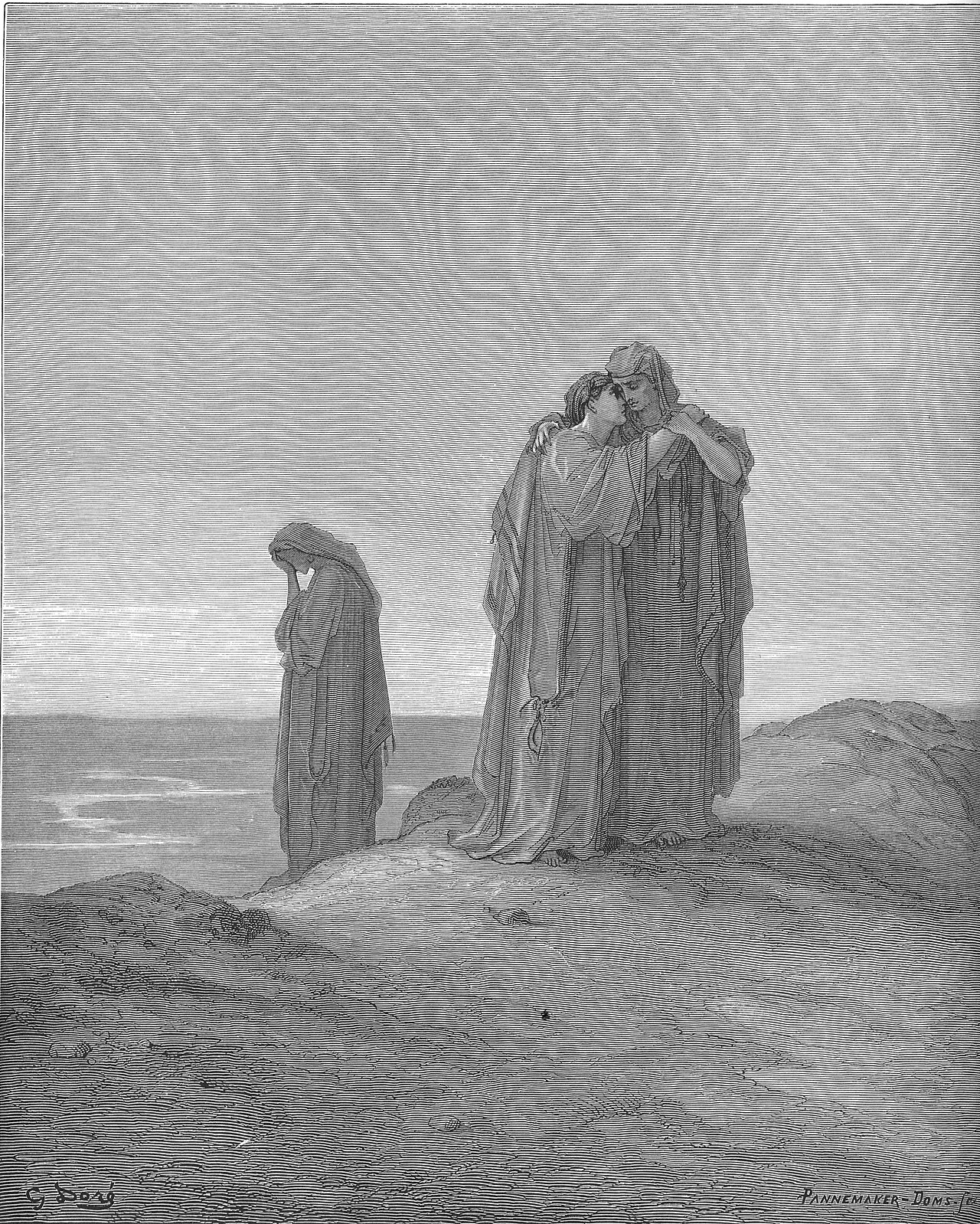
Naomi and Her Daughters-in-Law, Gustave Doré, Doré's English Bible (1866), public domain
Original Language
Ruth 1— Hebrew word study · with the Hebrew tradition
How to read a word below: the Hebrewword, then how it sounds, then what it means, then its number in Strong’s concordance, a widely used lookup this site follows (H for Hebrew and Aramaic, G for Greek). Square brackets hold a word the English supplies that the Hebrew does not, angle brackets mark the Hebrew’s own grammatical elements that English renders as separate words, and the mark ס or פ is where the Hebrew manuscripts end a paragraph.
Famine, Moab, and three graves1
Ruth 1:1· Hebrew and glosses: STEP Bible
Rashi on Ruth 1:1
And it happened in the days when judges judged. [During the period] before King Shaul reigned, when the generations were administered by judges; 1 There was no individual judge who could exercise control over all of Yisroel, rather there were many judges.
Read it in full at Sefaria · The Metsudah Five Megillot, Lakewood, N.J., 2001
Ruth 1:2· Hebrew and glosses: STEP Bible
Ruth 1:3· Hebrew and glosses: STEP Bible
Ruth 1:4· Hebrew and glosses: STEP Bible
Ruth 1:5· Hebrew and glosses: STEP Bible
Whither thou goest, I will go6
Ruth 1:6· Hebrew and glosses: STEP Bible
Ruth 1:7· Hebrew and glosses: STEP Bible
Ruth 1:8· Hebrew and glosses: STEP Bible
Ruth 1:9· Hebrew and glosses: STEP Bible
Ruth 1:10· Hebrew and glosses: STEP Bible
Ruth 1:11· Hebrew and glosses: STEP Bible
Ibn Ezra on Ruth 1:11
"Are there yet any more sons in my womb?" Many of our colleagues thought that this response was directed at those who deny (the custom), not realizing that our ancestors transmitted that levirate marriage (yibbum) applies to brothers from the father, not from the mother. She was simply saying to them, if I had sons in my womb, I would give them to you in place of the deceased.
Read it in full at Sefaria · Sefaria Community Translation
Ruth 1:12· Hebrew and glosses: STEP Bible
Ruth 1:13· Hebrew and glosses: STEP Bible
Rashi on Ruth 1:13
Would you wait for them. This is a question posed in wonder, “Would you perhaps wait for them until they grew up?” 17 The feminine form of them [להן] is used, because Naomi was hinting that perhaps she would bear daughters instead of sons, so why wait for “them”?
Read it in full at Sefaria · The Metsudah Five Megillot, Lakewood, N.J., 2001
Ruth 1:14· Hebrew and glosses: STEP Bible
Ruth 1:15· Hebrew and glosses: STEP Bible
Rashi on Ruth 1:15
See, your sister-in-law has gone back. In this [word], the accent is at the beginning [on the first syllable] under the shin, because it is in the past tense. [But,] “and in the morning she would return,” 22 Megillas Esther:14.
Read it in full at Sefaria · The Metsudah Five Megillot, Lakewood, N.J., 2001
Ruth 1:16· Hebrew and glosses: STEP Bible
Ruth 1:17· Hebrew and glosses: STEP Bible
Ruth 1:18· Hebrew and glosses: STEP Bible
Call me not Naomi, call me Mara19
Ruth 1:19· Hebrew and glosses: STEP Bible
Ruth 1:20· Hebrew and glosses: STEP Bible
Ruth 1:21· Hebrew and glosses: STEP Bible
Ruth 1:22· Hebrew and glosses: STEP Bible