
Psalm 137
9 verses · Imprecatory psalm
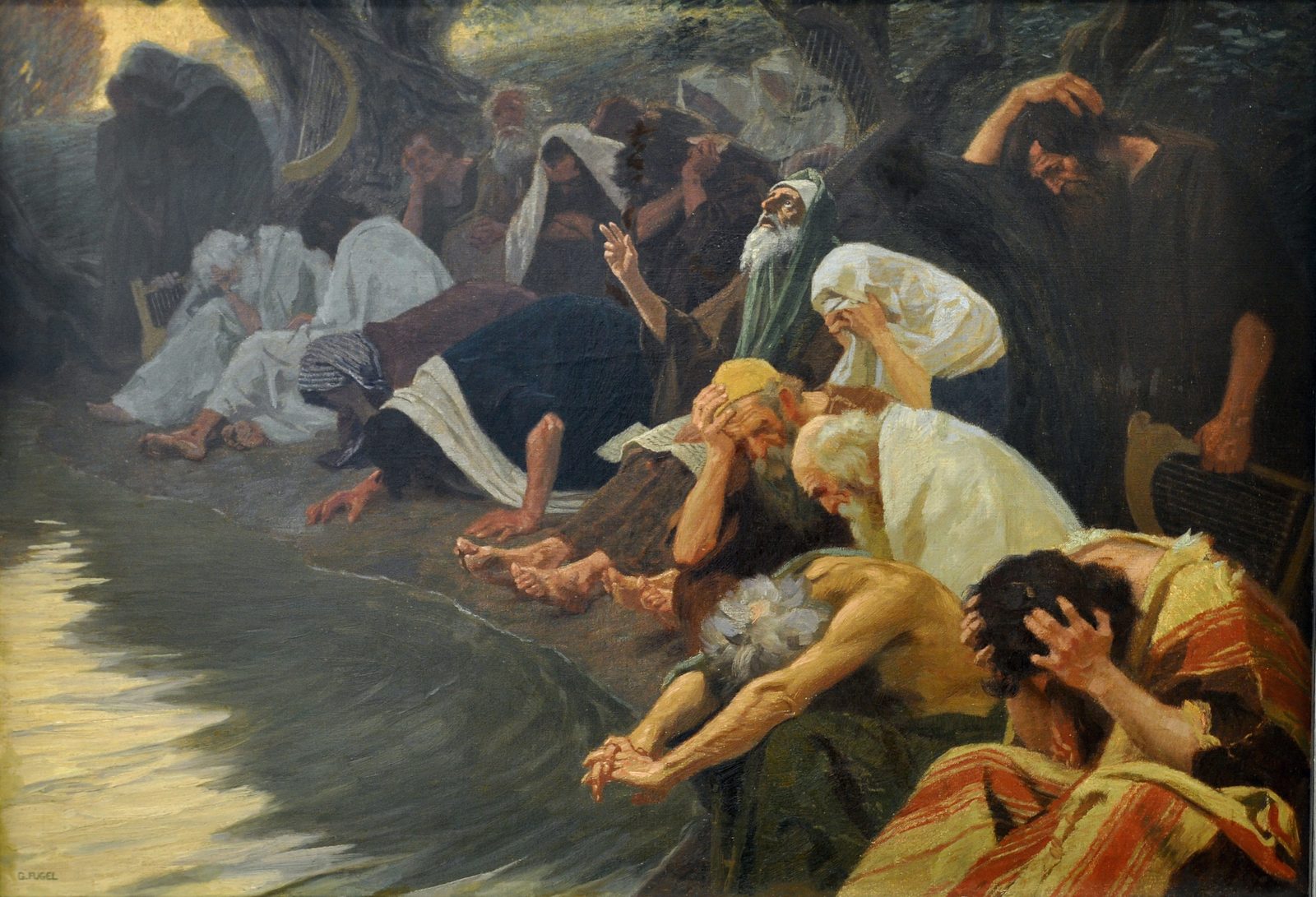
By the rivers of Babylon we sat and wept when we remembered Zion.
Introduction
Author unstated, By the Rivers of Babylon, Book 5: The return and the great Hallelujah, Poetry, Psalms Overview.
This psalm was written by an unnamed singer, likely a temple musician, among the people of Judah deported to Babylon after Jerusalem burned in 586 BC. It speaks for captives who had lost their city, their temple and their homes, and who were then mocked by their captors and asked to entertain them. It moves from grief to a vow of memory to a cry for justice. Listen for what the singer is willing to lose rather than forget his city. The closing lines are among the hardest in Scripture, and they hand the judgment to God.
Context
- Who
- Israelites who had been marched a thousand miles from a burned city and were then asked to perform
- Where
- The canal banks of Babylonia, where the deported communities of Judah were settled
- When
- The Babylonian exile. No author is named; the psalm speaks from inside the deportation, which places it between the fall of Jerusalem in 586 BC and the return after 538 BC
Historical context
The singer is unnamed and speaks as one of a group. He is a temple musician, and the oath he swears in the middle of the psalm costs him his right hand and his tongue, a harpist's and a singer's only tools. The rivers of Babylon were mostly canals, cut off the Tigris and the Euphrates, and the deported communities were settled along them. Captured musicians were a normal spoil of war, so being told to perform your homeland's temple music for the men who burned the temple was a form of mockery with a history behind it. Edom is named at verse 7 because Edom was there; Obadiah 1:11 says that on the day strangers carried off Jerusalem's wealth, Edom stood aloof and was just like one of them. The last lines quote a sentence already passed, since Isaiah 13:16 had already announced that the horror of an ancient sack would be done to Babylon. The psalmist leaves the doing of it to God.
Significance
The first singers were people who had lost everything and were being asked to be entertaining about it. The psalm lets them refuse and lets them say why. Its centre is a vow. In a foreign country with a foreign calendar and foreign gods, remembering Jerusalem was the act that kept a people a people.
This chapter in Jewish lifeWhat this chapter is in Jewish life and reading.
What is done
Psalm 137 is the psalm of the exile in Babylon, and the practice it has left in Jewish life comes out of its fifth and sixth verses. Rashi reads those verses as the vow of the congregation of Israel, and says that the remembrance of the mourning for the destruction of Jerusalem is brought up "at the head of every joyous occasion of mine" (Rashi on Psalms 137:6:1, the Judaica Press complete Tanach with Rashi, translated by A. J. Rosenberg, CC-BY). Malbim reads the same lines the same way and presses them further, saying that even in worldly success Jerusalem stands above the joy, to the point where joy is overturned into sadness by the memory of her destruction (Malbim on Psalms 137:5:1, translated by Rabbi Mike Feuer, Jerusalem Anthology, CC-BY). The custom of keeping a sign of that mourning inside a celebration is the practice these verses carry, and this site names the verses and the two commentators rather than any particular rite, because the corpus records no rite for it.
How it is read
Rashi reads the opening scene as a demand made of the exiles: they sat down by the rivers of Babylon when they went into exile, and Nebuchadnezzar asked them to sing for him as they used to sing on the stage. He glosses the word for the tormentors two ways, as kinds of musical instrument, following Menachem, and as enemies who scorned and mocked. Malbim dates the psalm to the first year after Cyrus took Babylon and reads the weeping as grief for what was holy rather than for what was owned. The exiles had houses, fields and vineyards in Babylon, he says, and they wept "for the spiritual joy which was lost to us" (Malbim on Psalms 137:1:1, Feuer translation, CC-BY). On the seventh verse Rashi glosses the cry against Edom as an expression for uprooting from the ground. The psalm ends with a curse on the children of Babylon that a Christian reader finds hard, and the corpus holds no comment with English text on that last verse, so this site records the two rabbinic locators on it and leaves the reading open. Ibn Ezra, Radak and Metzudat David comment across the psalm with no English version in the corpus, and stand as citations at Ibn Ezra on Psalms 137:1:1, Radak on Psalms 137:2:1 and Metzudat David on Psalms 137:3:1.
What the rabbis say
The corpus records forty locators on this chapter, thirty-four Midrash and six Talmud. The sitting and weeping by the rivers is taken up at Eikhah Rabbah 1:23, Eikhah Rabbah 5:5 and both Petichta 19 and Petichta 24 of the same work. The vow about the right hand is taken up at Aggadat Bereshit 71:1 and 71:2, Eikhah Rabbah 1:54, Avodah Zarah 3b:10 and Bava Batra 60b:16, and the line about setting Jerusalem above every joy at Bava Batra 60b:17 and Midrash Lekach Tov on Lamentations 5:15:1. The cry against Edom is taken up at Eikhah Rabbah 5:1, Bamidbar Rabbah 7:10 and Jerusalem Talmud Yoma 1:1:20. The closing verse carries two locators, Midrash Tehillim 138:1 and Midrash Tehillim 17:15. Each is a locator without text in the corpus.
Sources: Rashi, Rashi on Psalms 137:1:1, 137:3:1, 137:5:1, 137:6:1 and 137:7:1, the Judaica Press complete Tanach with Rashi, translated by A. J. Rosenberg, CC-BY; Malbim, Malbim on Psalms 137:1:1 and 137:5:1, translated by Rabbi Mike Feuer, Jerusalem Anthology, CC-BY; Ibn Ezra, Ibn Ezra on Psalms 137:1:1, cited only, no English version in the corpus; Radak, Radak on Psalms 137:2:1, cited only; Metzudat David, Metzudat David on Psalms 137:3:1, cited only; Midrash, Eikhah Rabbah 1:23, 5:5, 1:54 and 5:1 with Petichta 19 and Petichta 24, Aggadat Bereshit 71:1 and 71:2, Bamidbar Rabbah 7:10, Midrash Tehillim 138:1 and 17:15, Midrash Lekach Tov on Lamentations 5:15:1; Babylonian Talmud, Avodah Zarah 3b:10, Bava Batra 60b:16 and 60b:17, Gittin 58a:3; Jerusalem Talmud, Yoma 1:1:20, Yevamot 9:8:2.
Psalms 137:1-2
By the rivers of Babylon: Exiles sat down by the rivers of Babylon and wept when they remembered Zion. There, at that same water, they hung their harps up in the willows. The instruments of praise were put away unplayed.
Psalms 137:1
“By the rivers of Babylon, there we sat down and wept, when we remembered Sion. If someone is not sick, he does not know how much health is worth. And again, a lame man does not know how much he is worth who is sound of foot. Likewise the blind man does not know the one who sees. All this has been said because the psalm says: "By the rivers of Babylon, there we sat down and wept, when we remembered Sion." Babylon is interpreted as "confusion": therefore Babylon is this world.”
Jerome · written before 420 · Homily 48, on Psalm 136patristic
1 more voice on this verseWhat preachers and commentators have said about this verse, in their own words.
Psalms 137:1
“By the rivers of Babylon, there we sat down. Water courses were abundant in Babylon, wherein were not only natural streams but artificial canals: it was place of broad rivers and streams. Glad to be away from the noisy streets, the captives sought the river side, where the flow of the waters seemed to be in sympathy with their tears. It was some slight comfort to be out of the crowd, and to have a little breathing room, and therefore they sat down, as if to rest a while and solace themselves in their sorrow.”
Charles Spurgeon · The Treasury of David, Vol. 7 (1885)Particular Baptist
There on the willows: The willows are arbim, often taken for the poplars by the rivers of Babylon. The word for harps is kinnor, the lyre David played for Saul in 1 Samuel 16:23, used in the temple for songs to the LORD. Verse 3 gives the reason they hung.
Psalms 137:2
“We hanged our harps upon the willows in the midst thereof. The drooping branches appeared to weep as we did, and so we gave to them our instruments of music; the willows could as well make melody as we, for we had no mind for minstrelsy. In the midst of the willows, or in the midst of the rivers, or in the midst of Babylon, it matters little which, they hung their harps aloft—those harps which once in Zion's halls the soul of music shed.”
Charles Spurgeon · The Treasury of David, Vol. 7 (1885)Particular Baptist
2 more voices on this verse
Psalms 137:2
“On the willows in the midst of it we hung up our instruments. The willow has such a nature: it is indeed a barren tree, and it is said that if anyone takes a drink from it or eats of it, he does not beget children. There, then, we hung up our instruments. Now the instrument is the body of man.”
Jerome · written before 420 · Homily 48, on Psalm 136patristic
Psalms 137:2
“Whether the request was in curiosity or derision, the answer intimates that a compliance was incongruous with their mournful feelings (Pr 25:20). For joyful songs would imply forgetfulness of their desolated homes and fallen Church. The solemn imprecations on the hand and tongue, if thus forgetful, relate to the cunning or skill in playing, and the power of singing.”
Jamieson, Fausset & Brown · Commentary Critical and Explanatory on the Whole Bible (1871)reformed
Psalms 137:3-4
our captors requested a song: The captors ask for songs of joy, and the song they name is a song of Zion. The answer is a question about singing to the LORD in a foreign land. Spurgeon read that question as a refusal put humbly.
Psalms 137:3
“For there they that carried us away captive required of us a song. It was ill to be a singer at all when it was demanded that this talent should go into bondage to an oppressor's will. Better be dumb than be forced to please an enemy with forced song. What cruelty to make a people sigh, and then require them to sing! Shall men be carried away from home and all that is dear to them, and yet chant merrily for the pleasure of their unfeeling captors? This is studied torture: the iron enters into the soul.”
Charles Spurgeon · The Treasury of David, Vol. 7 (1885)Particular Baptist
1 more voice on this verse
Psalms 137:3
For there they that led us away captive asked of us the words of songs. The demons, who deceived us and led us away captive, now, as though mocking us and boasting, say to us: "Give us back a word about your faith, and just as when you were in Jerusalem, sing a hymn to God."
Jerome · written before 420 · Homily 48, on Psalm 136patristic
How can we sing a song: The captors asked for a song of Zion. The answer names it a song of the LORD, the phrase 2 Chronicles 29:27 uses for the temple singing at the burnt offering. That song belonged at His altar in Zion, and the exiles stood in a foreign land.
Psalms 137:4
“How shall we sing the Lord's song in a strange land? They answer, those who have sinned and been deceived, and they say: "How shall we sing you the Lord's song in a strange land, set as we are in our sins, we who have fallen from Jerusalem into Babylon?" Therefore no one can praise the Lord unless he is holy. For the sinner ought not to sing to the Lord, but to mourn his sins.”
Jerome · written before 420 · Homily 48, on Psalm 136patristic
2 more voices on this verse
Psalms 137:4
“How shall we sing the Lord's song in a strange land How shall they sing at all? sing in a strange land? sing Jehovah's song among the uncircumcised? No, that must not be; it shall not be. With one voice they refuse, but the refusal is humbly worded by being put in the form of a question.”
Charles Spurgeon · The Treasury of David, Vol. 7 (1885)Particular Baptist
Psalms 137:4
“Profane scoffers are not to be humoured, nor pearls cast before swine. David prudently kept silence even from good when the wicked were before him, who, he knew, would ridicule what he said and make a jest of it, Ps. xxxix. The reason they gave is very mild and pious: How shall we sing the Lord's song in a strange land?”
Matthew Henry · Commentary on the Whole Bible (1707-1721)puritan
Psalms 137:5-6
If I forget you, O Jerusalem: The singer swears by naming what he loses if he fails. The Hebrew uses the verb forget twice, of the man and then of his own right hand, a hand that would cease to work. His tongue is staked on it too, and Jerusalem is set above every joy.
Psalms 137:5
“If I forget you, Jerusalem, let my right hand be given over to forgetfulness. Therefore, because he has sinned and fallen, he calls to mind his former way of life and Jerusalem, and he sets before himself this resolve: that unless I shall always be mindful of you, and always hold you in mind, let my right hand be given over to forgetfulness — that is, my works. He did not say the left hand, but the right: for the left hand is always in forgetfulness. Do you wish, then, always to be in remembrance of the Lord?”
Jerome · written before 420 · Homily 48, on Psalm 136patristic
2 more voices on this verse
Psalms 137:5
“If I forget thee, O Jerusalem, let my right hand forget her cunning. To sing Zion's songs for the pleasure of Zion's foes, would be to forget the Holy City Each Jew declares for himself that he will not do this; for the pronoun alters from "we" to "I." Individually the captives pledge themselves to fidelity to Jerusalem, and each one asserts that he had sooner forget the art which drew music from his harp strings than use it for Babel's delectation.”
Charles Spurgeon · The Treasury of David, Vol. 7 (1885)Particular Baptist
Psalms 137:5
“If I forget thee, O Jerusalem,.... This was said by one or everyone of the Levites; or singers, as Aben Ezra and Kimchi; or by the congregation of Israel, as Jarchi; by one of them, in the name of the rest; or by the composer of the psalm.”
May my tongue cling to the roof: The oath sets the right hand of verse 5, which plays the harp, beside the tongue, which sings the song. Ezekiel 3:26 uses the same picture of a tongue made to cling to the roof of the mouth. Greatest joy is in Hebrew the head of joy.
Psalms 137:6
“If I do not remember thee, let my tongue cleave to the roof of my mouth. Thus the singers imprecate eternal silence upon their mouths if they forget Jerusalem to gratify Babylon. The players on instruments and the sweet songsters are of one mind: the enemies of the Lord will get no mirthful tune or song from them. If I prefer not Jerusalem above my chief joy.”
Charles Spurgeon · The Treasury of David, Vol. 7 (1885)Particular Baptist
1 more voice on this verse
Psalms 137:6
“Let my tongue cleave to my jaws, if I do not remember you. That is, let me have neither works nor speech, if the memory of you is not continually turned over in my heart.”
Jerome · written before 420 · Homily 48, on Psalm 136patristic
Remember, O LORD, the sons of Edom: The prayer turns to Edom and quotes what Edom said on the day Jerusalem fell, to tear the city down to its foundations. Edom descends from Esau, Jacob's brother, and Obadiah 10 to 14 charges him with violence against that brother. The psalm asks the LORD to remember it.
Psalms 137:7
“Remember, O Lord, the children of Edom in the day of Jerusalem. The case is left in Jehovah's hands. He is a God of recompenses, and will deal out justice with impartiality. The Edomites ought to have been friendly with the Israelites, from kinship; but there was a deep hatred and cruel spite displayed by them. The elder loved not to serve the younger, and so when Jacob's day of tribulation came, Esau was ready to take advantage of it.”
Charles Spurgeon · The Treasury of David, Vol. 7 (1885)Particular Baptist
Psalms 137:8-9
O Daughter of Babylon, doomed to destruction: The exiles ask for Babylon to be repaid, down to her infants on the rocks. Isaiah 13:16 had said Babylon's infants would be dashed to pieces, and Jeremiah 51:24 that the LORD would repay Babylon for what she did. The psalm asks the LORD for a doom He had spoken.
Psalms 137:8
And David, pitying her, says, "O wretched daughter of Babylon." Wretched indeed, as being the daughter of Babylon, when she ceased to be the daughter of Jerusalem. And yet he calls for a healer for her and says, "Blessed is he who shall take your little ones and dash them against the rock."
Ambrose of Milan · written before 397 · Concerning Repentance 2.11.106patristic
3 more voices on this verse
Psalms 137:8
“O daughter of Babylon, who art to be destroyed. Or the destroyer: let us accept the word either way, or both ways: the destroyer would be destroyed, and the Psalmist in vision saw her as already destroyed. It is usual to speak of a city as a virgin daughter. Babylon was in her prime and beauty, but she was already doomed for her crimes. Happy shall he be that rewardeth thee as thou hast served us. The avenger would be fulfilling an honourable calling in overthrowing a power so brutal, so inhuman.”
Charles Spurgeon · The Treasury of David, Vol. 7 (1885)Particular Baptist
Psalms 137:8
“Happy shall those be that do it; for they are fulfilling God's counsels; and therefore he calls Cyrus, who did it, his servant, his shepherd, his anointed ( Isa. xliv. 1 ), and the soldiers that were employed in it his sanctified ones, Isa. xiii. They are making way for the enlargement of God's Israel, and happy are those who are in any way serviceable to that.”
Matthew Henry · Commentary on the Whole Bible (1707-1721)puritan
Psalms 137:8
“O daughter of Babylon, who art to be destroyed - Or, O thou daughter of Babylon the destroyer, or, who art to be ruined. In being reduced under the empire of the Persians, Babylon was already greatly humbled and brought low from what it was in the days of Nebuchadnezzar; but it was afterwards so totally ruined that not a vestige of it remains. After its capture by Cyrus, A.M. 3468, it could never be considered a capital city; but it appeared to follow the fortunes of its various conquerors till it was, as a city, finally destroyed.”
Adam Clarke · Commentary on the Bible (1810-1826)evangelical
Blessed is he who seizes your infants: Blessed is ashrei, the word that opens Psalm 1, and here it falls on the one who repays Babylon as she had done. The prayer hands that vengeance to the LORD. Augustine read the infants of Babylon as evil desires newly born, dashed against the rock that is Christ.
Psalms 137:9
“Blessed is he who shall take hold of and dash your little ones against the rock. The "little ones" are said to be thoughts. For example: I have seen a woman, I have desired her: at once, if I do not cut off that desire, and, as it were, take it by the foot and dash it against the rock while the desire is small, it cannot afterwards be cut off when it has grown. Blessed, then, is he who cuts it off at once, and dashes it against the rock. And the Rock is Christ.”
Jerome · written before 420 · Homily 48, on Psalm 136patristic
1 more voice on this verse
Psalms 137:9
“Happy shall he be, that taketh and dasheth thy little ones against the stones. Fierce was the heart of the Jew who had seen his beloved city the scene of such terrific butchery. His heart pronounced like sentence upon Babylon. She should be scourged with her own whip of wire. The desire for righteous retribution is rather the spirit of the law than of the gospel; and yet in moments of righteous wrath the old fire will burn; and while justice survives in the human breast it will not lack for fuel among the various tyrannies which still survive.”
Charles Spurgeon · The Treasury of David, Vol. 7 (1885)Particular Baptist
How this psalm is built
The form: A mournful psalm, a lamentation, which the Septuagint places among the lamentations and names Jeremiah for its author, as Henry classes it.
The patterns in this chapter
| Device | What it does | Where to see it |
|---|---|---|
| Four hearers in turn | The psalm changes who it is speaking to three times. Verses 1 to 4 report what happened, verses 5 and 6 speak to Jerusalem, verse 7 speaks to the LORD, and verses 8 and 9 speak to Babylon. Spurgeon notes of verse 7 that the case is left in Jehovah's hands rather than taken up by the singer, which is what the turn to God at that point does.Charles Spurgeon, The Treasury of David, Vol. 7, 1885, on Psalm 137:7. | Psalm 137:4, Psalm 137:5, Psalm 137:7, Psalm 137:8 |
| Remember, three times | The verb carries the psalm. They wept when they remembered Zion at verse 1. At verse 6 the singer asks to be struck dumb if he does not remember Jerusalem. At verse 7 the same verb is turned toward God, as a request that He remember the sons of Edom. The psalm is an argument about who remembers what.Matthew Henry, Commentary on the Whole Bible, 1710, on Psalm 137:5. | Psalm 137:1, Psalm 137:6, Psalm 137:7 |
| The hand and the tongue | Verses 5 and 6 name the two organs a temple musician works with and asks that both be taken away if he uses them for Babylon. Clarke reads the oath as the loss of the voice and all its powers of melody, the tongue and all its faculty of speech. It is a self imposed sentence fitted exactly to the trade of the man taking it.Adam Clarke, Commentary on the Bible, 1832, on Psalm 137:6. | Psalm 137:5, Psalm 137:6 |
| Blessed is he, said twice | The last two verses are one sentence in two halves, each opening with the same formula. Verse 8 blesses the man who repays Babylon as Babylon repaid Judah, and verse 9 states the form that repayment took in an ancient sack. Jamieson, Fausset and Brown read the ending as God's righteous judgment already foretold rather than the passions of the singer.Jamieson, Fausset and Brown, Commentary Critical and Explanatory on the Whole Bible, 1871, on Psalm 137:8. | Psalm 137:8, Psalm 137:9 |
The structure
8 more paragraphs on the patterns
The psalm changes who it is speaking to three times in nine verses, and that is its shape. Verses 1 to 4 report, verses 5 and 6 speak to Jerusalem, verse 7 speaks to the LORD, and verses 8 and 9 speak to Babylon. The verb to remember runs through it at verse 1, verse 6 and verse 7, and the last two verses are a matched pair opening on the same formula.
The prophecy and the New Testament's use
No New Testament writer quotes Psalm 137. Its closing measure appears again at Revelation 18:6, which says of Babylon, give back to her as she has done to others, the standard of verse 8 stated in the same shape. The judgment the psalm asks for had already been announced by the prophets. Isaiah 13:16 says of Babylon that her infants would be dashed to pieces before their eyes. Jeremiah 51:56 says that the LORD is a God of retribution who will repay her in full.
The debate
The last verse is the most argued line in the Psalter and the positions are real. Jamieson, Fausset and Brown read it as God's righteous judgment rather than the passions of the singer, pointing at the prophets who had already announced Babylon's fall. Spurgeon reads it as the plain speech of a man who had seen his city butchered, and leaves the recompense with God, who will deal out justice with impartiality.
Jerome and Augustine read the little ones as the first thoughts of sin, to be dashed against the rock while they are still small. That is a spiritual reading laid over the plain sense rather than a replacement for it. What the psalm does not do is instruct anyone to act: it asks, and it asks God.
Where it sits
The Psalter puts its bitterest page directly after its most joyful one. Psalm 136 is the Exodus with a refrain of mercy after every line. Psalm 137 is the exile with no refrain at all, and after it the run of David psalms from 138 to 145 begins. The site's page on the imprecatory psalms treats the whole group.
Keep studying
Studies4
Sources for this chapter
The summary
Jamieson, Fausset & Brown, Commentary Critical and Explanatory; John Calvin, Commentaries; John Wesley, Notes on the Old Testament and Matthew Henry, Complete Commentary.
The form and classifications
Charles Spurgeon, The Treasury of David, Vol. 7, 1885, on Psalm 137:7; Jamieson, Fausset and Brown, Commentary Critical and Explanatory on the Whole Bible, 1871, on Psalm 137:2 and Matthew Henry, Commentary on the Whole Bible, 1710, on Psalm 137:8.
The exposition
Adam Clarke, Commentary on the Bible; Albert Barnes, Notes on the Book of Psalms; Augustine of Hippo, Expositions on the Psalms; Charles Spurgeon, The Treasury of David; Franz Delitzsch, Biblical Commentary on the Psalms; John Calvin, Commentary on the Psalms; John Gill, Exposition of the Old Testament; Keil and Delitzsch, Biblical Commentary on the Old Testament and Matthew Henry, Commentary on the Whole Bible.
The painting
An den Wassern Babylons. Gebhard Fugel, circa 1920. Wikimedia Commons. Public domain.