
Psalms 137:2
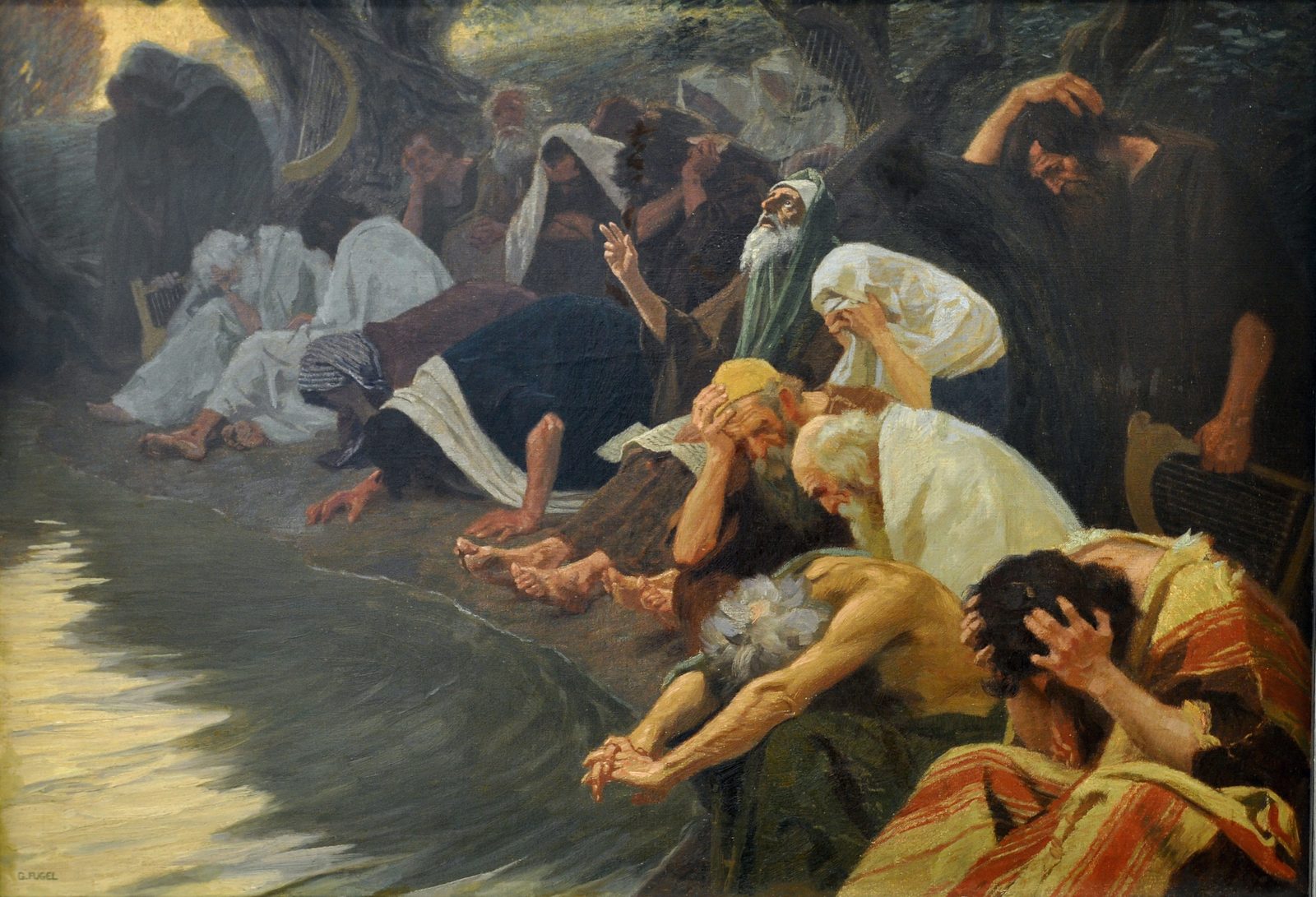
in Psalms 137There on the willows we hung our harps,
BSB
The same verse in ASV and KJV ▾
ASV
Upon the willows in the midst thereof We hanged up our harps.
KJV
We hanged our harps upon the willows in the midst thereof.
⋯
This verse in Psalms 137
Commentary
11 notes on this verseOn the willows in the midst of it we hung up our instruments. The willow has such a nature: it is indeed a barren tree, and it is said that if anyone takes a drink from it or eats of it, he does not beget children. There, then, we hung up our instruments. Now the instrument is the body of man.
This site's exposition
By the rivers of Babylon
on Psalms 137:1-2
Exiles sat down by the rivers of Babylon and wept when they remembered Zion. There, at that same water, they hung their harps up in the willows. The instruments of praise were put away unplayed.
The record, by era
The Church Fathers2 voices
"On the willows in the midst thereof we hung up our instruments of music" [Psalm 137:2]. The citizens of Jerusalem have their "instruments of music," God's Scriptures, God's commands, God's promises, meditation on the life to come; but while they are dwelling "in Babylon," they "hang up their instruments." Willows are unfruitful trees, and here so placed, that no good whatever can be understood of them: elsewhere perhaps there may. Here understand barren trees, growing by the waters of Babylon. These trees are watered by the waters of Babylon, and bring forth no fruit; just as there are men greedy, covetous, barren in good works, citizens of Babylon in such wise, that they are even trees of that region; they are fed there by these pleasures of transitory things, as though watered by "the waters of Babylon." Thou seekest fruit of them, and nowhere findest it....Therefore by deferring to apply the Scriptures to them, "we hang up our instruments of music upon the willows." For we hold them not worthy to carry our instruments. We do not therefore insert our instruments into them and bind them to them, but defer to use them, and so hang them up. For the willows are the unfruitful trees of Babylon, fed by temporal pleasures, as by the "waters of Babylon."
A commentator
Methodius of OlympusSYMPOSIUM OR THE BANQUET OF THE TEN VIRGINS 3:3 · Written before 311.
proposed
But not to pass away from our subject, come, let us take in our hands and examine this psalm, which the pure and stainless souls sing to God, saying: "By the rivers of Babylon there we sat down; yea, we wept, when we remembered Zion. We hanged our harps upon the willows in the midst thereof," clearly giving the name of harps to their bodies which they hung upon the branches of chastity, fastening them to the wood that they might not be snatched away and dragged along again by the stream of incontinence. For Babylon, which is interpreted "disturbance" or "confusion," signifies this life around which the water flows, while we sit in the midst of which the water flows round us, as long as we are in the world, the rivers of evil always beating upon us. Wherefore, also, we are always fearful, and we groan and cry with weeping to God, that our harps may not be snatched off by the waves of pleasure, and slip down from the tree of chastity.
The Puritans and the Awakening2 voices
We hanged our harps upon the willows in the midst thereof.
Music makes some people melancholy. As vinegar upon nitre, so is he that sings songs to a heavy heart. (2.) The harps they used in God's worship, the Levites' harps.
The Nineteenth Century1 voice
We hanged our harps upon the willows in the midst thereof. The drooping branches appeared to weep as we did, and so we gave to them our instruments of music; the willows could as well make melody as we, for we had no mind for minstrelsy. In the midst of the willows, or in the midst of the rivers, or in the midst of Babylon, it matters little which, they hung their harps aloft—those harps which once in Zion's halls the soul of music shed.
4 more voices on this verse
The Nineteenth Century4 voices
A commentator
Jamieson, Fausset & Brown1802–1910
Commentary Critical and Explanatory on the Whole Bible (1871)
Whether the request was in curiosity or derision, the answer intimates that a compliance was incongruous with their mournful feelings (Pr 25:20). For joyful songs would imply forgetfulness of their desolated homes and fallen Church. The solemn imprecations on the hand and tongue, if thus forgetful, relate to the cunning or skill in playing, and the power of singing.
We hanged our harps upon the willows in the midst thereof. The drooping branches appeared to weep as we did, and so we gave to them our instruments of music; the willows could as well make melody as we, for we had no mind for minstrelsy. In the midst of the willows, or in the midst of the rivers, or in the midst of Babylon, it matters little which, they hung their harps aloft—those harps which once in Zion's halls the soul of music shed. Better to hang them up than to dash them down: better to hang them on willows than profane them to the service of idols. Sad indeed is the child of sorrow when he grows weary of his harp, from which in better days he had been able to draw sweet solaces. Music hath charms to give unquiet spirits rest; but when the heart is sorely sad it only mocks the grief which flies to it. Men put away their instruments of mirth when a heavy cloud darkens their souls.
We hanged our harps upon the willows - The ערבים arabim or willows were very plentiful in Babylon. The great quantity of them that were on the banks of the Euphrates caused Isaiah, Isa 15:7, to call it the brook or river of willows. This is a most affecting picture. Perhaps resting themselves after toil, and wishing to spend their time religiously, they took their harps, and were about to sing one of the songs of Zion; but, reflecting on their own country, they became so filled with distress, that they unstrung their harps with one consent, and hung them on the willow bushes, and gave a general loose to their grief. Some of the Babylonians, who probably attended such meetings for the sake of the music, being present at the time here specified, desired them to sing one of Zion’s songs: this is affectingly told.
A commentator
Albert Barnes1798–1870
Notes, Explanatory and Practical, on the Old and New Testaments (1832-1869)
proposed
We hanged our harps upon the willows - The harps once used to accompany the songs of praise and the service of God in the temple; the harps with which they had sought to beguile their weary hours, and to console their sad spirits in their captivity. The word rendered “willows” - ערבים ‛ărâbiym - used only in the plural, denotes the willow or osier, so called from its white, silvery leaves. Gesenius, Lexicon. Compare Isa 15:7. It is probable that the weeping willow - the willow with long pendulous branches - is here referred to. Trees in desert lands spring up along the courses of the streams, and appear, in the wide desolation, as long and waving lines of green wherever the rivers wind along. The course of a stream can thus be marked by the prolonged line of meandering green in the desert as far as the eye can reach. It has been objected to the statement here that the willow is not now found in the neighborhood of ancient Babylon, but that the palm is the only tree which grows there. I saw, however, in 1852, in James’ Park in London, a willow-tree with a label on it, stating that it was taken from the site of ancient Babylon; and there seems no reason to doubt the correctness of the account. The willow may be less abundant there now than it was in former times, as is true of the palm. tree in Palestine, but there is no reason to doubt that it grew there. All that the psalm, however, would necessarily demand in a fair interpretation would be that there should have been even a single clump of these trees planted there, under which a little band of exiles may have seated themselves when they gave utterance to the plaintive language of this psalm. In the midst thereof - In the midst of Babylon; showing that this referred to the city proper. […]
How the passage was read
What the Jewish commentators add
On the verses either side of this one
By the rivers of Babylon, there we sat when we went down into exile, and Nebuchadnezzar asked them to sing for him as they used to sing on the stage.
This section is reception history: how the passage was read and kept in the Jewish tradition. Where a reading parts from an essential of the Christian faith, the section says so at that point.
Texts and citation data: Sefaria; each excerpt follows its version’s licence. 5 further sources are cited on this chapter that carry no English text this site may quote or only restate the verse.
The words behind it
5 Hebrew wordsEvery Hebrew word of this verse in the order it stands, with what it means and the door to its own study. The last column counts the times a word stands in the whole Bible: the rarer the word, the more the places it appears belong together.
| Hebrew | Sound | Meaning | Word study | In the Bible |
|---|---|---|---|---|
| עַֽל־ | ʾal- | on | H5921 → | 5755 times |
| עֲרָבִ֥ים | ʾaravim | poplars | H6155 → | |
| בְּתוֹכָ֑הּ | betokhah | in [the] midst of it | H8432 → | 418 times |
| תָּ֝לִ֗ינוּ | talinu | we hung up | H8518 → | |
| כִּנֹּרוֹתֵֽינוּ׃ | kinoroteinu | harps our | H3658 → | 42 times |
עַֽל־on
ʾal-H5921 →5755 times
עֲרָבִ֥יםpoplars
ʾaravimH6155 →
בְּתוֹכָ֑הּin [the] midst of it
betokhahH8432 →418 times
תָּ֝לִ֗ינוּwe hung up
talinuH8518 →
כִּנֹּרוֹתֵֽינוּ׃harps our
kinoroteinuH3658 →42 times
A shaded row is a word that stands 400 times or fewer in the Bible.
The walk
8 stopsEach card is a verse this one points to, and under it the verses that one points to in turn. Where several paths arrive at the same place, that place is listed first: the text keeps returning to it.
Through
Revelation 18:22And the sound of harpists and musicians, of flute players and trumpeters, will never ring out in you again. Nor will any craftsmen of any trade be found in you again, nor the sound…
it leads to
- Ezekiel 26:13
So I will silence the sound of your songs, and the music of your lyres will no longer be heard.
Reached by 2 separate paths from here.
- Jeremiah 25:10
Moreover, I will banish from them the sounds of joy and gladness, the voices of the bride and bridegroom, the sound of the millstones, and the light of the lamp.
Reached by 2 separate paths from here.
- Jeremiah 7:34
I will remove from the cities of Judah and the streets of Jerusalem the sounds of joy and gladness and the voices of the bride and bridegroom, for the land will become a wasteland.”
Reached by 3 separate paths from here.
- Jeremiah 16:9
For this is what the LORD of Hosts, the God of Israel, says: I am going to remove from this place, before your very eyes and in your days, the sounds of joy and…
Reached by 2 separate paths from here.
- Ezekiel 26:13
Through
Psalms 33:2Praise the LORD with the harp; make music to Him with ten strings.
it leads to
- Psalms 150:3–6
Praise Him with the sound of the horn; praise Him with the harp and lyre.
- Psalms 98:4–5
Make a joyful noise to the LORD, all the earth; break forth—let your cry ring out, and sing praises!
- Psalms 150:3–6
Through
Amos 8:10I will turn your feasts into mourning and all your songs into lamentation. I will cause everyone to wear sackcloth and every head to be shaved. I will make it like a time of…
it leads to
- Jeremiah 6:26
O daughter of my people, dress yourselves in sackcloth and roll in ashes. Mourn with bitter wailing, as you would for an only son, for suddenly the destroyer will come upon us.
- Jeremiah 6:26
Through
Ezekiel 26:13So I will silence the sound of your songs, and the music of your lyres will no longer be heard.
it leads to
- Isaiah 24:8–9
The joyful tambourines have ceased; the noise of revelers has stopped; the joyful harp is silent.
Reached by 2 separate paths from here.
- Isaiah 24:8–9
Where this verse is studied
On this page
Studies2
On this verse
On this chapter
About Psalms
This page draws on 10 works. Open the list of works
This page draws on Adam Clarke, Commentary on the Bible; Albert Barnes, Notes on the Book of Psalms; Albert Barnes, Notes, Explanatory and Practical, on the Old and New Testaments (1832-1869); Augustine of Hippo, Exposition on Psalm 137; Charles Spurgeon, The Treasury of David, Vol. 7; Jamieson, Fausset & Brown, Commentary Critical and Explanatory on the Whole Bible; Jerome, Homily 48, on Psalm 136; John Gill, Exposition of the Old Testament (1748-1763); Matthew Henry, Commentary on the Whole Bible and Methodius of Olympus, SYMPOSIUM OR THE BANQUET OF THE TEN VIRGINS 3:3.