
Psalms 137:6
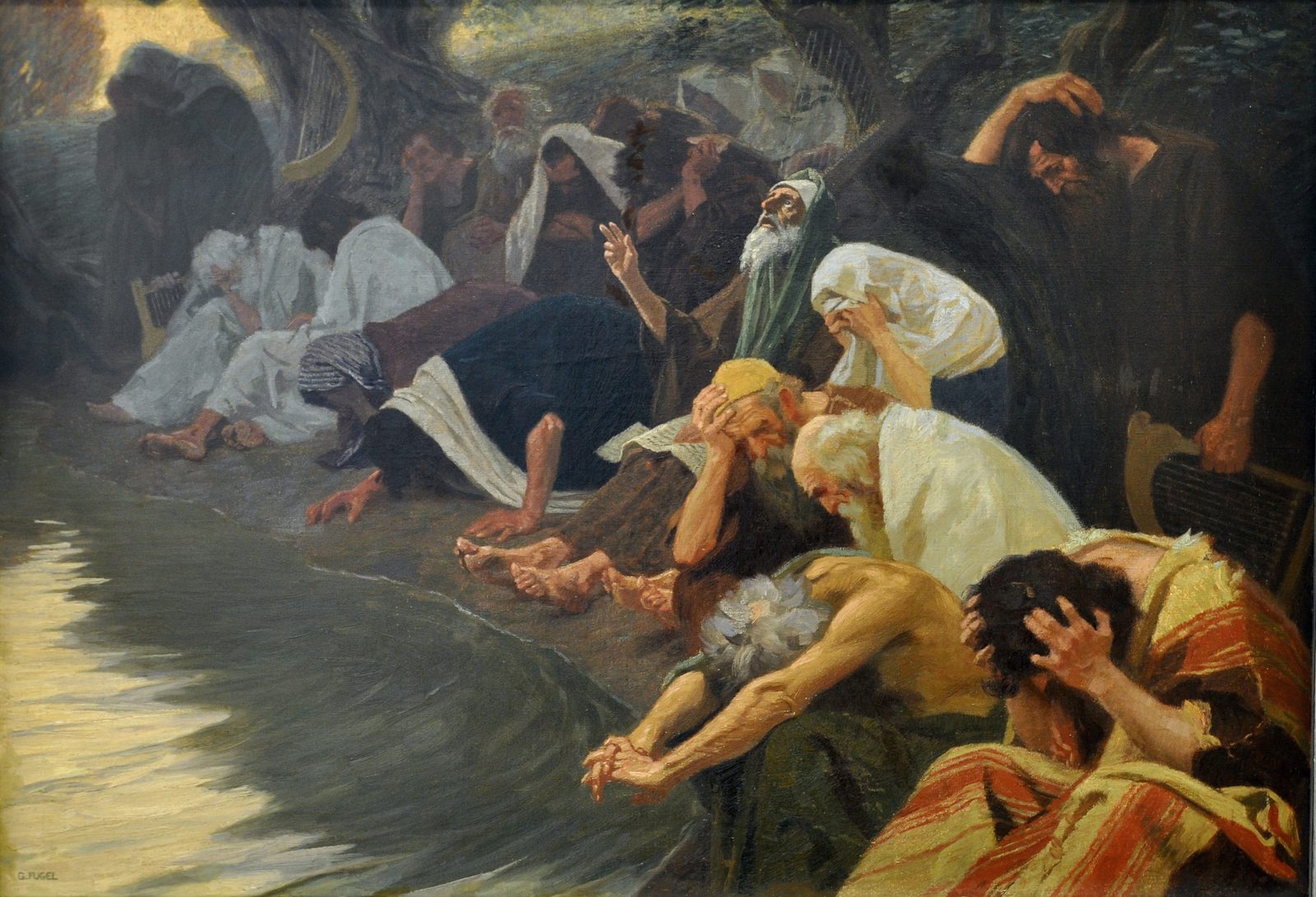
in Psalms 137May my tongue cling to the roof of my mouth if I do not remember you, if I do not exalt Jerusalem as my greatest joy!
BSB
The same verse in ASV and KJV ▾
ASV
Let my tongue cleave to the roof of my mouth, If I remember thee not; If I prefer not Jerusalem Above my chief joy.
KJV
If I do not remember thee, let my tongue cleave to the roof of my mouth; if I prefer not Jerusalem above my chief joy.
⋯
This verse in Psalms 137
Commentary
10 notes on this verseLet my tongue cleave to my jaws, if I do not remember you. That is, let me have neither works nor speech, if the memory of you is not continually turned over in my heart.
This site's exposition
If I forget you, O Jerusalem
on Psalms 137:5-6
The singer swears by naming what he loses if he fails. The Hebrew uses the verb forget twice, of the man and then of his own right hand, a hand that would cease to work. His tongue is staked on it too, and Jerusalem is set above every joy.
This site's exposition
May my tongue cling to the roof
The oath sets the right hand of verse 5, which plays the harp, beside the tongue, which sings the song. Ezekiel 3:26 uses the same picture of a tongue made to cling to the roof of the mouth. Greatest joy is in Hebrew the head of joy.
The record, by era
The Church Fathers1 voice
"Let my tongue cleave to my jaws, if I remember not you" [Psalm 137:6]. That is, let me be dumb, he says, if I remember not you. For what word, what sound does he utter, who utters not songs of Sion? That is our tongue, the song of Jerusalem. The song of the love of this world is a strange tongue, a barbarous tongue, which we have learned in our captivity. Dumb then will he be to God, who forgets Jerusalem. And it is not enough to remember: for her enemies too remember her, desiring to overthrow her. "What is that city?" say they; "who are the Christians? What sort of men are the Christians? Would they were not Christians." Now the captive band has conquered its capturers; still they murmur, and rage, and desire to slay the holy city that dwells as a stranger among them. Not enough then is it to remember: take heed how you remember. For some things we remember in hate, some in love. And so, when he had said, "If I forget you, O Jerusalem," etc., he added at once, "if I prefer not Jerusalem in the height of my joy." For there is the height of joy where we enjoy God, where we are safe of united brotherhood, and the union of citizenship. There no tempter shall assail us, no one be able so much as to urge us on to any allurement: there nought will delight us but good: there all want will die, there perfect bliss will dawn on us.
The Puritans and the Awakening2 voices
If I do not remember thee,....
They preferred it above their chief joy, and therefore they remembered it and could not forget it. What we love we love to think of. Those that rejoice in God do, for his sake, make Jerusalem their joy, and prefer it before that, whatever it is, which is the head of their joy, which is dearest to them in this world.
The Nineteenth Century2 voices
If I do not remember thee, let my tongue cleave to the roof of my mouth. Thus the singers imprecate eternal silence upon their mouths if they forget Jerusalem to gratify Babylon. The players on instruments and the sweet songsters are of one mind: the enemies of the Lord will get no mirthful tune or song from them. If I prefer not Jerusalem above my chief joy.
If I do not remember thee, let my tongue cleave to the roof of my mouth. Thus the singers imprecate eternal silence upon their mouths if they forget Jerusalem to gratify Babylon. The players on instruments and the sweet songsters are of one mind: the enemies of the Lord will get no mirthful tune or song from them. If I prefer not Jerusalem above my chief joy. The sacred city must ever be first in their thoughts, the queen of their souls; they had sooner be dumb than dishonour her sacred hymns, and give occasion to the oppressor to ridicule her worship. If such the attachment of a banished Jew to his native land, how much more should we love the church of God of which we are children and citizens. How jealous should we be of her honour, how zealous for her prosperity. Never let us find jests in the words of Scripture, or make amusement out of holy things, lest we be guilty of forgetting the Lord and his cause. It is to be feared that many tongues have lost all power to charm the regations of the saints because they have forgotten the gospel, and God has forgotten them.
2 more voices on this verse
The Nineteenth Century2 voices
Let my tongue cleave - Let me lose my voice, and all its powers of melody; my tongue, and all its faculty of speech; my ear, and its discernment of sounds; if I do not prefer my country, my people, and the ordinances of my God, beyond all these, and whatever may constitute the chiefest joy I can possess in aught else beside. This is truly patriotic, truly noble and dignified. Such sentiments can only be found in the hearts and mouths of those slaves whom the grace of God has made free.
A commentator
Albert Barnes1798–1870
Notes, Explanatory and Practical, on the Old and New Testaments (1832-1869)
proposed
If I do not remember thee - Equivalent to, “If I forget thee.” If I ever fail to remember thee; if I shall ever act as if I had forgotten thee. Singing in a strange land, among those who had perpetrated such wrongs in thee - appearing to be happy, cheerful, joyous, happy, merry there - would be understood to imply that I had ceased to remember thee, and cared nothing for thee. Let my tongue cleave to the roof of my mouth - Compare Eze 3:26. Let me be unable to speak; let my tongue be as it were attached to the upper part of the mouth, so that it could not be used. If I employ it in an unworthy purpose - in any way whereby it can be inferred that I have ceased to remember my native land, and the city of our solemnities, let my tongue be ever after useless. This language is often employed by Virgil: Vox faucibus haesit. If I prefer not Jerusalem - literally, “If I do not cause to ascend.” That is, If I do not exalt Jerusalem in my estimation above everything that gives me pleasure; if I do not find my supreme happiness in that. Above my chief joy - Margin, as in Hebrew, the head of my joy. The chief thing which gives me joy; as the head is the chief, or is supreme over the body. This is expressive of a great truth in regard to religion. Anything else - everything else - is to be sooner sacrificed than that. The happiness which is found in religion is superior to that found in every other source of enjoyment, and is preferred to every other. If either is to be sacrificed - the joy of religion, or the pleasure derived from society, from the frivolous world, from literature, from music, from dancing, from works of art - it will be the latter and not the former. There are other sources of joy which are not in any way inconsistent with religion: the joy of friendship; of domestic life; of honorable pursuits of the esteem of people. […]
How the passage was read
What the Jewish commentators add
If I do not bring up Jerusalem The remembrance of the mourning of its destruction I shall bring up to mention at the head of every joyous occasion of mine.
1 more on this passage, in their own words ▾
If I forget you, O Jerusalem The congregation of Israel says this.
This section is reception history: how the passage was read and kept in the Jewish tradition. Where a reading parts from an essential of the Christian faith, the section says so at that point.
Texts and citation data: Sefaria; each excerpt follows its version’s licence. 5 further sources are cited on this chapter that carry no English text this site may quote or only restate the verse.
The words behind it
14 Hebrew wordsEvery Hebrew word of this verse in the order it stands, with what it means and the door to its own study. The last column counts the times a word stands in the whole Bible: the rarer the word, the more the places it appears belong together.
| Hebrew | Sound | Meaning | Word study | In the Bible |
|---|---|---|---|---|
| תִּדְבַּ֥ק־ | tidbak- | may it cleave | H1692 → | 54 times |
| לְשׁוֹנִ֨י׀ | leshoni | tongue my | H3956 → | 117 times |
| לְחִכִּי֮ | lechiki | to palate my | H2441 → | |
| אִם־ | ʾim- | if | H518 → | 1069 times |
| לֹ֪א | lo' | not | H3808 → | 5168 times |
| אֶ֫זְכְּרֵ֥כִי | ʾezkerekhi | I will remember you | H2142 → | 230 times |
| אִם־ | ʾim- | if | H518 → | 1069 times |
| לֹ֣א | lo' | not | H3808 → | 5168 times |
| אַ֭עֲלֶה | ʾaaleh | I will lift up | H5927 → | 890 times |
| אֶת־ | ʾet- | <obj.> | H853 → | 10935 times |
| יְרוּשָׁלִַ֑ם | yerushalim | Jerusalem | H3389 → | 643 times |
| עַ֝֗ל | ʾal | above | H5921 → | 5755 times |
| רֹ֣אשׁ | rosh | [the] chief of | H7218 → | 599 times |
| שִׂמְחָתִֽי׃ | simchati | joy my | H8057 → | 94 times |
תִּדְבַּ֥ק־may it cleave
tidbak-H1692 →54 times
לְשׁוֹנִ֨י׀tongue my
leshoniH3956 →117 times
לְחִכִּי֮to palate my
lechikiH2441 →
אִם־if
ʾim-H518 →1069 times
לֹ֪אnot
lo'H3808 →5168 times
אֶ֫זְכְּרֵ֥כִיI will remember you
ʾezkerekhiH2142 →230 times
אִם־if
ʾim-H518 →1069 times
לֹ֣אnot
lo'H3808 →5168 times
אַ֭עֲלֶהI will lift up
ʾaalehH5927 →890 times
אֶת־<obj.>
ʾet-H853 →10935 times
יְרוּשָׁלִַ֑םJerusalem
yerushalimH3389 →643 times
עַ֝֗לabove
ʾalH5921 →5755 times
רֹ֣אשׁ[the] chief of
roshH7218 →599 times
שִׂמְחָתִֽי׃joy my
simchatiH8057 →94 times
A shaded row is a word that stands 400 times or fewer in the Bible.
The walk
8 stopsEach card is a verse this one points to, and under it the verses that one points to in turn. Where several paths arrive at the same place, that place is listed first: the text keeps returning to it.
Through
Psalms 84:10For better is one day in Your courts than a thousand elsewhere. I would rather be a doorkeeper in the house of my God than dwell in the tents of the wicked.
it leads to
- Psalms 27:4
One thing I have asked of the LORD; this is what I desire: to dwell in the house of the LORD all the days of my life, to gaze on the beauty of the…
- Psalms 26:8–10
O LORD, I love the house where You dwell, the place where Your glory resides.
- Psalms 63:2
So I have seen You in the sanctuary and beheld Your power and glory.
- Philippians 3:20
But our citizenship is in heaven, and we eagerly await a Savior from there, the Lord Jesus Christ,
- Romans 8:5–6
Those who live according to the flesh set their minds on the things of the flesh; but those who live according to the Spirit set their minds on the things of the Spirit.
- Psalms 27:4
Through
Psalms 22:15My strength is dried up like a potsherd, and my tongue sticks to the roof of my mouth. You lay me in the dust of death.
it leads to
- John 19:28
After this, knowing that everything had now been accomplished, and to fulfill the Scripture, Jesus said, “I am thirsty.”
- John 19:28
Through
Isaiah 41:17The poor and needy seek water, but there is none; their tongues are parched with thirst. I, the LORD, will answer them; I, the God of Israel, will not forsake them.
it leads to
- Isaiah 55:1
“Come, all you who are thirsty, come to the waters; and you without money, come, buy, and eat! Come, buy wine and milk without money and without cost!
- Isaiah 30:19
O people in Zion who dwell in Jerusalem, you will weep no more. He will surely be gracious when you cry for help; when He hears, He will answer you.
- Isaiah 55:1
Where this verse is studied
On this page
Studies3
On this verse
On this chapter
About Psalms
Who and where
1 name in this verse with a page on the site.
This page draws on Adam Clarke, Commentary on the Bible; Albert Barnes, Notes, Explanatory and Practical, on the Old and New Testaments (1832-1869); Augustine of Hippo, Exposition on Psalm 137; Charles Spurgeon, The Treasury of David, Vol. 7; Jerome, Homily 48, on Psalm 136; John Gill, Exposition of the Old Testament; John Gill, Exposition of the Old Testament (1748-1763) and Matthew Henry, Commentary on the Whole Bible.