
Psalms 137:4
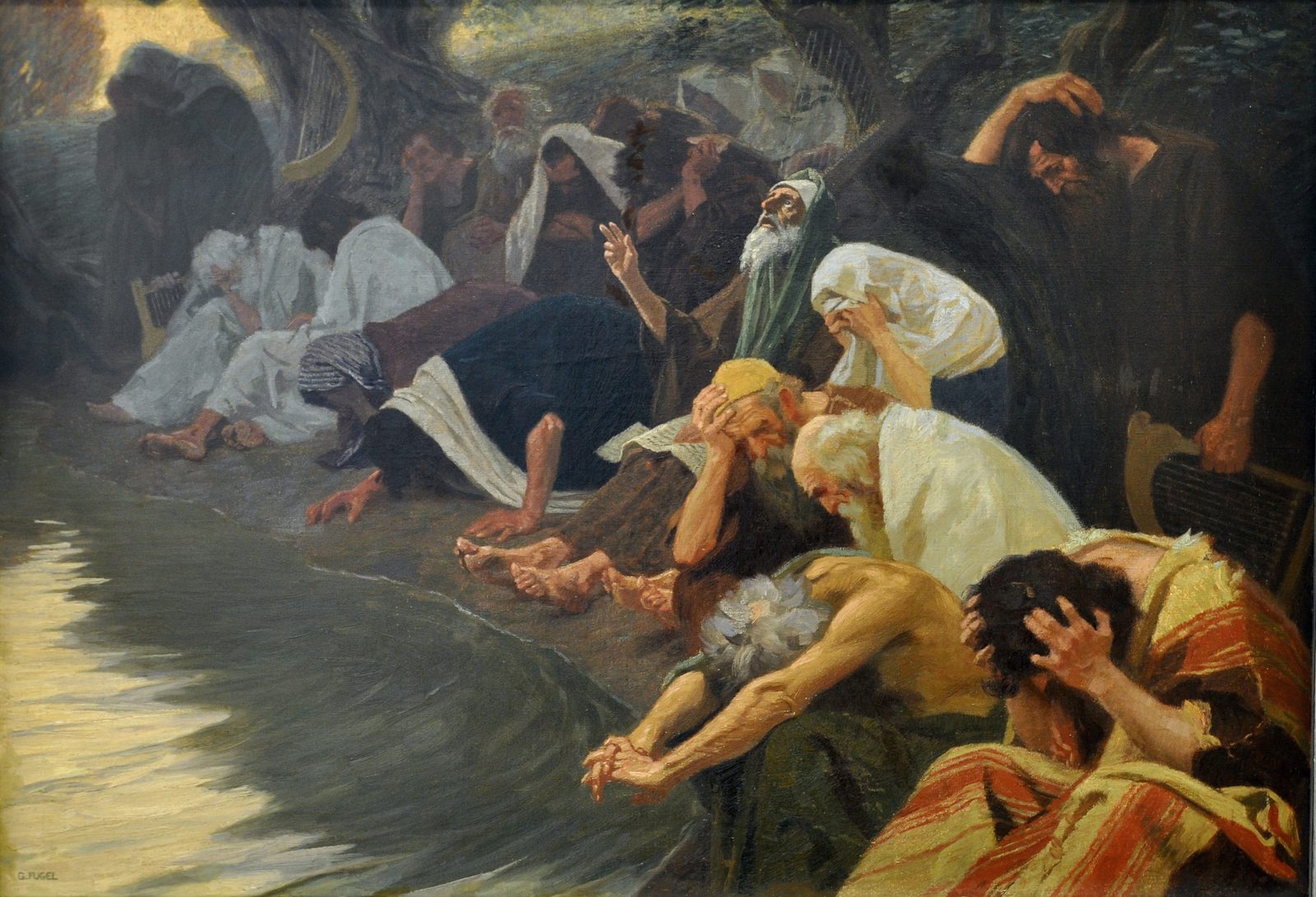
in Psalms 137How can we sing a song of the LORD in a foreign land?
BSB
The same verse in ASV and KJV ▾
ASV
How shall we sing Jehovah’s song In a foreign land?
KJV
How shall we sing the Lord’s song in a strange land?
⋯
This verse in Psalms 137
Commentary
13 notes on this verseHow shall we sing the Lord's song in a strange land? They answer, those who have sinned and been deceived, and they say: "How shall we sing you the Lord's song in a strange land, set as we are in our sins, we who have fallen from Jerusalem into Babylon?" Therefore no one can praise the Lord unless he is holy. For the sinner ought not to sing to the Lord, but to mourn his sins.
This site's exposition
our captors requested a song
on Psalms 137:3-4
The captors ask for songs of joy, and the song they name is a song of Zion. The answer is a question about singing to the LORD in a foreign land. Spurgeon read that question as a refusal put humbly.
This site's exposition
How can we sing a song
The captors asked for a song of Zion. The answer names it a song of the LORD, the phrase 2 Chronicles 29:27 uses for the temple singing at the burnt offering. That song belonged at His altar in Zion, and the exiles stood in a foreign land.
The record, by era
The Church Fathers2 voices
A commentator
Gregory of NazianzusAGAINST THE EUNOMIANS, THEOLOGICAL ORATION 1[27].5 · Written before 390.
proposed
Certainly not, friends and brethren—I still call you "brethren," though your attitude is not brotherly—do not let us accept such a view. We must not be like fiery, unruly horses, throwing reason our rider and spitting out the bit of discretion that so usefully restrains us, and running wide of the turning post. Let us conduct our debates within our frontiers and not be carried away to Egypt or dragged off to Assyria. Let us not "sing the song of the Lord in a foreign land," by which I mean before any and every audience, heathen or Christian, friend or foe, sympathetic or hostile: these keep all too close a watch on us, and they would wish that the spark of our dissensions might become a conflagration; they kindle it, they fan it, by means of its own draught they raise it to the skies, and without our knowing what they are up to, they make it higher than the flames of Babylon that blazed all around. Having no strength in their own teaching, they hunt for it in our weakness, and for this reason like flies settling on wounds, they settle on our misfortune—or should I say our mistakes? Let us be blind to our doings no longer, and let us not neglect the proprieties in these matters. If we cannot resolve our disputes outright, let us at least make this mutual concession, to utter spiritual truths with the restraint due to them, to discuss holy things in a holy manner and not be broadcast to profane hearing what is not to be divulged.
"Those" then "who have led us captive," the devil and his angels, when have they spoken unto us: "Sing us one of the songs of Sion"? What answer we? Babylon beareth thee, Babylon containeth thee, Babylon nourisheth thee, Babylon speaks by thy mouth, thou knowest not to take in save what glitters for the present, thou knowest not how to meditate on things of eternity, thou takest not in what thou askest. "How shall we sing the Lord's song in a strange land?" [Psalm 137:4]. Truly, brethren, so it is. Begin to wish to preach the truth in such measure as ye know it, and see how needful it is for you to endure such mockers, persecutors of the truth, full of falsehood. Reply to them, when they ask of you what they cannot take in, and say in full confidence of your holy song, "How shall we sing the Lord's song in a strange land!"
The Puritans and the Awakening2 voices
Profane scoffers are not to be humoured, nor pearls cast before swine. David prudently kept silence even from good when the wicked were before him, who, he knew, would ridicule what he said and make a jest of it, Ps. xxxix. The reason they gave is very mild and pious: How shall we sing the Lord's song in a strange land?
How shall we sing the Lord's song in a strange land?
The Nineteenth Century1 voice
How shall we sing the Lord's song in a strange land How shall they sing at all? sing in a strange land? sing Jehovah's song among the uncircumcised? No, that must not be; it shall not be. With one voice they refuse, but the refusal is humbly worded by being put in the form of a question.
5 more voices on this verse
The Nineteenth Century4 voices
St. John Chrysostom observes the improvement such tribulation effected in the Jews, who previously derided, nay, even put to death, some of the prophets; but now that they were captives in a foreign land, they would not attempt to expose their sacred hymns to the ridicule of the Gentiles.— Robert Bellarmine.
How shall we sing the Lord's song in a strange land How shall they sing at all? sing in a strange land? sing Jehovah's song among the uncircumcised? No, that must not be; it shall not be. With one voice they refuse, but the refusal is humbly worded by being put in the form of a question. If the men of Babylon were wicked enough to suggest the defiling of holy things for the gratification of curiosity, or for the creation of amusement, the men of Zion had not so hardened their hearts as to be willing to please them at such a fearful cost. There are many things which the ungodly could do, and think nothing of the doing thereof, which gracious men cannot venture upon. The question "How can I?" or "How shall we?" comes of a tender conscience and denotes an inability to sin which is greatly to be cultivated.
How shall we sing the Lord’s song - איך נשיר eich! nashir; O, we sing! Who does not hear the deep sigh in the strongly guttural sound of the original איך eich! wrung, as it were, from the bottom of the heart? Can We, in this state of slavery, - We, exiles, from our country, We, stripped of all our property, - We, reduced to contempt by our strong enemy, - We, deprived of our religious privileges, - We, insulted by our oppressors, - We, in the land of heathens, - We sing, or be mirthful in these circumstances? No: God does not expect it; man should not wish it; and it is base in our enemies to require it.
A commentator
Albert Barnes1798–1870
Notes, Explanatory and Practical, on the Old and New Testaments (1832-1869)
proposed
How shall we sing the Lord’s song - The song designed to celebrate his praise; that is, appropriate to the worship of Yahweh. In a strange land - Far from our home; far from the temple; exiles; captives: how can we find spirit in such circumstances to sing? How can we do that which would be indicative of what we do not feel, and cannot feel - joy and happiness! The idea is not that those psalms or songs would be profaned by being sung there, or that there would be anything improper in itself in singing them, but that it would be misplaced and incongruous to sing them in their circumstances. It would be doing violence to their own feelings; their feelings would not allow them to do it. There are states of mind when the language of joy is appropriate and natural; there are states where the heart is so sad that it cannot sing.
Modern Voices1 voice
A commentator
GK ChestertonTremendous Trifles, XXX. The Little Birds Who Won't Sing (1909) (1909)
proposed
And the more I thought about the matter the more painfully certain it seemed that the most important and typical modern things could not be done with a chorus. One could not, for instance, be a great financier and sing; because the essence of being …
How the passage was read
What the Jewish commentators add
On the verses either side of this one
If I forget you, O Jerusalem The congregation of Israel says this.
This section is reception history: how the passage was read and kept in the Jewish tradition. Where a reading parts from an essential of the Christian faith, the section says so at that point.
Texts and citation data: Sefaria; each excerpt follows its version’s licence. 5 further sources are cited on this chapter that carry no English text this site may quote or only restate the verse.
The words behind it
8 Hebrew wordsEvery Hebrew word of this verse in the order it stands, with what it means and the door to its own study. The last column counts the times a word stands in the whole Bible: the rarer the word, the more the places it appears belong together.
| Hebrew | Sound | Meaning | Word study | In the Bible |
|---|---|---|---|---|
| אֵ֗יךְ | ʾeikh | how? | H349 → | 82 times |
| נָשִׁ֥יר | nashir | will we sing | H7891 → | 86 times |
| אֶת־ | ʾet- | <obj.> | H853 → | 10935 times |
| שִׁיר־ | shir- | [the] song of | H7892 → | 59 times |
| יְהוָ֑ה | yahweh | Yahweh | H3068 → | 6520 times |
| עַ֝֗ל | ʾal | on | H5921 → | 5755 times |
| אַדְמַ֥ת | ʾadmat | ground of | H127 → | 225 times |
| נֵכָֽר׃ | nekhar | foreignness | H5236 → | 36 times |
אֵ֗יךְhow?
ʾeikhH349 →82 times
נָשִׁ֥ירwill we sing
nashirH7891 →86 times
אֶת־<obj.>
ʾet-H853 →10935 times
שִׁיר־[the] song of
shir-H7892 →59 times
יְהוָ֑הYahweh
yahwehH3068 →6520 times
עַ֝֗לon
ʾalH5921 →5755 times
אַדְמַ֥תground of
ʾadmatH127 →225 times
נֵכָֽר׃foreignness
nekharH5236 →36 times
A shaded row is a word that stands 400 times or fewer in the Bible.
The walk
8 stopsEach card is a verse this one points to, and under it the verses that one points to in turn. Where several paths arrive at the same place, that place is listed first: the text keeps returning to it.
Through
Ecclesiastes 3:4a time to weep and a time to laugh, a time to mourn and a time to dance,
it leads to
- Psalms 30:5
For His anger is fleeting, but His favor lasts a lifetime. Weeping may stay the night, but joy comes in the morning.
- Romans 12:15
Rejoice with those who rejoice; weep with those who weep.
- James 4:9
Grieve, mourn, and weep. Turn your laughter to mourning, and your joy to gloom.
- Psalms 126:1–2
When the LORD restored the captives of Zion, we were like dreamers.
- John 16:20–22
Truly, truly, I tell you, you will weep and wail while the world rejoices. You will grieve, but your grief will turn to joy.
- Psalms 30:5
Through
Amos 8:3“In that day,” declares the Lord GOD, “the songs of the temple will turn to wailing. Many will be the corpses, strewn in silence everywhere!”
it leads to
- Amos 5:23
Take away from Me the noise of your songs! I will not listen to the music of your harps.
- Amos 5:23
Through
Isaiah 22:12On that day the Lord GOD of Hosts called for weeping and wailing, for shaven heads and the wearing of sackcloth.
it leads to
- Joel 1:13
Put on sackcloth and lament, O priests; wail, O ministers of the altar. Come, spend the night in sackcloth, O ministers of my God, because the grain and drink offerings are withheld from the…
- Micah 1:16
Shave yourselves bald and cut off your hair in mourning for your precious children; make yourselves as bald as an eagle, for they will go from you into exile.
- Joel 1:13
Where this verse is studied
On this page
Studies3
On this verse
On this chapter
About Psalms
This page draws on 13 works. Open the list of works
This page draws on Adam Clarke, Commentary on the Bible; Albert Barnes, Notes, Explanatory and Practical, on the Old and New Testaments (1832-1869); Augustine of Hippo, Exposition on Psalm 137; Charles Spurgeon, The Treasury of David; Charles Spurgeon, The Treasury of David, Vol. 7; Franz Delitzsch, Biblical Commentary on the Psalms; GK Chesterton, Tremendous Trifles, XXX. The Little Birds Who Won't Sing (1909); Gregory of Nazianzus, AGAINST THE EUNOMIANS, THEOLOGICAL ORATION 1[27].5; Jerome, Homily 48, on Psalm 136; John Gill, Exposition of the Old Testament; John Gill, Exposition of the Old Testament (1748-1763); Keil and Delitzsch, Biblical Commentary on the Old Testament and Matthew Henry, Commentary on the Whole Bible.