
Psalms 137:3
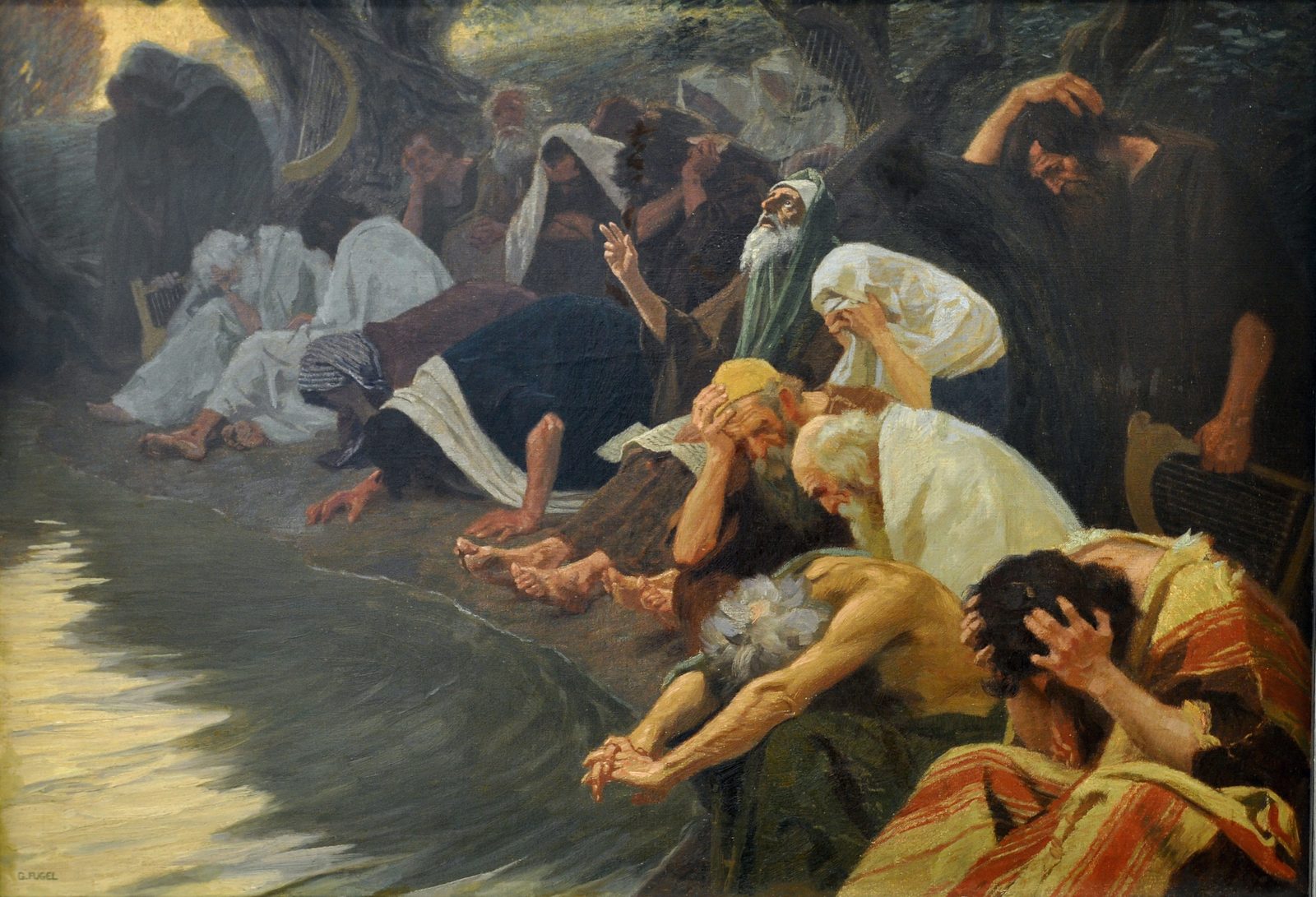
in Psalms 137for there our captors requested a song; our tormentors demanded songs of joy: “Sing us a song of Zion.”
BSB
The same verse in ASV and KJV ▾
ASV
For there they that led us captive required of us songs, And they that wasted us required of us mirth, saying, Sing us one of the songs of Zion.
KJV
For there they that carried us away captive required of us a song; and they that wasted us required of us mirth, saying, Sing us one of the songs of Zion.
⋯
This verse in Psalms 137
Commentary
10 notes on this verseFor there they that led us away captive asked of us the words of songs. The demons, who deceived us and led us away captive, now, as though mocking us and boasting, say to us: "Give us back a word about your faith, and just as when you were in Jerusalem, sing a hymn to God."
This site's exposition
our captors requested a song
on Psalms 137:3-4
The captors ask for songs of joy, and the song they name is a song of Zion. The answer is a question about singing to the LORD in a foreign land. Spurgeon read that question as a refusal put humbly.
The record, by era
The Church Fathers1 voice
"For there they that led us captive demanded of us words of songs, and they that led us away, an hymn" [Psalm 137:3]. They demanded of us words of songs and an hymn, who led us captive....We are tempted by the delights of earthly things, and we struggle daily with the suggestions of unlawful pleasures; scarce do we breathe freely even in prayer: we understand that we are captives. But who led us captive? what men? what race? what king? If we are redeemed, we once were captives. Who hath redeemed us? Christ. From whom hath He redeemed us? From the devil. The devil then and his angels led us captive: and they would not lead us, unless we consented....
The Puritans and the Awakening2 voices
For there they that carried us away captive required of us a song,.... Or, "words of a song" (z).
They had carried them away captive from their own land and then wasted them in the land of their captivity, took what little they had from them. But this was not enough; to complete their woes they insulted over them: They required of us mirth and a song. This was very barbarous and inhuman; even an enemy, in misery, is to be pitied and not trampled upon.
The Nineteenth Century2 voices
For there they that carried us away captive required of us a song. It was ill to be a singer at all when it was demanded that this talent should go into bondage to an oppressor's will. Better be dumb than be forced to please an enemy with forced song. What cruelty to make a people sigh, and then require them to sing! Shall men be carried away from home and all that is dear to them, and yet chant merrily for the pleasure of their unfeeling captors? This is studied torture: the iron enters into the soul.
For there they that carried us away captive required of us a song. It was ill to be a singer at all when it was demanded that this talent should go into bondage to an oppressor's will. Better be dumb than be forced to please an enemy with forced song. What cruelty to make a people sigh, and then require them to sing! Shall men be carried away from home and all that is dear to them, and yet chant merrily for the pleasure of their unfeeling captors? This is studied torture: the iron enters into the soul. It is indeed "woe to the conquered" when they are forced to sing to increase the triumph of their conquerors. Cruelty herein reached a refinement seldom thought of. We do not wonder that the captives sat them down to weep when thus insulted. "And they that wasted us required of us mirth." The captives must not only sing but smile, and add merriment to their music. Blind Samson in former days must be brought forth to make sport for Philistines, and now the Babylonians prove themselves to be loaves of the same leaven. Plundered, wounded, fettered, carried into captivity and poverty, yet must the people laugh as if it were all a play, and they must sport as if they felt no sorrow. This was worm wood and gall to the true lovers of God and his chosen land. "Saying, Sing us one of the songs of Zion." Nothing would serve their turn but a holy hymn, and a tune sacred to the worship of Jehovah. Nothing will content the Babylonian mockers but one of israel's Psalms when in her happiest days she sang unto the Lord whose mercy endureth for ever: this would make rare fun for their persecutors, who would deride their worship and ridicule their faith in Jehovah. In this demand there was an insult to their God as well as a mockery of themselves, and this made it the more intensely cruel. Nothing could have been more malicious, nothing more productive of grief.
3 more voices on this verse
The Nineteenth Century3 voices
St. John Chrysostom observes the improvement such tribulation effected in the Jews, who previously derided, nay, even put to death, some of the prophets; but now that they were captives in a foreign land, they would not attempt to expose their sacred hymns to the ridicule of the Gentiles.— Robert Bellarmine.
They that carried us away captive required of us a song - This was as unreasonable as it was insulting. How could they who had reduced us to slavery, and dragged us in chains from our own beautiful land and privileges, expect us to sing a sacred ode to please them, who were enemies both to us and to our God? And how could those who wasted us expect mirth from people in captivity, deprived of all their possessions, and in the most abject state of poverty and oppression?
A commentator
Albert Barnes1798–1870
Notes, Explanatory and Practical, on the Old and New Testaments (1832-1869)
proposed
For there they that carried us away captive - The Babylonians. Required of us a song - Asked of us a song. The word does not express the idea of compulsion or force. Margin, as in Hebrew, words of a song. Perhaps the idea is that they did not merely ask music, but they wished to hear the words - the songs themselves - in which they were accustomed to praise God. This may have been a taunt, and the request may have been in derision; or it may have been seriously, and with no desire to reproach them, or to add to their sorrows. We are not to impute bad motives to others where there is no evidence that there are any, and where the supposition of good motives will answer just as well; and the expression here may have been a kind and natural wish to hear the songs of these foreigners - songs of which they might have heard much by report; perhaps songs which they had overheard them singing when they were in a less desponding state of mind, and when they sought to comfort themselves by these ancient national melodies. As the only reason assigned for not complying with this request was that they could not “sing the Lord’s song in a strange land” Psa 137:3, we are rather led to infer that there was no bad motive - no disposition to taunt and ridicule them by the request that was made. And they that wasted us - Margin, laid us on heaps. The Hebrew word means a tormentor; properly, one who extorts lamentation from others, or who causes them to howl - to wit, under oppression or wrong. The Septuagint and Latin Vulgate render it, “They who led us away.” The general idea is, those under whom they were then suffering; or, who had caused these trials to come upon them. Required of us mirth - literally, “Our tormentors, joy.” The Hebrew word means joy; and the sense is, that they asked them to give the usual indications of joy and happiness - to wit, a song. […]
The words behind it
12 Hebrew wordsEvery Hebrew word of this verse in the order it stands, with what it means and the door to its own study. The last column counts the times a word stands in the whole Bible: the rarer the word, the more the places it appears belong together.
| Hebrew | Sound | Meaning | Word study | In the Bible |
|---|---|---|---|---|
| כִּ֤י | ki | for | H3588 → | 4482 times |
| שָׁ֨ם | sham | there | H8033 → | 834 times |
| שְֽׁאֵל֪וּנוּ | sheelunu | they asked us | H7592 → | 171 times |
| שׁוֹבֵ֡ינוּ | shoveinu | captors our | H7617 → | 47 times |
| דִּבְרֵי־ | divreishi- | words of | H1697 → | 1440 times |
| שִׁ֭יר | shir | a song | H7892 → | 59 times |
| וְתוֹלָלֵ֣ינוּ | vetolaleinu | and mockers our | H8437 → | |
| שִׂמְחָ֑ה | simchah | gladness | H8057 → | 94 times |
| שִׁ֥ירוּ | shiru | sing | H7891 → | 86 times |
| לָ֝֗נוּ | lanu | for us | ||
| מִשִּׁ֥יר | mishir | one of [the] song[s] of | H7892 → | 59 times |
| צִיּֽוֹן׃ | tziyon | Zion | H6726 → | 154 times |
כִּ֤יfor
kiH3588 →4482 times
שָׁ֨םthere
shamH8033 →834 times
שְֽׁאֵל֪וּנוּthey asked us
sheelunuH7592 →171 times
שׁוֹבֵ֡ינוּcaptors our
shoveinuH7617 →47 times
דִּבְרֵי־words of
divreishi-H1697 →1440 times
שִׁ֭ירa song
shirH7892 →59 times
וְתוֹלָלֵ֣ינוּand mockers our
vetolaleinuH8437 →
שִׂמְחָ֑הgladness
simchahH8057 →94 times
שִׁ֥ירוּsing
shiruH7891 →86 times
לָ֝֗נוּfor us
lanu
מִשִּׁ֥ירone of [the] song[s] of
mishirH7892 →59 times
צִיּֽוֹן׃Zion
tziyonH6726 →154 times
A shaded row is a word that stands 400 times or fewer in the Bible.
The walk
8 stopsEach card is a verse this one points to, and under it the verses that one points to in turn. Where several paths arrive at the same place, that place is listed first: the text keeps returning to it.
Through
Micah 3:12Therefore, because of you, Zion will be plowed like a field, Jerusalem will become a heap of rubble, and the temple mount a wooded ridge.
it leads to
- Jeremiah 26:18
“Micah the Moreshite prophesied in the days of Hezekiah king of Judah and told all the people of Judah that this is what the LORD of Hosts says: ‘Zion will be plowed like a…
Reached by 2 separate paths from here.
- Psalms 79:1
The nations, O God, have invaded Your inheritance; they have defiled Your holy temple and reduced Jerusalem to rubble.
- Micah 4:1–2
In the last days the mountain of the house of the LORD will be established as the chief of the mountains; it will be raised above the hills, and the peoples will stream to…
- Jeremiah 26:18
Through
Luke 21:6“As for what you see here, the time will come when not one stone will be left on another; every one will be thrown down.”
it leads to
- Matthew 24:2
“Do you see all these things?” He replied. “Truly I tell you, not one stone here will be left on another; every one will be thrown down.”
Reached by 2 separate paths from here.
- Matthew 24:2
Through
Psalms 9:14that I may declare all Your praises— that within the gates of Daughter Zion I may rejoice in Your salvation.
it leads to
- Psalms 13:5
But I have trusted in Your loving devotion; my heart will rejoice in Your salvation.
- Psalms 20:5
May we shout for joy at your victory and raise a banner in the name of our God. May the LORD grant all your petitions.
- Psalms 51:12
Restore to me the joy of Your salvation, and sustain me with a willing spirit.
- 1 Samuel 2:1
At that time Hannah prayed: “My heart rejoices in the LORD in whom my horn is exalted. My mouth speaks boldly against my enemies, for I rejoice in Your salvation.
- Psalms 13:5
Where this verse is studied
On this page
Studies2
On this verse
On this chapter
About Psalms
Who and where
1 name in this verse with a page on the site.
This page draws on 9 works. Open the list of works
This page draws on Adam Clarke, Commentary on the Bible; Albert Barnes, Notes, Explanatory and Practical, on the Old and New Testaments (1832-1869); Augustine of Hippo, Exposition on Psalm 137; Charles Spurgeon, The Treasury of David; Charles Spurgeon, The Treasury of David, Vol. 7; Franz Delitzsch, Biblical Commentary on the Psalms; Jerome, Homily 48, on Psalm 136; John Gill, Exposition of the Old Testament (1748-1763) and Matthew Henry, Commentary on the Whole Bible.