
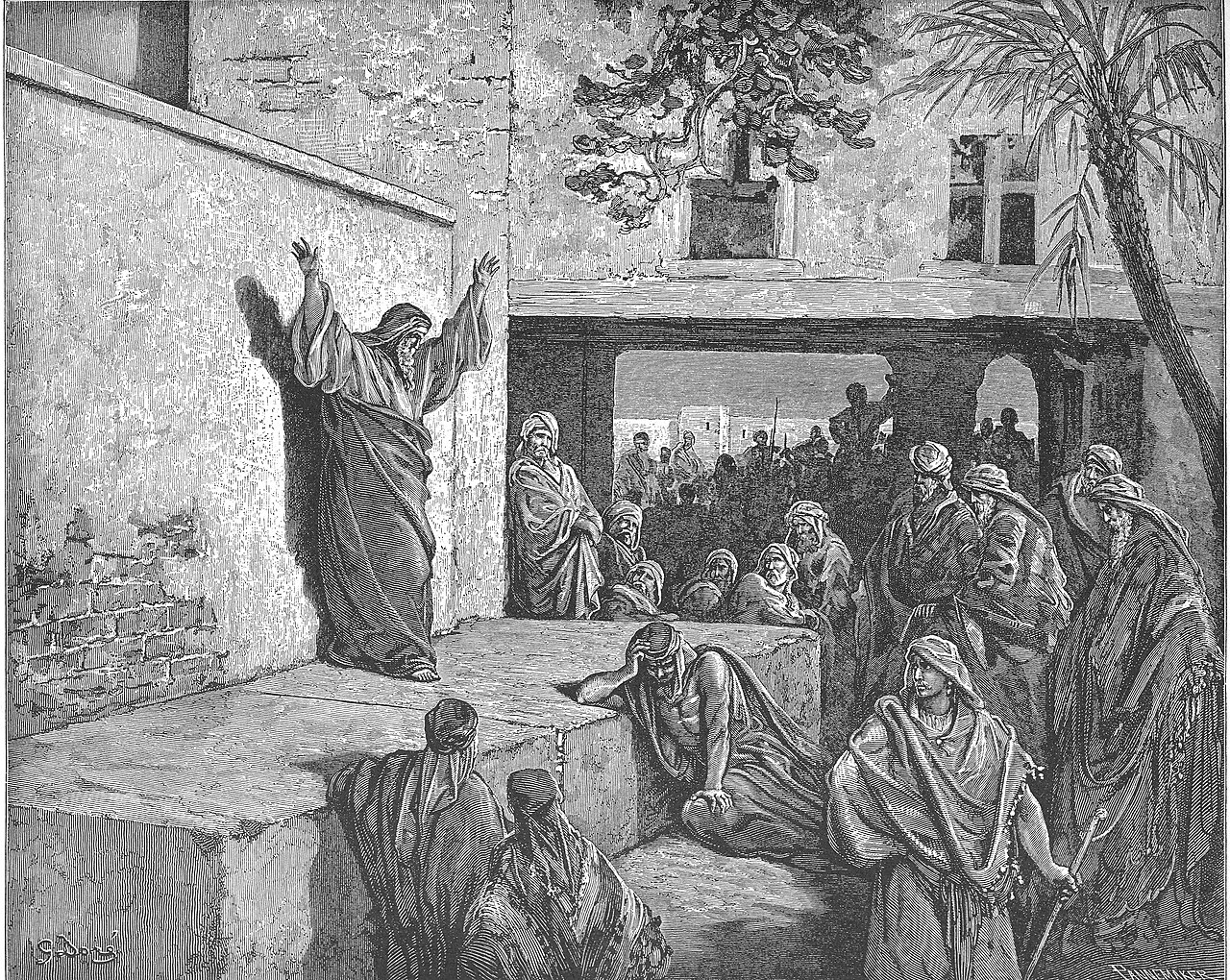
Micahchapter 6
16 verses · Micah · 750 to 686 BC · The Twelve
Key verse
Hear ye, O mountains, the Lord’s controversy, and ye strong foundations of the earth: for the Lord hath a controversy with his people, and he will plead with Israel.
It stands in Plead before the mountains: what have I done to you?, verses 1 to 5.
The chapter
Chapter summary
God takes his people to court before the mountains: 'O my people, what have I done unto thee? and wherein have I wearied thee? testify against me.' The evidence is all rescue: Egypt, Moses and Aaron and Miriam, Balak and Balaam, Shittim to Gilgal. The worshiper answers by bidding upward: burnt-offerings? thousands of rams? ten thousands of rivers of oil? my first-born for my transgression? And the reply is a summit of the Old Testament: 'what doth Jehovah require of thee, but to do justly, and to love kindness, and to walk humbly with thy God?' (6:8). Then back to the shop floor: wicked balances, a bag of deceitful weights, the statutes of Omri kept instead.
Context
Prophecy · Micah · Micah overview
The world behind this chapter
Micah 6The history
The mountains and the foundations of the earth are called as jury because they were there for the whole history under review. This is a formal covenant lawsuit, a form Israel's prophets used repeatedly, and it opens the way a legal complaint opens: God asks what he has done to weary his people.
The rest of the history, and what it meant to them
The evidence he cites is a walking tour. Egypt, Moses and Aaron and Miriam, Balak of Moab hiring Balaam to curse Israel and failing, and then the stretch from Shittim, the last camp east of the Jordan, to Gilgal, the first camp inside the land. It is the crossing itself, the moment the promise became ground under their feet.
The escalating offers in the middle are a bidding war: burnt offerings, calves a year old, thousands of rams, ten thousand rivers of oil, and finally the firstborn son. Child sacrifice was not a hypothetical horror in that region; it was practised by Israel's neighbours and, in Judah's worst periods, by Judeans in the valley outside Jerusalem. The bidder is offering the most extreme thing the surrounding cultures had on the price list.
The chapter then drops to a merchant's bag. Wicked scales and a bag of deceitful weights are the same fraud Amos named, one set of stones for buying and a lighter set for selling. The statutes of Omri and the works of Ahab are named as the pattern being followed, which was a deep insult in Judah, since those were northern kings.
What it meant to them
The answer to the bidding war is the most quoted sentence in the book: he has shown you, O man, what is good, to do justice, to love mercy, and to walk humbly with your God. None of the three can be bought, and all three cost more than ten thousand rivers of oil.
The curses that follow are the covenant curses in domestic form: you will eat and not be satisfied, sow and not reap, tread olives but not anoint yourself with oil, tread grapes but not drink the wine. Hearers who lived by those exact processes knew precisely what a life that shape would feel like.
Sources cited
- Roland de Vaux, Ancient Israel: Its Life and Institutions
- John H. Walton, Victor H. Matthews, Mark W. Chavalas, The IVP Bible Background Commentary: Old Testament
Where the chapter sits
Micah 6 falls in Three judgment-and-hope cycles (chapters 1–7). Judgment on Samaria and Jerusalem (1–2); hope of the latter-day mountain (4); Bethlehem and the Ruler out of her (5); the LORD's controversy and ‘what doth the LORD require’ (6); hope closing with ‘who is a God like unto thee?’ (7).
What the LORD requires. The covenant lawsuit; the book's summary line.
The whole shape of Micah→The structure of this chapter
The heads below are this chapter's scenes. The numbered points under each are its verses.
A. Plead before the mountains: what have I done to you?
1. (vv. 1-2)
Arise, contend thou before the mountains: The Lord summons Israel to a lawsuit, arise, contend thou before the mountains, and let the hills hear thy voice, with the mountains and the strong foundations of the earth called as the assembly before whom the case is argued. The form matches the covenant lawsuit shape found elsewhere in the prophets, heaven and earth called as witnesses to a covenant older than any living generation (Deuteronomy 32:1, Isaiah 1:2), since only they were present when the terms were first agreed. The Lord's controversy is not with the mountains but with his own people, the mountains standing as jury rather than defendant.
2. (vv. 3-5)
O my people, what have I done unto thee?: The Lord's opening plea is tenderness rather than accusation, O my people, what have I done unto thee, and wherein have I wearied thee, testify against me, the defendant asking his accuser to name the offense. The evidence he offers is his own past faithfulness, bringing Israel up out of Egypt, redeeming her from the house of servants, and sending Moses, Aaron and Miriam before her, the three named together as the leadership he provided. Verse 5 recalls Balak's hire of Balaam to curse Israel and the Lord's turning of that curse into blessing (Numbers 22-24), offered as a further exhibit of the righteousness of the Lord toward a people who now stand accused of forgetting him.
B. What the LORD requires: do justly, love mercy, walk humbly
1. (vv. 6-7)
Wherewith shall I come before the Lord: The worshiper's questions climb a deliberate ladder, burnt offerings of calves a year old, thousands of rams, ten thousands of rivers of oil, and finally shall I give my firstborn for my transgression, each offer larger and more extreme than the one before it. The escalation exposes the underlying error, the assumption that sheer quantity, or even human sacrifice, could purchase what God actually requires, a direction the surrounding nations practiced outright (2 Kings 3:27) and that Micah's question rejects rather than recommends. The passage prepares the ground for the answer the next verse gives, which is not a larger offering but a different kind of response altogether.
2. (v. 8)
Micah 6:8
“You ask what you should offer: offer yourself. For what else does the Lord seek of you but you? Because of all earthly creatures he has made nothing better than you, he seeks yourself from yourself, because you have lost yourself.”
Augustine of Hippo· written before 430· SERMON 48:2patristic
He hath shewed thee, O man, what is good: The question of the previous verses is answered directly, not sacrifice piled higher but to do justly, and to love mercy, and to walk humbly with thy God, the whole moral law compressed into a single sentence rather than a rejection of the sacrificial system as such. To do justly governs a person's dealings with others, to love mercy, the Hebrew chesed of covenant loyalty, governs the spirit behind those dealings, and to walk humbly with thy God governs the relationship beneath both. The verse stands as the courtroom's summation and among the most quoted lines in the Twelve, the same triad of justice and loyal love and humility the Lord commends through the Torah and the prophets together.
C. Wicked balances and the statutes of Omri
1. (vv. 9-12)
The Lord’s voice crieth unto the city: , addressed now directly to Jerusalem or Samaria, and the man of wisdom is told to see thy name, hear ye the rod, and who hath appointed it, the coming judgment named before it is described. The specific charge follows, treasures of wickedness kept in the house of the wicked, the scant measure that is abominable, wicked balances and a bag of deceitful weights, violations of the law's own standard for honest trade (Leviticus 19:35-36, Deuteronomy 25:13-15). The rich men are full of violence, the inhabitants speak lies, and their tongue is deceitful in their mouth, commercial injustice named as the covenant's specific complaint rather than a general charge of unbelief.
2. (vv. 13-16)
Therefore also will I make thee sick in smiting thee: The sentence follows the charge point for point, and its shape matches the futility curses of Deuteronomy 28 almost word for word, eating without being satisfied, sowing without reaping, treading olives without anointing with the oil, treading sweet wine without drinking the wine, the judgment tied to a covenant Israel herself had signed rather than to an arbitrary punishment. The close names the source of the corruption directly, the statutes of Omri are kept, and all the works of the house of Ahab, the northern dynasty's own institutionalized idolatry (1 Kings 16:25, 30-33), now walked in by Judah as well. The reproach of my people that Judah bears is therefore a reproach earned by adopting a neighbor kingdom's sin rather than a fate imposed without cause.
This page carries no textual note on Micah 6. Where this site has examined a place the manuscripts differ, the examination is in the manuscripts room. Every place this site examines →
Sources for this chapter
The summary
Jamieson, Fausset & Brown, Commentary Critical and Explanatory; John Calvin, Commentaries; John Wesley, Notes on the Old Testament and Matthew Henry, Complete Commentary.
The exposition
Adam Clarke, Commentary on the Bible; Albert Barnes, Notes on the Old Testament; Carl Friedrich Keil, The Twelve Minor Prophets; Edward Bouverie Pusey, The Minor Prophets: A Commentary; Jamieson, Fausset and Brown, Commentary Critical and Explanatory on the Whole Bible; John Gill, Exposition of the Old Testament; John Wesley, Explanatory Notes upon the Old Testament and Matthew Henry, Commentary on the Whole Bible.
Keep studying
On this page
Studies4
Words12