
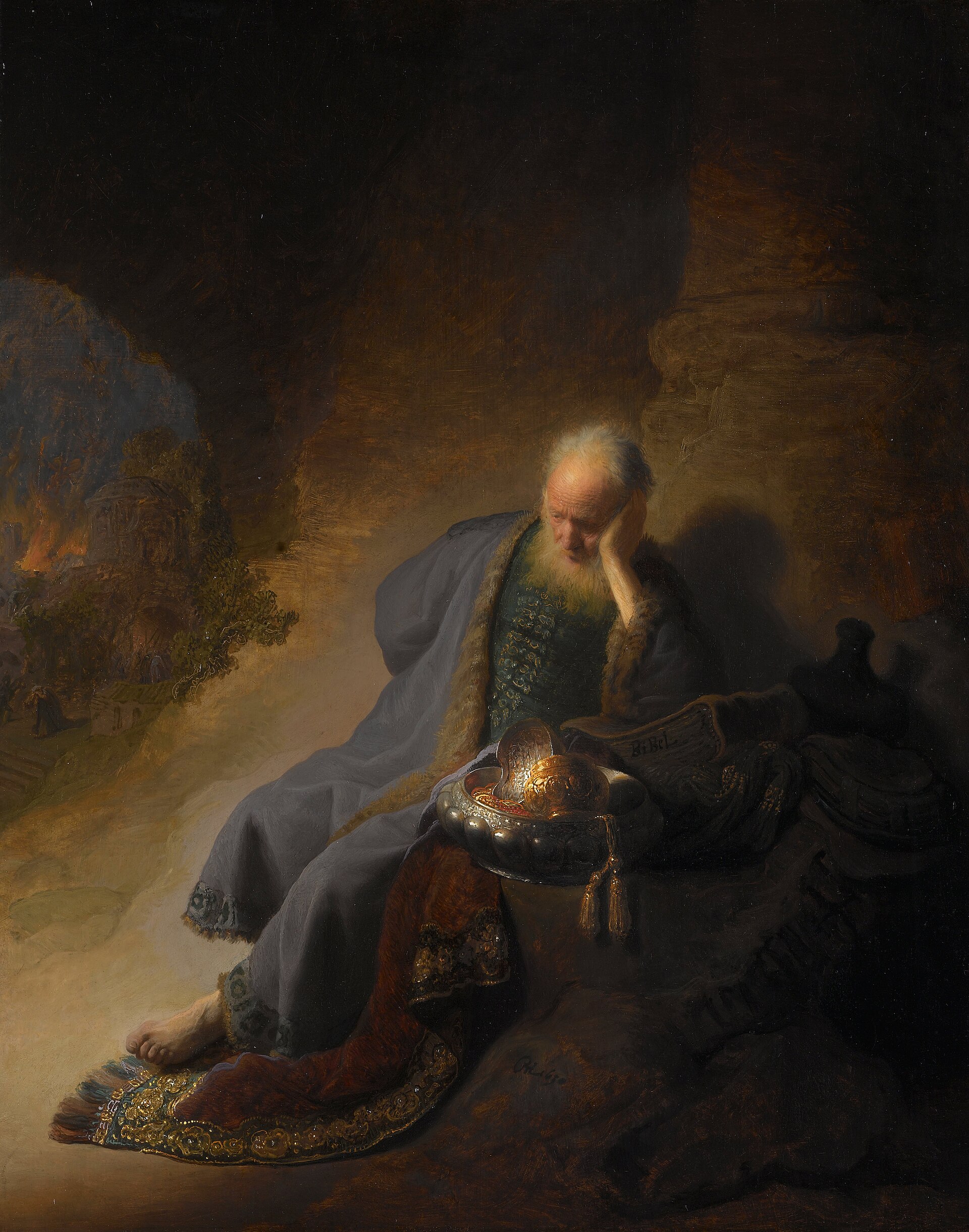
Jeremiahchapter 6
30 verses · Jeremiah, written by Baruch · 7th to 6th century BC · The Prophets
They dress the wound of My people with very little care, saying, ‘Peace, peace,’ when there is no peace at all.
Introduction
Jeremiah, written by Baruch, The Prophets, Jeremiah Overview.
Jeremiah preached this to Judeans who knew every place it names, because they lived between those towns. It closes the first group of sermons in the book, and it describes a siege stage by stage before any army has arrived. The hearers had heard warnings before that came to nothing, and their teachers told them all was well. Listen for the signals passed from town to town, and for the speakers inside the city who answer the alarm with comfort. Listen at the close for the work of a metal refiner. Read it as the last word of the early preaching before the temple sermon.
Context
- Who
- Judeans who knew every place name in the warning because they lived between them
- What
- A warning of the siege of Jerusalem, with the charge against prophets and priests who heal the people's wound lightly.
- Where
- Jerusalem and the towns around it, from Benjamin to Tekoa and Beth-haccherem to the south.
- When
- The chapter carries no date; it closes the early sermons and is usually placed before the Babylonian advance of 605 BC.
- Why
- To expose the easy assurance of peace, and to show that God's discipline had failed to purify the nation.
Historical context
The chapter names the alarm system by its stations: blow the horn in Tekoa, ten miles south of Jerusalem, and raise the fire signal over Beth-haccherem. Judah really ran on relayed fire signals. One of the letters written on pottery found in the ruins of Lachish, from an officer to his commander in the final year of the kingdom, says they are watching for the fire signals of Lachish because they can no longer see Azekah.
Show the rest of the historical context, 3 more paragraphs
Then comes a siege, described in order. The attackers arrive at noon, when a defender hopes they will wait for dawn. Trees are cut down for miles around, orchards included, for timber. Earth is piled against the wall in a long ramp until it reaches the top, and the battering engine is dragged up it. A besieged city can watch this happen for months and can do very little about it.
The last picture is a metal refiner's shop. Silver was purified by heating the ore with lead in a shallow hearth and blowing air across it; the lead carried off the impurities and left clean silver behind. The bellows here blow until the lead itself burns away and the refining fails, and the smelter throws out the batch as rejected silver.
Two lines are quoted back to us by history. The people ask where the good old paths are and refuse to walk in them, and the prophets treat a deep wound like a scratch, saying peace, peace, when there is none.
Significance
Hearers who had already heard several invasion warnings that came to nothing would recognise the accusation about healing a wound lightly. Cheap reassurance was the market-leading product of Judah's religion.
Show the rest of the significance, 1 more paragraph
The refiner's furnace answers the obvious objection. God had already tried the fire. The point of preaching had been to purify a nation, and the assayer was now reporting that no clean metal had come out.
This chapter in Jewish lifeWhat this chapter is in Jewish life and reading.
What is done
No part of this chapter is read in the synagogue. Probed for this lane, the site's own table in src/lib/hebraic/readings.ts printed parashot 0 and haftarah uses 0 for Jeremiah 6, and no festival reading for the book. Across chapters 1 to 26 of Jeremiah the same probe found a Haftarah only in chapters 1, 2, 3, 4, 7, 8, 9, 16 and 17.
How it is read
Rashi is the one commentator on this chapter whose English the corpus carries, quoted here from The Judaica Press complete Tanach with Rashi, translated by A. J. Rosenberg, which Sefaria reports as CC-BY.
Rashi reads the shepherds and their flocks as "Figurative of kings and their armies" (Rashi on Jeremiah 6:3:1). On the gleaning of the remnant he draws the picture from the vineyard, where the poor return to glean after the harvest, "so will they spoil and return and spoil" (Rashi on Jeremiah 6:9:1). The false prophets heal the wound lightly because it is "easy" to say peace (Rashi on Jeremiah 6:14:1).
The watchmen of the seventeenth verse he reads as the prophets. A lookout on the tower sounds the shofar when a troop approaches, and God appointed prophets to warn of the coming judgment in the same way (Rashi on Jeremiah 6:17:1).
The corpus carries four further notes on this chapter without an English text, each marked linked because Sefaria holds no English version of the ref. They stand cited and unquoted at Radak on Jeremiah 6:5:1, 6:21:1, 6:22:1 and 6:24:1.
What the rabbis say
The corpus carries 40 rabbinic locators on the verses of this chapter, 8 in the Talmud and 32 in the Midrash. It carries the text of none, so each is cited by ref here and never quoted or paraphrased. The verse numbers are the Hebrew ones the corpus prints.
On verse 1 it holds Introductions to Tanaitic Literature, Introductions to Tractates of the Mishnah, Rosh HaShanah 79, Midrash Lekach Tov, Exodus 9:19:1 and Midrash Sekhel Tov, Shemot 9:19:1. On verse 4 it holds Aggadat Bereshit 36:1, Ein Yaakov, Taanit 4:11 and Introductions to Tanaitic Literature, Introductions to Tractates of the Mishnah, Pesachim 51. On verse 7 it holds Bava Metzia 59a:8, Berakhot 56b:13 and Ein Yaakov (Glick Edition), Bava Metzia 4:8. On verse 8 it holds Midrash Sekhel Tov, Bereshit 32:26:4.
On verse 9 it holds Midrash Lekach Tov on Lamentations 1:12:1, Midrash Tanchuma Buber, Noach 28:3 and Midrash Tanchuma, Noach 18:15. On verse 10 it holds Aggadat Bereshit 70:2, Bereshit Rabbah 46:5 and Ein Yaakov, Shabbat 14:3. On verse 11 it holds Eikhah Rabbah 2:24, Ein Yaakov (Glick Edition), Shabbat 16:19 and Ein Yaakov, Shabbat 16:21. On verse 15 it holds Ein Yaakov (Glick Edition), Shabbat 16:20, Ein Yaakov, Shabbat 16:22 and Mekhilta DeRabbi Yishmael, Tractate Bachodesh 9:14.
On verse 16 it holds Midrash Tannaim on Deuteronomy 32:1:1, Midrash Tehillim 119:5 and Otzar Midrashim, Midrash on Psalms, Addendum to Psalm 118 7. On verse 18 it holds Bereshit Rabbati, Parashat Bereshit 46. On verse 19 it holds Ein Yaakov (Glick Edition), Kiddushin 1:30, Ein Yaakov, Kiddushin 1:42 and Kiddushin 40a:13. On verse 21 it holds Otzar Midrashim, Midrashim on Missing and Extra Letters 2:12. On verse 23 it holds Midrash Tehillim 79:2.
On verse 26 it holds Ein Yaakov (Glick Edition), Gittin 5:20, Ein Yaakov, Gittin 5:23 and Gittin 58a:17. On verse 29 it holds Jerusalem Talmud Megillah 3:2:6, Midrash Sekhel Tov, Shemot 9:8:2 and Tractate Soferim 7:3. On verse 30 it holds Bamidbar Rabbah 13:20, Bamidbar Rabbah 13:8 and Bereshit Rabbati, Parashat Vayechi 32.
Sources: Rashi, Rashi on Jeremiah 6:1:1 to 6:23:1, The Judaica Press complete Tanach with Rashi, translated by A. J. Rosenberg, reported CC-BY; Radak, Radak on Jeremiah 6:5:1, 6:21:1, 6:22:1 and 6:24:1, cited by ref because the corpus carries no English text; The Sefaria corpus, scripts/data/sources/sefaria/jeremiah/6.json, the 40 Talmud and Midrash locators on the verses of this chapter; The site's own files, src/lib/hebraic/readings.ts, probed for Jeremiah 6: parashot 0, haftarah uses 0, and no festival reading for the book.
The heads below are this chapter's scenes. The numbered points under each are its verses.
Flee, Children of Benjamin: Siege Mounds Against Jerusalem
Jeremiah 6:1-5
Sound the ram’s horn in Tekoa: Benjamin is told to “flee from Jerusalem”, so the order to leave comes from inside the city under threat. The enemy is pictured as “Shepherds and their flocks” pitching tents around Zion. The invaders set their own hour, “let us attack at noon” and then “let us attack by night”.
Jeremiah 6:1
“Though it was inhabited partly by Benjamites, partly by men of Judah, he addresses the former as being his own countrymen. blow . . . trumpet . . . Tekoa--Tikehu, Tekoa form a play on sounds. Beth-haccerem--meaning in Hebrew, "vineyard-house." It and Tekoa were a few miles south of Jerusalem.”
Jamieson, Fausset & Brown · Commentary Critical and Explanatory on the Whole Bible (1871)reformed
beautiful and delicate: Gill pictures Zion as a delicate woman living at ease, secure and unafraid of any enemy. Barnes renders the verse to a pasture, a luxuriant pasture, which prepares for the shepherds of the next verse. The comfort invites the flocks.
Jeremiah 6:2
“I have likened the daughter of Zion to a comely and delicate woman. That dwells at home and lives in pleasure, and deliciously, in great peace and quietness, in entire ease and security, in no fear of enemies, or apprehension of danger; and so it describes the secure state of the Jews. Kimchi and Ben Melech supply the word "woman" as we do; but others supply "land" or "pasture"; and think that the Jewish nation is compared to pleasant and delightful lands and pastures, which are inviting to shepherds to come and pitch their tents about them; as follows.”
1 more voice on this verse
Jeremiah 6:2
The whole verse is difficult, but should probably be translated; “to a pasturage, yea a luxuriant pasturage, have I likened (or, have reduced to silence, i. e., destroyed) the daughter of Zion.”
Shepherds and their flocks will come against her: The Targum, as Gill reports, reads the shepherds as kings and their flocks as armies. Nebuchadnezzar and his generals come to Jerusalem as to good pasture. Military tents ring the city like herdsmen's camps.
Jeremiah 6:3
“The shepherds with their flocks shall come unto her,.... Kings and their armies, as the Targum paraphrases it; kings and generals are compared to shepherds, and their armies to flocks, who are under their command and direction; here they design Nebuchadnezzar king of Babylon, with his generals and armies, who should come up against Jerusalem, as to a good pasture: they shall pitch their tents against her round about; their military tents, in allusion to pastoral ones.”
The besiegers speak among themselves, eager to attack at noon in full light. The daylight fades before they are ready. Jerome set the lengthening evening shadows beside a line of Virgil on mountain shadows falling longer.
Jeremiah 6:4
“Prepare ye war - Rather, Sanctify ye war against her. War in ancient times was never undertaken without religions solemnities (see Deu 20:2 note). For some of these compare Eze 21:21-23. At noon - The mid-day heat is so great in the East as to be usually passed under shelter 2Sa 4:5; Son 1:7. The morning-march of an army was made fasting, and was usually over by eight or nine. But so great is the impatience of the Chaldeans for the assault that they cry, “we will make the assault at noon!” Woe unto us! - Or, Alas for us!”
3 more voices on this verse
Jeremiah 6:4
“Prepare ye war against her,.... Not only proclaim it, but prepare themselves for it; get everything ready for the siege, and begin it.”
Jeremiah 6:4
“Prepare ye war against her - The words of the invaders exciting each other to the assault, and impatient lest any time should be lost; lest the besieged should have time to strengthen themselves, or get in supplies.”
Adam Clarke · Commentary on the Bible (1810-1826)evangelical
Jeremiah 6:4
“Secondly, They confidently expect to be very successful: " Let us go up, and let us destroy her palaces and make ourselves masters of the wealth that is in them." It was not that they might fulfill God's counsels, but that they might fill their own treasures, that they were thus eager; yet God thereby served his own purposes. The cause of this judgment assigned.”
Matthew Henry · Commentary on the Whole Bible (1707-1721)puritan
Barnes reads the scene as generals delaying the assault to morning and soldiers clamoring to go at once by night. The fortresses of Jerusalem are the target. The enemy is impatient to destroy.
Jeremiah 6:6-8
raise a siege ramp against Jerusalem: The LORD himself orders the siege, “Cut down the trees and raise a siege ramp against Jerusalem”. The figure “As a well gushes its water, so she pours out her evil” makes wickedness Jerusalem's continual output. The last appeal, “Be forewarned, O Jerusalem”, comes before the desolation.
Jeremiah 6:6
“Hew ye down trees - To form machines. And cast a mount - That may overlook the city, on which to place our engines. This is the city to be visited - We are sure of success, for their God will deliver it into our hands, for it is full of oppression, and he has consigned it to destruction.”
Adam Clarke · Commentary on the Bible (1810-1826)evangelical
1 more voice on this verse
Jeremiah 6:6
“The "trees" were also used to make warlike engines. this--pointing the invaders to Jerusalem. visited--that is, punished. wholly oppression--or join "wholly" with "visited," that is, she is altogether (in her whole extent) to be punished [MAURER].”
Jamieson, Fausset & Brown · Commentary Critical and Explanatory on the Whole Bible (1871)reformed
As a well gushes its water: Barnes renders the figure as a cistern that keeps its water cool, and Jerome's Latin reads the same: the city keeps its evil fresh. Sickness and wounds are the marks of poverty and violence, in Barnes's reading. The LORD sees them always.
Jeremiah 6:7
“As a fountain casteth out - Better, As a cistern “cooleth.” Before me ... - Before My face continually there is disease and wounding: Disease as the result of poverty and want: wounding, or, the commission of deeds of actual violence.”
Be forewarned, O Jerusalem: Wesley notes the Hebrew for turn away means to be disjointed, like a limb torn, a picture of the grief the LORD feels in withdrawing. The LORD would still spare them. Jerome reads the warning as the chastening the LORD gives every son he receives.
Jeremiah 6:8
“Oppression - There are found in her all kinds of oppression and injustice. Be thou instructed - I would yet willingly spare them if it might be. Depart - Hebrew. be disjointed, a most emphatical metaphor, whereby God would express how great grief it is to him to withdraw himself from them, even like the separating one limb from another.”
John Wesley · Explanatory Notes upon the Old Testament (1765)evangelical
Jeremiah 6:9-11
The gleaning figure pictures the invasion as a second and more thorough harvest, a hand passed “once more like a grape gatherer over the branches”. His confession, “I am full of the LORD’s wrath; I am tired of holding it back”, shows the message costing the messenger first.
Peace, Peace, When There Is No Peace
their ears are closed: The Hebrew calls the ears uncircumcised, and Jerome notes that Scripture speaks of circumcision in three places: the foreskin, the heart and the ears. The word of the LORD has become an offense to them. Matthew Henry reads the prophet as finding no one willing even to listen.
Jeremiah 6:10
“I cannot find out any that will so much as give me a patient hearing. I may give warning long enough, but these is nobody that will take warning. I cannot speak that they may hear, cannot speak to any purpose, or with any hope of success; for their ear is uncircumcised, it is carnal and fleshly, indisposed to receive the voice of God, so that they cannot hearken.”
Matthew Henry · Commentary on the Whole Bible (1707-1721)puritan
Barnes counts five stages of life in the verse, from children in the street to the very old, and the wrath reaches them all. Matthew Henry pictures the children at play in the streets. The prophet can hold the message back no longer.
Jeremiah 6:11
“Or, But I am filled with “the fury of Yahweh: I am weary with holding” it “in.” Pour it out “upon the children” in the street, and upon the company of youths “together;” for both man and “wife shall be taken;” the older and he whose days are full. With emphatic abruptness Jeremiah bids himself give full utterance to God’s message. And the message is to reach all. Five stages of human life are successively marked out.”
1 more voice on this verse
Jeremiah 6:11
“Now see on whom the fury is poured out in full vials-- upon the children abroad, or in the streets, where they are playing ( Zech. viii. 5 ) or whither they run out innocently to look about them: the sword of the merciless Chaldeans shall not spare them, ch. ix. The children perish in the calamity which the fathers' sins have procured.”
Matthew Henry · Commentary on the Whole Bible (1707-1721)puritan
Jeremiah 6:12-15
Their houses will be turned over to others: The corruption named at 5:31 is now total, “from the least of them to the greatest”. From it comes the book's best-known false comfort, “saying, ‘Peace, peace,’ when there is no peace at all”. The line “they do not even know how to blush” names a conscience past feeling.
Jeremiah 6:12
“Turned - Violently transferred. Houses, fields, wives, all they most valued, and most jealously kept to themselves - are gone.”
from the least of them to the greatest: Barnes renders greedy for gain literally as everyone has gained gains. Prophet and priest practice deceit, which Barnes renders as fraud. No rank is spared the charge.
Jeremiah 6:13
Given to covetousness - literally, everyone has gained gains. The temper of mind which gains the world is not that which gains heaven. Falsely - Rather, “fraudulently.”
They dress the wound of My people with very little care: Clarke reads Peace, peace as the false prophets promising prosperity to a people God had marked for none. The wound of the people gets a light dressing. Spurgeon preached the verse against those who build men up in a false peace.
Jeremiah 6:14
“They have healed also the hurt of the daughter of my people slightly - Of the daughter is not in the text, and is here improperly added: it is, however, in some MSS. Peace, peace - Ye shall have prosperity - when there was none, and when God had determined that there should be none. Here the prophets prophesied falsely; and the people continued in sin, being deceived by the priests and the prophets.”
Adam Clarke · Commentary on the Bible (1810-1826)evangelical
1 more voice on this verse
Jeremiah 6:14
“MINISTERS ARE FEARFULLY GUILTY if they intentionally build up men in a false peace. I cannot imagine any man more greatly guilty of blood than he who plays jackal to the lion of hell, by pandering to the depraved tastes of vain, rebellious man.”
Are they ashamed of the abomination they have committed?: Jerome reads the inability to blush as refusal, contempt that habit has turned into incapacity. They fall among the fallen. When the LORD punishes them, they collapse with the rest.
Jeremiah 6:15
“They are brought to shame because They have “committed abomination:” Shame nevertheless they feel not; To blush nevertheless they know not; “Therefore they shall fall among” the falling; “At the time” when “I visit them, they shall” stumble, “Saith Yahweh.” The fact is expressed that their conduct was a disgrace to them, though they did not feel it as such. “Abomination” has its usual meaning of idolatry Jer 4:1.”
2 more voices on this verse
Jeremiah 6:15
“Were they ashamed when they had committed abomination?....”
Jeremiah 6:15
“Some refer this to the priests and prophets, who had healed the people slightly and told them that they should have peace, and yet were not ashamed of their treachery and falsehood, no, not when the event disproved them and gave them the lie. Those that are shameless are graceless and their case is hopeless.”
Matthew Henry · Commentary on the Whole Bible (1707-1721)puritan
Ask for the Old Paths: but They Said, We Will Not Walk
Jeremiah 6:16-19
Ask for the ancient paths: The invitation to “Ask for the ancient paths” promises “rest for your souls”, and the people answer “We will not walk in it”. The disaster that follows is “the fruit of their own schemes”, the harvest of a mind that had already rejected the LORD's instruction.
Jeremiah 6:16
What sprinklings shall we now employ while we celebrate the feast? Who will be our guide as we haste to this festival? None can do this, my beloved, but him whom you will name with me, even our Lord Jesus Christ, who said, "I am the Way." For it is he who, according to the blessed John, "takes away the sin of the world."
Athanasius of Alexandria · written before 373 · Festal Letters 14:2patristic
1 more voice on this verse
Jeremiah 6:16
“Image from travellers who have lost their road, stopping and inquiring which is the right way on which they once had been, but from which they have wandered. old paths--Idolatry and apostasy are the modern way; the worship of God the old way. Evil is not coeval with good, but a modern degeneracy from good.”
Jamieson, Fausset & Brown · Commentary Critical and Explanatory on the Whole Bible (1871)reformed
Barnes identifies the watchmen as the prophets, and the ram's horn as the signal for flight sounded at verse 1. Irenaeus quoted the verse to show that one Father sent the prophets and then his own Son. The people refuse to listen.
Jeremiah 6:17
“And again in like manner does Jeremiah speak: "I set watchmen over you; hearken to the sound of the trumpet; and they said, We will not hearken. Therefore have the Gentiles heard, and they who feed the flocks in them." It is therefore one and the same Father who planted the vineyard, who led forth the people, who sent the prophets, who sent His own Son, and who gave the vineyard to those other husbandmen that render the fruits in their season.”
Irenaeus · written before 202 · Against Heresies 4:36.2patristic
1 more voice on this verse
Jeremiah 6:17
“Watchmen - The prophets Isa 52:8. The second of the trumpet - This was the signal for flight Jer 6:1; Amo 3:6. Similarly the prophet’s warning was to move men to escape from God’s judgments.”
Therefore hear, O nations: Barnes counts three witnesses to the sentence: the Gentile nations, the congregations of all mankind, and the earth of verse 19. Jerome heard in the turn to the nations the apostles' words at Acts 13:46, turning to the Gentiles. The verdict is public.
Jeremiah 6:18
God summons three witnesses to hear His sentence. (1) the Gentiles. (2) all mankind, Jews and Gentiles. (3) nature (see Jer 6:19). What is among them - Rather, “what happens” in them; i. e., “Know what great things I will do to them.”
Hear, O earth!: The disaster is the fruit of their own schemes, and Gill reads it as sin committed with thought and design. Spurgeon preached from the verse that God punishes thoughts as well as deeds. Kimchi read the fruit as the deeds that thoughts produce.
Jeremiah 6:19
“Hear, O earth: behold, I will bring evil upon this people,.... The people of the Jews; the evil of punishment, for the evil of sin committed by them; wherefore the earth, and the inhabitants of it, are called upon to bear witness to, the righteousness of such a procedure: even the fruit of their thoughts; which they thought of, contrived, and devised; which shows that they did not do what they did inadvertently, but with thought and design. Kimchi interprets it of sinful deeds and actions, the fruit of thoughts; but his father, of thoughts themselves.”
1 more voice on this verse
Jeremiah 6:19
“Do you observe here, my Brothers and Sisters, how God declares that He would not only punish Israel for gross overt acts of sin, but that He would also bring upon the nation terrible chastisements for their thoughts? A solemn warning, full of instruction to us. It has almost passed into a proverb, that "thought is free." Whether this is true or false, an axiom or a gaffe, must depend on the sphere in which thought moves.”
Charles Spurgeon · written before 1892 · The Metropolitan Tabernacle Pulpit, Sermon No. 3257: “Thoughts and Their Fruit” (lightly modernized text, CCEL edition)Particular Baptist
Jeremiah 6:20-21
frankincense from Sheba: and sweet cane “from a distant land” were brought at real cost, yet the LORD says “Your burnt offerings are not acceptable”. The “stumbling blocks before this people” fall on fathers and sons, friends and neighbors, reaching every relation the false peace had promised to protect.
Jeremiah 6:20
“Actions not done lawfully and piously are not of advantage, though they may be reputed to be so, but they rather argue hypocrisy in those who venture on them. Therefore, although such persons feign to offer sacrifices, yet they hear from the Father, "Your whole burnt offerings are not acceptable, and your sacrifices do not please me. Although you bring fine flour, it is vanity. Incense also is an abomination to me." … And by Jeremiah, since they were very bold, he threatens, "Gather together your whole burnt offerings with your sacrifices, and eat flesh.”
Athanasius of Alexandria · written before 373 · Festal Letters 19:2patristic
1 more voice on this verse
Jeremiah 6:20
“Incense frown Sheba - Sheba was in Arabian famous for the best incense. It was situated towards the southern extremity of the peninsula of Arabia; and was, in respect of Judea, a far country. And the sweet cane from a far country - The calamus aromaticus, which, when dried and pulverized, yields a very fine aromatic smell; see on Isa 43:24 (note). This was employed in making the holy anointing oil. See Exo 30:23.”
Adam Clarke · Commentary on the Bible (1810-1826)evangelical
Barnes reads the stumbling blocks as God's moral law, by which willful sin in one point spreads through the whole life, citing James 1:13-14. Their worship was hypocrisy, so their dealings with neighbors failed too. Fathers and sons fall together.
Jeremiah 6:21
“Behold,” I give unto “this people” causes of stumbling, And they shall stumble against them: Fathers and sons together, “The neighbor and his friend shall perish.” This is the natural consequence of their conduct. Their service of Yahweh was a systematic hypocrisy: how then could they walk uprightly with their fellow-men? When God lays stumblingblocks in men’s way, it is by the general action of His moral law Jas 1:13-14, by which willful sin in one point reacts upon the whole moral nature Jas 2:10.
1 more voice on this verse
Jeremiah 6:21
“He will make use of the Chaldeans as instruments of it; for whatever work God has to do he will find out proper instruments for the doing of it. This is a people fetched from the north, from the sides of the earth. Babylon itself lay a great way off northward; and some of the countries that were subject to the king of Babylon, out of which his army was levied, lay much further.”
Matthew Henry · Commentary on the Whole Bible (1707-1721)puritan
Reprobate Silver: the Refiner Melts in Vain
Jeremiah 6:22-26
an army is coming from the land of the north: The invader from the north named at 1:14 and 4:6 is given a face, “cruel and merciless”, riding “against you, O Daughter of Zion”. The report breaks the city's nerve, “our hands hang limp”. Mourning “as you would for an only son” was the sharpest grief the culture knew.
Jeremiah 6:22
“Thus saith the Lord, behold, a people cometh from the north country,.... The Assyrians from Babylon, which lay north of Judea, as in Jer 1:14, and a great nation shall be raised; that is, by the Lord, who would stir them up to this undertaking. The Targum is, "many people shall come openly:'' from the sides of the earth; afar off, as Babylon was, Jer 5:15.”
They grasp the bow and spear: Gill notes each man carried both, the bow for shooting at a distance and the spear for thrusting at close range. Barnes calls the spear a javelin, and he reads cruel and merciless beside Assyrian monuments showing captives impaled. The whole army is lined up against the Daughter of Zion.
Jeremiah 6:23
Spear - Properly, a javelin for hurling at the enemy (see 1Sa 17:6 note): an ordinary weapon of the Babylonians. Cruel - ruthless, inhuman. In the Assyrian monuments warriors put the vanquished to death; rows of impaled victims hang round the walls of the besieged towns; and men collect in heaps hands cut from the vanquished. Horses, set in array - A full stop should be put after horses. It - the whole army, and not the cavalry only - is “set in array.” As men for war against thee - Rather, as a warrior for battle “against thee.”
1 more voice on this verse
Jeremiah 6:23
“They shall lay hold on bow and spear,.... That is, everyone of them should be furnished with both these pieces of armour, that they might be able to fight near and afar off; they had bows to shoot arrows at a distance, and spears to strike with when near. The Targum renders it bows and shields.”
pain like that of a woman in labor: Barnes sets the limp hands of Judah against the enemy of verse 23, who grasp the bow and spear. Terror loosens the grip on their own weapons. The report alone does it.
Jeremiah 6:24
“The effect upon the Jewish people of the news of Nebuchadnezzars approach. Wax feeble - Are relaxed. It is the opposite of what is said in Jer 6:23 of the enemy, “They lay hold etc.” Terror makes the hands of the Jews hold their weapons with nerveless grasp.”
Do not go out to the fields: Terror is on every side renders Magor-missabib, which Barnes calls Jeremiah's watchword; the phrase returns at 20:3 and 20:10. Barnes reads the enemy's sword as a commission from God. The roads and fields belong to the enemy.
Jeremiah 6:25
“For the sword of the enemy - literally, “for to the enemy a sword; i. e., for the enemy is armed,” he has a commission from God to execute judgment. See Jer 12:12; Isa 10:5, and Psa 17:13 note. Fear is on every side - Magor-Missabib, Jeremiah’s watchword (compare Jer 20:3, Jer 20:10). The “and” before it should be omitted.”
dress yourselves in sackcloth and roll in ashes: Gill notes sackcloth served as a sign of repentance, as at Nineveh in Jonah 3:6, and as a sign of mourning, as in Genesis 37:34. The Targum reads cover your heads with ashes. The destroyer comes suddenly.
Jeremiah 6:27-30
Jeremiah is given a new office, set to examine the people “like ore, so you may know and try their ways”. The refining reports failure, “The bellows blow fiercely” yet “The refining proceeds in vain”. The verdict is returned, “They are called rejected silver, because the LORD has rejected them”.
Jeremiah 6:27
“Render it: I have set thee among My people as a prover of ore, And thou shalt know and try their way. They are all of them rebels of rebels (i. e., utter rebels): Slander-walkers, were copper and iron, Corrupters all of them. The bellows glow: from their fire lead only! In vain hath the smelter smelted, And the wicked are not separated. Refuse-silver have men called them: For Yahweh hath refused them. The intermixture throughout of moral words and metallurgical terms is remarkable.”
2 more voices on this verse
Jeremiah 6:27
“I have set thee - Here God speaks by way of encouragement to the prophet, and tells him, he had made him a fortified tower, that he might be safe, notwithstanding all the attempts against him. And try - As refiners do metals; hereby be is encouraged to reprove them more freely, God will give him prudence to see what is amiss, and undauntedness to oppose it.”
John Wesley · Explanatory Notes upon the Old Testament (1765)evangelical
Jeremiah 6:27
“The Hebrew for "assayer" (English Version, "tower") is from a root "to try" metals. "Explorer" (English Version, "fortress") is from an Arabic root, "keen-sighted"; or a Hebrew root, "cutting," that is, separating the metal from the dross [EWALD].”
Jamieson, Fausset & Brown · Commentary Critical and Explanatory on the Whole Bible (1871)reformed
All are hardened rebels: Gill renders the Hebrew as revolters of revolters, the greatest rebels of all. Bronze and iron are baser metals than silver, and Barnes notes how the passage interweaves moral and metallurgical terms. Slander travels with them.
Jeremiah 6:28
“They are all grievous revolters,.... From the right way of God and his worship: or, they are all revolters of revolters (e); of all, the greatest revolters, the greatest sinners and transgressors, the most stubborn and disobedient; or sons of revolters; fathers and children are alike. The Targum, is, "all their princes rebel;'' and so the Vulgate Latin and Syriac versions: "walking with slanders": of one another; or with deceit, as the Targum; in a hypocritical and fraudulent manner; playing the hypocrite with God, or tricking and deceiving their neighbours.”
1 more voice on this verse
Jeremiah 6:28
“Perhaps he will say to me, who am not reformed even by blows, I know that you are obstinate, and your neck is an iron sinew, the heedless is heedless, and the lawless person acts lawlessly, naught is the heavenly correction, naught the scourges. The bellows are burned, the lead is consumed, as I once reproached you by the mouth of Jeremiah, the founder melted the silver in vain, your evil deeds are not melted away. Can you abide my wrath? says the Lord. Has not my hand the power to inflict on you other plagues also?”
Gregory of Nazianzus · written before 390 · On His Father's Silence, Oration 16:11patristic
The bellows blow fiercely: , and Barnes gives them three readings: burned out, snorting or glowing with heat. The fire should blast away the lead and purge the dross, and still the wicked remain. Spurgeon preached the verse as The Bellows Burned.
Jeremiah 6:29
“The bellows are burned - Worn out by continual blowing. The prophet has exhausted all his efforts. His heart, consumed by the heat of divine inspiration, can labor no more. Others translate “The bellows snort,” i. e., blow furiously. More probably, “The bellows glow” with the strong heat of the fire. Plucked away - Separated. The smelter’s object is to separate the metal from the dross.”
1 more voice on this verse
Jeremiah 6:29
THE Prophets frequently spoke in parables. They did this partly to excite the attention of their hearers. Those to whom they spoke might not have listened to didactic truth expressed in abstract terms, but when they heard mention of common things, such as bellows and lead and brass, they turned aside and asked, "What is this which this man has to say?"
They are called rejected silver: Barnes reads the scene as a parable of preaching: God's prophet is the smelter, inspiration the bellows, and earnestness the flux. Rejected silver is dross called by the name of silver. The LORD's refusal ends the assay.
Jeremiah 6:30
“Reprobate - See the margin; not really silver, but the dross. The Lord hath rejected them - This then is the end. The smelter is God’s prophet: the bellows the breath of inspiration: the flux his earnestness in preaching. But in vain does the fervour of prophecy essay to melt the hearts of the people. They are so utterly corrupt, that no particle even of pure metal can be found in them. All the refiner’s art is in vain.”
Keep studying
Sources for this chapter
The summary
Jamieson, Fausset & Brown, Commentary Critical and Explanatory; John Calvin, Commentaries; John Wesley, Notes on the Old Testament and Matthew Henry, Complete Commentary.
The exposition
Adam Clarke, Commentary on the Bible; Albert Barnes; Carl Friedrich Keil, The Prophecies of Jeremiah; Charles Spurgeon; Irenaeus, AGAINST HERESIES 4:36.2; Jerome, Commentary on Jeremiah; John Calvin, Commentary on Jeremiah and Lamentations; John Gill; John Wesley, Explanatory Notes upon the Old Testament and Matthew Henry, Commentary on the Whole Bible.