
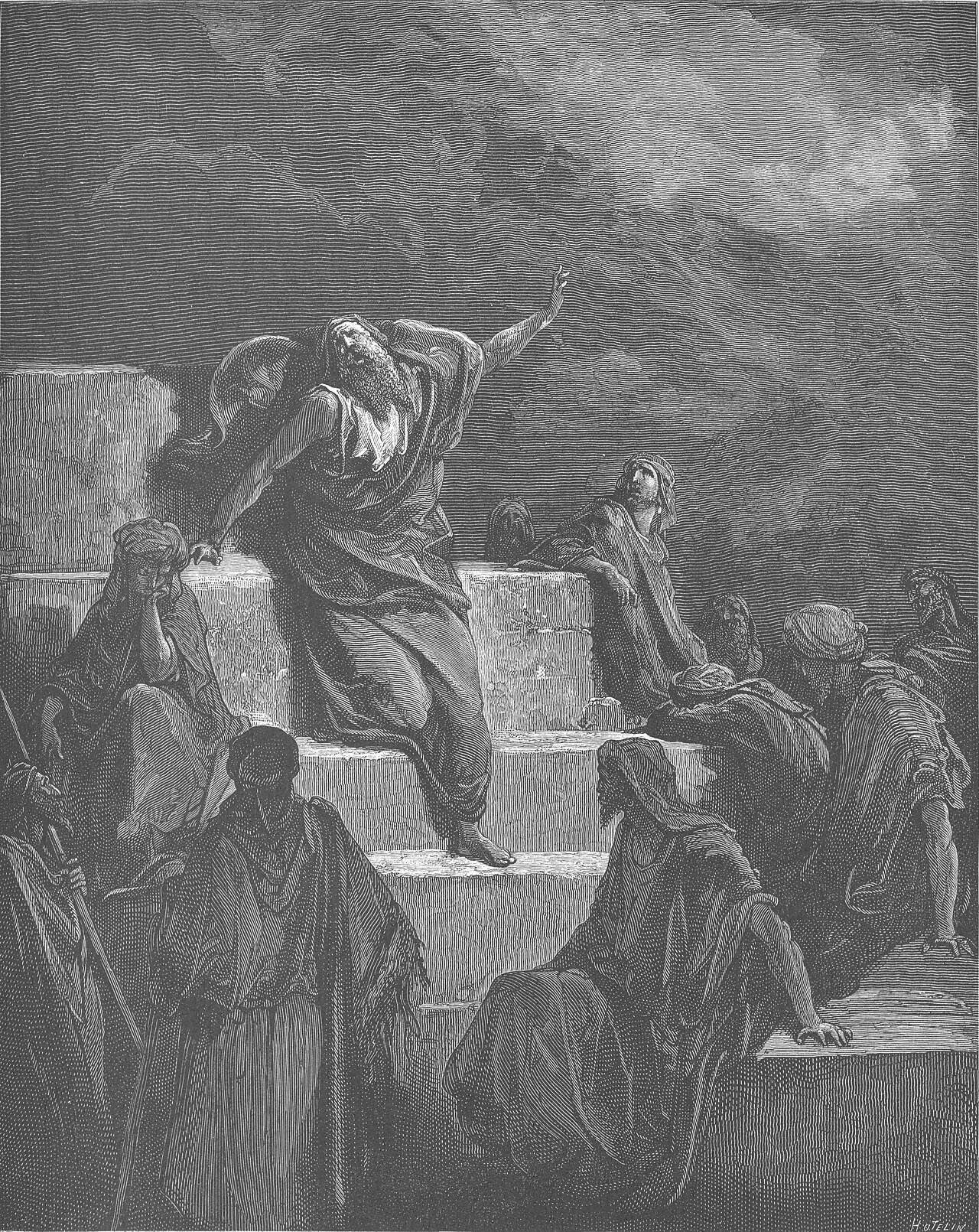
Jeremiahchapter 1
19 verses · Jeremiah, written by Baruch · 7th to 6th century BC · The Prophets
And the word of the LORD came to me, asking, “Jeremiah, what do you see?” “I see a branch of an almond tree,” I replied.
Introduction
Jeremiah, written by Baruch, The Prophets, Jeremiah Overview.
Jeremiah grew up in a village of priests who had been kept away from the altar in Jerusalem for generations. This chapter stands at the head of his book and gives his credentials before a single sermon is preached. His first hearers knew him as a young man from that village, and they wanted to know who had sent him. The chapter answers that question. Listen for the objection he raises and for how God meets it. Listen as well for a play on two Hebrew words that English cannot carry. Read it as the commission behind every chapter that follows.
Context
- Who
- Judeans who knew the young man from the priestly village and wanted to know what gave him the right to speak
- What
- The account of Jeremiah's call to be a prophet, confirmed by two things he is shown and closed by God's promise to stand with him.
- Where
- Anathoth, a village of priests in the land of Benjamin, about three miles north-east of Jerusalem.
- When
- The thirteenth year of King Josiah, about 627 BC, as the chapter's own heading dates it.
- Why
- To show Judah that Jeremiah spoke by God's appointment and to set out the judgment from the north that his preaching would announce.
Historical context
Anathoth was a village set aside for priests. Generations earlier Solomon had banished the priest Abiathar to his family land there, and the descendants of that line lived on in the village without ever serving at the altar in Jerusalem. Jeremiah grew up inside the priesthood and outside its power at the same time.
Show the rest of the historical context, 3 more paragraphs
Josiah was on the throne, and his thirteenth year fell about five years before the discovery of the book of the Law in the temple that set off the great national cleanup. Assyria, the empire that had crushed the northern kingdom a century before, was collapsing. Everyone could feel that something was about to move; nobody yet knew which way.
Two small pictures carry the chapter. The first is an almond branch, the almond is the first tree in that country to wake up, blooming in late winter before anything else, and the Hebrew word for almond sounds almost exactly like the word for watching. The second is a cooking pot tilting away from the north, because armies never came from the east; the desert blocked that road, so invaders always swung up the Euphrates and came down on Judah from above.
God's answer to Jeremiah's protest that he is only a boy is military: a fortified city, an iron pillar, a bronze wall. Those were the three things a besieged town wanted most.
Significance
The first hearers were being told that this man was not appointed by the temple establishment, by his village, or by the king. The words about being known before birth are a credential, not a comfort.
Show the rest of the significance, 1 more paragraph
And the pot tipping from the north set the terms for everything that followed. Judah's danger would not come from Egypt in the south, where the politicians kept looking. It was coming down the northern road, and it was already boiling.
This chapter in Jewish lifeWhat this chapter is in Jewish life and reading.
What is done
This chapter is read aloud in the synagogue. The site's table in src/lib/hebraic/readings.ts records Jeremiah 1:1 to 2:3 as the Haftarah of Matot (Numbers 30:2 to 32:42) in both the Ashkenazi and the Sephardi rite. The same table records it as the Sephardi Haftarah of Shemot (Exodus 1:1 to 6:1), where the Ashkenazi rite reads from Isaiah instead.
How it is read
Rashi is the main commentator on this chapter in the corpus, quoted here from The Judaica Press complete Tanach with Rashi, translated by A. J. Rosenberg, which Sefaria reports as CC-BY. Malbim is quoted on the first verse from the Sefaria Community Translation, which Sefaria reports as CC0.
Rashi opens with a reading of Jeremiah's descent. He reports that Jeremiah came from Rahab, and draws a lesson from it: "let him reprove the son of the righteous woman whose deeds are corrupt these are Israel" (Rashi on Jeremiah 1:1:1). Malbim reads the first verses as the frame of the whole book. He notes that Jeremiah was a priest of Anathoth from the land of Benjamin, and holds that a rebuke from outside the city is "heard better" (Malbim on Jeremiah 1:1:1).
At the call Rashi sets Jeremiah beside Moses. Jeremiah says he is a youth because Moses reproved Israel only near his death, after the miracles, while Jeremiah must "reprove them at the beginning of my mission" (Rashi on Jeremiah 1:6:2). The almond branch he reads as a tree that blossoms before all others, as God hastens to perform His word (Rashi on Jeremiah 1:12:1).
In the same note Rashi reports a reading of the Midrash, Ecclesiastes Rabbah 12:8, that ties the almond to the calendar of mourning. An almond takes twenty-one days from blossom to ripeness. That is "as the number of days between the seventeenth of Tammuz, when the city was broken into, until the ninth of Ab, when the Temple was burnt" (Rashi on Jeremiah 1:12:1). The boiling pot from the north he reads as Babylon (Rashi on Jeremiah 1:14:1).
The corpus carries four further notes on this chapter without an English text, each marked linked because Sefaria holds no English version of the ref. They stand cited and unquoted at Metzudat David on Jeremiah 1:2:1 and 1:4:1. The same holds for Radak on Jeremiah 1:8:1 and 1:15:1.
What the rabbis say
The corpus carries 39 rabbinic locators on the verses of this chapter, 5 in the Talmud and 34 in the Midrash. It carries the text of none, so each is cited by ref here and never quoted or paraphrased. The verse numbers are the Hebrew ones the corpus prints.
On verse 1 it holds Bereshit Rabbah 64:5, Bereshit Rabbati, Parashat Vayishlach 26, Eikhah Rabbah 1:1 and Eikhah Rabbah, Petichta 1. On verse 2 it holds Pesikta DeRav Kahana 13:15. On verse 3 it holds Bereshit Rabbah 42:3, Ein Yaakov (Glick Edition), Megillah 1:8, Ein Yaakov, Megillah 1:14 and Esther Rabbah, Petichta 10. On verse 5 it holds Avot DeRabbi Natan 2:5, Bamidbar Rabbah 10:5, Bereshit Rabbah 63:6 and Bereshit Rabbati, Parashat Lech Lecha 28.
On verse 6 it holds Midrash Aggadah, Numbers 30:15:11, Midrash Tanchuma Buber, Shemot 14:2, Midrash Tanchuma Buber, Vayera 21:1 and Midrash Tanchuma, Shemot 18:5. On verse 7 it holds Pesikta Rabbati 27:1 and Shemot Rabbah 4:3. On verse 8 it holds Sifrei Devarim 325:4. On verse 9 it holds Midrash Sekhel Tov, Bereshit 42:27:5. On verse 10 it holds Midrash Tannaim on Deuteronomy 18:15:3 and Shemot Rabbah 45:1. On verse 11 it holds Bamidbar Rabbah 2:15, Eikhah Rabbah, Petichta 23, Jerusalem Talmud Taanit 4:5:5 and Kohelet Rabbah 12:7:1.
On verse 12 it holds Berakhot 58a:2 and Berakhot 58b:5. On verse 13 it holds Otzar Midrashim, Baraita of Samuel HaKatan 1:10. On verse 14 it holds Bava Batra 25b:9, Ein Yaakov (Glick Edition), Bava Batra 2:6 and Ein Yaakov, Bava Batra 2:6. On verse 15 it holds Midrash Tanchuma Buber, Appendix to Devarim 5:1, Midrash Tehillim 79:2 and Otzar Midrashim, Baraita of Samuel HaKatan 1:38. On verse 16 it holds Tanna DeBei Eliyahu Rabbah 6:1. On verse 17 it holds Bereshit Rabbah 34:10.
On verse 18 it holds Midrash Lekach Tov on Song of Songs 8:10:2.
The corpus also files Berakhot 63b:12 under Jeremiah 1:36, a verse this chapter does not have. It is left out of the list above rather than cited on a verse that is not there.
Sources: Malbim, Malbim on Jeremiah 1:1:1 to 1:3:1, Sefaria Community Translation, reported CC0; Rashi, Rashi on Jeremiah 1:1:1 to 1:19:1, The Judaica Press complete Tanach with Rashi, translated by A. J. Rosenberg, reported CC-BY; Metzudat David, Metzudat David on Jeremiah 1:2:1 and 1:4:1, cited by ref because the corpus carries no English text; Radak, Radak on Jeremiah 1:8:1 and 1:15:1, cited by ref because the corpus carries no English text; The Sefaria corpus, scripts/data/sources/sefaria/jeremiah/1.json, the 39 Talmud and Midrash locators on the verses of this chapter; The site's own files, src/lib/hebraic/readings.ts, probed for Jeremiah 1: a Haftarah use, and no festival reading for the book.
The heads below are this chapter's scenes. The numbered points under each are its verses.
The Words of Jeremiah in the Days of Josiah
Jeremiah 1:1-4
These are the words of Jeremiah son of Hilkiah: The book names its author as “Jeremiah son of Hilkiah, one of the priests in Anathoth”. The dates run from “the thirteenth year of the reign of Josiah” to Zedekiah's eleventh year. Some forty years lie between the king who tore his robes and the king who cut Jeremiah's scroll.
Jeremiah 1:1
“The words of Jeremiah the son of Hilkiah,.... This is the general title of the whole book, and includes all his discourses, sermons, and prophecies; and designs not his own words, but the words of the Lord, which were put into his mouth, and he delivered under divine inspiration. The Septuagint version renders it, "the word of God": and the Arabic version, "the word of the Lord": the Targum, "the words of the prophecy of Jeremiah;'' who is described by his descent and parentage, "the son of Hilkiah". The Arabic version calls him Selkiah.”
2 more voices on this verseWhat preachers and commentators have said about this verse, in their own words.
Jeremiah 1:1
“Compare 1Ki 2:26, 27; a stigma was cast thenceforth on the whole sacerdotal family resident there; this may be alluded to in the words here, "the priests . . . in Anathoth." God chooses "the weak, base, and despised things . . . to confound the mighty." 2, 3. Zedekiah--Jehoahaz and Jehoiachin are omitted for they reigned only three months each.”
Jamieson, Fausset & Brown · Commentary Critical and Explanatory on the Whole Bible (1871)reformed
Jeremiah 1:1
“The words of Jeremiah - The usual title of the prophetic books is “the Word of the Lord,” but the two books of Amos and Jeremiah are called the words of those prophets, probably because they contain not merely the words of those prophets, probably because they contain not merely prophecies, but also the record of much which belongs to the personal history of the writers. This title might therefore be translated the “life of Jeremiah” or “acts of Jeremiah,” though some understand by it a collection of the prophecies of Jeremiah.”
in the thirteenth year of the reign of Josiah: The thirteenth year of Josiah falls in 629 BC on the ordinary reckoning and in 627 BC by the Ptolemaic canon. It was the year after Josiah began his reforms. The Hebrew verb behind came is literally was, so the word stayed with Jeremiah from that day on.
Jeremiah 1:2
“Came - literally, was (and in Jer 1:4); the phrase implies that Jeremiah possessed God’s word from that time onward, not fitfully as coming and going, but constantly. The thirteenth year of his reign - According to the ordinary reckoning, this would be 629 b.c., but if the Ptolemaic canon be right in putting the capture of Jerusalem at 586 b.c., it would be two years later, namely 627 b.c. However, according to the Assyrian chronology, it would be 608 b.c. It was the year after that in which Josiah began his reforms.”
until the fifth month of the eleventh year of Zedekiah: The date closes the prophecies given while Jerusalem stood, and Jeremiah went on to speak in Judah and in Egypt in chapters 40 to 44. The city was breached in the fourth month and destroyed in the fifth. Two short reigns, of Jehoahaz and Jehoiachin, go unnamed.
Jeremiah 1:3
“The whole period contained in this verse is no less than 40 years and 6 months, namely, 18 years under Josiah, two periods of 11 years each under Jehoiakim and Zedekiah, and 3 months under each of the omitted kings, Jehoahaz and Jeconiah. In the fifth month - The capture of Jerusalem took place in the fourth month, but its destruction was in the fifth month (see the marginal references), the ninth day of which was subsequently kept as a fast-day Zec 7:3.”
2 more voices on this verse
Jeremiah 1:3
“Of Jerusalem - The inhabitants of Jerusalem, under Zedekiah, during all which time Jeremiah prophesied. Captive - This does not terminate the time of his prophecies; for he prophesied also both in Judea, and in Egypt afterwards: but only relates to what he prophesied while the city and temple were standing, the rest seeming to be added as a supplement.”
John Wesley · Explanatory Notes upon the Old Testament (1765)evangelical
Jeremiah 1:3
“At what age he was called to the prophetic office, we do not know; it is, however, probable that he was of mature age, for it was a work of high authority; and further, had he been a youth, doubtless such a miracle would not have been passed over in silence, that is, that he was made a prophet before the age of maturity.”
John Calvin · Commentaries (1554)reformed
Before I Formed Thee in the Belly I Knew Thee
The word of the LORD came to me: The heading ends and Jeremiah speaks. The Septuagint and the Latin Vulgate read to him, and the Hebrew keeps the first person. The call that follows is dated to the thirteenth year of Josiah, the year verse 2 names.
Jeremiah 1:4
“Then the word of the Lord came unto me, saying. Not in the days of Jehoiakim, but in the thirteenth year of the reign of Josiah, Jer 1:2. The Septuagint and Vulgate Latin versions read, "unto him".”
1 more voice on this verse
Jeremiah 1:4
“Jeremiah's call to the prophetical office. unto me--other manuscripts read "to him"; but English Version probably represents the true Hebrew text; this inscription was doubtless made by Jeremiah himself.”
Jamieson, Fausset & Brown · Commentary Critical and Explanatory on the Whole Bible (1871)reformed
The call comes before the man exists. The appointment “as a prophet to the nations” follows the knowing and the setting apart, so the office rests on the LORD's choice. Isaiah's servant songs and Paul's account of his own call show the same pattern of a calling set before birth.
Jeremiah 1:5
“Rather, “Before I formed thee in the belly.” I approved of thee (as one fit for the prophetic office),” and before thou camest forth from the womb” I made thee holy (dedicated thee to holy uses); I have appointed thee (now by this public call to be) “a prophet unto the nations.” Unto the nations - The privileges contained in this verse are so great as in their full sense to be true only of Christ Himself, while to Jeremiah they belong as being in so many particulars a type of Christ.”
2 more voices on this verse
Jeremiah 1:5
“Before I formed thee in the belly I knew thee,.... Not merely by his omniscience, so he knows all men before their conception and birth; but with such a knowledge as had special love and affection joined with it; in which sense the Lord knows them that are his, as he does not others, and predestinates them unto eternal life; and which is not only before their formation in the womb, but before the foundation of the world, even from all eternity.”
Jeremiah 1:5
“I sanctified - I ordained thee for this public service. He speaks thus to Jeremiah, not to the other prophets, because he stood in need of greater encouragement than they, both in respect of the tenderness of his years, and the difficulties which he was to encounter with.”
John Wesley · Explanatory Notes upon the Old Testament (1765)evangelical
Jeremiah 1:6-8
Jeremiah answers with a plea of weakness, “I surely do not know how to speak, for I am only a child”. The LORD answers the objection with the sending itself: “Do not say, ‘I am only a child.’ For to everyone I send you, you must go”.
Jeremiah 1:6
“From the long duration of his office (Jer 1:2, 3; Jer 43:8, &c.), it is supposed that he was at the time of his call under twenty-five years of age. child--the same word is translated, "young man" (2Sa 18:5).”
Jamieson, Fausset & Brown · Commentary Critical and Explanatory on the Whole Bible (1871)reformed
to everyone I send you, you must go: The LORD answers the first of Jeremiah's two fears, his inexperience. Plain obedience needs no experience: he must go to everyone the LORD sends him to and speak all He commands. The second fear, of the people, is met in verse 8.
Jeremiah 1:7
“But the Lord said unto me, say not, I am a child,.... This excuse will not be admitted: for thou shall go to all that I shall send thee; either to "every place", as the Targum paraphrases; or "to all persons to whom" he should be sent, as the Septuagint and Arabic versions render the words; or "to all things for which" he should send him, as the Syriac and Vulgate Latin versions.”
1 more voice on this verse
Jeremiah 1:7
“Jeremiah suggested two difficulties, the first inexperience, the second timidity. God now removes the first of these. Inexperience is no obstacle where the duty is simple obedience His timidity is removed by the promise given him in the next verse.”
Do not be afraid of them: Fear of the people was the second of Jeremiah's difficulties, and this promise meets it. An earthly king sends his envoy and stays at home; the LORD goes with the one He sends to deliver him. The same promise closes the chapter at verse 19.
Jeremiah 1:8
“Be not afraid of their faces,.... Their stern looks, their frowning brows, and angry countenances, which would threaten him with destruction and death: for I am with thee, to deliver thee, saith the Lord; out of their hands, when in the most imminent danger. The Targum paraphrases the words thus, "my Word shall be thine help to deliver thee:'' which is true of Christ, the essential Word of God.”
Jeremiah 1:9-10
Then the LORD reached out His hand: The commission is sealed by touch, “I have put My words in your mouth”. The six verbs of verse 10 give the book its program. Four of judgment, “to uproot and tear down, to destroy and overthrow”, and two of restoration, “to build and plant”.
Jeremiah 1:9
“Touched - “Made it touch.” This was the symbol of the bestowal of divine grace and help, by which that want of eloquence, which the prophet had pleaded as a disqualification, was removed.”
over nations and kingdoms: The verbs uproot and tear down sound alike in Hebrew, linthosh and linthotz, and the picture moves from a planted field to a built wall. At Jeremiah 31:28 the LORD says He Himself will uproot and build. The prophet's word is the LORD's act.
Jeremiah 1:10
“It is important to observe here that two joys succeed four sorrows. The good cannot be built up unless the evil is destroyed, nor can the best be planted unless the worst is eradicated. For "every plant that the heavenly Father has not planted will be uprooted," and every building that does not have its foundation on rock but was built on sand is undermined and destroyed by the word of God.”
Jerome · written before 420 · Six Books on Jeremiah 1:6.1-5patristic
3 more voices on this verse
Jeremiah 1:10
“In Jer 31:28, God is said to do what Jeremiah here is represented as doing (compare Jer 18:7; Eze 43:3). root out-- (Mt 15:13). pull down--change of metaphor to architecture (2Co 10:4). There is a play on the similar sounds, linthosh, linthotz, in the Hebrew for "root out . . . pull down." build . . . plant--restore upon their repenting.”
Jamieson, Fausset & Brown · Commentary Critical and Explanatory on the Whole Bible (1871)reformed
Jeremiah 1:10
“It is a strange commission that is here given him: See, I have this day set thee over the nations and over the kingdoms. This sounds very great, and yet Jeremiah is a poor despicable priest still; he is not set over the kingdoms as a prince to rule them by the sword, but as a prophet by the power of the word of God.”
Matthew Henry · Commentary on the Whole Bible (1707-1721)puritan
Jeremiah 1:10
“The kingdoms - Having now received his commission, he is directed to whom he is to go; to the greatest, not only single persons, but whole nations, as the Babylonians, Persians, and Egyptians.”
John Wesley · Explanatory Notes upon the Old Testament (1765)evangelical
ConnectionsJeremiah 24:6
The Almond Rod, the Boiling Pot, and a Fortified City
Jeremiah 1:11-12
The first sign turns on a Hebrew wordplay: the almond, shaqed, is the tree that wakes first in spring. The LORD answers, “I am watching over My word to accomplish it”, where watching is shoqed. The almond branch is a pledge that the word will not lie dormant.
Jeremiah 1:11
“Moreover, the word of the Lord came unto me,.... At the same time as before: saying, Jeremiah, what seest thou? The Septuagint version leaves out the word "Jeremiah": and I said, I see a rod of an almond tree; a dry stick, without leaves or fruit upon it, and yet he knew it to be an almond tree stick; though some think it had leaves and fruit on it, by which it was known. The Targum is, "and I said, a king hastening to do evil I see;'' meaning Nebuchadnezzar, king of Babylon, hastening to bring destruction upon the Jews.”
2 more voices on this verse
Jeremiah 1:11
“It is written in the book of the prophet, "Take a branch from a nut tree." So we must consider why the Lord said this to the prophet, for it is not written without a purpose, since we also read in the Pentateuch that the nut tree of Aaron, the priest, blossomed after it had been laid away for a long while.”
Ambrose of Milan · written before 397 · LETTER 62patristic
Jeremiah 1:11
“OBSERVE, first, dear Friends, that before Jeremiah becomes a speaker for God, he must be a seer. The name for a Prophet, in the olden time, was a "seer"—a man who could see—one who could see with his mind's eye, one who could also see with spiritual insight, so as vividly to realize the Truth of God which he had to deliver in the name of the Lord. Learn that simple lesson well, O you who try to speak for God! You must be seers before you can be speakers.”
Charles Spurgeon · written before 1892 · The Metropolitan Tabernacle Pulpit, Sermon No. 2678: “The Lesson of the Almond Tree” (lightly modernized text, CCEL edition)Particular Baptist
The LORD commends Jeremiah for seeing rightly before He gives the meaning. A prophet had first to see what he would later say, and the older name for a prophet was seer, at 1 Samuel 9:9. The word in view is the judgment the boiling pot announces.
Jeremiah 1:12
“I will hasten my word - Here is a paronomasia. What dost thou see? I see שקד shaked, “an almond,” the hastening tree: that which first awakes. Thou hast well seen, for (שקד shoked) I will hasten my word. I will awake, or watch over my word for the first opportunity to inflict the judgments which I threaten. The judgment shall come speedily; it shall soon flourish, and come to maturity.”
Adam Clarke · Commentary on the Bible (1810-1826)evangelical
Jeremiah 1:13-16
The second sign is a boiling pot “tilting toward us from the north”. Northern kings will “set up their thrones at the entrance of the gates of Jerusalem”, the invasion Babylon carries out. The cause follows: “they have forsaken Me to burn incense to other gods”.
Jeremiah 1:13
“Some think that those scoffers referred to this who said ( Ezek. xi. 3 ), This city is the cauldron, and we are the flesh. Now the mouth or face of the furnace or hearth, over which this pot boiled, was towards the north, for thence the fire and the fuel were to come that must make the pot boil thus.”
Matthew Henry · Commentary on the Whole Bible (1707-1721)puritan
2 more voices on this verse
Jeremiah 1:13
“The first vision was for the support of the prophet’s own faith during his long struggle with his countrymen: the second explains to him the general nature of his mission. He was to be the bearer of tidings of a great national calamity about to break forth item the north. He sees a caldron. It was a vessel of metal Eze 24:11, large enough to prepare the meal of a numerous community 2Ki 4:38, and broad at the top, as it was also used for washing purposes Psa 60:8. This caldron was boiling furiously.”
Jeremiah 1:13
“Another vision, signifying what is the "word" about to be "performed," and by what instrumentality. seething--literally, "blown under"; so boiling by reason of the flame under it kept brisk by blowing.”
Jamieson, Fausset & Brown · Commentary Critical and Explanatory on the Whole Bible (1871)reformed
The Hebrew verb behind poured out means to be opened, like a door thrown wide so disaster passes out freely. The kings of Judah had once looked north for help, when Hezekiah welcomed envoys from Babylon at 2 Kings 20:12 and 13. Disaster came from the same north.
Jeremiah 1:14
“Shall break forth - תפתח tippathach, shall be opened. The door shall be thrown abroad, that these calamities may pass out freely.”
Adam Clarke · Commentary on the Bible (1810-1826)evangelical
set up their thrones at the entrance of the gates of Jerusalem: The city gate was the place of judgment, where cases were heard in the open space inside the entrance. The northern kings set their thrones there as the LORD's own court. At Jeremiah 25:9 the LORD names Nebuchadnezzar as His servant.
Jeremiah 1:15
“I will call - I am calling. The judgment has begun. God is summoning His hosts to the war. Families - The various races by which the provinces of the Babylonian empire were populated. They shall set every one his throne - The chiefs of these various races come as God’s ministers to hold solemn court, and give sentence in His name (see Jer 25:9). They therefore set each one his throne in the usual place for administering justice, namely, the entering in of the gates, where a large open space was always left in cities for the purpose.”
1 more voice on this verse
Jeremiah 1:15
“The families - Those nations that were under one Lord. Kingdoms - The Babylonians, and their assistants; the Medes also being in confederacy with them, whose king's daughter Nebuchadnezzar married.”
John Wesley · Explanatory Notes upon the Old Testament (1765)evangelical
I will pronounce My judgments against them: Them here means the people of Judah, the ones the invaders come against. Many Hebrew manuscripts read work in the singular, as if idolatry were the one business of their life. The charge comes with the sentence, so its justice is seen.
Jeremiah 1:16
“And I will utter my judgments against them,.... Not against the kingdoms of the north, but against the people of the Jews. The sense is, that God would enter into judgment with this people, and pass sentence upon them, and execute it: touching all their wickedness; or on account of all their sins and transgressions hereafter mentioned: who have forsaken me.”
1 more voice on this verse
Jeremiah 1:16
“I will utter my judgments - God denounced his judgments: the conquest of their cities, and the destruction of the realm, were the facts to which these judgments referred; and these facts prove that the threatening was fulfilled. Worshipped the works of their own hands - Idolatry was the source of all their wickedness and was the cause of their desolations. For למעשי lemaasey, the works, more than a hundred MSS. of Kennicott’s and De Rossi’s, with many editions, have למעשה lemaaseh, the work. Idolatry was their One great Work, the business of their life, their trade.”
Adam Clarke · Commentary on the Bible (1810-1826)evangelical
Jeremiah 1:17-19
Get yourself ready: The call closes with a promise of fortification, “like a fortified city, an iron pillar, and bronze walls against the whole land”. The opposition runs through every rank. The fight is certain: “They will fight against you but will never overcome you, since I am with you to deliver you”.
Jeremiah 1:17
“Gird up thy loins - A symbol of preparation for earnest exertion, and implying also firm purpose, and some degree of alacrit Be not dismayed ... - literally, “be not dismayed at their faces, lest I dismay thee before their faces.” Naturally despondent and self-distrustful, there was yet no feebleness in Jeremiah’s character. There was in him a moral superiority of the will, which made him, at any cost to himself, faithfully discharge whatever his conscience told him was his duty.”
2 more voices on this verse
Jeremiah 1:17
“Gird up - It is a speech taken from the custom of the countries where they wore long garments; and therefore they girt them up about them, that they might not hinder them in any work that required expedition.”
John Wesley · Explanatory Notes upon the Old Testament (1765)evangelical
Jeremiah 1:17
“He was of the priests, and, as a priest, was authorized and appointed to teach the people; but to that authority and appointment God added the extraordinary commission of a prophet. Ezekiel also was a priest. Thus God would support the honour of the priesthood at a time when, by their sins and God's judgments upon them, it was sadly eclipsed.”
Matthew Henry · Commentary on the Whole Bible (1707-1721)puritan
I have made you like a fortified city: A fortified city cannot be taken, an iron pillar cannot be moved, and bronze walls cannot be broken. Jerusalem itself, with all its walls, would fall to Babylon. The prophet it rejected outlived its fall.
Jeremiah 1:18
“For, behold, I have made thee this day a defenced city,.... Or, "as" one; so read the Targum, Septuagint, Syriac, and Arabic versions; which is inexpungible, and cannot be taken: and an iron pillar; which cannot be removed out of its place: and brasen walls; which cannot be broken down.”
1 more voice on this verse
Jeremiah 1:18
“I have made thee this day a defenced city, and an iron pillar, and, brazen walls - Though thou shalt be exposed to persecutions and various indignities, they shall not prevail against thee. To their attacks thou shalt be as an impregnable city; as unshaken as an iron pillar; and as imperishable as a wall of brass. None, therefore, can have less cause to apprehend danger than thou hast. The issue proved the truth of this promise: he outlived all their insults; and saw Jerusalem destroyed, and his enemies, and the enemies of his Lord, carried into captivity.”
Adam Clarke · Commentary on the Bible (1810-1826)evangelical
They will fight against you: The chapter ends on the promise of verse 8, now made to a prophet set against his whole nation. The LORD hid him when Jehoiakim ordered his arrest, at Jeremiah 36:26. At 38:13 he was drawn up out of the muddy cistern.
Jeremiah 1:19
“And they shall fight against thee,.... The Targum adds, "that they may hide the words of thy prophecy;'' hinder him from prophesying, stop his mouth, and even take away his life: but they shall not prevail against thee; as to do either: for I am with thee, saith the Lord, to deliver thee; as he did; he hid him when they sought for him, and delivered him out of the dungeon and bonds into which he was cast by them; See Gill on Jer 1:8.”
1 more voice on this verse
Jeremiah 1:19
They shall not prevail against thee - Because I am determined to defend and support thee against all thy enemies. One of the ancients has said, Θεου θελοντος, και επι ῥιπος πλεῃ Σωζῃ· Thestius, apud Theophil. ad Autolyc. lib. 2: “God protecting thee, though thou wert at sea upon a twig, thou shouldst be safe.”
Adam Clarke · Commentary on the Bible (1810-1826)evangelical
Keep studying
Sources for this chapter
The summary
Jamieson, Fausset & Brown, Commentary Critical and Explanatory; John Calvin, Commentaries; John Wesley, Notes on the Old Testament and Matthew Henry, Complete Commentary.
The exposition
Adam Clarke, Commentary on the Bible; Albert Barnes, Notes, Explanatory and Practical, on the Old and New Testaments (1832-1869); Carl Friedrich Keil, The Prophecies of Jeremiah; Charles Spurgeon, The Metropolitan Tabernacle Pulpit, Sermon No. 2678: “The Lesson of the Almond Tree” (lightly modernized text, CCEL edition); Jamieson, Fausset & Brown, Commentary Critical and Explanatory on the Whole Bible; John Calvin, Commentary on Jeremiah and Lamentations; John Gill; John Wesley, Explanatory Notes upon the Old Testament; Matthew Henry, Commentary on the Whole Bible and Theodoret of Cyrus, ON JEREMIAH 1:1.16.