
Jeremiah 1:6
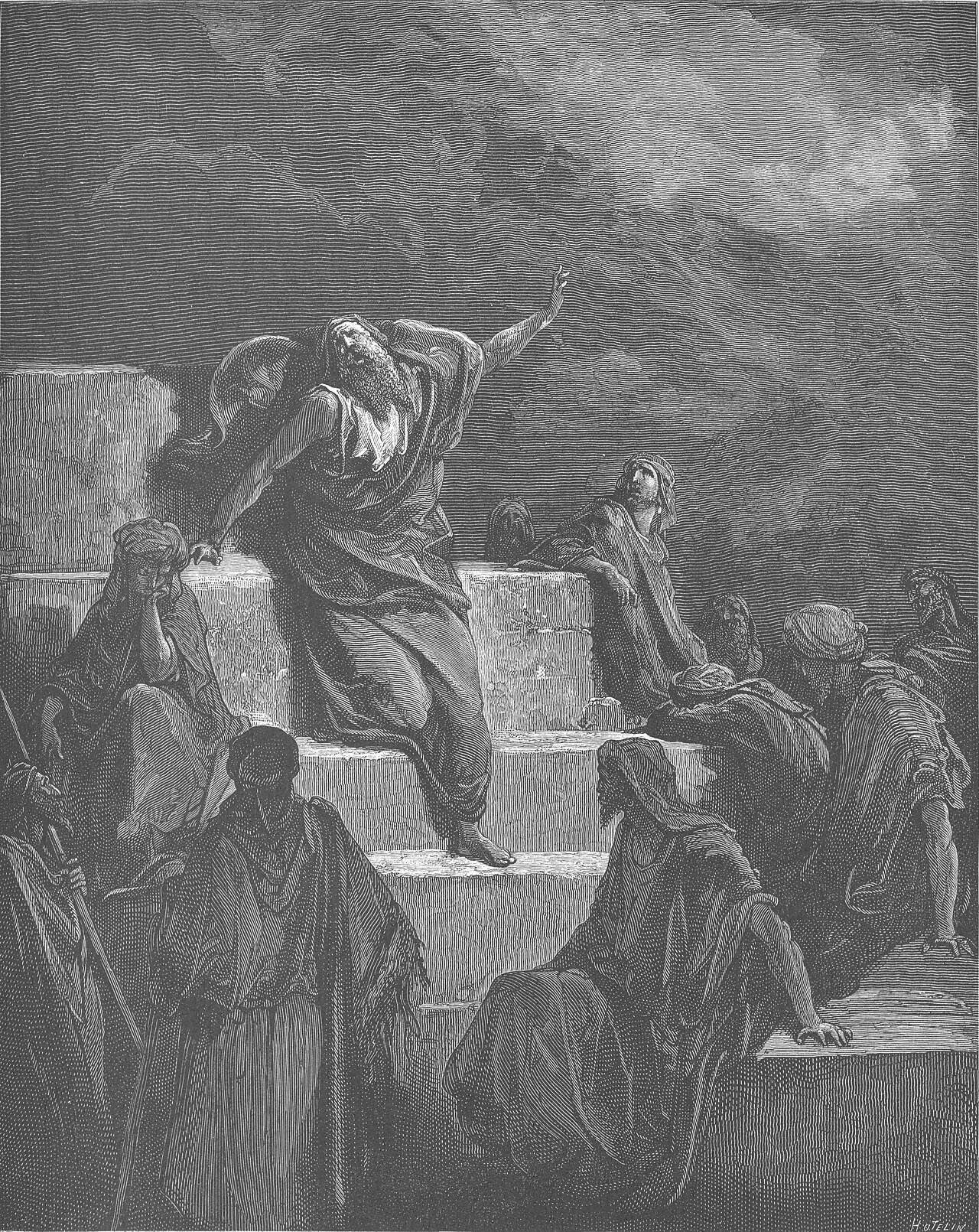
in Jeremiah 1“Ah, Lord GOD,” I said, “I surely do not know how to speak, for I am only a child!”
BSB
The same verse in ASV and KJV ▾
ASV
Then said I, Ah, Lord Jehovah! behold, I know not how to speak; for I am a child.
KJV
Then said I, Ah, Lord God! behold, I cannot speak: for I am a child.
⋯
This verse in Jeremiah 1
Commentary
16 notes on this verseThen said I, Ah, Lord God!.... The word אהה, "Ah", or "Ahah", is used in distress and grief, as Kimchi observes; and is expressive of mourning and complaint, as Jarchi notes; and shows that the prophet was troubled and uneasy at his call, and would gladly have been excused on the following account: behold, I cannot speak; or, "I know not how to speak" (r); properly and pertinently, politely and eloquently, especially before great personages, kings and princes, and the citizens of Jerusalem, being brought up in a rustic manner in the country. A like excuse Moses made, Exo 4:
This site's exposition
I surely do not know how to speak
on Jeremiah 1:6-8
Jeremiah answers with a plea of weakness, “I surely do not know how to speak, for I am only a child”. The LORD answers the objection with the sending itself: “Do not say, ‘I am only a child.’ For to everyone I send you, you must go”.
The record, by era
The Church Fathers5 voices
Both Moses and Jeremiah, chosen by the Lord to declare the words of God to the people, avoided through modesty that which through grace they could do.
Someone of those who hear will say to me: Exercise the other argument as well, and try to present all the things written as fitting the Savior. Concerning the second matters, do not be anxious; for it is evident that the Savior rooted out the kingdoms of the devil and pulled down the nations, having destroyed the heathen life. Here, in what seems ill-omened as regards the Savior, exercise the argument somehow, how the Savior can say: "I do not know how to speak, for I am young," and what follows. Do you see that the argument is hard pressed? We know the Savior as Lord. We seek, according to the worth of the passage and according to the truth, to refer these things to the Savior. We must take the Scriptures as witnesses; for our undertakings are without witnesses, and expositions without witnesses are untrustworthy. And "By the mouth of two and three witnesses shall every word stand" fits the case of expositions rather than of human beings, so that I may establish the words of the interpretation by taking two witnesses from the New and Old Testament, and by taking three witnesses from the gospel, from a prophet, from an apostle; for thus shall every word stand. How, then, are we able to refer these things to the Savior? […]
"And I said: O You who are, Master, Lord, behold, I do not know how to speak, for I am young. And the Lord said to me: Do not say that I am young, for to all to whom I shall send you, you shall go." We have often said that it is possible to be a child according to the inner man, even though one be in the aged stage of the body; and it is possible sometimes to be a child according to the outer man, but according to the inner a man. Such was Jeremiah, already having the grace from God while still being in the childhood stage as regards the body. Therefore the Lord says to him: "Do not say that I am young." And a sign that he is not young, but "a perfect man," is the "to all to whom I shall send you, you shall go, and according to all that I command you, you shall speak. Do not be afraid before their face." The Word of God knows that those who serve as ambassadors of the Word are in danger among their hearers; for, being convicted, men hate them, being rebuked, they persecute them. The prophets suffer anything whatsoever: "A prophet is not without honor except in his own homeland and in his own house," which we also mentioned recently. God knows, then, when He sends the prophet, how many dangers he will take upon himself, and He says to him: "Do not be afraid before their face, for I am with you to deliver you, says the Lord." The things Jeremiah suffered are recorded: he was cast into a pit of mire, he remained there "eating one loaf a day" and drinking only water, and countless other things which his prophecy has made clear that he suffered. "Which of the prophets did your fathers not persecute?" is said to the Jews. […]
We are not ignorant that some refer these things, as being too great for Jeremiah, to our Savior and Lord; and one must know that most of them are in accord with Him and can be referred to the Savior, which I will set forth; but a few of the things said to Jeremiah press hard upon the argument, being unable, as they can with respect to the many, to be fitted to the Savior. What, then, are the things that fit the Savior? "To all to whom I shall send you, you shall go, and according to all that I command you, you shall speak. Do not be afraid before their face, for I am with you to deliver you, says the Lord." These would not yet seem to be referred to the Savior; but what follows—"and the Lord stretched out His hand to me and touched my mouth, and the Lord said to me: Behold, I have given my words into your mouth. Behold, I have set you this day over nations and kingdoms, to root out and to pull down"—presses hard upon the interpretation concerning Jeremiah. What nations did Jeremiah root out, what kingdoms did he overthrow? For it is written: "Behold, I have set you this day over nations and kingdoms, to root out and to pull down." And what authority did Jeremiah have "to destroy," which is said as if to Jeremiah in the phrase "and to destroy"? And how many so great did Jeremiah build up, that it should be said "and to build"? Jeremiah says: "I have not benefited, nor has anyone benefited me." How then has "to build and to plant" been given to him? How will "to plant" fit Jeremiah? These things, referred to the Savior, do not press hard upon the interpreter, since Jeremiah in these matters is a symbol of the Savior. […]
The Hebrew Scripture introduces Moses at first as declining the leadership of the people by what he said to God who conversed with him: "I beg you, O Lord, appoint someone else who is able, whom you will send." Afterwards it portrays Saul as hiding himself to avoid assuming the kingdom and the prophet Jeremiah as humbly declining his mission.
9 more voices on this verse
The Church Fathers4 voices
A commentator
Gregory of NazianzusIN DEFENSE OF HIS FLIGHT TO PONTUS, ORATION 2:114 · Written before 390.
proposed
I resort once again to history. When I consider the men of best repute in ancient days, who were ever preferred by grace to the office of ruler or prophet, I discover that some readily complied with the call while others deprecated the gift. I also learn that those who drew back were not blamed for their timidity, nor were those who came forward accused of being too eager. The former stood in awe of the greatness of the ministry; the latter trustfully obeyed him who called them. Aaron was eager, but Moses resisted; Isaiah readily submitted, but Jeremiah was afraid of his youth and did not venture to prophesy until he had received from God a promise and a power beyond his years.
A commentator
Gregory of NazianzusON EASTER AND HIS RELUCTANCE, ORATION 1:1 · Written before 390.
proposed
It is a good thing even to hold back from God for a little while—as did the great Moses in ancient times, and Jeremiah later on—and then to run readily to him when he calls. This is what Aaron and Isaiah did—as long as both are done with a respectful spirit. Do the former because you lack strength. Do the latter because of the power of God who calls you.
But what is sanctified in the womb, we should understand according to the words of the Apostle: But when it pleased him, who separated me from my mother's womb, and called me by his grace, to reveal his Son in me; that I might preach him among the Gentiles (Galatians 1:15). John the Baptist is also sanctified in the womb, and receives the Holy Spirit, and is stirred in the womb, and speaks through the mouth of his mother (Luke 1). (Verse 6.) And I said: Ah, ah, ah, Lord God, behold, I do not know how to speak, for I am a child. LXX: And I said, O Lord God, I do not know how to speak, for I am young. He detests the office that he cannot sustain due to his age, with the same modesty that Moses himself says he has a thin and weak voice (Exodus IV and 6). But he, as if he were seized with great and robust age, is caught up; forgiveness is given to this childhood, which is adorned with modesty and shame.
Therefore, you see, they had power either to speak or to refrain from speaking. For they were not bound by necessity, but were honored with a privilege. For this cause Jonah fled; for this cause Ezekiel delayed; for this cause Jeremiah excused himself. And God thrusts them not on by compulsion, but advising, exhorting, threatening; not darkening their mind; for to cause distraction and madness and great darkness, is the proper work of a demon: but it is God's work to illuminate and with consideration to teach things needful.
The Puritans and the Awakening1 voice
Those that are young should consider that they are so, should be afraid, as Elihu was, and not venture beyond their length. The assurance God graciously gave him that he would stand by him and carry him on in his work.
The Nineteenth Century4 voices
A commentator
Jamieson, Fausset & Brown1802–1910
Commentary Critical and Explanatory on the Whole Bible (1871)
From the long duration of his office (Jer 1:2, 3; Jer 43:8, &c.), it is supposed that he was at the time of his call under twenty-five years of age. child--the same word is translated, "young man" (2Sa 18:5).
A commentator
Jamieson, Fausset & Brown1802–1910
Commentary Critical and Explanatory on the Whole Bible (1871)
Jeremiah's call to the prophetical office. unto me--other manuscripts read "to him"; but English Version probably represents the true Hebrew text; this inscription was doubtless made by Jeremiah himself.
I cannot speak - Being very young, and wholly inexperienced, I am utterly incapable of conceiving aright, or of clothing these Divine subjects in suitable language. Those who are really called of God to the sacred ministry are such as have been brought to a deep acquaintance with themselves, feel their own ignorance, and know their own weakness. They know also the awful responsibility that attaches to the work; and nothing but the authority of God can induce such to undertake it.
A commentator
Albert Barnes1798–1870
Notes, Explanatory and Practical, on the Old and New Testaments (1832-1869)
proposed
There is no resistance on Jeremiah’s part, but he shrinks back alarmed. I cannot speak - i. e., “I cannot prophesy,” I have not those powers of oratory necessary for success. The prophets of Israel were the national preachers in religious matters, and their orators in political. I am a child - This implies nothing very definite about Jeremiah’s age. Still the long duration of his prophetic mission makes it probable that he was very young when called to the office, as also were Isaiah, Hosea, Zechariah, and others.
The words behind it
11 Hebrew wordsEvery Hebrew word of this verse in the order it stands, with what it means and the door to its own study. The last column counts the times a word stands in the whole Bible: the rarer the word, the more the places it appears belong together.
| Hebrew | Sound | Meaning | Word study | In the Bible |
|---|---|---|---|---|
| וָאֹמַ֗ר | vaomar | and I said | H559 → | 5305 times |
| אֲהָהּ֙ | ʾahah | alas! | H162 → | 15 times |
| אֲדֹנָ֣י | ʾadonai | O Lord | H136 → | 440 times |
| יְהֹוִ֔ה | yahweh | Yahweh | H3069 → | 306 times |
| הִנֵּ֥ה | hineh | here! | H2009 → | 843 times |
| לֹא־ | lo'- | not | H3808 → | 5168 times |
| יָדַ֖עְתִּי | yada'ti | I know | H3045 → | 945 times |
| דַּבֵּ֑ר | daber | to speak | H1696 → | 1141 times |
| כִּי־ | ki- | for | H3588 → | 4482 times |
| נַ֖עַר | naar | [am] a youth | H5288 → | 239 times |
| אָנֹֽכִי׃ פ | ʾanokhi | I | H595 → | 359 times |
וָאֹמַ֗רand I said
vaomarH559 →5305 times
אֲהָהּ֙alas!
ʾahahH162 →15 times
אֲדֹנָ֣יO Lord
ʾadonaiH136 →440 times
יְהֹוִ֔הYahweh
yahwehH3069 →306 times
הִנֵּ֥הhere!
hinehH2009 →843 times
לֹא־not
lo'-H3808 →5168 times
יָדַ֖עְתִּיI know
yada'tiH3045 →945 times
דַּבֵּ֑רto speak
daberH1696 →1141 times
כִּי־for
ki-H3588 →4482 times
נַ֖עַר[am] a youth
naarH5288 →239 times
אָנֹֽכִי׃ פI
ʾanokhiH595 →359 times
A shaded row is a word that stands 400 times or fewer in the Bible.
The walk
8 stopsEach card is a verse this one points to, and under it the verses that one points to in turn. Where several paths arrive at the same place, that place is listed first: the text keeps returning to it.
Through
Jeremiah 32:17“Oh, Lord GOD! You have made the heavens and the earth by Your great power and outstretched arm. Nothing is too difficult for You!
it leads to
- Luke 1:37
For no word from God will ever fail.”
- Jeremiah 32:27
“Behold, I am the LORD, the God of all flesh. Is anything too difficult for Me?
- Genesis 18:14
Is anything too difficult for the LORD? At the appointed time I will return to you—in about a year—and Sarah will have a son.”
- Job 42:2
“I know that You can do all things and that no plan of Yours can be thwarted.
- Matthew 19:26
Jesus looked at them and said, “With man this is impossible, but with God all things are possible.”
- Luke 1:37
Through
Exodus 6:12But in the LORD’s presence Moses replied, “If the Israelites will not listen to me, then why would Pharaoh listen to me, since I am unskilled in speech?”
it leads to
- Exodus 6:30
But in the LORD’s presence Moses replied, “Since I am unskilled in speech, why would Pharaoh listen to me?”
Reached by 2 separate paths from here.
- Exodus 4:10
“Please, Lord,” Moses replied, “I have never been eloquent, neither in the past nor since You have spoken to Your servant, for I am slow of speech and tongue.”
- Exodus 6:30
Through
Exodus 4:1Then Moses answered, “What if they do not believe me or listen to my voice? For they may say, ‘The LORD has not appeared to you.’”
it leads to
- Exodus 3:18
The elders of Israel will listen to what you say, and you must go with them to the king of Egypt and tell him, ‘The LORD, the God of the Hebrews, has met with…
- Exodus 3:18
Where this verse is studied
On this page
Studies8
On this verse
About Jeremiah
This page draws on 13 works. Open the list of works
This page draws on Adam Clarke, Commentary on the Bible; Albert Barnes, Notes, Explanatory and Practical, on the Old and New Testaments (1832-1869); Ambrose of Milan, On the Duties of the Clergy 1.17.66; Eusebius of Caesarea, PREPARATION FOR THE GOSPEL 12:9; Gregory of Nazianzus, IN DEFENSE OF HIS FLIGHT TO PONTUS, ORATION 2:114; Gregory of Nazianzus, ON EASTER AND HIS RELUCTANCE, ORATION 1:1; Jamieson, Fausset & Brown, Commentary Critical and Explanatory on the Whole Bible; Jerome, Commentary on Jeremiah; John Chrysostom, HOMILIES ON 1 CORINTHIANS 29:2; John Gill, Exposition of the Old Testament (1748-1763); John Gill, Exposition of the Old Testament; Matthew Henry, Commentary on the Whole Bible and Origen of Alexandria, HOMILIES ON JEREMIAH 1.