
Jeremiah 1:4
in Jeremiah 1The word of the LORD came to me, saying:
BSB
The same verse in ASV and KJV ▾
ASV
Now the word of Jehovah came unto me, saying,
KJV
Then the word of the Lord came unto me, saying,
⋯
This verse in Jeremiah 1
Commentary
7 notes on this verseThen the word of the Lord came unto me, saying. Not in the days of Jehoiakim, but in the thirteenth year of the reign of Josiah, Jer 1:2. The Septuagint and Vulgate Latin versions read, "unto him".
This site's exposition
The words of Jeremiah the son of Hilkiah
on Jeremiah 1:1-4
The book opens by naming its author twice over, the words of Jeremiah the son of Hilkiah, one of the priests of Anathoth in Benjamin, so a priest's son becomes the prophet who watches the priesthood fail. The reign markers set the whole book on a timeline that never loosens its grip, the thirteenth year of Josiah, forward through Jehoiakim, to the eleventh year of Zedekiah and the carrying away of Jerusalem in the fifth month. Forty years of ministry are compressed into these opening verses, spanning a king who tore his robes over the found law and a king who cut Jeremiah's own scroll with a penknife, before the word of the Lord comes to him directly.
The record, by era
The Church Fathers1 voice
(Vers. 4, 5.) And the word of the Lord came to me, saying: Before I formed you in the womb, I knew you; and before you came forth out of the womb, I sanctified you: I have made you a prophet to the nations. Not that Jeremiah existed before his conception, as some heresy suspects, but that the Lord foresaw him to be. To whom things not yet made already exist, according to what the Apostle spoke: Who calls those things that are not, as those that are (Rom. IV, 17).
The Puritans and the Awakening1 voice
Yet he was given to be a prophet, not to the Jews only, but to the neighbouring nations, to whom he was to send yokes ( ch. xxvii. 2, 3 ) and whom he must make to drink of the cup of the Lord's anger, ch. xxv. He is still in his writings a prophet to the nations (to our nation among the rest), to tell them what the national judgments are which may be expected for national sins.
The Nineteenth Century3 voices
A commentator
Jamieson, Fausset & Brown1802–1910
Commentary Critical and Explanatory on the Whole Bible (1871)
Jeremiah's call to the prophetical office. unto me--other manuscripts read "to him"; but English Version probably represents the true Hebrew text; this inscription was doubtless made by Jeremiah himself.
The word of the Lord came unto me - Then I first felt the inspiring influence of the Divine Spirit, not only revealing to me the subjects which he would have me to declare to the people, but also the words which I should use in these declarations.
A commentator
Albert Barnes1798–1870
Notes, Explanatory and Practical, on the Old and New Testaments (1832-1869)
proposed
This history of Jeremiah’s call to his office formed a part of his first address to the people. He claimed to act by an external authority, and to speak not his own words but those of Yahweh; and this even when resisting the divine call (see Jer 15:13; Jer 20:7, Jer 20:14-18).
The words behind it
5 Hebrew wordsEvery Hebrew word of this verse in the order it stands, with what it means and the door to its own study. The last column counts the times a word stands in the whole Bible: the rarer the word, the more the places it appears belong together.
| Hebrew | Sound | Meaning | Word study | In the Bible |
|---|---|---|---|---|
| וַיְהִ֥י | vayhi | and it came | H1961 → | 3559 times |
| דְבַר־ | devar- | [the] word of | H1697 → | 1440 times |
| יְהוָ֖ה | yahweh | Yahweh | H3068 → | 6520 times |
| אֵלַ֥י | ʾelai | to me | H413 → | 5510 times |
| לֵאמֹֽר׃ | lemor | <to> saying | H559 → | 5305 times |
וַיְהִ֥יand it came
vayhiH1961 →3559 times
דְבַר־[the] word of
devar-H1697 →1440 times
יְהוָ֖הYahweh
yahwehH3068 →6520 times
אֵלַ֥יto me
ʾelaiH413 →5510 times
לֵאמֹֽר׃<to> saying
lemorH559 →5305 times
A shaded row is a word that stands 400 times or fewer in the Bible.
The walk
8 stopsEach card is a verse this one points to, and under it the verses that one points to in turn. Where several paths arrive at the same place, that place is listed first: the text keeps returning to it.
Through
Ezekiel 1:3the word of the LORD came directly to Ezekiel the priest, the son of Buzi, in the land of the Chaldeans by the River Kebar. And there the LORD’s hand was upon him.
it leads to
- Ezekiel 3:22
And there the hand of the LORD was upon me, and He said to me, “Get up, go out to the plain, and there I will speak with you.”
- Ezekiel 3:14
So the Spirit lifted me up and took me away, and I went in bitterness and in the anger of my spirit, with the strong hand of the LORD upon me.
- 2 Kings 3:15
But now, bring me a harpist.” And while the harpist played, the hand of the LORD came upon Elisha
- 1 Kings 18:46
And the hand of the LORD came upon Elijah, and he tucked his cloak into his belt and ran ahead of Ahab all the way to Jezreel.
- Ezekiel 37:1
The hand of the LORD was upon me, and He brought me out by His Spirit and set me down in the middle of the valley, and it was full of bones.
- Ezekiel 3:22
Through
Jeremiah 1:2The word of the LORD came to Jeremiah in the thirteenth year of the reign of Josiah son of Amon king of Judah,
it leads to
- Jonah 1:1
Now the word of the LORD came to Jonah son of Amittai, saying,
- Micah 1:1
This is the word of the LORD that came to Micah the Moreshite in the days of Jotham, Ahaz, and Hezekiah, kings of Judah—what he saw regarding Samaria and Jerusalem:
- Jeremiah 1:11
And the word of the LORD came to me, asking, “Jeremiah, what do you see?” “I see a branch of an almond tree,” I replied.
- Jonah 1:1
Where this verse is studied
About Jeremiah
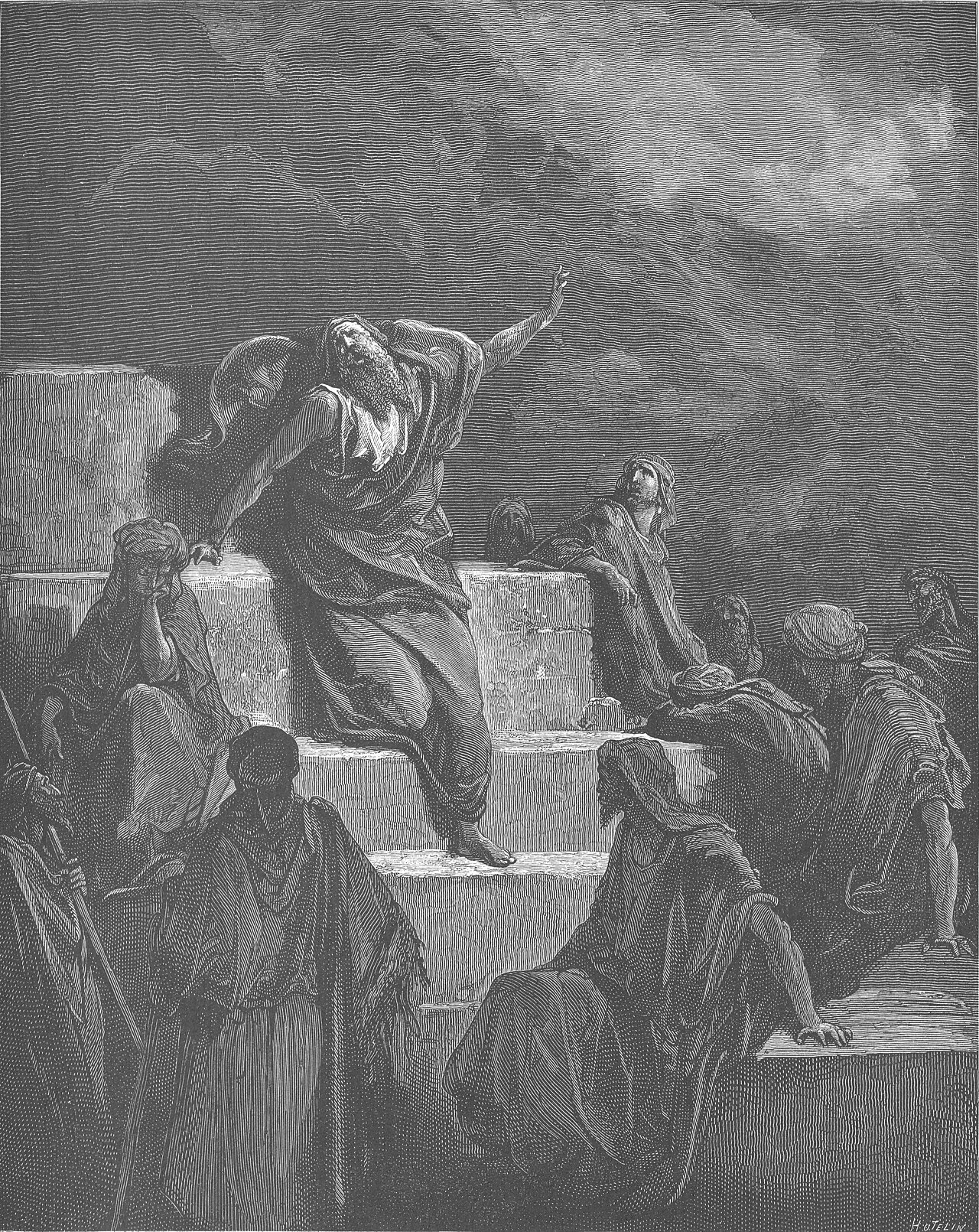
This page draws on Adam Clarke, Commentary on the Bible; Albert Barnes, Notes, Explanatory and Practical, on the Old and New Testaments (1832-1869); Carl Friedrich Keil, The Prophecies of Jeremiah; Jamieson, Fausset & Brown, Commentary Critical and Explanatory on the Whole Bible; Jerome, Commentary on Jeremiah; John Gill, Exposition of the Old Testament (1748-1763) and Matthew Henry, Commentary on the Whole Bible.