
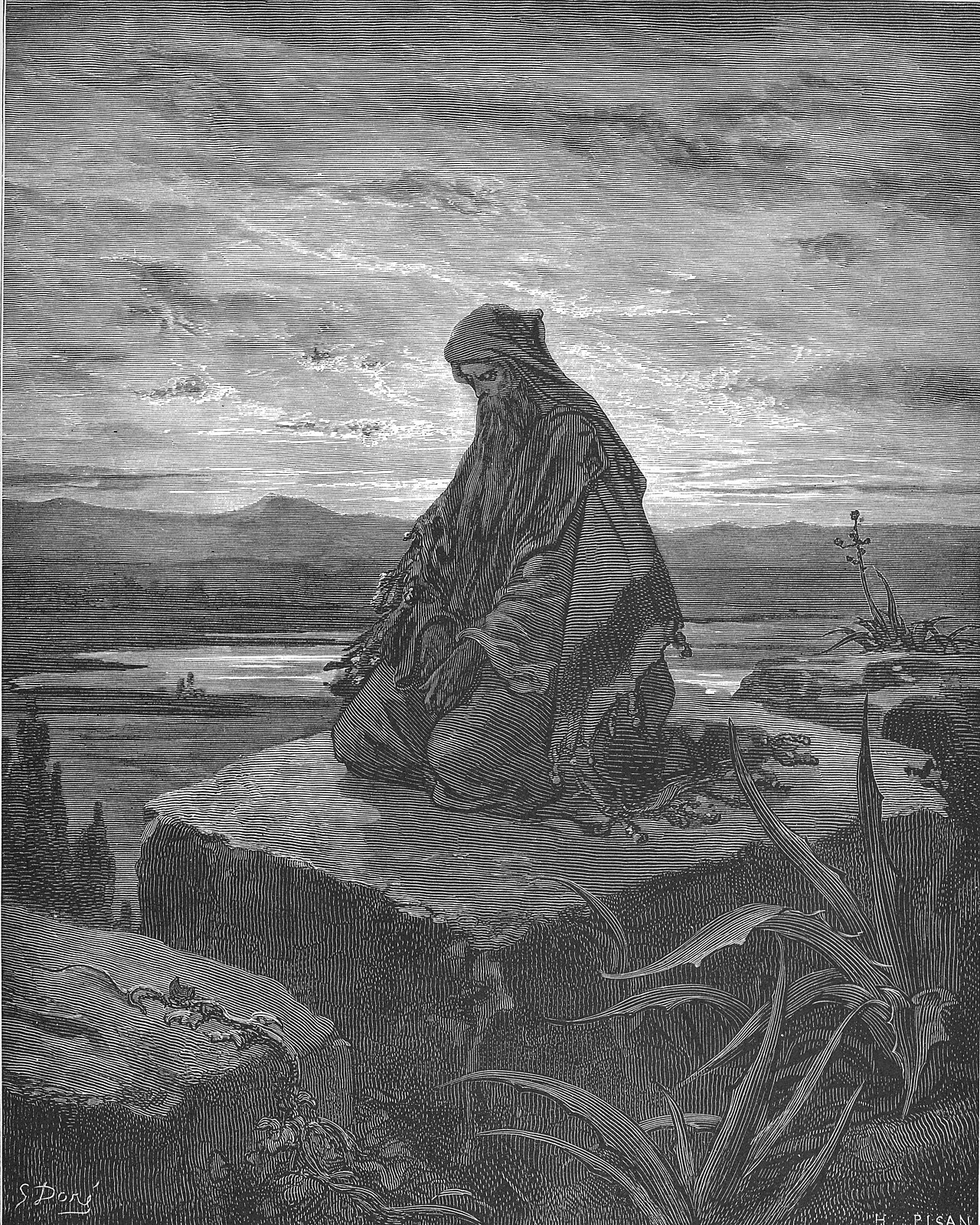
Isaiahchapter 63
19 verses · Isaiah · 8th century BC · The Prophets
Who is this coming from Edom, from Bozrah with crimson-stained garments? Who is this robed in splendor, marching in the greatness of His strength? “It is I, proclaiming vindication, mighty to save.”
Introduction
Isaiah, The Prophets, Isaiah Overview.
Isaiah wrote this for people who wanted to know whether the LORD still counted them as His family. The chapter opens with a question put to a figure coming from Edom in red garments, and he answers. Then a long prayer begins that runs into the next chapter. The pictures come from the vineyard and from the Exodus. Listen for the treader in the winepress and who stood with him. Listen too for the questions the prayer asks about where the LORD has gone. The prayer rests its case on one title of God.
Context
- Who
- People who wanted to know whether God still counted them as his family
- What
- A vision of the LORD returning alone from judging Edom, followed by a prayer that remembers His mercy in the Exodus and asks Him to act again.
- Where
- Edom and its city Bozrah, then the sea and the wilderness road of the Exodus remembered in prayer.
- When
- Spoken about 700 to 690 BC on the site's reading, with the prayer looking back to the Exodus from Egypt.
- Why
- To show that the LORD alone judges the nations and saves His people, and to model a prayer that pleads His past mercies.
Historical context
The opening scene is a winepress, and every detail is what treading actually looked like. Grapes were tipped into a shallow floor cut into bedrock, and men trod them barefoot, holding onto ropes or a beam for balance; the juice ran through a channel into a lower vat. The treader's legs and clothes ended the day stained dark red to the waist. There was normally a work song and a crowd. Isaiah's treader says, I have trodden the winepress alone, and of the peoples there was no one with me.
Show the rest of the historical context, 4 more paragraphs
The place names carry a pun. He comes from Edom, from Bozrah, with dyed garments, and Bozrah sounds like the Hebrew word for grape-gathering, while Edom sounds like the word for red. The whole picture is built on the sound of two towns.
The prayer that fills the rest of the chapter is a history lesson turned into an appeal, and it contains one of the most tender lines in the Old Testament: in all their affliction he was afflicted, and the angel of his presence saved them; in his love and in his pity he redeemed them, and he carried them all the days of old.
Then the questions, and they are the questions of a people whose situation makes no sense to them. Where is he who brought them up out of the sea with the shepherd of his flock? Where is he who put his Holy Spirit within them, who led them by the right hand of Moses, who divided the water before them? Praying by reciting the old rescues and asking where that God went is a recognized way of praying in Israel.
The last appeal is a family one, and it goes over the family's head. Doubtless you are our Father, though Abraham does not know us and Israel does not acknowledge us; you, O LORD, are our Father, our Redeemer from everlasting is your name. The dead patriarchs cannot help. The claim goes straight to God.
Significance
For the first hearers, the winepress scene answered a question raised all through the book: what happens to the nations that trampled Israel? Someone treads, and he treads alone.
Show the rest of the significance, 1 more paragraph
And the prayer that follows is the honest other half. It admits they rebelled and grieved his Holy Spirit, so that he turned to be their enemy and fought against them, and then asks him to look down from heaven anyway.
This chapter in Jewish lifeWhat this chapter is in Jewish life and reading.
What is done
The site's own table in src/lib/hebraic/readings.ts sets this chapter in one prophetic reading of the annual cycle. It is read as the Haftarah of Nitzavim, Isaiah 61:10 to 63:9, in both rites, on the Sabbath of the portion Deuteronomy 29:9 to 30:20. A congregation keeping that cycle hears the verses of each reference read aloud after the Torah portion of its Sabbath.
The corpus joins the chapter to the weeks of the Torah portions through the works arranged by portion. Under the fourth verse it carries Bereshit Rabbati, Parashat Bereshit 8. Under the sixteenth verse it carries Bereshit Rabbati, Parashat Vayetze 32.
How it is read
Two commentators on this chapter carry English in the corpus. Rashi is quoted from The Judaica Press complete Tanach with Rashi, translated by A. J. Rosenberg, which Sefaria reports as CC-BY, and every quotation of it is held to fifty words or fewer because the translation is modern. Ibn Ezra is quoted from the version Sefaria titles Commentary of Ibn Ezra on Isaiah - trans. by M. Friedlander, 1873, which it reports as Public Domain.
Rashi reads the figure coming from Edom as God Himself, come to take vengeance on Edom. He slays its heavenly prince first, as 34:5 sets the sword in the heavens before it descends. Israel asks who this is, seeing the stained garments (Rashi on Isaiah 63:1:1 and 63:1:2). Ibn Ezra's note on the red apparel is plain: "Blood is in colour similar to wine". He reads the day of vengeance of the fourth verse as vengeance on God's enemies and the redemption of His friends (Ibn Ezra on Isaiah 63:2:1 and 63:4:1).
The seventh verse begins a prayer that runs to 64:11, and Rashi marks both ends: "The prophet says, I will remind Israel of the kind acts of the Lord". At the eighth verse he hears God speak knowing the betrayal to come, "they are, nevertheless, My people" (Rashi on Isaiah 63:7:1 and 63:8:1). In the eleventh verse he hears Israel in exile remember Moses and say, Where is Moses our shepherd (Rashi on Isaiah 63:11:1).
The father of the sixteenth verse is the one bound to look on Israel's troubles (Rashi on Isaiah 63:16:1). The seventeenth verse asks why God leads Israel astray. Rashi answers from God's power over the heart, "Since You have the power to remove the evil inclination", citing Jeremiah 18:6 and Ezekiel 36:26 (Rashi on Isaiah 63:17:1).
The corpus carries two further notes on this chapter without an English text, each marked linked because Sefaria holds no English version of the ref. They stand cited and unquoted at Radak on Isaiah 63:2:1 and 63:4:1.
What the rabbis say
The corpus carries forty rabbinic locators on this chapter and the text of none, so each is cited and linked here rather than quoted. On the first verse it holds Aggadat Bereshit 64:1, Bamidbar Rabbah 14:10 and Bamidbar Rabbah 7:10. On the second verse it holds Aggadat Bereshit 84:3, Bereshit Rabbah 63:12 and Bereshit Rabbah 75:4. On the third verse it holds Bamidbar Rabbah 11:7, Bamidbar Rabbah 14:1 and Berakhot 58a:16. On the fourth verse it holds Bereshit Rabbah 65:12, Bereshit Rabbati, Parashat Bereshit 8 and Ein Yaakov (Glick Edition), Sanhedrin 11:54.
On the fifth verse it holds Mekhilta DeRabbi Yishmael, Tractate Bachodesh 1:17 and Otzar Midrashim, Midrashim of Rabbi Akiba, Aleph Bet of Rabbi Akiba (Version 1) 37. It holds Tanna DeBei Eliyahu Rabbah 11:1 there as well. On the sixth verse it holds Midrash Tehillim 84:1. On the seventh verse it holds Mekhilta DeRabbi Shimon Ben Yochai 15:13, Mekhilta DeRabbi Yishmael, Tractate Shirah 9:6 and Midrash Lekach Tov on Lamentations 3:22:1. On the eighth verse it holds Mekhilta DeRabbi Shimon Ben Yochai, Additions 6:3. On the ninth verse it holds Ein Yaakov (Glick Edition), Sotah 5:4, Ein Yaakov, Sotah 5:3 and Ein Yaakov, Taanit 2:3.
On the tenth verse it holds Eikhah Rabbah 1:57 and Kohelet Rabbah 3:8:2. On the eleventh verse it holds Aggadat Bereshit 79:3 and Bamidbar Rabbah 14:4. On the twelfth verse it holds Mekhilta DeRabbi Shimon Ben Yochai 14:19 and Mekhilta DeRabbi Yishmael, Tractate Vayehi Beshalach 4:13. On the fourteenth verse it holds Avot DeRabbi Natan 33:2 and Avot DeRabbi Natan, Recension B 38:2. On the fifteenth verse it holds Chagigah 12b:6 and Ein Yaakov (Glick Edition), Khagigah 2:10. On the sixteenth verse it holds Bereshit Rabbah 67:7 and Bereshit Rabbati, Parashat Vayetze 32.
On the seventeenth verse it holds Aggadat Bereshit 77:4 and Bereshit Rabbah 84:18. On the eighteenth verse it holds Midrash Tehillim 42:4. On the nineteenth verse it holds Midrash Sekhel Tov, Shemot 2:10:2. One more, Aggadat Bereshit 72:1, carries the anchor Isaiah 63:340, which this lane could not match to a verse. What each of them teaches is a saying of the rabbis, and is reported as theirs wherever this site quotes one. The quotations wait on a fetch that carries the text.
Sources: Rashi, Rashi on Isaiah 63:1:1 to 63:19:1, The Judaica Press complete Tanach with Rashi, translated by A. J. Rosenberg, reported CC-BY; Ibn Ezra, Ibn Ezra on Isaiah 63:2:1 to 63:4:1, Commentary of Ibn Ezra on Isaiah - trans. by M. Friedlander, 1873, reported Public Domain; Radak, Radak on Isaiah 63:2:1 and 63:4:1, cited by ref because the corpus carries no English text; The Sefaria corpus, scripts/data/sources/sefaria/isaiah/63.json, the 40 Talmud and Midrash locators of this chapter; The site's own files, src/lib/hebraic/readings.ts, the Haftarah entries for Nitzavim (Isaiah 61:10 to 63:9).
The heads below are this chapter's scenes. The numbered points under each are its verses.
Who Is This That Cometh from Edom in Dyed Garments?
Isaiah 63:1-2
Who is this coming from Edom: The chapter opens as a watchman's dialogue, asking who comes “from Bozrah with crimson-stained garments”. Bozrah was the chief city of Edom, the nation descended from Esau and set against Zion in 34:5-6. The answer comes in the first person, “It is I, proclaiming vindication, mighty to save”.
Isaiah 63:1
“THIS, of course, refers to our blessed Lord Jesus Christ, who is described as “coming from Edom with dyed garments from Bozrah,” and who, when it is questioned who he is, replies, “I that speak in righteousness, mighty to save.” It will be well, then, at the commencement of our discourse to make one or two remarks concerning the mysteriously complex person of the man and God whom we call our Redeemer, Jesus Christ our Saviour. It is one of the mysteries of the Christian religion, that we are taught to believe that Christ is God, and yet a man.”
2 more voices on this verseWhat preachers and commentators have said about this verse, in their own words.
Isaiah 63:1
“Here is also an allusion to the garments of this conqueror, Edom signifying red, and Bozrah a vintage. Glorious - Such as generals march before their armies in. Righteousness - Here Christ gives an answer, wherein he both asserts his fidelity, that he will faithfully perform what he hath promised, and that he will truly execute justice.”
John Wesley · Explanatory Notes upon the Old Testament (1765)evangelical
Isaiah 63:1
“Who is this - The language of the people who see Yahweh returning as a triumphant conqueror from Idumea. Struck with his stately bearing as a warrior; with his gorgeous apparel; and with the blood on his raiment, they ask who he could be? This is a striking instance of the bold and abrupt manner of Isaiah.”
Why are Your clothes red: The Hebrew word for red here echoes Edom in verse 1, and Jerome reads the place name as a name for blood. Barnes explains the winepress as a pit where grapes were trodden barefoot until the juice stained the treader. Bozrah stood in grape country, Jamieson, Fausset & Brown add.
Isaiah 63:2
“Wherefore art thou red in thine apparel - For ללבושך lilebushecha, twenty-nine MSS. (nine ancient) of Kennicott’s, and thirty of De Rossi s, and one edition, have ללבושיך lilebusheycha in the plural; so the Septuagint and Syriac. And all the ancient Versions read it with מ mem, instead of the first ל lamed. But the true reading is probably מלבושך malbushecha in the singular, as in Isa 63:3. - L.”
Adam Clarke · Commentary on the Bible (1810-1826)evangelical
1 more voice on this verse
Isaiah 63:2
“The image was appropriate, as the country round Bozrah abounded in grapes. This final blow inflicted by Messiah and His armies (Re 19:13-15) shall decide His claim to the kingdoms usurped by Satan, and by the "beast," to whom Satan delegates his power. It will be a day of judgment to the hostile Gentiles, as His first coming was a day of judgment to the unbelieving Jews.”
Jamieson, Fausset & Brown · Commentary Critical and Explanatory on the Whole Bible (1871)reformed
Isaiah 63:3-4
“I have trodden the winepress alone”, a picture of war in the prophets, as at Joel 3:13. Revelation 19:13-15 takes up these words for the returning Christ. Verse 4 gives the reason: “For the day of vengeance was in My heart, and the year of My redemption had come”.
Isaiah 63:3
“I have trodden the wine-press alone - I, Yahweh, have indeed trod the wine-press of my wrath, and I have done it alone (compare the notes at Isa 34:5-6). The idea here is, that he had completely destroyed his foes in Idumea, and had done it by a great slaughter. For I will tread - Or rather, I trod them. It refers to what he had done; or what was then past. And their blood shall be sprinkled - Or rather, their blood was sprinkled.”
2 more voices on this verse
Isaiah 63:3
“Edom is by interpretation either "earthy" or "bloody"; Bosor either "flesh" or "in tribulation." In a few words, [Isaiah] shows the whole mystery of the resurrection, that is, the reality of the flesh and the growth in glory. And the meaning is, Who is he that comes up from the earth, comes up from blood?”
Jerome · written before 420 · Against John of Jerusalem 34patristic
Isaiah 63:3
“For the image, see La 1:15. He "treads the wine-press" here not as a sufferer, but as an inflicter of vengeance. will tread . . . shall be . . . will stain--rather preterites, "I trod . . . trampled . . . was sprinkled . . . I stained." blood--literally, "spirited juice" of the grape, pressed out by treading [GESENIUS].”
Jamieson, Fausset & Brown · Commentary Critical and Explanatory on the Whole Bible (1871)reformed
the day of vengeance was in My heart: Vengeance is given a day and redemption a year, the same pairing Isaiah 34:8 and 61:2 make. Jamieson, Fausset & Brown read the short span as the measure of judgment and the long one as the measure of grace. Henry adds that the rescue waited for its appointed time.
Isaiah 63:4
“For the day of vengeance - (See the notes at Isa 34:8). And the year of my redeemed is come - The year when my people are to be redeemed. It is a year when their foes are all to be destroyed, and when their entire liberty is to be effected.”
1 more voice on this verse
Isaiah 63:4
"Now that the year of my redeemed has come, Lo, I come; delay shall be no longer. Now will I arise, saith the Lord. Now thou shalt see what I will do to Pharaoh. " Note, The promised salvation must be patiently waited for till the time appointed comes; yet we must attend the promises with our prayers.
Matthew Henry · Commentary on the Whole Bible (1707-1721)puritan
Isaiah 63:5-6
I looked, but there was no one to help: “I looked, but there was no one to help”, and so “My arm brought Me salvation”, the words of 59:16. Verse 6 repeats the treading of verse 3, “I trampled the nations in My anger”. The speech circles back on itself before a new voice begins at verse 7.
Isaiah 63:5
“The same words as in Isa 59:16, except that there it is His "righteousness," here it is His "fury," which is said to have upheld Him.”
Jamieson, Fausset & Brown · Commentary Critical and Explanatory on the Whole Bible (1871)reformed
2 more voices on this verse
Isaiah 63:5
“None to help - Not that he needed it, but to see what men would do, in regard his people needed it; therefore the standing, or not standing by his people, is the same thing with standing, or not standing by him. Uphold - A metaphor, taken from a staff, that is an help to one that leans on it.”
John Wesley · Explanatory Notes upon the Old Testament (1765)evangelical
Isaiah 63:5
“But this is most fully applicable to Christ's victories over our spiritual enemies, which he obtained by a single combat. He trod the wine-press of his Father's wrath alone, and triumphed over principalities and powers in himself, Col. ii. Of the people there was none with him; for, when he entered the lists with the powers of darkness, all his disciples forsook him and fled.”
Matthew Henry · Commentary on the Whole Bible (1707-1721)puritan
in My wrath I made them drunk: Barnes pictures the nations reeling under the wrath of the LORD like drunken men until they fall to the ground. Clarke reports Hebrew manuscripts reading crushed for drunk. The poured blood is the same word as the blood that stained the garments in verse 3, Jamieson, Fausset & Brown note.
Isaiah 63:6
“Rather, preterites, "I trod down . . . made them drunk." The same image occurs Isa 51:17, 21-23; Jer 25:26, 27. will bring down . . . strength to . . . earth--rather, "I spilled their life-blood (the same Hebrew words as in Isa 63:3) on the earth" [LOWTH and Septuagint].”
Jamieson, Fausset & Brown · Commentary Critical and Explanatory on the Whole Bible (1871)reformed
1 more voice on this verse
Isaiah 63:6
“And make them drunk in my fury “And I crushed them in mine indignation” - For ואשכרם vaashkerem, and I made them drunken, twenty-seven MSS., (three ancient), twelve of De Rossi’s, and the old edition of 1488, have ואשברם vaashabberem, and I crushed them: and so the Syriac and Chaldee. The Septuagint have omitted this whole line.”
Adam Clarke · Commentary on the Bible (1810-1826)evangelical
I Will Make Mention of the Lovingkindnesses of the LORD
Isaiah 63:7-9
I will make known the LORD’s loving devotion: The voice changes from the warrior to a worshipper: “I will make known the LORD’s loving devotion and His praiseworthy acts”. Verse 8 gives the ground, “They are surely My people”. Verse 9 says “He too was afflicted” in their distress, and He “carried them all the days of old”.
Isaiah 63:7
“Of the goodness that is in God. God does good because he is good; what he bestowed upon us must be traced up to the original; it is according to his mercies (not according to our merits) and according to the multitude of his loving-kindnesses, which can never be spent.”
Matthew Henry · Commentary on the Whole Bible (1707-1721)puritan
1 more voice on this verse
Isaiah 63:7
“Mention - Here begins a new matter, which contains the prophet's prayer, to the end of chap. 64, wherein he begins with mentioning the great kindnesses that God had shewn the Jews, and that emphatically, setting them forth with the greatest advantages.”
John Wesley · Explanatory Notes upon the Old Testament (1765)evangelical
He said marks the resolve of the LORD when He chose Israel as His people, Jamieson, Fausset & Brown explain. Clarke follows the Septuagint and reads So He became their Savior with verse 9, their Savior in all their distress. Wesley names that Savior as Christ.
Isaiah 63:8
“So he was their Savior. In all their affliction “And he became their Savior in all their distress” - I have followed the translation of the Septuagint in the latter part of the eighth, and the former part of the ninth verse; which agrees with the present text, a little differently divided as to thee members of the sentence.”
Adam Clarke · Commentary on the Bible (1810-1826)evangelical
2 more voices on this verse
Isaiah 63:8
“He said - When he made a covenant with our fathers, and brought them out of Egypt. Not lie - That will keep my covenant. So he - Not Cyrus, Zerubbabel, or Nehemiah, but Christ himself.”
John Wesley · Explanatory Notes upon the Old Testament (1765)evangelical
Isaiah 63:8
“They are children of the covenant ( Acts iii. 25 ), children of those that clave unto the Lord, and therefore it may be hoped that they will tread in the steps of their fathers' constancy. Note, God's people are children that will not lie; for those that will are not his children but the devil's.”
Matthew Henry · Commentary on the Whole Bible (1707-1721)puritan
In all their distress, He too was afflicted: Barnes notes a doubt over the Hebrew of He too was afflicted, and Jerome reads He was not afflicted. Jamieson, Fausset & Brown read the Angel of His Presence as the angel of His face, who stands before the LORD. Henry names the Angel who saved them the covenant angel.
Isaiah 63:9
“The angel - The same that conducted them through the wilderness; the Lord Jesus Christ, who appeared to Moses in the bush. Saved them - From the house of bondage.”
John Wesley · Explanatory Notes upon the Old Testament (1765)evangelical
3 more voices on this verse
Isaiah 63:9
“We say that these human things are his by an economic appropriation, along with the flesh all the things belonging to it. We recognize no other Son apart from him, for the Lord has saved us, giving his own blood as a ransom for the life of all.”
Cyril of Alexandria · written before 444 · On the Unity of Christpatristic
Isaiah 63:9
“In all their affliction he was afflicted - This is a most beautiful sentiment, meaning that God sympathized with them in all their trials, and that he was ever ready to aid them. This sentiment accords well with the connection; but there has been some doubt whether this is the meaning of the Hebrew.”
Isaiah 63:9
“He is the angel of the covenant, God's messenger to the world, Mal. iii. He is the angel of God's face, for he is the express image of his person; and the glory of God shines in the face of Christ. He that was to work out the eternal salvation, as an earnest of that, wrought out the temporal salvations that were typical of it.”
Matthew Henry · Commentary on the Whole Bible (1707-1721)puritan
But they rebelled and grieved His Holy Spirit: The praise turns in one verse: “But they rebelled and grieved His Holy Spirit”. The Spirit is named as one who can be grieved, the word Paul echoes at Ephesians 4:30. The God who fought for Israel against Egypt now fights against Israel: “So He turned and became their enemy”.
Isaiah 63:10
“And he fought against them - Twenty-six MSS. (ten ancient) and the first edition, with another, add the conjunction ו vau, והוא vehu, and he.”
Adam Clarke · Commentary on the Bible (1810-1826)evangelical
1 more voice on this verse
Isaiah 63:10
“This refers especially to those calamities that were of late brought upon them by their captivity in Babylon for their idolatries and other sins. That which is both the original and the great aggravation of their troubles was that God was turned to be their enemy.”
Matthew Henry · Commentary on the Whole Bible (1707-1721)puritan
Isaiah 63:11-14
Then His people remembered the days of old, the days of Moses: “Then His people remembered the days of old” and asked, “Where is the One who set His Holy Spirit among them”. Verses 12 to 14 review the exodus: the arm at “the right hand of Moses”. Twice the purpose is His name, “everlasting renown” and “a glorious name”.
Isaiah 63:11
“Then he remembered - He did not forget his solemn premises to be their protector and their God. For their crimes they were subjected to punishment, but God did not forget that they were his people, nor that he had entered into covenant with them. The object of this part of the petition seems to be, to recall the fact that in former times God had never wholly forsaken them, and to plead that the same thing might occur now. Even in the darkest days of adversity, God still remembered his promises, and interposed to save them.”
1 more voice on this verse
Isaiah 63:11
“It may look back to their condition in the wilderness, and thus they may properly say, Where is he? Or that God who delivered his people of old, to do the like for us now? There is a like phrase used by God, as it were recollecting himself, Where is he?”
John Wesley · Explanatory Notes upon the Old Testament (1765)evangelical
who sent His glorious arm: Barnes ties the divided waters to Exodus 14:21 and reads the everlasting renown as a work no false god could perform. Spurgeon preached this renown as God's highest aim, for His creatures' highest good is to know Him. Aquinas glosses the right hand as prosperity.
Isaiah 63:12
“That led them by the right hand of Moses - (See the notes at Isa 41:10-13; Isa 45:1). Dividing the water before them - Exo 14:21. To make himself an everlasting name - He designed to perform a work which, it would be seen, could not be performed by any false god or by any human arm, and to do it in such circumstances, and in such a manner, that it might be seen everywhere that this was the true God (compare the notes at Isa 45:6).”
2 more voices on this verse
Isaiah 63:12
“By the right hand, prosperously; where is the spirit that divided the waters before them? Who divided the Red Sea into parts (Ps 135[136]:13).”
Thomas Aquinas · written before 1274 · Commentary on Isaiahpatristic
Isaiah 63:12
“Herein he was a type of Christ the good shepherd, that lays down his life for the sheep, which was more than Moses did for Israel, though he did a great deal for them. [2.] He put his holy Spirit within him; the Spirit of God was among them, and not only his providence, but his grace, did work for them.”
Matthew Henry · Commentary on the Whole Bible (1707-1721)puritan
like a horse in the wilderness: The depths are the bed of the sea, where the waters had stood deepest, Gill notes. He takes the word for wilderness as a smooth plain, where a horse runs and does not stumble. The wind the LORD sent had dried the path, Wesley adds.
Isaiah 63:13
“That led them through the deep,.... The depths, the bottom of the sea; not through the shallow, but where the waters had been deepest, the descent greatest; and at the bottom of which might have been expected much filth and dirt to hinder them in their passage, yet through this he led them: as an horse in the wilderness; or rather, "in a plain", as the word (b) sometimes signifies; and so Kimchi renders it a plain land, and Jarchi smooth land.”
3 more voices on this verse
Isaiah 63:13
“That led them through the deep - They went through the deep on dry land - the waters having divided and left an unobstructed path. As an horse in the wilderness - As an horse, or a courser, goes through a desert without stumbling. This is a most beautiful image. The reference is to vast level plains like those in Arabia, where there are no stones, no trees, no gullies, no obstacles, and where a fleet courser bounds over the plain without any danger of stumbling. So the Israelites were led on their way without falling.”
Isaiah 63:13
“There can be no doubt that in refusing the accompaniment of an angel Moses was inviting God to lead them himself. God was making this promise, "This word that you have just spoken I shall accomplish, since you have found favor with me and I know you in preference to all the others." It is also said in Isaiah, "the one who made the shepherd of the sheep to ascend the earth?”
Athanasius of Alexandria · written before 373 · Letter to Serapion 1:12patristic
Isaiah 63:13
“As an horse - With as much ease and tenderness, as an horse led by the bridle. Not stumble - That, tho' the sea were but newly divided, yet it was dried and smoothed by the wind, that God sent, as it were to prepare the way before them.”
John Wesley · Explanatory Notes upon the Old Testament (1765)evangelical
Like cattle going down to the valley: Barnes pictures cattle leaving the sunbaked hills at midday for a shaded valley with running water. Jamieson, Fausset & Brown read the rest as Canaan after the wilderness years and set it beside Psalm 23:2. The Septuagint reads the verb as led them, Clarke reports.
Isaiah 63:14
“The Spirit of the Lord caused him to rest “The Spirit of Jehovah conducted them” - For תניחנו tenichennu, caused him to rest, the Septuagint have ὡδηγησεν αυτους, conducted them; they read תנחם tanchem. The Syriac, Chaldee, and Vulgate read תנחנו tanchennu, conducted him. Two MSS. have the word without the י yod in the middle.”
Adam Clarke · Commentary on the Bible (1810-1826)evangelical
2 more voices on this verse
Isaiah 63:14
“As a beast goeth down into the valley,.... Softly and gently, especially when laden; which may have some respect to the descent of the Israelites into the sea, into which they entered without any fear and dread, and without any hurry and precipitation, though Pharaoh's host was behind them; or rather, "as a beast goes along a valley", or "plain" (c); with ease, and without any interruption, so passed the Israelites through the sea.”
Isaiah 63:14
“Some good interpreters think this prayer looks further, and that it expresses the complaints of the Jews under their last and final rejection from God and destruction by the Romans; for there is one passage in it ( ch. lxiv. 4 ) which is applied to the grace of the gospel by the apostle ( 1 Cor. ii. 9 ), that grace for the rejecting of which they were rejected.”
Matthew Henry · Commentary on the Whole Bible (1707-1721)puritan
Look Down from Heaven: Doubtless Thou Art Our Father
Isaiah 63:15-16
Look down from heaven and see: The review becomes a plea, “Look down from heaven and see”. Verse 16 gives the confession: “Yet You are our Father, though Abraham does not know us”. Descent from Abraham is set beneath a fatherhood that does not depend on it: “our Redeemer from Everlasting is Your name”.
Isaiah 63:15
“Look down from heaven - This commences an earnest appeal that God would have mercy on them in their present calamities and trials. They entreat him to remember his former mercies, and to return and bless them, as he had done in ancient times. And behold from the habitation - (See the notes at Isa 57:15). Where is thy zeal - That is, thy former zeal for thy people; where is now the proof of the interest for their welfare which was vouchsafed in times that are past.”
1 more voice on this verse
Isaiah 63:15
“God sees everywhere, and every thing, but he is said to look down from heaven, because there is his throne whereon he sits in majesty. Behold - Not barely see, but behold with regard, and respect thy poor people. Where - What is become of that love, which of old would not let thee suffer thy people to be wronged?”
John Wesley · Explanatory Notes upon the Old Testament (1765)evangelical
though Abraham does not know us: Wesley reads Abraham does not know as the fact of death. Jamieson, Fausset & Brown explain why Israel stands beside Abraham, for all the sons of Jacob were in the covenant. Cyril of Jerusalem reads the LORD as Father of His people by care and Father of Christ by nature.
Isaiah 63:16
“Abraham - He who was our father after the flesh, though he be dead, and so ignorant of our condition. Redeemer - This is urged as another argument for pity; because their Father was their Redeemer. From everlasting - Thou hast been our Redeemer of old.”
John Wesley · Explanatory Notes upon the Old Testament (1765)evangelical
1 more voice on this verse
Isaiah 63:16
“Our Redeemer; thy name is from everlasting “O deliver us for the sake of thy name” - The present text reads, as our translation has rendered it, “Our Redeemer, thy name is from everlasting.” But instead of מעולם meolam, from everlasting, an ancient MS. has למען lemaan, for the sake of, which gives a much better sense.”
Adam Clarke · Commentary on the Bible (1810-1826)evangelical
Isaiah 63:17-19
Why, O LORD, do You make us stray from Your ways: The prayer grows bold to ask why the LORD makes them “stray from Your ways and harden our hearts from fearing You”. It asks for His return on the ground of belonging, “for the sake of Your servants”. Verse 19 ends raw: “We have become like those You never ruled”.
Isaiah 63:17
“O Lord, why hast thou made us to err from thy ways? - Lowth and Noyes render this, ‘Why dost thou suffer us to wander from thy way?’ Calvin remarks on the passage, ‘The prophet uses a common form of speaking, for it is usual in the Scriptures to say that God gives the wicked over to a reprobate mind, and hardens their hearts.”
1 more voice on this verse
Isaiah 63:17
“Now this they complain of, as their great misery and burden, that God had for their sins left them to this, had permitted them to err from his ways and had justly withheld his grace, so that their hearts were hardened from his fear. When they ask, Why hast thou done this? it is not as charging him with wrong, but lamenting it as a sore judgment.”
Matthew Henry · Commentary on the Whole Bible (1707-1721)puritan
For a short while Your people possessed: Clarke says every interpreter finds the first clause hard to construe. Aquinas reads it as enemies who possessed the holy people without resistance. Jamieson, Fausset & Brown hear an argument in Your sanctuary, for the cause of the people is the cause of the LORD.
Isaiah 63:18
“The people of thy holiness have possessed it but a little while “It is little that they have taken possession of thy holy mountain” - The difficulty of the construction in this place is acknowledged on all hands.”
Adam Clarke · Commentary on the Bible (1810-1826)evangelical
1 more voice on this verse
Isaiah 63:18
"Though we are the people of thy holiness, distinguished from other people and consecrated to thee, yet we are soon dislodged." But this they might thank themselves for; they were, in profession, the people of God's holiness, but it was their wickedness that turned them out of the possession of that land.
Matthew Henry · Commentary on the Whole Bible (1707-1721)puritan
like those You never ruled: Barnes takes the Hebrew word for from of old with Israel, so the verse claims a belonging to God from ancient times. Jamieson, Fausset & Brown give the reading close to the Berean, Israel long like a people God never ruled. Eusebius hears Israel back in Egypt before Moses.
Isaiah 63:19
“We are thine - We urge it as a reason for thy interposition to restore the land and the temple, that we are thine from ancient times. Such I take to be the meaning of the passage - in accordance with the common translation, except that the expression מעולם mē‛ôlâm, ‘from ancient times,’ rendered by our translators in connection with לא lo', ‘never,’ is thus connected with the Jewish people, instead of being regarded as applied to their enemies.”
1 more voice on this verse
Isaiah 63:19
“Thine - We continue so; we are in covenant, which they never were; and thus it is an argument they use with God to look upon them. Never - Not in that manner thou didst over us.”
John Wesley · Explanatory Notes upon the Old Testament (1765)evangelical
Keep studying
Words12
Subjects1
Sources for this chapter
The summary
Jamieson, Fausset & Brown, Commentary Critical and Explanatory; John Calvin, Commentaries; John Wesley, Notes on the Old Testament and Matthew Henry, Complete Commentary.
The exposition
Adam Clarke, Commentary on the Bible; Albert Barnes; Charles Spurgeon, The Metropolitan Tabernacle Pulpit, Sermon No. 2229: “God's Glorious and Everlasting Name” (lightly modernized text, CCEL edition); Cyril of Jerusalem, ''Catechetical Lectures, Lecture 7''; Eusebius of Caesarea, COMMENTARY ON ISAIAH 2:54; Franz Delitzsch, Biblical Commentary on the Prophecies of Isaiah; Jamieson, Fausset & Brown, Commentary Critical and Explanatory on the Whole Bible; Jerome, Commentary on Isaiah; John Gill; John Wesley, Explanatory Notes upon the Old Testament; Matthew Henry, Commentary on the Whole Bible and Thomas Aquinas, Commentary on Isaiah.