
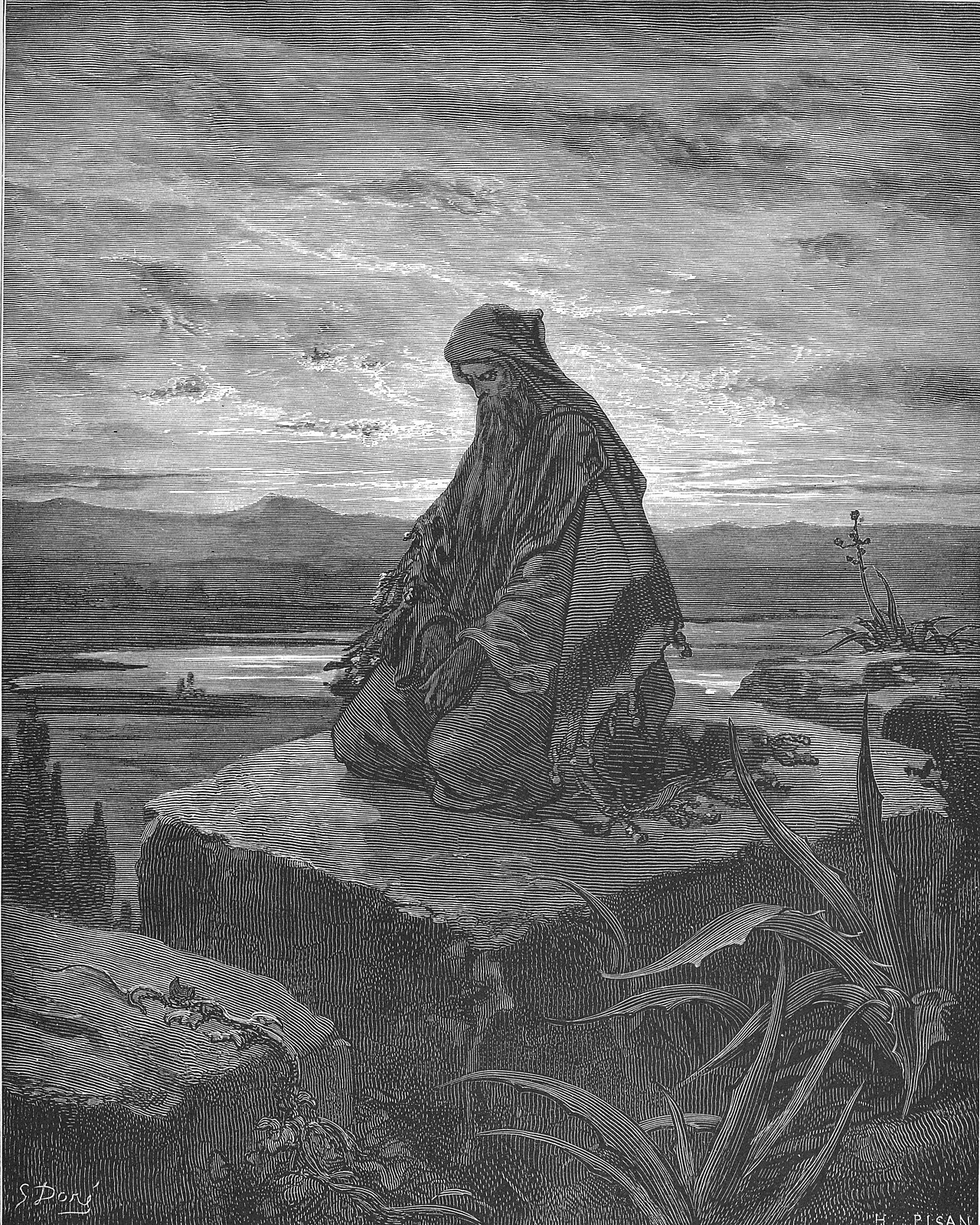
Isaiahchapter 53
12 verses · Isaiah · 8th century BC · The Prophets
He was oppressed and afflicted, yet He did not open His mouth. He was led like a lamb to the slaughter, and as a sheep before her shearers is silent, so He did not open His mouth.
This chapter opens in the middle of a passage. The fourth of Isaiah's songs about the Servant begins three verses earlier, at Isaiah 52:13. Read Isaiah 52 from the start→
Introduction
Isaiah, The Prophets, Isaiah Overview.
Isaiah wrote this for a people whose worship turned on an animal dying in the worshipper's place. The chapter is the body of the fourth Servant song, which opens at 52:13 and closes here. It is poetry, and much of it is spoken by a group looking back and admitting what they got wrong. Listen for the change of speaker between the watchers and the LORD, and for the sacrificial words the prophet borrows from the tabernacle. Listen too for where the account passes through a death and keeps going. The New Testament quotes this chapter more than any other passage of the prophets.
Context
- Who
- A people whose whole religion ran on a substitute dying in their place
- What
- A poem in which the watchers confess how they misjudged the Servant, followed by the LORD's verdict on His Servant's suffering and reward.
- Where
- Jerusalem and Judah, with pictures drawn from the shearing floor, the court, the place of execution and a rich man's tomb.
- When
- Spoken about 700 to 690 BC in the reign of Hezekiah on the site's reading of the book as Isaiah's own work, since the book gives no date for this chapter.
- Why
- To show that the suffering of the Servant was the LORD's own plan to carry the guilt of others and make many righteous.
Historical context
The whole chapter is built out of the sacrificial system, and every hearer had watched it work. A worshipper brought an animal, laid his hand on its head, the gesture that transferred the guilt, and the animal died in his place. The technical term used in this chapter for what the Servant becomes, the guilt offering, is the specific sacrifice that dealt with wrongs requiring restitution, where something owed had to be paid back with interest.
Show the rest of the historical context, 3 more paragraphs
The silence is an observed fact from the shearing floor. A sheep being sheared goes still under the shears; a lamb led to slaughter does not fight. Anyone who kept sheep had seen it a hundred times, and it is the plainest possible image of a death that is not resisted.
The burial detail is a legal oddity. Executed criminals were thrown into a common pit; a chambered tomb cut into rock was the property of a wealthy family and cost a great deal to hew.
There is a long-running disagreement over the Servant's identity here. From the medieval period onward, most Jewish interpretation has read the sufferer as the nation Israel, afflicted among the Gentiles; older Jewish tradition, including several ancient rabbinic sources and the ancient Aramaic paraphrase, read the passage of the Messiah. The New Testament reads it of Jesus, and that is the reading held here, with the note that the chapter itself says the Servant suffers for the transgression of my people, which is difficult to square with the Servant being that same people.
Significance
The first hearers carried the assumption every ancient people carried: a man who suffers like that is being punished, and God is against him. The chapter says the crowd made exactly that mistake, we esteemed him stricken, struck by God, and afflicted, and then says the opposite was true.
Show the rest of the significance, 1 more paragraph
For a generation that read its own suffering as proof of rejection, that was the deepest possible comfort and the deepest possible warning. The most God-forsaken-looking thing in the passage turns out to be the thing God planned: it pleased the LORD to bruise him.
This chapter in Jewish lifeWhat this chapter is in Jewish life and reading.
What is done
The site's own table in src/lib/hebraic/readings.ts, probed for this lane, printed no weekly portion and no Haftarah from this chapter, and no festival reading for the book. That table carries the Haftarah of each of the fifty-four weekly portions and the books read whole at the feasts, and it carries nothing for the special Sabbaths or the fast days. This card therefore names no public reading of the chapter and leaves that question to a source that holds those readings.
The corpus joins the chapter to the weeks of the Torah portions through the works arranged by portion. Under the fifth verse it carries Bereshit Rabbati, Parashat Chayei Sarah 8. Under the seventh verse it carries Midrash Tanchuma, Noach 13:4.
How it is read
Two commentators on this chapter carry English in the corpus. Rashi is quoted from The Judaica Press complete Tanach with Rashi, translated by A. J. Rosenberg, which Sefaria reports as CC-BY, and every quotation of it is held to fifty words or fewer because the translation is modern. Ibn Ezra is quoted from the version Sefaria titles Commentary of Ibn Ezra on Isaiah - trans. by M. Friedlander, 1873, which it reports as Public Domain.
This is the chapter on which the classical Jewish reading and the Christian reading part most plainly, and the card sets the Jewish reading down in its own words. A Christian reader knows it as the church's text on the suffering and death of Christ. Rashi reads the servant as Israel and the speakers as the nations at the end of days. He states the method of the prophet: "So is the custom of this prophet: he mentions all Israel as one man". He cites Isaiah 44:1, 44:2 and 52:13 for it (Rashi on Isaiah 53:3:1). The two readings differ on who the servant is, and neither is softened here.
Within his reading the chapter is an astonished confession by the nations. "Were we to hear from others what we see, it would be unbelievable". The suffering of the fourth verse is suffering on their behalf: "he was chastised with pains so that all the nations be atoned for with Israel’s suffering. The illness that should rightfully have come upon us, he bore". The chastisement of the fifth verse was "so that there be peace for the entire world" (Rashi on Isaiah 53:1:1, 53:4:1 and 53:5:1).
The grave of the ninth verse he reads as Israel's faithfulness under persecution. The servant was willing to be buried at the will of the wicked, "and he would not deny the living God". The offering for guilt in the tenth verse he explains as a ransom paid to the one sinned against. He sets it beside the guilt offering the Philistines sent back in 1 Samuel 6:3. The portion of the twelfth verse is an inheritance with the Patriarchs (Rashi on Isaiah 53:9:2, 53:10:2 and 53:12:1).
Ibn Ezra's one note on the chapter in the corpus is on a single word in the fifth verse. He renders it slain where the Authorized Version has wounded, and compares Deuteronomy 21:1 (Ibn Ezra on Isaiah 53:5:1).
What the rabbis say
The corpus carries forty rabbinic locators on this chapter and the text of none, so each is cited and linked here rather than quoted. On the third verse it holds Otzar Midrashim, Midrashim of Rabbi Shimon bar Yochai, Chapter of Rabbi Shimon Bar Yochai 6. On the fourth verse it holds Sanhedrin 98b:14. On the fifth verse it holds Bereshit Rabbati, Parashat Chayei Sarah 8, Midrash Shmuel 19:1, Ruth Rabbah (Lerner) 5:6:7 and Ruth Rabbah 5:6. On the seventh verse it holds Bereshit Rabbah 61:7, Midrash Tanchuma, Noach 13:4, Yalkut Shimoni on Torah 294:1 and Yalkut Shimoni on Torah 787:2.
On the tenth verse it holds Berakhot 57b:14, Berakhot 5a:11, Berakhot 5a:12 and Berakhot 5a:13. It holds Bereshit Rabbah 20:10, Ein Yaakov (Glick Edition), Berakhot 1:16, Ein Yaakov, Berakhot 1:22 and Ein Yaakov, Berakhot 1:23 there as well. It holds Midrash Sekhel Tov, Bereshit 19:35:5, Midrash Sekhel Tov, Shemot 15:26:22 and Otzar Midrashim, Chuppah of Eliyahu, Chuppat Eliyahu Rabbah 218 there as well. It holds Pesikta DeRav Kahana 19:5, Yalkut Shimoni on Torah 33:1 and Yoma 88a:11 there as well. On the eleventh verse it holds Tanna DeBei Eliyahu Rabbah 13:1.
On the twelfth verse it holds Bamidbar Rabbah 13:2, Ein Yaakov (Glick Edition), Sotah 1:55 and Ein Yaakov, Sotah 1:62. It holds Introductions to Tanaitic Literature, Introduction to Mishnah and Tosefta, Ancient Tannaitic Compilations 27, Jerusalem Talmud Shekalim 5:1:3 and Midrash Lekach Tov, Numbers 25:13:1 there as well. It holds Midrash Tannaim on Deuteronomy 3:25:3, Midrash Tannaim on Deuteronomy 31:14:9 and Midrash Tannaim on Deuteronomy 33:21:4 there as well. It holds Otzar Midrashim, Midrash Yelamdeinu, Last Composition from Midrash Yelamdenu 52, Sifrei Bamidbar 131:5, Sifrei Devarim 355:8 and Sotah 14a:8 there as well. It holds Yalkut Shimoni on Torah 816:2 there as well.
On the fifteenth verse it holds Midrash Aggadah, Numbers 23:22:4. What each of them teaches is a saying of the rabbis, and is reported as theirs wherever this site quotes one. The quotations wait on a fetch that carries the text.
Sources: Rashi, Rashi on Isaiah 53:1:1 to 53:12:2, The Judaica Press complete Tanach with Rashi, translated by A. J. Rosenberg, reported CC-BY; Ibn Ezra, Ibn Ezra on Isaiah 53:5:1, Commentary of Ibn Ezra on Isaiah - trans. by M. Friedlander, 1873, reported Public Domain; The Sefaria corpus, scripts/data/sources/sefaria/isaiah/53.json, the 40 Talmud and Midrash locators of this chapter; The site's own files, src/lib/hebraic/readings.ts, printing no portion and no Haftarah for this chapter and no festival reading for this book.
The heads below are this chapter's scenes. The numbered points under each are its verses.
The song opens here, at Isaiah 52:13
52:13Behold, My Servant will prosper;He will be raised and lifted up and highly exalted.
52:14Just as many were appalled at Him—His appearance was disfigured beyond that of any man, and His form was marred beyond human likeness—
52:15so He will sprinkle many nations.Kings will shut their mouths because of Him.For they will see what they have not been told, and they will understand what they have not heard.
These verses are numbered in Isaiah 52.
Despised and Rejected, No Beauty That We Should Desire Him
Isaiah 53:1-3
Who has believed our message?: The heart of the song opens with a question about who has believed the message, quoted at John 12:38 and Romans 10:16. There follows a man no one wanted to look at. The speakers tell a suffering still to come in the past tense, which Delitzsch calls the prophetic perfect.
Isaiah 53:1
“Who hath believed our report? - The main design of the prophet in all this portion of his prophecy is, undoubtedly, to state the fact that the Redeemer would be greatly exalted (see Isa 52:13; Isa 53:12). But in order to furnish a fair view of his exaltation, it was necessary also to exhibit the depth of his humiliation, and the intensity of his sorrows, and also the fact that he would be rejected by those to whom he was sent.”
1 more voice on this verseWhat preachers and commentators have said about this verse, in their own words.
Isaiah 53:1
“The unbelief of the Jews in our Saviour's time is expressly said to be the fulfilling of this word, John xii. And it is applied likewise to the little success which the apostles' preaching met with among Jews and Gentiles, Rom. x. Of the many that hear the report of the gospel there are few, very few, that believe it.”
Matthew Henry · Commentary on the Whole Bible (1707-1721)puritan
Cross references
Isaiah 53:1
- Quoted inJohn 12:38This was to fulfill the word of Isaiah the prophet: “Lord, who has believed our message? And to whom has the arm of the Lord been revealed?”
'Lord, who hath believed our report?', unbelief fulfillment ('that the saying of Esaias might be fulfilled')
- Quoted inRomans 10:16But not all of them welcomed the good news. For Isaiah says, “Lord, who has believed our message?”
'Lord, who hath believed our report?' ('Esaias saith')
ConnectionsJohn 12:38
He grew up before Him: Barnes reads grew up as the rising of a shoot from dry ground, like the shoot from the stump of Jesse at 11:1. Jamieson, Fausset & Brown take the root as David's line in decay. Chrysostom sets His lack of beauty and stately form against the majesty of His Godhead.
Isaiah 53:2
“THE Prophet is speaking of the Messiah. He declares of Him, "He shall grow up before Him as a tender plant, and as a root out of a dry ground: He has no form nor comeliness; and when we shall see Him, there is no beauty that we should desire Him." It is marvelous that with such plain prophecies concerning the Messiah the Jews should have made such a fatal mistake in reference to Him. They looked for a temporal prince who would come in splendor, notwithstanding that this and other Scriptures speak of His humiliation in express terms.”
2 more voices on this verse
Isaiah 53:2
“Therefore, Christ is both the great mountain and the small mountain: truly great because He is the great Lord and His power is great; small because it is written: You have made him a little lower than the angels. Wherefore also Isaiah says: We beheld Him, and He had no form nor comeliness. Nevertheless, He became less from great and greater from less.”
Ambrose of Milan · written before 397 · Interrogation of Job and David, 2.4.17patristic
Isaiah 53:2
“For he shall grow up - Supposes something to have preceded; as it might be asked, what or who shall ‘grow up before him,’ etc. As the translation now stands, no correct answer can be given to this question. The translation then is wrong, the connection broken, and the sense obscured. זרוע zeroa, translated the arm, from the root zara. 1. To sow, or plant; also seed, etc. 2. The limb which reaches from the shoulder to the hand, called the arm; or more properly beginning at the shoulder and ending at the elbow.”
Adam Clarke · Commentary on the Bible (1810-1826)evangelical
a man of sorrows: Jamieson, Fausset & Brown give the Hebrew for grief as disease. Spurgeon sets out two readings of the faces men hide, a leper, or a man of sorrows whose face men could hardly bear to see. Clarke records that the Vulgate reads stricken in verse 4 as leprous.
Isaiah 53:3
“You will find in the margin of some of your Bibles that this passage is rendered, "He hid, as it were, His face from us." The literal translation of the Hebrew would be, "He was as a hiding of faces from him," or, "from us." Some critical readers think these words were intended to describe our Lord as having so humbled Himself and brought Himself to such a deep degradation, that He was comparable to the leper who covered his face and cried, "Unclean, unclean!" hiding himself from the gaze of men.”
Charles Spurgeon · written before 1892 · The Metropolitan Tabernacle Pulpit, Sermon No. 3530: “A Sad Confession” (lightly modernized text, CCEL edition)Particular Baptist
2 more voices on this verse
Isaiah 53:3
“Nor is even his death passed over in silence: on the contrary, it is referred to in the divine Scriptures, even exceedingly clearly.… He suffers it not for his own sake but for the immortality and salvation of all, and the counsels of the Jews against him and the indignities offered him at their hands.… O marvel at the loving-kindness of the Word, that for our sakes he is dishonored, that we may be brought to honor.”
Athanasius of Alexandria · written before 373 · On the Incarnation of the Word 34:1-2patristic
Isaiah 53:3
“He is despised - This requires no explanation; and it needs no comment to show that it was fulfilled. The Redeemer was eminently the object of contempt and scorn alike by the Pharisees, the Sadducees, and the Romans. In his life on earth it was so; in his death it was still so; and since then, his name and person have been extensively the object of contempt. Nothing is a more striking fulfillment of this than the conduct of the Jews at the present day.”
Wounded for Our Transgressions, Bruised for Our Iniquities
Isaiah 53:4-6
Surely He took on our infirmities: The pronouns carry the exchange: “He was pierced for our transgressions, He was crushed for our iniquities”. Matthew 8:17 quotes verse 4 of the healings of Jesus, and 1 Peter 2:24 quotes verse 5. Verse 6 ends: “the LORD has laid upon Him the iniquity of us all”.
Isaiah 53:4
“Surely he Bath borne our griefs “Surely our infirmities he hath borne” - Seven MSS. (two ancient) and three editions have חליינו cholayeynu in the plural number. And carried our sorrows “And our sorrows, he hath carried them” - Seventeen MSS. (two ancient) of Dr. Kennicott’s, two of De Rossi’s, and two editions have the word הוא hu, he, before סבלם sebalam, “carrieth them, “in the text; four other MSS. have it in the margin. This adds force to the sense, and elegance to the construction.”
Adam Clarke · Commentary on the Bible (1810-1826)evangelical
1 more voice on this verse
Isaiah 53:4
“Faith in the shed blood of Jesus. Faith in the fact that He took our weakness upon Himself, has borne our sicknesses and carried our pains, and that He is our life today.”
Cross references
Isaiah 53:4
- Quoted inMatthew 8:17This was to fulfill what was spoken through the prophet Isaiah: “He took on our infirmities and carried our diseases.”
'Himself took our infirmities', healing fulfillment formula
ConnectionsMatthew 8:17
He was pierced for our transgressions: Jamieson, Fausset & Brown take pierced as a bodily wound, and set it beside the pierced hands and feet of Psalm 22:16. Clarke reads the punishment for peace as the penalty by which sinners are brought into peace with God. Jerome reads the stripes as one wound healing many wounds.
Isaiah 53:5
“But he was wounded - Margin, ‘Tormented.’ Jerome and the Septuagint also render this, ‘He was wounded.’ Junius and Tremellius, ‘He was affected with grief.’ The Chaldee has given a singular paraphrase of it, showing how confused was the view of the whole passage in the mind of that interpreter. ‘And he shall build the house of the sanctuary which was defiled on account of our sins, and which was delivered on account of our iniquities. And in his doctrine, peace shall be multiplied to us.”
2 more voices on this verse
Isaiah 53:5
“Wounds and bruises were the consequences of sin, what we deserved and what we had brought upon ourselves, ch. i. That these wounds and bruises, though they are painful, may not be mortal, Christ was wounded for our transgressions, was tormented or pained (the word is used for the pains of a woman in travail) for our revolts and rebellions.”
Matthew Henry · Commentary on the Whole Bible (1707-1721)puritan
Isaiah 53:5
“It did not say, "He remedied our infirmities," lest, as being external to the body and only healing it, as he has always done, he should leave people subject still to death. Rather, he carries our infirmities, and he himself bears our sins, that it might be shown that he has become human for us, and that the body that in him bore them was his own body.”
Athanasius of Alexandria · written before 373 · Discourses Against the Arians 3.31patristic
Connections1 Peter 2:24
We all like sheep have gone astray: Barnes pictures a flock that has lost its shepherd, and sets it beside 1 Peter 2:25, where the sheep have turned back to their Shepherd. Theodoret reads each one's own way as the many idolatries of the nations. Spurgeon hears each sinner confessing a guilt all his own.
Isaiah 53:6
THE VERSE OPENS with a confession of sin common to all the persons intended in the verse. The whole of the elect people of God seem to me to be here represented; they have all fallen, those of them who have lived to years of responsibility have all actually sinned, and therefore in common chorus they all say from the first who entered heaven to the last who shall enter there, “All we like sheep have gone astray.” But the confession while thus hearty and unanimous, is also special and particular: “We have turned every one to his own way.”
1 more voice on this verse
Isaiah 53:6
“The Iniquity of us all - For עון avon, “iniquity,” the ancient interpreters read עונות avonoth, “iniquities,” plural; and so the Vulgate in MS. Blanchini. And the Lord hath הפגיע בו hiphgia bo, caused to meet in him the iniquities of us all. He was the subject on which all the rays collected on the focal point fell. These fiery rays, which should have fallen on all mankind, diverged from Divine justice to the east, west, north, and south, were deflected from them, and converged in him.”
Adam Clarke · Commentary on the Bible (1810-1826)evangelical
Connections1 Peter 2:25, Leviticus 16:21
As a Lamb Led to the Slaughter, a Grave with the Rich
Isaiah 53:7-8
He was led like a lamb to the slaughter: He was “led like a lamb to the slaughter”, and “as a sheep before her shearers is silent, so He did not open His mouth”. The Ethiopian was reading this passage at Acts 8:32-35. Verse 8 makes the death judicial and substitutionary: “stricken for the transgression of My people”.
Isaiah 53:7
“He was oppressed - (נגשׂ niggas'). Lowth renders this, ‘It was exacted.’ Hengstenberg, ‘He was abased.’ Jerome (the Vulgate), ‘He was offered because he was willing.’ The Septuagint ‘He, on account of his affliction, opened not his mouth,’ implying that his silence arose from the extremity of his sorrows.”
1 more voice on this verse
Isaiah 53:7
“It is very suggestive of the way in which our Lord Jesus took the sinner's place that we are here, in the context, compared to sheep—"All we like sheep have gone astray," and then He who comes to take our place is also compared to a sheep—"As a sheep before her shearers is dumb." It is wonderful how complete was the interchange of positions between Christ and His people so that what they were He became in order that what He is they may become! See how closely He became like His brethren?”
Cross references
Isaiah 53:7
- Quoted inActs 8:32“The eunuch was reading this passage of Scripture: “He was led like a sheep to the slaughter, and as a lamb before the shearer is silent, so He did not open His mouth.”
'He was led as a sheep to the slaughter', the Ethiopian eunuch's scroll
ConnectionsActs 8:32
By oppression and judgment He was taken away: Barnes gives the Hebrew for oppression as a shutting up, and notes that Acts 8:33 quotes the Greek version, where His judgment was taken away. Athanasius reads the question about His descendants as His birth from a virgin. Leo the Great refers it to both His births.
Isaiah 53:8
“He was delivered to death for our offences, Rom. iv. Hence it is said to be according to the scriptures, according to this scripture, that Christ died for our sins, 1 Cor. xv. Some read this, by the transgressions of my people; that is, by the wicked hands of the Jews, who were, in profession, God's people, he was stricken, was crucified and slain, Acts ii.”
Matthew Henry · Commentary on the Whole Bible (1707-1721)puritan
2 more voices on this verse
Isaiah 53:8
“Rather, JEHOVAH speaks in the person of His prophet, "My people," by the election of grace (Heb 2:13). was he stricken--Hebrew, "the stroke (was laid) upon Him." GESENIUS says the Hebrew means "them"; the collective body, whether of the prophets or people, to which the Jews refer the whole prophecy.”
Jamieson, Fausset & Brown · Commentary Critical and Explanatory on the Whole Bible (1871)reformed
Isaiah 53:8
“For he it is who proceeded from a virgin and appeared as man on the earth and whose generation after the flesh cannot be declared. For there is none who can tell his father after the flesh, his body not being of a man but of a virgin alone. Thus, no one can declare the corporeal generation of the Savior from a man in the same way as one can draw up a genealogy of David and Moses and of all the patriarchs.”
Athanasius of Alexandria · written before 373 · On the Incarnation of the Word 37patristic
He was assigned a grave with the wicked: He “was assigned a grave with the wicked, and with a rich man in His death”. The ground given is His innocence, “although He had done no violence, nor was any deceit in His mouth”. The Hebrew word for death is plural here, as Gill and Barnes note.
Isaiah 53:9
“And he made his grave with the wicked, and with the rich in his death,.... These words are generally supposed to refer to a fact that was afterwards done; that Christ, who died with wicked men, as if he himself had been one, was buried in a rich man's grave. Could the words admit of the following transposition, they would exactly agree with it, "and he made his grave with the rich; and with the wicked in his death"; for he died between two thieves, and was buried in the sepulchre of Joseph of Arimathaea, a rich man.”
2 more voices on this verse
Isaiah 53:9
“And he made his grave with the wicked - Jerome renders this, Et dabit impios pro sepultura et divitem pro morte sua. The Septuagint renders it, ‘I will give the wicked instead of his burial (ἀντὶ τῆς ταφῆς anti tēs taphēs), and the rich in the place, or instead of his death’ (ἀντὶ τοῦ θανάτου anti tou thanatou).”
Isaiah 53:9
“He did no sin, neither was guile found in his mouth. He never offended either in word or deed, nor could any of his enemies take up that challenge of his, Which of you convinceth me of sin? The judge that condemned owned he found no fault in him, and the centurion that executed him professed that certainly he was a righteous man.”
Matthew Henry · Commentary on the Whole Bible (1707-1721)puritan
Cross references
Isaiah 53:9
- Quoted in1 Peter 2:22“He committed no sin, and no deceit was found in His mouth.”
'Who did no sin, neither was guile found in his mouth' (Christ's example in suffering)
Connections1 Peter 2:22, Matthew 27:57
It Pleased the LORD to Bruise Him: He Shall See His Seed
Isaiah 53:10-11
Yet it was the LORD’s will to crush Him: The suffering is appointed, since “it was the LORD’s will to crush Him”. His soul is “made a guilt offering”, the asham of Leviticus 5. Verse 11 joins justification and sin-bearing in one line: “My righteous Servant will justify many, and He will bear their iniquities”.
Isaiah 53:10
“They were voluntarily borne by Messiah, in order that thereby He might "do Jehovah's will" (Joh 6:38; Heb 10:7, 9), as to man's redemption; so at the end of the verse, "the pleasure of the LORD shall prosper in His hand." bruise--(see Isa 53:5); Ge 3:15, was hereby fulfilled, though the Hebrew word for "bruise," there, is not the one used here.”
Jamieson, Fausset & Brown · Commentary Critical and Explanatory on the Whole Bible (1871)reformed
2 more voices on this verse
Isaiah 53:10
“To grief “With affliction” - For החלי hecheli, the verb, the construction of which seems to be hard and inelegant in this place, the Vulgate reads בחלי bocholi, in infirmitate, “with infirmity.” When thou shalt make his soul “If his soul shall make” - For תשים tasim, a MS. has תשם tasem, which may be taken passively, “If his soul shall be made” agreeably to some copies of the Septuagint, which have δωται See likewise the Syriac. When thou shalt make his soul an offering - The word נפש dro nephesh, soul, is frequently used in Hebrew to signify life.”
Adam Clarke · Commentary on the Bible (1810-1826)evangelical
Isaiah 53:10
“THE first thought suggested by this text is that Jesus is still alive, for to see anything is the act of a living person. Our Lord Jesus died. We know that He died. We are glad that there is overwhelming evidence that, not in appearance, but in fact, He died. His side was pierced. He was given up by the Roman authorities for burial—the imperial authorities were sure of His death. The soldier had made assurance doubly sure by piercing His side. His disciples buried Him.”
ConnectionsGenesis 3:15, Leviticus 5:15
Note on the text · Isaiah 53:11
The Hebrew text copied through the Middle Ages says the Servant "shall see and be satisfied"; two Isaiah scrolls from Qumran and the ancient Greek translation say he shall see light. The NIV, the NRSV, the CSB and the Berean text this site prints adopt it; the ESV, the NASB and the NKJV keep the Masoretic reading and note the scrolls beneath the line.
The witnesses, and what each reads here
- The Great Isaiah Scroll from Qumran (1QIsaᵃ) · roughly the second century BC"he shall see light", the extra word present in the Hebrew.
- A second Isaiah scroll from the same caves · Dead Sea Scrolls period, last centuries BCAlso supports the reading with "light."
- The Greek Old Testament (Septuagint) · translated in the last centuries BC; surviving in later manuscriptsReads "to show him light", inside a sentence built differently from the Hebrew.
- The Masoretic Hebrew text · the Aleppo Codex, about AD 930; the Leningrad Codex, AD 1008"He shall see, he shall be satisfied", without "light".
After the anguish of His soul: Barnes reads the anguish of His soul as toil to exhaustion, and He is satisfied to see so many saved. Chrysostom cites the Greek version, in which the LORD will show Him light, and reads it as His rising to life. Clarke records three manuscripts that omit righteous before Servant.
Isaiah 53:11
“He shall see of the travail of his soul - This is the language of Yahweh, who is again introduced as speaking. The sense is, he shall see the fruit, or the result of his sufferings, and shall be satisfied. He shall see so much good resulting from his great sorrows; so much happiness, and so many saved, that the benefit shall be an ample compensation for all that he endured. The word rendered here ‘travail’ (עמל ‛âmâl), denotes properly labor, toil; wearisome labor; labor and toil which produce exhaustion; and hence, sometimes vexation, sorrow, grief, trouble.”
2 more voices on this verse
Isaiah 53:11
“He has bought us with his own blood. He endured the cross, despising its shame, so that he might win our salvation. Therefore bow your necks to his yoke. For your soul will see the fruitful seed, that is, you will be sharers in those being kept for eternal life, that is, the saints who have been enriched with the hope of eternal life. For there was no idea of the resurrection of the dead among the Greeks, and the mystery until now was not set forth.”
Cyril of Alexandria · written before 444 · Commentary on Isaiah 5:1.53:11patristic
Isaiah 53:11
“He shall see of the travail of his soul, and shall be satisfied,.... "The travail of his soul" is the toil and labour he endured, in working out the salvation of his people; his obedience and death, his sorrows and sufferings; particularly those birth throes of his soul, under a sense of divine wrath, for the allusion is to women in travail; and all the agonies and pains of death which he went through.”
numbered with the transgressors: Jesus applies “He was numbered with the transgressors” to Himself at Luke 22:37. The Servant “made intercession for the transgressors”, praying for those He was counted among, as Luke 23:34 records. The Targum of Jonathan names the Servant of 52:13 the Messiah, and Rashi reads him as Israel.
Isaiah 53:12
“Understand because before "He was numbered . . . He bare . . . made intercession." His meritorious death and intercession are the cause of His ultimate triumph. MAURER, for the parallelism, translates, "He was put on the same footing with the transgressors." But English Version agrees better with the Hebrew, and with the sense and fact as to Christ.”
Jamieson, Fausset & Brown · Commentary Critical and Explanatory on the Whole Bible (1871)reformed
2 more voices on this verse
Isaiah 53:12
“Our blessed Lord made intercession for transgressors in so many words while He was being crucified, for He was heard to say, "Father, forgive them, for they know not what they do." It is generally thought that He uttered this prayer at the moment when the nails were piercing His hands and feet and the Roman soldiers were roughly performing their duty as executioners. At the very commencement of His passion He begins to bless His enemies with His prayers. As soon as the Rock of our salvation was smitten, there flowed forth from Him a blessed stream of intercession.”
Isaiah 53:12
“He bare the sin of many - רבים rabbim, the multitudes, the many that were made sinners by the offenses of one; i.e., the whole human race; for all have sinned - all have fallen; and for all that have sinned, and for all that have fallen, Jesus Christ died. The רבים rabbim of the prophet answers to the οἱ πολλοι, of the apostle, Rom 5:15, Rom 5:19. As the πολλοι of the apostle means all that have sinned; so the רבים rabbim of the prophet means those for whom Christ died; i.e., all that have sinned.”
Adam Clarke · Commentary on the Bible (1810-1826)evangelical
Cross references
Isaiah 53:12
- Quoted inLuke 22:37For I tell you that this Scripture must be fulfilled in Me: ‘And He was numbered with the transgressors.’ For what is written about Me is reaching its fulfillment.”
'he was reckoned among the transgressors' ('this that is written must be accomplished in me')
ConnectionsLuke 22:37
This site records the readings below for this chapter. Spelling and word-order differences that change no meaning are passed over.
- "He shall see light": the word the Dead Sea Scrolls restored Isaiah 53:11, at the verse ↑
Keep studying
Studies26
- The Suffering Servant
- Lamb of God
- The Lamb: Revelation's Christology
- The Designer's Fingerprint
- The Major Prophets
- Chiasmus: the Bible's Mirror Writing
Show the next 6 titles
Words12
Trails1
Subjects3
Sources for this chapter
The summary
Jamieson, Fausset & Brown, Commentary Critical and Explanatory; John Calvin, Commentaries; John Wesley, Notes on the Old Testament and Matthew Henry, Complete Commentary.
The context
Albert Barnes, Notes on the Book of Isaiah and Franz Delitzsch, Biblical Commentary on the Prophecies of Isaiah.
The exposition
Adam Clarke, Commentary on the Bible; Albert Barnes; Athanasius of Alexandria, On the Incarnation of the Word 37; Charles Spurgeon; Franz Delitzsch, Biblical Commentary on the Prophecies of Isaiah; Jamieson, Fausset & Brown, Commentary Critical and Explanatory on the Whole Bible; Jerome, Commentary on Isaiah; John Chrysostom; John Gill, Exposition of the Old Testament; Leo the Great, SERMON 30:1; Matthew Henry, Commentary on the Whole Bible and Theodoret of Cyrus, COMMENTARY ON ISAIAH 17:53.6.