
Ezrachapter 7
28 verses · Ezra, by tradition · 5th century BC · History
For Ezra had set his heart to study the Law of the LORD, to practice it, and to teach its statutes and ordinances in Israel.
Introduction
Ezra, by tradition, History, Ezra Overview.
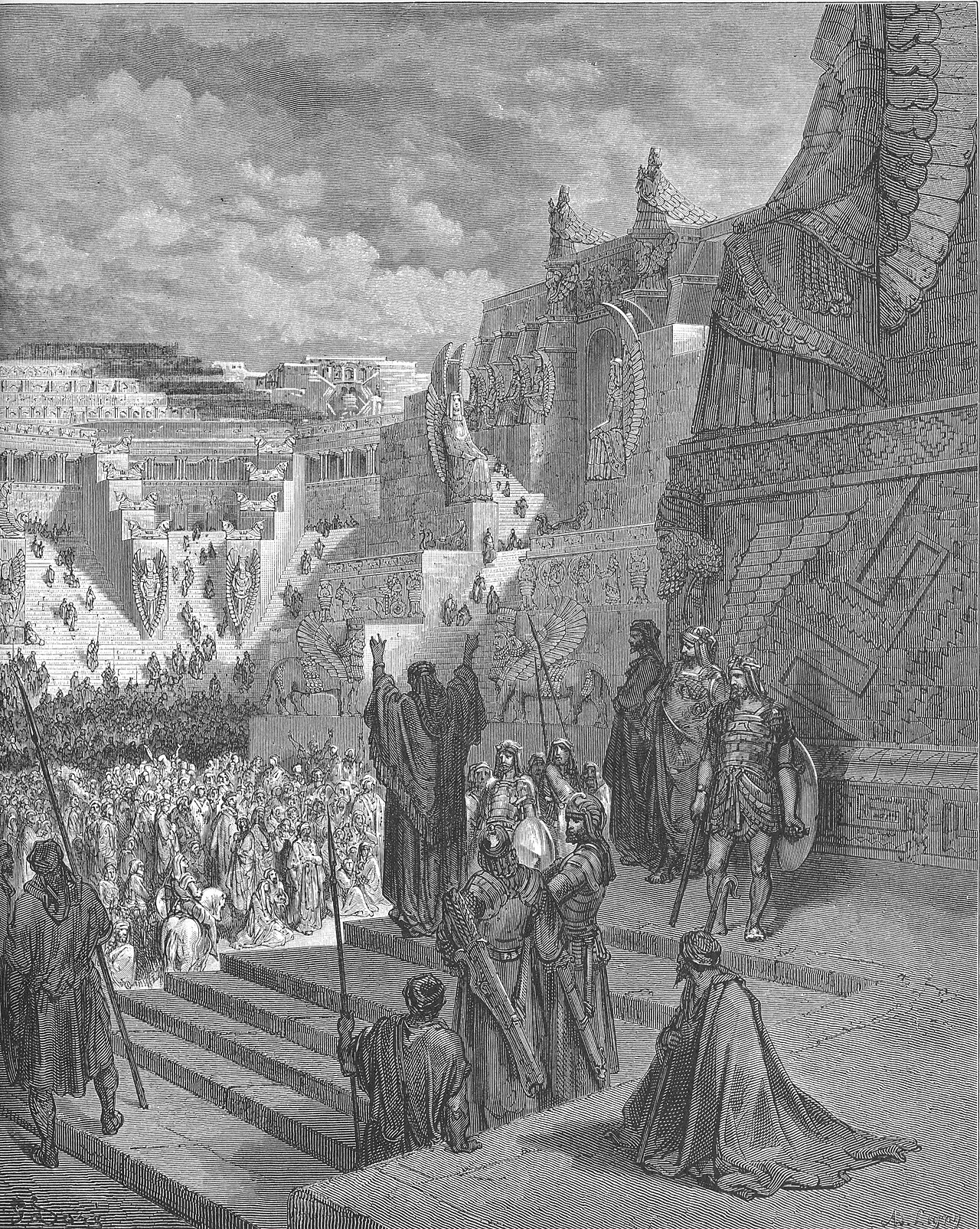
This chapter was written for a community that had a temple and had drifted from the Law it was built for. It opens the second part of the book and brings Ezra himself on stage, a priest by descent and a scribe by training. Its first hearers knew what a royal commission meant. The chapter joins a family line, a royal letter and a prayer in Ezra's own voice. Listen for the phrase about the hand of God that returns through the chapter, and for the three things Ezra set his heart to do. Read it as a teacher sent with a book.
Context
- Who
- A community that had a temple and had drifted from the book it was built for
- What
- An account of Ezra's descent, his going up to Jerusalem, the letter of Artaxerxes that authorised his work and Ezra's own thanksgiving.
- Where
- Babylon and the Persian court, the road to Jerusalem, and the region west of the Euphrates whose treasurers were told to supply him.
- When
- The seventh year of Artaxerxes, taken by most as Artaxerxes I in 458 BC, about fifty-eight years after the temple was finished; a minority place it under Artaxerxes II in 398 BC.
- Why
- To show that the LORD sent the returned community a teacher of His Law, with the backing of the Persian crown.
Historical context
There is a gap of about fifty-eight years between chapter 6 and chapter 7, the whole span in which the events of Esther take place. The temple has stood for two generations.
Show the rest of the historical context, 4 more paragraphs
Ezra is introduced by pedigree and profession: a priest descended from Aaron, and "a ready scribe in the law of Moses." A scribe was a professional literate official, and in the Persian system a scribe of a people's law could hold real state authority, an expert in the local legal tradition, empowered to administer it on the king's behalf.
The letter Artaxerxes gives him reads like exactly that kind of appointment. Ezra may take volunteers, carry the king's and the nobles' silver and gold, draw further supplies from the treasurers Beyond the River up to stated limits, appoint magistrates and judges, and teach those who do not know the laws of his God.
It also grants a tax exemption to priests, Levites, singers, gatekeepers, and temple servants. Exempting temple staff from tolls and tribute was a known Persian practice, and a similar exemption appears in a Greek-inscribed letter from a Persian king concerning a sanctuary.
The summary line about Ezra himself is the one the chapter turns on: he had prepared his heart to seek the law of the LORD, and to do it, and to teach in Israel statutes and judgments. That order, seek, do, teach, is the whole job description.
Significance
For the Jerusalem community, what arrived in 458 BC was not another construction crew. It was a teacher with a book and a royal mandate to apply it.
Show the rest of the significance, 1 more paragraph
The recurring phrase in the chapter is "according to the good hand of his God upon him." A Persian king signs a generous letter, and Ezra's explanation is a hand on his own life, not his standing at court.
This chapter in Jewish lifeWhat this chapter is in Jewish life and reading.
What is done
Ezra's coming to Jerusalem has no place in the synagogue year. The site's own table in src/lib/hebraic/readings.ts printed parashot total 0 and haftarah uses total 0 for Ezra, and no festival reading.
The chapter records the offerings the king provided for, and Rashi reads them through the law of the altar. The salt is given "according to the matter that is stated (Lev. 2:13)", the rule that every meal-offering is salted (Rashi on Ezra 7:21:1). Salt had no measure written, so it was given as much as was needed (Rashi on Ezra 7:22:1).
How it is read
Rashi is the one commentator on this chapter whose English the corpus carries, quoted here from The Judaica Press complete Tanach with Rashi, translated by A. J. Rosenberg, which Sefaria reports as CC-BY. He reads the chapter as following directly on the finished House. "After these incidents" means "of the building of the House" (Rashi on Ezra 7:1:1). The seventh year "is a year after the completion of the Temple" (Rashi on Ezra 7:7:1). The king who granted Ezra's request he names as Darius (Rashi on Ezra 7:6:1), and he names Darius again as the speaker of the king's decree (Rashi on Ezra 7:21:1). This follows his reading in chapter 4 that Cyrus, Darius and Artaxerxes are one name for the kingdom.
The going up he dates by the months. The ascent began on the first of Nissan, "and on the first of the month of Av they arrived in Jerusalem" (Rashi on Ezra 7:8:1). He reads the tenth verse as the reason Ezra prospered on the way. "Therefore, he went and prospered in his way, because Ezra prepared his heart, etc. He gives a reason for his words." (Rashi on Ezra 7:10:1).
The decree he reads clause by clause as the king's charge to Ezra. Any of Israel, the priests or the Levites whose heart prompts him may go (Rashi on Ezra 7:13:1). The servants of the House are freed from tribute: "no man shall be empowered over them to levy upon them any tribute or head tax" (Rashi on Ezra 7:24:1). Ezra's wisdom is greater than that of the judges beyond the river (Rashi on Ezra 7:25:1). At the blessing that closes the chapter Rashi names the writer. "Ezra wrote this in his Book when he gave thanks to the Holy One, blessed be He." (Rashi on Ezra 7:27:1).
The corpus carries one further note on this chapter without an English text, marked linked because Sefaria holds no English version of the ref. It stands cited and unquoted at Metzudat David on Ezra 7:5:1.
What the rabbis say
The corpus carries forty rabbinic locators on this chapter and the text of none, so each is cited here rather than quoted. On the fifth verse it holds Kohelet Rabbah 1:4:4 and Yalkut Shimoni on Nach 1068:4. On the sixth, where Rashi names the king as Darius, it holds Sanhedrin 21b:24, Bereshit Rabbah 37:3, Esther Rabbah 1:2 and Midrash Lekach Tov, Genesis 10:9:2. With them stand Midrash Tehillim 105:2, Seder Olam Rabbah 29:1, and a passage of Otzar Midrashim from the Baraita of Rabbi Pinchas Ben Yair, at 1:33.
The going up and the dates draw the next run. On the seventh verse the corpus holds Jerusalem Talmud Kiddushin 4:1:2. On the eighth it holds Rosh Hashanah 3b:3 and 3b:9, Arakhin 13a:4, Ein Yaakov, Rosh Hashanah 1:3 and Esther Rabbah 7:11. On the ninth it holds Bereshit Rabbati, Parashat Vayetze 76.
Ezra's preparing of his heart carries the heaviest weight. On the tenth verse the corpus holds Avot DeRabbi Natan 13:2 and Recension B 23:2, Jerusalem Talmud Sanhedrin 1:2:27, Ein Yaakov, Sanhedrin 2:16, Ein Yaakov (Glick Edition), Sanhedrin 2:15, and Midrash Tehillim 108:1. With them stands an entry of Introductions to Tanaitic Literature, Introduction to Halakhic Midrashim, Halakhic Midrash 20. On the eleventh it holds Jerusalem Talmud Shekalim 5:1:5 and two entries of the same Introductions, at Halakhic Midrash 22 and at Ancient Tannaitic Compilations 27.
The decree carries the rest. On the twenty-second verse the corpus holds Rosh Hashanah 4a:10, and on the twenty-third an entry of the Introductions to the tractates of the Mishnah, Eruvin 155. On the twenty-fourth, the freedom from tribute, it holds Bava Batra 8a:5, Ein Yaakov (Glick Edition), Bava Batra 1:6, Nedarim 62b:2 and Yalkut Shimoni on Torah 951:28. On the twenty-sixth, on whoever does not fulfill the law, it holds Moed Katan 16a:11 and Ein Yaakov, Moed Katan 3:3. With them stand the Introductions entry on Baba Batra, Chapter I, at 290, and a passage of Otzar Midrashim from Midrash Hashkem ('Arise Early'), at 15. On the twenty-seventh it holds Jerusalem Talmud Chagigah 2:1:3. The corpus also sets Pirkei DeRabbi Eliezer 34:14, 53:10 and 18:3 under anchors it prints as Ezra 7:35, 7:80-87 and 7:135-137. Those lie past the last verse its commentary on this chapter reaches, so they are listed here as the corpus gives them. What each of them teaches is a saying of the rabbis, and is reported as theirs wherever this site quotes one. The quotations wait on a fetch that carries the text.
Sources: Rashi, Rashi on Ezra 7:1:1 to 7:27:1, The Judaica Press complete Tanach with Rashi, translated by A. J. Rosenberg, reported CC-BY; Metzudat David, Metzudat David on Ezra 7:5:1, cited by ref because the corpus carries no English text; The Sefaria corpus, scripts/data/sources/sefaria/ezra/7.json, the 40 Talmud and Midrash locators of this chapter, three of them under the anchors Ezra 7:35, 7:80-87 and 7:135-137; The site's own files, src/lib/hebraic/readings.ts, probed for this book and printing parashot total 0, haftarah uses total 0 and festivalReadingForBook null.
The heads below are this chapter's scenes. The numbered points under each are its verses.
Ezra prepared his heart to seek, to do, and to teach
Ezra 7:1-5
during the reign of Artaxerxes king of Persia: Many years later marks a silence of roughly six decades. Ezra's pedigree runs to Aaron the chief priest, and John Wesley notes that several generations are omitted. Ezra 2:62 has already put priests without a recorded genealogy out of the priesthood, so this scribe's credentials stand before he speaks.
Ezra 7:1
“After these things - The words mark an interval of 57 years; if, with most commentators, we take Artaxerxes to be Longimanus. See the introduction to the Book of Ezra. Three kings named Artaxerxes, the Greek rendering of the Hebrew Artakhshasta, and the Persian Artakhshatra, ruled over Persia, namely,: Longimanus, Mnemon, and Ochus. The evidence is in favor of the first being meant here: he was the grandson of Darius Hystaspis, Jeshua’s contemporary. The genealogy of Ezra here is incomplete.”
1 more voice on this verseWhat preachers and commentators have said about this verse, in their own words.
Ezra 7:1
“Artaxerxes - The same of whom he speaks, chap. vi, 14. Here are divers persons omitted for brevity sake, which may be supplied out of 1 Chron. vi, 1-xi, 47. Ezra was not himself the high priest; but he was nearly related to him.”
John Wesley · Explanatory Notes upon the Old Testament (1765)evangelical
the son of Zadok: Shallum, Zadok and Ahitub stand in the order of 1 Chronicles 6:12 to 13, where Ahitub fathers Zadok, Zadok fathers Shallum, and Shallum fathers Hilkiah. That list carries two pairs named Ahitub and Zadok, the first at 6:8. This Zadok is the later one.
the son of Azariah: Between Meraioth and this Azariah, 1 Chronicles 6:7 to 10 names six generations that Ezra's list passes over: Amariah, Ahitub, Zadok, Ahimaaz, Azariah and Johanan. Albert Barnes calls Ezra's genealogy incomplete, and the gap falls here. The Azariah of this verse matches the one who served in Solomon's temple.
the son of Zerahiah: Zerahiah, Uzzi and Bukki match 1 Chronicles 6:5 to 6 name for name. Counting down from Aaron, Bukki is the fourth generation, Uzzi the fifth and Zerahiah the sixth. The two lists agree at every step from Aaron to Meraioth.
the son of Phinehas: The line reaches Aaron through Eleazar, one of the four sons named at 1 Chronicles 6:3, and through his son Phinehas. The roll of Ezra's company at 8:2 opens with Gershom of the house of Phinehas and Daniel of Ithamar. Wesley calls Ezra near kin to the high priest.
a scribe skilled in the Law of Moses: Ezra was a scribe skilled in the Law of Moses. Adam Clarke takes the term for one able to expound the law, the sense the New Testament gives the word scribe. The king granted all his requests, for the hand of the LORD his God was upon him.
Ezra 7:6
“A ready scribe - סופר מחיר sopher machir does not merely signify a speedy writer or an excellent penman, but one who was eminently skillful in expounding the law. In this sense the word γραμματευς, scribe, is repeatedly used in the New Testament, and we find that both in the Old and New Testament it had the same signification. The Syriac gives the sense of the word by translating sophro chocimo, a wise scribe, or expounder.”
Adam Clarke · Commentary on the Bible (1810-1826)evangelical
Ezra 7:7-9
in the seventh year of King Artaxerxes: Priests, Levites, singers, gatekeepers and temple servants go up with Ezra. He left Babylon on the first day of the first month and arrived on the first day of the fifth. Jamieson Fausset and Brown attribute the slow pace to a caravan carrying the aged, women, children and goods.
in the fifth month of the seventh year: The commentators differ on which king's seventh year this is. Albert Barnes takes Artaxerxes as Longimanus, grandson of Darius, and Bede reports that Josephus made him Xerxes. John Gill, with Jarchi and Aben Ezra, identifies him with the Darius of chapter 6.
Ezra 7:8
“He came to Jerusalem in the fifth month - From the following verse we learn that Ezra and his company set off from Babylon on the first day of the first month, and thus we find they were upwards of four months on their journey. They could not travel fast, as they were a great company, composed in part of the aged and infirm, besides multitudes of women and children. They appear also to have taken a circuitous route. See on Ezr 8:24-32 (note).”
Adam Clarke · Commentary on the Bible (1810-1826)evangelical
on the first day of the first month: Barnes puts the direct distance from Babylon to Jerusalem at about 520 miles, and the usual route at about 900. Ezra 8:31 has his company leave the Ahava Canal on the twelfth day of the first month. Barnes ties the four months to the dangers of 8:22.
Ezra 7:9
“The direct distance of Babylon from Jerusalem is about 520 miles; and the circuitous route by Carchemish and the Orontes valley, which was ordinarily taken by armies or large bodies of men, is about 900 miles. The time occupied in the journey is long, and is perhaps to be accounted for by the dangers alluded to in Ezr 8:22, Ezr 8:31.”
had set his heart to study the Law: Ezra had set his heart to study the Law of the LORD, to practice it, and to teach its statutes and ordinances in Israel. The order is the sentence's own argument, study before practice and practice before teaching. Adam Clarke gives the Hebrew verb the sense of fixed and determined.
Ezra 7:10
“Ezra had prepared his heart - Here is a fine character of a minister of God: He prepares, הכין hechin, he fixes, purposes, and determines, לבבו lebabo, with his heart - with all his powers and affections, to seek the law of God, and to do it himself, that he may be properly qualified to teach its statutes and judgments to Israel.”
Adam Clarke · Commentary on the Bible (1810-1826)evangelical
1 more voice on this verse
Ezra 7:10
“This use we must make of our knowledge of the scriptures; for happy are we if we do what we know of the will of God. (4.) He set himself to teach Israel the statutes and judgments of that law. What he knew he was willing to communicate for the good of others; for the ministration of the Spirit is given to every man to profit withal.”
Matthew Henry · Commentary on the Whole Bible (1707-1721)puritan
Artaxerxes writes: whatever is commanded by the God of heaven
Ezra 7:11-14
This is the text of the letter: The king's own letter follows, and verses 12 to 26 run in Aramaic. Artaxerxes styles himself king of kings, a title Adam Clarke notes was partly true of the Persian throne. Ezra is sent by the king to evaluate Judah and Jerusalem by the Law in his hand.
Ezra 7:11
“Now this is the copy of the letter that the King Artaxerxes gave unto Ezra the priest,.... This title relating to his office is justly given him, since he was the son of an high priest, and lineally descended from Aaron, as the above account of his pedigree shows: the scribe, even a scribe of the words of the commandments of the Lord, and of his statutes to Israel; the doubling of the word "scribe" shows that he was very wise and learned in the law, in the commandments and statutes of it the Lord gave to Israel; not only…”
Artaxerxes, king of kings: Adam Clarke gives the Persian form of the title as Ardsheer shahinshah, king of kings. The letter styles Ezra the scribe of the Law of God, and verse 21 repeats the title word for word to the treasurers. God of heaven is the name Cyrus used at 1:2.
Ezra 7:12
Artaxerxes, king of kings - This letter, from the beginning of this verse to the end of Ezr 7:26, is in the Aramitic or Chaldee language. This title of the king would, in Persian, run thus: Ardsheer shahinshah, or padshah, “Ardsheer, king of kings;” “great or supreme king, or emperor.”
Adam Clarke · Commentary on the Bible (1810-1826)evangelical
1 more voice on this verse
Ezra 7:12
“Artaxerxes, king of kings--That title might have been assumed as, with literal truth, applicable to him, since many of the tributary princes of his empire still retained the name and authority of kings.”
Jamieson, Fausset & Brown · Commentary Critical and Explanatory on the Whole Bible (1871)reformed
including the priests and Levites: The decree names priests and Levites among the volunteers. When the company mustered at the Ahava Canal, 8:15 records that Ezra found no Levites in it. He sent to Casiphia for them, and 8:18 to 20 lists those who came.
Ezra 7:13
“Their own free-will - None shall be forced either to go or to stay. He who loves his God will avail himself of this favorable opportunity.”
Adam Clarke · Commentary on the Bible (1810-1826)evangelical
which is in your hand: The king makes the Law of Ezra's God the measure of the inquiry into Judah and Jerusalem. He calls it a law in Ezra's hand, and verse 25 speaks in the same way of the wisdom of your God which you possess. Verse 6 calls it the Law of Moses.
Ezra 7:14
“Secondly, he was empowered to carry a large donation in money, partly from the royal treasury and partly raised by voluntary contributions among his countrymen, to create a fund out of which to make suitable provision for maintaining the regular worship of God in Jerusalem (Ezr 7:16, 17).”
Jamieson, Fausset & Brown · Commentary Critical and Explanatory on the Whole Bible (1871)reformed
Ezra 7:15-18
the silver and gold that the king: The king and his counselors first give silver and gold, freely offered to the God of Israel, whose dwelling is in Jerusalem. John Gill traces its use. Bulls, rams and lambs go to the altar, and Ezra and his brothers spend the rest "according to the will of your God."
Ezra 7:15
“Those that had been trained up in the knowledge and worship of the God of Israel, and had his law and his prophets, often plundered and impoverished the temple; but here a heathen prince enriched it. Thus afterwards the gospel was rejected by the Jews, but welcomed by the Gentiles. 11 , Through their fall salvation has come to the Gentiles.”
Matthew Henry · Commentary on the Whole Bible (1707-1721)puritan
all the silver and gold you may find: Matthew Henry sets this gift against the temple's history, when those who had the law and the prophets often plundered it. A heathen prince now enriches it. The whole contribution is weighed out at 8:26 as 650 talents of silver, 100 talents of silver articles and 100 talents of gold.
Ezra 7:16
“And all the silver and gold - The king and his counsellors had already made a present to the house of the God of Israel; and Ezra is now empowered to receive any contribution which any of the inhabitants of the province of Babylon may think proper to give.”
Adam Clarke · Commentary on the Bible (1810-1826)evangelical
their grain offerings and drink offerings: John Gill observes that grain and drink offerings always went with burnt offerings under the Law of Moses. He holds that Ezra or another Jew at court taught the king this detail. The returned exiles offered 12 bulls, 96 rams and 77 lambs.
Ezra 7:17
“That thou mayest buy speedily with this money,.... Thus freely contributed by one and another: bullocks, rams, lambs; which were for burnt offerings: with their meat offerings, and their drink offerings; which always went along with the burnt offerings, according to the law of Moses; and which the king seemed to have a right knowledge of, being, no doubt, instructed by Ezra, or some other Jew in his court: and offer them upon the altar of the house of your God which is in Jerusalem; the altar of burnt offering in the temple there.”
according to the will of your God: Adam Clarke reads the grant as the fullest liberty to order everything by their own institutions. The decision rests with Ezra and his brothers together. At 8:24 to 30 Ezra hands the silver and gold to twelve leading priests with Sherebiah, Hashabiah and ten of their brothers.
Ezra 7:18
“After the will of your God - He gave them the fullest liberty to order every thing according to their own institutions, binding them to no form or mode of worship.”
Adam Clarke · Commentary on the Bible (1810-1826)evangelical
Ezra 7:19-20
all the articles given to you: Ezra must deliver to the God of Jerusalem all the articles given to him. These sacred articles are handled with the same care as the money. Anything more the house needs, he may pay for from the royal treasury, a provision with no limit named in these two verses.
from the royal treasury: Gill reads the need as the adorning of the house of God, paid from the king's treasury where the tribute was kept. Darius had paid the builders from the royal treasury at 6:8. The king now supplies a finished house.
Ezra 7:20
“And whatsoever more shall be needful for the house of thy God, which thou shall have occasion to bestow,.... For the beautifying and ornamenting the temple, Ezr 7:27, bestow it out of the king's treasure house; where the money collected by tribute, tax, and custom, was deposited; his exchequer, as it may be called, see Ezr 6:8.”
Ezra 7:21-24
I, King Artaxerxes, decree to all the treasurers: Artaxerxes repeats his decree, now to all the treasurers west of the Euphrates. He asks why wrath should fall on the king and his sons. The priests, Levites, singers, doorkeepers and temple servants are exempt from tribute, duty or toll, and Adam Clarke notes they held no private revenue.
Ezra 7:21
“And I, even I Artaxerxes the king, do make a decree to all the treasurers which are beyond the river,.... The receivers of his tribute, tax, and custom, beyond the river Euphrates, on the side towards the land of Israel: that whatsoever Ezra the priest, the scribe of the law of the God of heaven; see Ezr 7:12, shall require of you, it be done speedily; which seems at first a grant at large for whatsoever he should want or demand, but is limited and restrained by what follows.”
1 more voice on this verse
Ezra 7:21
“All the treasurers - The Persian system of taxing the provinces through the satraps involved the establishment in each province of at least one local treasury.”
and salt without limit: Adam Clarke reckons each cor at a little more than seventy-five gallons, and each bath at seven gallons and five pints. Salt alone has no limit. Darius had listed salt among the daily supplies at 6:9.
Ezra 7:22
“A hundred talents of silver - The talent of silver was 450£. A hundred measures of wheat - A hundred cors; each cor was a little more than seventy-five gallons, one quart, and a pint, wine measure. A hundred baths of wine - Each bath was seven gallons and five pints.”
Adam Clarke · Commentary on the Bible (1810-1826)evangelical
Whatever is commanded by the God of heaven: Clarke reads the king as believing God had appointed him to this work, and fearing that the kingdom would be cut off from him. The decree of 6:10 asked the priests to pray for the king and his sons as well. Both decrees name the king's sons.
Ezra 7:23
“Why should there be wrath - As he believed he was appointed by the Almighty to do this work, he therefore wished to do it heartily, knowing that if he did not, God would be displeased, and that the kingdom would be cut off from him or his posterity.”
Adam Clarke · Commentary on the Bible (1810-1826)evangelical
1 more voice on this verse
Ezra 7:23
“And, finally, in the expression of the king's desire for the divine blessing upon the king and his government (Ezr 7:23), we see the strong persuasion which pervaded the Persian court, and had been produced by the captivity of the Hebrew people, as to the being and directing providence of the God they worshipped.”
Jamieson, Fausset & Brown · Commentary Critical and Explanatory on the Whole Bible (1871)reformed
tribute, duty, or toll: Tribute, duty and toll are the three taxes the opponents at 4:13 warned the king a rebuilt Jerusalem would stop paying. Artaxerxes now forbids his officials to levy them on anyone who serves the temple. The exempt classes match the company of verse 7.
Ezra 7:24
“It shall not be lawful to impose toll - As these persons had no private revenues, it would have been unreasonable to have laid them under taxation.”
Adam Clarke · Commentary on the Bible (1810-1826)evangelical
Ezra 7:25-26
appoint magistrates and judges to judge all: Ezra is to appoint magistrates and judges for all the people west of the Euphrates who know the laws of his God. The Persian penalties are death, banishment, confiscation of property or imprisonment. Adam Clarke counts these as almost every punishment a state of that day could inflict.
Ezra 7:25
“If any good appear to be in our own hearts, or in the hearts of others, we must own it was God that put it there, and bless him for it; for it is he that worketh in us both to will and to do that which is good.”
Matthew Henry · Commentary on the Whole Bible (1707-1721)puritan
let a strict judgment be executed: Penalties of this kind return at 10:8. Anyone who failed to come to Jerusalem within three days would forfeit his property and be expelled from the assembly of the exiles. Adam Clarke traces Ezra's authority in chapter 10 to this decree.
Ezra 7:26
“Whether it be unto death - These include almost every species of punishment which should be inflicted on culprits in any civilized state. With this verse the Chaldee part of this chapter ends.”
Adam Clarke · Commentary on the Bible (1810-1826)evangelical
Blessed be the LORD who put this in the king's heart
Ezra 7:27-28
Blessed be the LORD: Ezra's own voice breaks in, blessing the LORD for putting it into the king's heart to honor the house of the LORD in Jerusalem. The chapter closes on the confidence of verses 6 and 9: "the hand of the LORD my God was upon me".
Ezra 7:27
“Blessed be the Lord God of our fathers,.... This is Ezra's thanksgiving to God for the above decree: which hath put such a thing as this in the king's heart; which he rightly took to be of God, who wrought in him to will and to do: to beautify the house of the Lord which is in Jerusalem; to provide for the ornamenting of it, for vessels in it, as well as for sacrifices; for as for the building of it, that was finished.”
2 more voices on this verse
Ezra 7:27
“An abrupt transition from the words of Artaxerxes to those of Ezra. Compare a similar abrupt change in Ezr 6:6. The language alters at the same time from Chaldee to Hebrew, continuing henceforth to be Hebrew until the close of the book.”
Ezra 7:27
“He was one of the sons of Aaron, a priest. Him God chose to be an instrument of good to Israel, that he might put honour upon the priesthood, the glory of which had been much eclipsed by the captivity. He is said to be the son of Seraiah, that Seraiah, as is supposed, whom the king of Babylon put to death when he sacked Jerusalem, 2 Kings xxv.”
Matthew Henry · Commentary on the Whole Bible (1707-1721)puritan
I took courage and gathered the leaders: Bede reads the hand of God as the power of God that works all things. John Wesley draws from the clause that God must have all the glory for any service done. Chapter 8 names these leaders house by house.
Ezra 7:28
“And I was strengthened - In what the king decreed he saw the hand of God; he therefore gave him the praise, and took courage. There is a most amiable spirit of piety in these reflections. Ezra simply states the case; shows what the king had determined, and tells what he said; and then points out the grand agent in the whole business - it was the Lord God of his fathers.”
Adam Clarke · Commentary on the Bible (1810-1826)evangelical
1 more voice on this verse
Ezra 7:28
“As the hand, &c. - If God gives us his hand, we are bold and chearful: if he withdraws it, we are weak as water. Whatever service we are enabled to do for God and our generation, God must have all the glory of it.”
John Wesley · Explanatory Notes upon the Old Testament (1765)evangelical
Keep studying
Studies6
Words11
Sources for this chapter
The summary
Jamieson, Fausset & Brown, Commentary Critical and Explanatory; John Wesley, Notes on the Old Testament and Matthew Henry, Complete Commentary.
The context
C. F. Keil, The Books of Ezra, Nehemiah, and Esther and Matthew Henry, Commentary on the Whole Bible.
The exposition
Adam Clarke, Commentary on the Bible; Albert Barnes, Notes, Explanatory and Practical, on the Old and New Testaments (1832-1869); Bede, Commentary on Ezra and Nehemiah; Berean Standard Bible; Jamieson Fausset and Brown, Commentary Critical and Explanatory on the Whole Bible; John Gill; John Wesley, Explanatory Notes upon the Old Testament; Keil, The Books of Ezra, Nehemiah, and Esther and Matthew Henry, Commentary on the Whole Bible.