
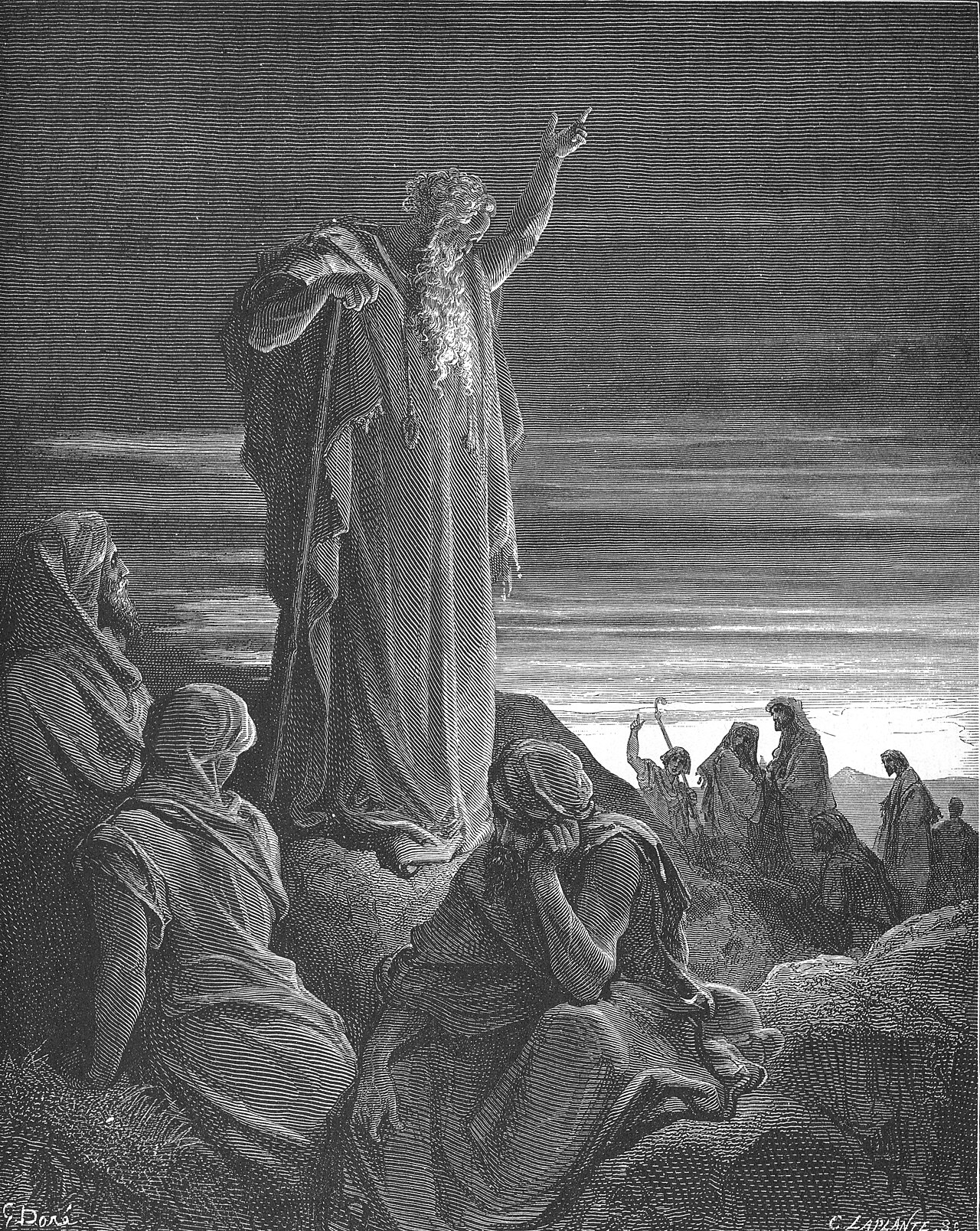
Ezekielchapter 1
28 verses · Ezekiel · 593 to 571 BC · The Prophets
Above the expanse over their heads was the likeness of a throne with the appearance of sapphire, and on the throne high above was a figure like that of a man.
Introduction
Ezekiel, The Prophets, Ezekiel Overview.
Ezekiel was a priest who should have begun serving at the temple in the year this chapter opens, and instead he was living in a work camp in Babylonia. He wrote for fellow exiles who believed that God dwelt in Jerusalem and had stayed behind there. The chapter is the first thing he saw, and he tells it with a priest's eye for order and detail. Listen for how often he writes likeness and appearance, as he reaches for words and keeps falling short. Hold on to the throne, because the whole book follows where it goes.
Context
- Who
- Exiles by the canal who still believed Jerusalem could not fall and that God had stayed behind in it
- What
- A vision of the living creatures, the wheels and the throne of God, given to a priest at the start of his call.
- Where
- Beside the Kebar canal in the land of the Chaldeans, in southern Babylonia.
- When
- The fifth year of King Jehoiachin's exile, about July 593 BC, a date the chapter gives itself.
- Why
- To show exiles far from the temple that the LORD reigns and comes to His people wherever they are.
Historical context
The Chebar was not a river in our sense. Babylonia ran on canals, engineered channels that carried Euphrates water across a flat, hot plain to water barley fields and date palms. Business tablets recovered from the city of Nippur name a waterway called the Kabaru, the Grand Canal, and that is almost certainly Ezekiel's Chebar. Deportees were parked along these channels in work villages and put to farming.
Show the rest of the historical context, 3 more paragraphs
Deportation was Babylonian policy, not random cruelty. When Jerusalem surrendered in 597 BC, Nebuchadnezzar took the young king Jehoiachin, the royal family, the officers, the metalworkers and the skilled craftsmen, the whole leadership class, and left the poor behind under a puppet king. Clay ration tablets dug up in Babylon list oil issued to Yaukin, king of the land of Yahud, and to his sons. The deported king was kept alive at royal expense, a hostage in reserve.
Ezekiel was a priest, the son of Buzi. The thirtieth year in his opening line is most simply his own age, the age at which a priest entered full service at the sanctuary. He should have been putting on linen in Jerusalem that summer. He was sitting beside an irrigation ditch in a foreign country instead.
The creatures would not have looked as alien to him as they do to us. Assyrian and Babylonian palace doorways were guarded by carved composite beings, the human-headed winged bull, the winged genie, set there to keep out what should not enter. Thrones of gods and kings were carried in procession or set on wheeled platforms. What Ezekiel sees is the real version: a throne that travels anywhere, on wheels that never have to turn to change direction, carried by living guardians.
Significance
Everything the exiles believed about where God could be found was tied to one building on one hill six hundred miles behind them. If God lived in the temple, then the people by the canal were cut off and the people still in Jerusalem were the safe ones.
Show the rest of the significance, 1 more paragraph
So the first thing Ezekiel is shown is the throne moving, arriving in Babylon, over a drainage canal, in the country of the winners. Before a single word of judgment is spoken, the exiles learn two things at once: God is not stuck in Jerusalem, and He has not lost.
This chapter in Jewish lifeWhat this chapter is in Jewish life and reading.
What is done
The site's table of synagogue readings ties no weekly portion and no Haftarah to this chapter. Probed for this lane, src/lib/hebraic/readings.ts printed parashot 0 and haftarah uses 0 for Ezekiel 1, and no festival reading for the book. The table holds the Haftarah of each weekly portion and the six books read whole on a feast or a fast. Across chapters 1 to 24 of Ezekiel the same probe found a Haftarah only in chapters 20 and 22.
How it is read
Rashi is the main commentator on this chapter in the corpus. He is quoted here from The Judaica Press complete Tanach with Rashi, translated by A. J. Rosenberg, which Sefaria reports as CC-BY. The translation is modern, so every quotation from it is fifty words or fewer.
Rashi opens on the date. The prophet "presented his words obscurely and did not tell his name" (Rashi on Ezekiel 1:1:1), so the next two verses break in to say who he was and where his count begins. Rashi counts the thirty years "from the beginning of the jubilee" (Rashi on Ezekiel 1:2:1). That jubilee began in the eighteenth year of Josiah, the year the scroll of the law was found in the Temple.
The third verse raises the question of a prophet in Babylon. Rashi reports the Sages in the Mekhilta, who read the doubled verb as a word that "had already come" to him. The reason they give is "because the Shechinah does not rest upon a prophet outside the [Holy] Land, except by having first rested upon him in the Land" (Rashi on Ezekiel 1:3:1).
The storm from the north "is the Chariot of the throne of the glory of the Shechinah" (Rashi on Ezekiel 1:4:1). It is drawn as a tempest because it came in fury to destroy Israel. The human face among the four "had the countenance of our father Jacob" (Rashi on Ezekiel 1:5:1). Rashi counts sixteen faces and sixty-four wings on each living being (Rashi on Ezekiel 1:6:1). The legs had no knee joints "because they do no sitting or lying" (Rashi on Ezekiel 1:7:1).
The spirit that moves the living beings is "The will of the Holy One, blessed be He" (Rashi on Ezekiel 1:20:1). At the sound of the wings Rashi sets the chapter beside Psalm 29, where the voice of the Lord breaks the cedars (Rashi on Ezekiel 1:24:1).
The corpus carries 1 note on this chapter without an English text, marked linked. Metzudat David's note stands at 1:10:1. It stands cited and unquoted, because Sefaria holds no English version of the ref.
What the rabbis say
The corpus carries 40 rabbinic locators on the verses of this chapter, 9 filed under the Talmud and 31 under the Midrash. It carries the text of none, so each is cited by ref here and never quoted or paraphrased. The verse numbers are the Hebrew ones the corpus prints.
On verse 1 it holds Aggadat Bereshit 68:1 and Bereshit Rabbah 16:3. On verse 3 it holds Bereshit Rabbati, Parashat Vayishlach 26 and Ein Yaakov (Glick Edition), Moed Katan 3:9. On verse 4 it holds Chagigah 13b:3 and Otzar Midrashim, Maaseh Beraishit & Maaseh Merkavah, Introduction 4. On verse 5 it holds Devarim Rabbah 2:20 and Devarim Rabbah 8:2. On verse 6 it holds Chagigah 13b:8 and Midrash Aggadah, Leviticus 22:27:11.
On verse 7 it holds Berakhot 10b:28 and Midrash Tanchuma Buber, Emor 11:1. On verse 8 it holds Ein Yaakov (Glick Edition), Berakhot 1:54 and Ein Yaakov (Glick Edition), Pesakhim 10:20. On verse 10 it holds Aggadat Bereshit 38:2 and Avodah Zarah 43b:1. On verse 12 it holds Otzar Midrashim, Midrashim of Rabbi Eliezer, The Chapter of Rabbi Eliezer ben Hurkanus 6. On verse 13 it holds Bamidbar Rabbah 15:7 and Midrash Lekach Tov, Exodus 27:20:5.
On verse 14 it holds Bamidbar Rabbah 12:8 and Bereshit Rabbah 50:1. On verse 15 it holds Chagigah 12b:14 and Chagigah 13b:4. On verse 17 it holds Midrash Aggadah, Exodus 32:4:1 and Midrash Lekach Tov, Exodus 32:4:1. On verse 18 it holds Aggadat Bereshit 45:1 and Midrash Tanchuma Buber, Toldot 20:1. On verse 19 it holds Midrash Tanchuma Buber, Tzav 16:1 and Midrash Tanchuma, Tzav 12:1.
On verse 22 it holds Chagigah 13a:1 and Ein Yaakov (Glick Edition), Khagigah 2:10. On verse 24 it holds Midrash Lekach Tov, Exodus 24:17:1 and Midrash Tanchuma Buber, Beshalach 13:3. On verse 25 it holds Bereshit Rabbah 65:21 and Jerusalem Talmud Berakhot 1:1:18. On verse 26 it holds Bamidbar Rabbah 17:5 and Bamidbar Rabbah 19:4. On verse 27 it holds Chagigah 13a:10 and Midrash Sekhel Tov, Shemot 12:20:50.
On verse 28 it holds Bamidbar Rabbah 14:3.
What each of them teaches is a saying of the rabbis, and is reported as theirs wherever this site quotes one. The quotations wait on a fetch that carries the text.
Sources: Rashi, Rashi on Ezekiel 1:1:1 to 1:24:1, The Judaica Press complete Tanach with Rashi, translated by A. J. Rosenberg, reported CC-BY; Metzudat David, Metzudat David on Ezekiel 1:10:1, cited by ref only: Sefaria holds no English version of the ref; The Sefaria corpus, scripts/data/sources/sefaria/ezekiel/1.json, the 40 Talmud and Midrash locators on the verses of this chapter; The site's own files, src/lib/hebraic/readings.ts, probed for Ezekiel 1: parashot 0, haftarah uses 0, no festival reading for the book.
The heads below are this chapter's scenes. The numbered points under each are its verses.
By the river Chebar, the heavens open
Ezekiel 1:1-3
the heavens opened: The date is given twice: “the thirtieth year” and “the fifth year of the exile of King Jehoiachin.” Many take the thirtieth year as Ezekiel’s own age, the age at which Numbers 4:3 has men begin their service. The word comes to “Ezekiel the priest” far from the temple.
Ezekiel 1:1
“The Prophet Ezekiel was led captive with Joachin king of Judah to Babylon, and he prophesied there to those who were captives with him, to those repenting that they had willingly handed over the prophecy of Jeremiah to enemies, and yet saw the city Jerusalem to stand, which he had predicted would fall. And in his thirtieth year of age, and in the fifth year of the captivity, he began to speak to his fellow captives. And at the same time, though later, this one in Chaldea and Jeremiah in Judea prophesied.”
Jerome · written before 420 · Prologue to Ezekielpatristic
2 more voices on this verseWhat preachers and commentators have said about this verse, in their own words.
Ezekiel 1:1
“The thirtieth year - being closely connected with as I, is rather in favor of considering this a personal date. It is not improbable that Ezekiel was called to his office at the age prescribed in the Law for Levites Num 4:23, Num 4:30, at which age both John the Baptist and our Lord began their ministry. His call is probably to be connected with the letter sent by Jeremiah to the captives Jer. 29 written a few months previously.”
Ezekiel 1:1
“We nowhere read that succeeding writers adopted this date as a standard. Besides, there is no doubt that the usual method among the Jews was to begin to reckon from a Jubilee. For this was a point of starting for the future.”
John Calvin · Commentaries (1554)reformed
the exile of King Jehoiachin—: The date is counted from the exile of King Jehoiachin. Jamieson, Fausset and Brown name two carryings away: the first under his father Jehoiakim, which took Daniel, and the second under Jehoiachin, which took Ezekiel. The fifth year of that exile is the year of this vision.
Ezekiel 1:2
“Jehoiachin's captivity--In the third or fourth year of Jehoiakim, father of Jehoiachin, the first carrying away of Jewish captives to Babylon took place, and among them was Daniel. The second was under Jehoiachin, when Ezekiel was carried away.”
Jamieson, Fausset & Brown · Commentary Critical and Explanatory on the Whole Bible (1871)reformed
2 more voices on this verse
Ezekiel 1:2
“The Holy Spirit descended on Christ and remained; he descends on people, assuredly, but does not remain. Furthermore, in the scroll of Ezekiel, who is properly a type of the Savior—no other prophet, I mean of the major prophets, is called, "Son of man"; the title is given strictly to Ezekiel.”
Jerome · written before 420 · HOMILIES ON MARK 75 (Mk 1:1-12)patristic
Ezekiel 1:2
“Jehoiachin’s captivity - Called also Jeconiah and Coniah; see 2Ki 24:12. He was carried away by Nebuchadnezzar; see 2Ki 24:14.”
Adam Clarke · Commentary on the Bible (1810-1826)evangelical
Ezekiel the priest, the son of Buzi: Ezekiel names himself a priest, the son of Buzi, living in the land of the Chaldeans. The word came directly to him there, far from the temple. Albert Barnes reads the LORD's hand upon him as a power that moved the prophet apart from his own will.
Ezekiel 1:3
“The word of the Lord came expressly,.... Or, "in being was" (d); which phrase denotes the reality, certainty, substantiality and evidence of the word of the Lord to him: unto Ezekiel the priest, the son of Buzi; which Buzi, some say, was Jeremiah.”
3 more voices on this verse
Ezekiel 1:3
“Came expressly - The phrase marks that it was in truth a heaven-sent vision. The hand of the Lord - A phrase in all prophecy implying a “constraining” power, because the spirit “constrains” the prophet independently of his own will.”
Ezekiel 1:3
“The word - What was visions, ver. 1, is here the word, both as signifying and declaring the mind of God, what he would do, and as continuing his commands to Ezekiel and to the people. Ezekiel - He speaks of himself in a third person. Priest - He was of the priests originally; he was a prophet by an extraordinary call.”
John Wesley · Explanatory Notes upon the Old Testament (1765)evangelical
Ezekiel 1:3
“It was upon him (as upon St. John, Rev. i. 17 ), to revive and support him, that he might bear up, and not faint, under these discoveries, that he might neither be lifted up nor cast down with the abundance of the revelations. God's grace is sufficient for him, and, in token of that, his hand is upon him.”
Matthew Henry · Commentary on the Whole Bible (1707-1721)puritan
A storm out of the north and four living creatures
Ezekiel 1:4-5
a whirlwind coming from the north: The vision comes “from the north,” the quarter from which Jeremiah 1:14 says disaster would be poured out. First comes a storm: “a great cloud with fire.” Within the fire is “the form of four living creatures,” of whom the first thing said is “They had a human form.”
Ezekiel 1:4
“A whirlwind came out of the north - Nebuchadnezzar, whose land, Babylonia, lay north of Judea. Chaldea is thus frequently denominated by Jeremiah. A great cloud, and a fire infolding itself - A mass of fire concentrated in a vast cloud, that the flames might be more distinctly observable, the fire never escaping from the cloud, but issuing, and then returning in upon itself. It was in a state of powerful agitation; but always involving itself, or returning back to the center whence it appeared to issue.”
Adam Clarke · Commentary on the Bible (1810-1826)evangelical
the form of four living creatures: Within the fire and the cloud Ezekiel sees four living creatures. Their first mark is a human form. Adam Clarke traces the order of the scene: the creatures come out of the center of the fire, and the fire sits within the cloud.
Ezekiel 1:5
“Living creatures - The Hebrew word answers very nearly to the English “beings,” and denotes those who live, whether angels, men (in whom is the breath of life), or inferior creatures.”
Ezekiel 1:6-9
four faces and four wings: Each creature had “four faces and four wings.” Under the wings were “human hands,” and “their wings were touching one another,” so the four moved as one rank. The text states the rule of their motion plainly: “They did not turn as they moved; each one went straight ahead.”
Ezekiel 1:6
“Every one had four faces - There were four several figures of these living creatures, and each of these figures had four distinct faces: but as the face of the man was that which was presented to the prophet’s view, so that he saw it more plainly than any of the others; hence it is said, Eze 1:5, that each of these figures had the likeness of a man; and the whole of this compound image bore a general resemblance to the human figure.”
Adam Clarke · Commentary on the Bible (1810-1826)evangelical
Their legs were straight: The legs of the creatures were straight and upright, like a man's. Albert Barnes reads the calf's hoof as a solid foot for a being that faced out on each of its four sides. The feet gleamed like polished bronze.
Ezekiel 1:7
“The “foot” seems here to mean the lower part of the leg, including the knee, and this was “straight,” i. e. upright like a man’s. The “sole” is the “foot” as distinguished from the “leg,” the leg terminated in a solid calf’s hoof. This was suitable for a being which was to present a front on each of its four sides.”
2 more voices on this verse
Ezekiel 1:7
“The sole of their feet was like that of a calf's foot, which divides the hoof and is therefore clean: as it were the sole of a round foot (as the Chaldee words it); they were ready for motion any way. Their feet were winged (so the LXX.); they went so swiftly that it was as if they flew.”
Matthew Henry · Commentary on the Whole Bible (1707-1721)puritan
Ezekiel 1:7
“Or, like solid pillars; not bending, as man's, at the knee. They glided along, rather than walked. Their movements were all sure, right, and without effort [KITTO, Cyclopedia]. sole . . . calf's foot--HENDERSON hence supposes that "straight feet" implies that they did not project horizontally like men's feet, but vertically as calves' feet.”
Jamieson, Fausset & Brown · Commentary Critical and Explanatory on the Whole Bible (1871)reformed
they had human hands: Under their wings, on all four sides, the creatures had human hands. Matthew Henry reads the hands as made for service and guided by reason, so the creatures act with judgment. Each of the four had faces and wings.
Ezekiel 1:8
They had the hands of a man under their wings - I doubt much whether the arms be not here represented as all covered with feathers, so that they had the appearance of wings, only the hand was bare; and I rather think that this is the meaning of their having “the hands of a man under their wings.”
Adam Clarke · Commentary on the Bible (1810-1826)evangelical
each one went straight ahead: The wings of the creatures touched one another, and they did not turn as they moved. Matthew Henry takes the straight course as a picture of a single aim with no hidden purpose. Each one went where it faced.
Ezekiel 1:9
“Two of the wings were in the act of flying, so stretched out that the extremity of each touched a wing of a neighboring living creature, similarly stretched out. This was only when they were in motion. See Eze 1:24. They went every one straight forward - The four together formed a square, and never altered their relative position.”
Ezekiel 1:10-12
the face of a lion on the right side: Each creature had a man’s face. Revelation 4:7 gives the four living creatures the likeness of a lion, a calf, a man and an eagle. Two wings touched “the wings of the creature on either side,” two were “covering its body,” and “Wherever the spirit would go, they would go.”
Ezekiel 1:10
“As for the likeness of their faces - There was but one body to each of those compound animals: but each body had four faces; the face of a man and of a lion on the right side; the face of an ox and an eagle on the left side. Many of these compound images appear in the Asiatic idols. Many are now before me: some with the head and feet of a monkey, with the body, arms, and legs of a man. Others with the head of the dog; body, arms, and legs human.”
Adam Clarke · Commentary on the Bible (1810-1826)evangelical
2 more voices on this verse
Ezekiel 1:10
“A man - Each face is compared to what is most excellent in its kind, man excels in wisdom, lions in strength, the ox in patience and constancy of labour, the eagle in speed and high flight.”
John Wesley · Explanatory Notes upon the Old Testament (1765)evangelical
Ezekiel 1:10
“The Fathers identified them with the four Gospels: Matthew the lion, Mark the ox, Luke the man, John the eagle. Two cherubim only stood over the ark in the temple; two more are now added, to imply that, while the law is retained as the basis, a new form is needed to be added to impart new life to it.”
Jamieson, Fausset & Brown · Commentary Critical and Explanatory on the Whole Bible (1871)reformed
Their wings were spread upward: Each creature had four wings with two tasks. Two wings were spread upward, each meeting a wing of the creature beside it, and two covered its body. Albert Barnes compares the covering wings with the seraphim of Isaiah 6.
Ezekiel 1:11
“However holy men may be in this life, they still have that which they ought to cover before the eyes of God, because it is utterly impossible that they should never sin in deed, or in speech, or in thought. Hence blessed Job, who had indeed spoken perfect things to men, yet hearing the voice of God and reproving himself for that very perfect speech of his, said: "I will lay my hand upon my mouth." For in the hand is work, in the mouth is speech.”
Gregory the Dialogist · written before 604 · Homilies on Ezekiel, Book 1, Homily 4patristic
1 more voice on this verse
Ezekiel 1:11
“The joining together of their wings above implies that, though the movements of Providence on earth may seem conflicting and confused, yet if one lift up his eyes to heaven, he will see that they admirably conspire towards the one end at last.”
Jamieson, Fausset & Brown · Commentary Critical and Explanatory on the Whole Bible (1871)reformed
Wherever the spirit would go, they would go: The four creatures moved as one body under one guide. Wherever the spirit would go, they went, straight ahead and without turning. Albert Barnes sees one spirit and one conscious life guiding the whole in perfect harmony.
Ezekiel 1:12
“Straight - Which way soever they went, each living creature had one face looking straight forward. The spirit - The will, command, and breathing of the Spirit of God, both gave and guided their motions. Was to go - Going is attributed here to the Spirit of God, by allusion, for he who is in every place cannot properly be said to go from or to any place.”
John Wesley · Explanatory Notes upon the Old Testament (1765)evangelical
1 more voice on this verse
Ezekiel 1:12
“They went every one straight forward - Not by progressive stepping, but by gliding. Whither the spirit was to go - Whither that whirlwind blew, they went, being borne on by the wind, see Eze 1:4.”
Adam Clarke · Commentary on the Bible (1810-1826)evangelical
Ezekiel 1:13-14
glowing coals of fire: Among the creatures was “the appearance of glowing coals of fire, or of torches.” The creatures matched the fire, “darting back and forth as quickly as flashes of lightning.” The word “appearance” here, like the word likeness in Ezekiel 1:26, is the prophet’s repeated way of giving the nearest comparison.
Ezekiel 1:13
Lamps - “like the appearance of” flames. Omit the “and” before “like.” The “bright flames” resembled “coals of fire.” It went up - i. e. “fire went up.”
1 more voice on this verse
Ezekiel 1:13
“So in Isa 6:2, 6, instead of cherubim, the name "seraphim," the burning ones, is applied, indicating God's consuming righteousness; whence their cry to Him is, "Holy! holy! holy!" and the burning coal is applied to his lips, for the message through his mouth was to be one of judicial severance of the godly from the ungodly, to the ruin of the latter. lamps--torches.”
Jamieson, Fausset & Brown · Commentary Critical and Explanatory on the Whole Bible (1871)reformed
flashes of lightning: The creatures were darting back and forth like flashes of lightning. Matthew Henry pictures them running to do their work below and returning quickly to God. Both the going and the return are quick.
Ezekiel 1:14
“The living creatures ran and returned - They had a circular movement; they were in rapid motion, but did not increase their distance from the spectator. So I think this should be understood.”
Adam Clarke · Commentary on the Bible (1810-1826)evangelical
Wheels within wheels, rims full of eyes
Ezekiel 1:15-18
a wheel on the ground: The prophet saw “a wheel on the ground beside each creature,” gleaming like beryl, each looking like “a wheel within a wheel.” Many read this as two wheels set crosswise, which fits the text’s statement that “they went in any of the four directions.” Their rims “were high and awesome.”
Ezekiel 1:15
“Translate it: “one wheel upon the earth by” each of “the liviing creatures” on his four sides (i. e. on the four sides of each of the living creatures). There was a wheel to “each” of the living creatures: it was set “by,” i. e. immediately “beneath” the feet of the living creature, and was constructed for direct motion in any of the four lines in which the creatures themselves moved.”
1 more voice on this verse
Ezekiel 1:15
“The cherubim and their wings and wheels stood in contrast to the symbolical figures, somewhat similar, then existing in Chaldea, and found in the remains of Assyria. The latter, though derived from the original revelation by tradition, came by corruption to symbolize the astronomical zodiac, or the sun and celestial sphere, by a circle with wings or irradiations.”
Jamieson, Fausset & Brown · Commentary Critical and Explanatory on the Whole Bible (1871)reformed
a wheel within a wheel: The wheels gleamed like beryl, and all four looked the same. Jamieson, Fausset and Brown note that beryl was one of the stones on the high priest's breastplate. They read the matching wheels as a sign of order in God's works, and each looked like a wheel within a wheel.
Ezekiel 1:16
“It was one of the gems in the breastplate of the high priest (Ex 28:20; Da 10:6). four had one likeness--The similarity of the wheels to one another implies that there is no inequality in all God's works, that all have a beautiful analogy and proportion.”
Jamieson, Fausset & Brown · Commentary Critical and Explanatory on the Whole Bible (1871)reformed
2 more voices on this verse
Ezekiel 1:16
“The wheel within a wheel is life under the law, life under grace; inasmuch as Jews are within the church, the law is included in grace. For one is within the church who is a Jew secretly; and circumcision of the heart is a sacrament within the church. But that Jewish people are within the church of which it is written: "In Judah is God known"; therefore as wheel runs within wheel, in the same way the wings were still and the wings were flying.”
Ambrose of Milan · written before 397 · On the Holy Spirit 3.21.162patristic
Ezekiel 1:16
“Work - All that was wrought, whether engraved or otherwise was of one colour. One likeness - The same for dimensions, colour, frame, and motion. In the middle - It is probable, the wheels were framed so as to be an exact sphere, which is easily rolled to any side.”
John Wesley · Explanatory Notes upon the Old Testament (1765)evangelical
without pivoting as they moved: The wheels could go in any of four directions with no pivoting. John Gill pictures two crossing rings, so a wheel could roll east, west, north or south with no need to turn about. The creatures above them also went straight ahead.
Ezekiel 1:17
“When they went, they went upon their four sides,.... On either of their crossing rings, as they were directed by the living creatures, at whose side they stood: and they returned not when they went; they had no need to turn about when they were to go east, west, north, or south, as wheels usually do; but they turned upon the crossing ring, which was towards either of the four points.”
1 more voice on this verse
Ezekiel 1:17
“Upon their four sides - i. e. straight in the direction toward which their faces looked. Since the four quarters express all directions, the construction of the living creatures was such that they could move in each direction alike.”
full of eyes all around: The rims of the wheels were high and awesome. Albert Barnes weighs two readings of the eyes: bright spots, or a sign of God's will, as in 2 Chronicles 16:9. He thinks the second more likely.
Ezekiel 1:18
“As for their rings - The strakes which form the rim or periphery. They were dreadful - They were exceedingly great in their diameter, so that it was tremendous to look from the part that touched the ground to that which was opposite above. Were full of eyes - Does not this refer to the appearance of nails keeping on the spokes, or strakes or bands upon the rim?”
Adam Clarke · Commentary on the Bible (1810-1826)evangelical
1 more voice on this verse
Ezekiel 1:18
“Three, however, are indicated both in the animals and in the wheels, when they stood, when they walked, when they were lifted up, which both the animals and the wheels did in common. For neither could animals that were standing walk on wheels, nor could animals walking on the ground lift themselves on wheels, but of those actions, one was rest, one was motion, and elevation.”
Jerome · written before 420 · Commentary on Ezekielpatristic
Ezekiel 1:19-21
the wheels moved beside them: The wheels followed the creatures in every motion: “When the creatures moved, the wheels moved; when the creatures stood still, the wheels stood still.” Twice, in verses 20 and 21, the text gives the one reason, “because the spirit of the living creatures was in the wheels.”
Ezekiel 1:19
“When the living creatures went, the wheels went - The wheels were attached to the living creatures, so that, in progress, they had the same motion.”
Adam Clarke · Commentary on the Bible (1810-1826)evangelical
1 more voice on this verse
Ezekiel 1:19
“The reason given of this is because the spirit of the living creatures was in the wheels; the same wisdom, power, and holiness of God, the same will and counsel of his, that guides and governs the angels and all their performances, does, by them, order and dispose of all the motions of the creatures in this lower world and the events and issues of them.”
Matthew Henry · Commentary on the Whole Bible (1707-1721)puritan
the spirit of the living creatures was in the wheels: The wheels moved only as the creatures moved. They rose and went with the creatures, and the verse gives the reason: the spirit of the creatures was in them. Jamieson, Fausset and Brown read that phrase as a way of naming all the cherubim together.
Ezekiel 1:20
"Wherever the spirit went, the wheels were equally lifted as the spirit went there, following it." For wherever the spirit of the reader tends, there the divine utterances are also lifted up, because if you seek something lofty in them by seeing and understanding, these same sacred utterances grow with you, ascend with you to higher things. And it is well said of these same wheels: Following him. For if the spirit of the reader seeks to know something moral or historical in them, the moral sense of history follows him. If something typological, the figurative speech is immediately recognized.
Gregory the Dialogist · written before 604 · Homilies on Ezekiel, Book 1, Homily 7patristic
1 more voice on this verse
Ezekiel 1:20
“The spirit of the living creature was in the wheels - That is, the wheels were instinct with a vital spirit; the wheels were alive, they also were animals, or endued with animal life, as the creatures were that stood upon them. Here then is the chariot of Jehovah.”
Adam Clarke · Commentary on the Bible (1810-1826)evangelical
the wheels stood still: Verse 21 repeats the rule of motion in three parts: moving, standing still and rising from the ground. In each the wheels matched the creatures. John Wesley reads the one spirit in both as the same will of God that guides the angels and orders the world below.
Ezekiel 1:21
“When those went, these went; and when those stood, these stood,.... When ministers are active and lively, then the churches are; but when they are indolent, dull, and inactive, then the churches are so likewise: and when those were lifted up from the earth, the wheels were lifted up over against them; See Gill on Eze 1:19; for the spirit of the living creature was in the wheels; or, "the spirit of life", as in Eze 1:20; see Rev 11:11.”
2 more voices on this verse
Ezekiel 1:21
“And this whole vision is: a Spirit lifting up, and a great cloud, and four living creatures, and wheels following the same creatures, and the spirit, which deserve to be under the firmament of God. And after they were lifted up, and heard a voice like many waters, and like the sublime word of God, and the voice of camps and armies, they let down their wings, and showed astonishment in silence.”
Jerome · written before 420 · Commentary on Ezekielpatristic
Ezekiel 1:21
“For - The same wisdom, power, and holiness of God, the same will and counsel of his, that guides and governs the angels, does by them order and dispose all the motions of the creatures in this lower world.”
John Wesley · Explanatory Notes upon the Old Testament (1765)evangelical
The crystal expanse and the throne above it
Ezekiel 1:22-25
an awesome expanse, gleaming like crystal: Over the creatures’ heads was “the likeness of an awesome expanse, gleaming like crystal.” When they moved, their wings sounded “like the roar of many waters, like the voice of the Almighty.” When they stood still they lowered their wings, and “there came a voice from above the expanse.”
Ezekiel 1:22
“And the likeness of the firmament upon the heads of the living creature,.... This was not a real firmament, but the likeness of one; it was like the firmament which God created on the second day, which divided between the waters above and below, and which he called Heaven; and is no other than the airy and starry heavens.”
2 more voices on this verse
Ezekiel 1:22
“The color of the terrible crystal - Like a crystal, well cut and well polished, with various faces, by which rays of light were refracted, assuming either a variety of prismatic colors, or an insufferably brilliant splendor. This seems to be the meaning of the terrible crystal. Newcome translates, fearful ice. The common translation is preferable.”
Adam Clarke · Commentary on the Bible (1810-1826)evangelical
Ezekiel 1:22
“Likeness - The appearance or resemblance. As crystal - For splendour, purity, and solidity, all that was above these creatures and wheels was beautiful and very majestic, and 'tis therefore called terrible, because it impressed a veneration upon the mind of the beholders.”
John Wesley · Explanatory Notes upon the Old Testament (1765)evangelical
their wings stretched out toward one another: Under the expanse the wings of the creatures stretched out toward one another. Two more wings covered each body. Jamieson, Fausset and Brown fit this to verse 11: the upper pair covered the upper body, and the lower pair covered the rest.
Ezekiel 1:23
“Every one had two, which covered on this side - While they employed two of their wings to form a foundation for the firmament to rest on, two other wings were let down to cover the lower part of their bodies: but this they did only when they stood, Eze 1:24.”
Adam Clarke · Commentary on the Bible (1810-1826)evangelical
like the roar of many waters: When the creatures moved, their wings sounded like the roar of many waters. Adam Clarke hears the voice of the Almighty as thunder, which Psalm 18:13 calls the voice of God. When they stood still, the wings came down.
Ezekiel 1:24
"And I heard the sound of their wings, as the sound of many waters." In sacred speech, peoples are customarily designated by waters. Hence it is said through John: "The waters are peoples." Peoples are designated by waters for this reason: because in life they have sound from the tumult of the flesh, and daily they flow away through the course of mortality. As we have now often said, the wings of the living creatures are the virtues of the saints.
Gregory the Dialogist · written before 604 · Homilies on Ezekiel, Book 1, Homily 8patristic
2 more voices on this verse
Ezekiel 1:24
“The noise of their wings - When the whirlwind drove the wheels, the wind rustling among the wings was like the noise of many waters; like a waterfall, or waters dashing continually against the rocks, or rushing down precipices. As the voice of the Almighty - Like distant thunder; for this is termed the voice of God Psa 18:13; Exo 9:23, Exo 9:28, Exo 9:29; Exo 20:18.”
Adam Clarke · Commentary on the Bible (1810-1826)evangelical
Ezekiel 1:24
“But while the animals were standing, their wings were lowered. For they could not bear the resonating voice of Almighty God in the heavens, but they stood and marveled; and with their silence, they demonstrated the power of God, who sat upon the firmament.”
Jerome · written before 420 · Commentary on Ezekielpatristic
a voice from above the expanse: A voice now comes from above the expanse over the heads of the creatures. They stand still with their wings lowered while it speaks. Albert Barnes compares Ezekiel 3:12 and hears clear words of God's glory amid the noise.
Ezekiel 1:25
"For when there was a voice above the firmament that was over their head, they stood and lowered their wings." We have judged that the upper firmament should be expounded under a twofold understanding. For, as has been said, by the name of firmament the celestial powers can be understood. And by the name of firmament the incarnate Only-begotten can be designated, through the fact that in him our nature has been made firm unto eternity. Let us therefore first speak of what we think concerning the angels, and afterwards concerning the Lord of angels.
Gregory the Dialogist · written before 604 · Homilies on Ezekiel, Book 1, Homily 8patristic
2 more voices on this verse
Ezekiel 1:25
“And there was a voice from the firmament that was over their heads,.... Which was the voice of Christ upon the throne, above the firmament, over the heads of the living creatures; which directed them when and where to go, and what to do, and when and where to stop: when they stood, and had let down their wings; either encouraging them to lift them up, and go on in their work, notwithstanding the sense they had of their own weakness and unworthiness; or, having done their work, calling them to himself in heaven.”
Ezekiel 1:25
“A voice from the firmament - Compare Eze 3:12; in the midst of the tumult, are heard articulate sounds declaring the glory of God.”
Ezekiel 1:26-28
the appearance of sapphire: Above the expanse was “the likeness of a throne with the appearance of sapphire,” and on it “a figure like that of a man.” He names it with stacked words, “the appearance of the likeness of the glory of the LORD,” and at the sight he “fell facedown.”
Ezekiel 1:26
“A sapphire - The pure oriental sapphire, a large well cut specimen of which is now before me, is one of the most beautiful and resplendent blues that can be conceived. I have sometimes seen the heavens assume this illustrious hue. The human form above this canopy is supposed to represent Him who, in the fullness of time, was manifested in the flesh.”
Adam Clarke · Commentary on the Bible (1810-1826)evangelical
1 more voice on this verse
Ezekiel 1:26
“The azure sapphire answers to the color of the sky. As others are called "sons of God," but He "the Son of God," so others are called "sons of man" (Eze 2:1, 3), but He "the Son of man" (Mt 16:13), being the embodied representative of humanity and the whole human race; as, on the other hand, He is the representative of "the fulness of the Godhead" (Col 2:9).”
Jamieson, Fausset & Brown · Commentary Critical and Explanatory on the Whole Bible (1871)reformed
a gleam like amber: Ezekiel describes the figure on the throne in two halves. Above the waist was a gleam like amber with fire inside it, and below was fire, with brilliant light all around. John Wesley takes the figure as Christ, dressed for judgment on a rebellious people.
Ezekiel 1:27
“The color of amber - There are specimens of amber which are very pure and beautifully transparent. One which I now hold up to the light gives a most beautiful bright yellow color. Such a splendid appearance had the august Being who sat upon this throne from the reins upward; but from thence downward he had the appearance of fire, burning with a clear and brilliant flame. For farther particulars see the notes on Ezekiel 10 (note).”
Adam Clarke · Commentary on the Bible (1810-1826)evangelical
1 more voice on this verse
Ezekiel 1:27
“Amber - In this colour does Christ appear against the rebellious Jews; he that would have visited them clothed with the garments of salvation, now puts on the garments of vengeance, expressed by such metaphors. Brightness - Majesty, justice, and unstained holiness, shine round about him.”
John Wesley · Explanatory Notes upon the Old Testament (1765)evangelical
like that of a rainbow in a cloud: The light around the throne looked like a rainbow on a rainy day. Albert Barnes links the bow to its first message after the flood, mercy and forgiveness, fitting a prophet who would announce judgment and promise restoration. Ezekiel fell facedown.
Ezekiel 1:28
“The bow - A like appearance of Christ in a surrounding brightness, as of the rainbow you have, Rev. iv, 3. Mercy, and truth, and both according to covenant are about the throne of Christ. Glory - It was not the full glory of God, but such as the prophet might bear.”
John Wesley · Explanatory Notes upon the Old Testament (1765)evangelical
1 more voice on this verse
Ezekiel 1:28
"Let those who said, We shall have peace though we go on, know that our God is a consuming fire, whom they cannot stand before." That this vision had a reference to the destruction of Jerusalem seems plain from ch. xliii. 3 , where he says that it was the vision which he saw when he came to destroy the city, that is, to prophesy the destruction of it.
Matthew Henry · Commentary on the Whole Bible (1707-1721)puritan
How this psalm is built
The form: A vision told from the ground upward, from the storm cloud to the creatures, the wheels, the expanse and the throne, as Wesley classes it.
The patterns in this chapter
| Device | What it does | Where to see it |
|---|---|---|
| Likeness and appearance | The prophet reports almost nothing plainly. He sees the form of creatures, the likeness of an expanse, the likeness of a throne, and a figure like that of a man, and verse 28 stacks the words into one line, the appearance of the likeness of the glory of the LORD. Wesley reads the restraint as mercy: what the prophet saw was a glory he could bear.John Wesley, Explanatory Notes upon the Old Testament, 1765, on Ezekiel 1:28. | Ezekiel 1:5, Ezekiel 1:22, Ezekiel 1:26, Ezekiel 1:28 |
How this chapter is built
1 more paragraph on the patterns
After the date in verses 1 to 3, the vision is told from the ground upward. The storm cloud comes in verse 4, the four living creatures in verses 5 to 14, the wheels in verses 15 to 21, the expanse in verses 22 to 25, and the throne with a figure like a man in verses 26 to 28. Each layer is described with the words likeness and appearance, and verse 28 joins them in one line before the prophet falls facedown. Wesley reads each of the four faces as the best of its kind, man for wisdom, the lion for strength, the ox for patient labour and the eagle for speed. Jamieson, Fausset and Brown record that the Fathers read the four faces of verse 10 as the four Gospels. Chapter 10 returns to the same creatures and names them cherubim.
Keep studying
People and groups2
Sources for this chapter
The summary
Jamieson, Fausset & Brown, Commentary Critical and Explanatory; John Calvin, Commentaries; John Wesley, Notes on the Old Testament and Matthew Henry, Complete Commentary.
The context
C. F. Keil, Biblical Commentary on the Prophecies of Ezekiel and Patrick Fairbairn, An Exposition of Ezekiel.
The form and classifications
John Wesley, Explanatory Notes upon the Old Testament, 1765, on Ezekiel 1:22.
The exposition
Adam Clarke, Commentary on the Bible; Albert Barnes; Carl Friedrich Keil, Biblical Commentary on the Prophecies of Ezekiel; Jamieson, Fausset & Brown, Commentary Critical and Explanatory on the Whole Bible; Jamieson, Fausset and Brown, Commentary Critical and Explanatory on the Whole Bible; John Calvin, Commentaries on the First Twenty Chapters of the Book of the Prophet Ezekiel; John Gill; John Wesley, Explanatory Notes upon the Old Testament; Matthew Henry, Commentary on the Whole Bible and Patrick Fairbairn, An Exposition of Ezekiel.