
Ecclesiasteschapter 2
26 verses · Solomon, by tradition · 10th century BC · Wisdom and poetry
I said to myself, “Come now, I will test you with pleasure; enjoy what is good!” But it proved to be futile.
Introduction
Solomon, by tradition, Wisdom and poetry, Ecclesiastes Overview.
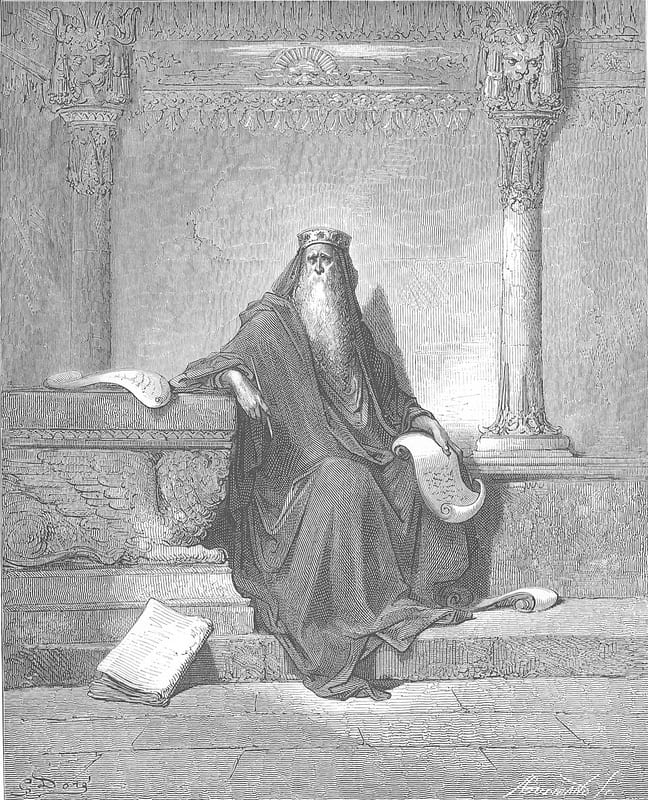
This chapter continues the account of a king who used his whole fortune to find out what makes a life worth living. Tradition gives it to Solomon, the one ruler of Israel with the means to run such a test in full. It was heard by people who had watched his building works rise and assumed they brought happiness. The chapter reports a deliberate experiment and then the audit of its results. Listen for the long list of what he acquired, and then for the worry about who will inherit it. Its last lines point to a gift that no amount of labor can buy.
Context
- Who
- People who had watched the building programme go up and assumed it meant happiness
- What
- The Teacher's report of testing pleasure, great works and wisdom, and his verdict on each.
- Where
- Jerusalem and the royal estates around it, with their houses, vineyards, parks and pools.
- When
- Late in the reign of Solomon, about 940 BC, on the traditional reading; many date the book's Hebrew to the Persian period, so the date is held with less certainty than the setting.
- Why
- To show that possessions and achievements, gathered at the fullest scale, cannot give a person lasting gain, and that enjoyment is a gift from God.
Historical context
This is an inventory of an ancient king's greatness, and it matches what the histories say Solomon actually did: houses, vineyards, gardens, orchards planted with every kind of fruit tree, and "pools of water, to water therewith the wood that bringeth forth trees." Royal parks with irrigation systems were the standard boast of Near Eastern monarchs, Assyrian kings recorded theirs in detail. South of Bethlehem there are large reservoirs long known as the Pools of Solomon, though the stonework standing there today is from later centuries.
Show the rest of the historical context, 3 more paragraphs
"Servants born in my house" describes a permanent household staff, not purchased labourers, people whose parents had served the same estate. "Great possessions of great and small cattle above all that were in Jerusalem before me" is the ancient measure of wealth, since herds were the capital that reproduced.
"Silver and gold, and the peculiar treasure of kings and of the provinces" refers to tribute, the payments that came in from subject territories and trading partners, which the records of Solomon's reign describe arriving by the shipload.
"Men singers and women singers, and the delights of the sons of men" covers court musicians and the royal household of wives and concubines. Every item on this list is something an ancient king would have carved on a monument. Here it is being listed in order to be dismissed.
Significance
The hearers were being told, by the one man in the world qualified to say it, that the experiment had been run at full budget. "Whatsoever mine eyes desired I kept not from them", and the verdict was still vapour.
Show the rest of the significance, 1 more paragraph
The sting for them was the inheritance question: "I shall leave it unto the man that shall be after me. And who knoweth whether he shall be a wise man or a fool?" Solomon's own son Rehoboam would answer that within a few years, and the kingdom would split.
This chapter in Jewish lifeWhat this chapter is in Jewish life and reading.
What is done
No part of this chapter is read on a weekly Sabbath. The site's own table in src/lib/hebraic/readings.ts printed parashot total 0 and haftarah uses total 0 for this book. It records one public reading instead: the whole book, read at Sukkot on the Sabbath that falls in the festival week, sourced there to Tractate Soferim 14:3. The king's account of his houses, gardens and pools is heard in that reading, in the week the harvest is gathered in.
How it is read
Rashi is the one commentator on this chapter whose English the corpus carries, quoted here from The Metsudah Five Megillot, Lakewood, N.J., 2001, which Sefaria reports as CC-BY. Every quotation is held to fifty words or fewer because the translation is modern, and the edition's own notes are never quoted as his.
Rashi reads the chapter as a king's trial of every pleasure, told in order. Having found no rest in wisdom, the king says, "I will refrain from wisdom, and I will indulge in drinking" (Rashi on Ecclesiastes 2:1:1). He searched his heart to grasp partying, wisdom and folly together, and Rashi adds that every luxurious banquet is called wine (Rashi on Ecclesiastes 2:3:1). The great works of the fourth verse were made "In the days of my greatness" (Rashi on Ecclesiastes 2:4:1).
The orchards draw the longest note, and Rashi gives its source as Midrash Tanchuma. Solomon in his wisdom knew the veins of the earth. He knew which vein ran to Cush and planted peppers over it, and which ran to a land of carobs and planted carobs there. All the veins of the lands come to Zion, "from where the world was founded" (Rashi on Ecclesiastes 2:5:1).
Two notes guard the king's wisdom through all of it. "I did not forsake my wisdom because of all these affairs, and it remained with me and I did not forget it" (Rashi on Ecclesiastes 2:9:1). His sharing of it lessened nothing, "like a candelabrum from which many candles are kindled, and none of its light is diminished" (Rashi on Ecclesiastes 2:10:1). Then he looked at all his deeds and found no benefit in them, "for from all of them I am lacking" (Rashi on Ecclesiastes 2:11:1).
The wise man whose eyes are in his head is the one who, at the start of a matter, "contemplates the end results" (Rashi on Ecclesiastes 2:14:1). The common death of the wise and the fool raises the question plainly: "so why should I be more righteous?" (Rashi on Ecclesiastes 2:15:1). The seventeenth verse, where the king hates life, Rashi reads as prophecy. "He was prophesying about the generation of Rechovam, who were wicked [people]" (Rashi on Ecclesiastes 2:17:1).
At the twenty-first verse Rashi names two readings and keeps both. "Its interpretation is according to its plain meaning." The Midrash Aggadah in Tanchuma reads the man who labours with wisdom as an allegory of the Holy One. It draws on the likeness of a man above the throne in Ezekiel 1:26 (Rashi on Ecclesiastes 2:21:1). The chapter's close he reads as a question rather than a counsel. Eating and drinking are good when a man guides his heart "to perform justice and righteousness with the food and drink", as Jeremiah 22:15 says to Jehoiakim of his father (Rashi on Ecclesiastes 2:24:1).
The corpus carries two further notes on this chapter without an English text, each marked linked because Sefaria holds no English version of the ref. They stand cited and unquoted at Ibn Ezra on Ecclesiastes 2:7:1 and 2:18:1.
What the rabbis say
The corpus carries forty rabbinic locators on this chapter and the text of none, so each is cited and linked here rather than quoted. Most of them are the Midrash on this book itself. Kohelet Rabbah stands under the first, third, fourth, fifth, sixth, seventh, ninth, eleventh and thirteenth verses, at 2:1:1, 2:3:1, 2:4:1, 2:5:1, 2:6:1, 2:7:1, 2:9:1, 2:11:1 and 2:13:1. It stands again under the fifteenth, sixteenth, seventeenth, twentieth, twenty-fourth and twenty-fifth, at 2:15:1, 2:16:1, 2:17:1, 2:20:1, 2:24:1 and 2:25:1, and a second passage of it, Kohelet Rabbah 2:8:2, stands under the fourth. Midrash Lekach Tov on Ecclesiastes stands beside it at 2:1:1, 2:3:1, 2:6:1, 2:7:1, 2:9:1, 2:11:1, 2:12:1 and 2:13:1, and alone at 2:18:1, 2:19:1 and 2:22:1.
The Talmud and the other Midrashim carry the rest. On the second verse, the laughter called senseless, the corpus holds Ein Yaakov (Glick Edition), Shabbat 2:11 and Ein Yaakov, Shabbat 2:21. On the fifth, the orchards, it holds Introductions to Amoraic Literature, Part II (Notes and Interpretations for Chapters of the Talmud), Baba Batra, Chapter I 237. On the eighth, the treasures of kings, it holds Bamidbar Rabbah 11:3 and Ein Yaakov (Glick Edition), Gittin 7:2. On the tenth it holds Ein Yaakov (Glick Edition), Sanhedrin 2:8 and Ein Yaakov, Gittin 7:4. On the twelfth it holds Bereshit Rabbah 12:1. On the fourteenth, the wise man's eyes, it holds Bamidbar Rabbah 14:6 and Chullin 44a:1. On the twenty-first it holds Bamidbar Rabbah 12:10, on the twenty-third Bereshit Rabbah 27:2, and on the twenty-sixth Ein Yaakov (Glick Edition), Megillah 1:12. What each of them teaches is a saying of the rabbis, and is reported as theirs wherever this site quotes one. The quotations wait on a fetch that carries the text.
Sources: Rashi, Rashi on Ecclesiastes 2:1:1 to 2:24:1, The Metsudah Five Megillot, Lakewood, N.J., 2001, reported CC-BY; Ibn Ezra, Ibn Ezra on Ecclesiastes 2:7:1 and 2:18:1, cited by ref because the corpus carries no English text; The Sefaria corpus, scripts/data/sources/sefaria/ecclesiastes/2.json, the 40 Talmud and Midrash locators of this chapter; The site's own files, src/lib/hebraic/readings.ts, probed for this book and printing parashot total 0, haftarah uses total 0, and the festival reading at Sukkot on the Sabbath that falls in the festival week, sourced there to Tractate Soferim 14:3.
The heads below are this chapter's scenes. The numbered points under each are its verses.
I Made Me Great Works, and Behold, All Was Vanity
Ecclesiastes 2:1-2
I will test you with pleasure: The Teacher turns from thought to a planned trial, telling his heart, I will test you with pleasure. Of laughter he says It is folly, and of pleasure he asks What does it accomplish. Delight taken as its own end cannot say what it has achieved.
Ecclesiastes 2:1
"I said to myself: Come, I will experiment with joy and enjoy pleasure. That, too, turned out to be futile." After I detected that pain and labour were in the essence of wisdom and the accumulation of knowledge, and nothing else except vain and endless struggle, I felt joyful that I would overflow with excess, accrue riches, amass great wealth, and take temporary pleasures before I die. But even in this I saw my vanity, for past pleasures do not help the present, and do not fill up what is empty.
Jerome · written before 420 · Commentary on Ecclesiastespatristic
1 more voice on this verseWhat preachers and commentators have said about this verse, in their own words.
Ecclesiastes 2:1
“Solomon’s trial of God’s second gift, namely, riches, and the enjoyment which riches supply; this brought him to the sane result (compare Ecc 1:12). Comparing Solomon’s action with Luk 12:16-21, it must be remembered that Solomon’s object was the acquisition of wisdom, not self-indulgence, and that he did not fail to look forward to the certainty of death overtaking him.”
I said of laughter: Jerome reports that Aquila gave the word for folly as delusion, and Symmachus as commotion. Jamieson, Fausset and Brown hold that laughter turns to folly when a man makes it his chief good, and in its place it is good. Henry asks what laughter can accomplish for a sorrowful heart.
Ecclesiastes 2:2
"I said of laughter, It is madness! And of joy, What does it accomplish?" Wherever we read "madness" the Hebrew text has "molal", which Aquila took to be "planesin", that is 'delusion' [Hier.. "error"], Symmachus has "thorubon", 'commotions' [Hier.. "tumultus".]. But the Septuagint and Theodotion as in many places, so too in this, also agree and translate it as "periphoran", which we, expressing word for word, can call 'revolution'. [Hier.. "circumlationem".] Those men therefore, who are carried around on the 'breeze' of all doctrines, are unstable and fluctuate between interpretations.
Jerome · written before 420 · Commentary on Ecclesiastespatristic
1 more voice on this verse
Ecclesiastes 2:2
“I said of laughter, It is mad - Literally “To laughter I said, O mad one! and to mirth, What is this one doing?” Solomon does not speak here of a sober enjoyment of the things of this world, but of intemperate pleasure, whose two attendants, laughter and mirth are introduced by a beautiful prosopopoeia as two persons; and the contemptuous manner wherewith he treats them has something remarkably striking.”
Adam Clarke · Commentary on the Bible (1810-1826)evangelical
Ecclesiastes 2:3-6
I sought to cheer my body with wine: The wine test follows the same design, I sought to cheer my body with wine and to embrace folly, my mind guiding me with wisdom. From wine he moves to building: houses, vineyards, gardens and parks, fruit trees and reservoirs to water my groves of flourishing trees.
Ecclesiastes 2:3
“I sought in mine heart to give myself unto wine,.... Not in an immoderate way, so as to intoxicate himself with it, in which there can be no pleasure, nor any show of happiness; but in a moderate, yet liberal way, so as to be innocently cheerful and pleasant, and hereby try what good and happiness were to be possessed in this way.”
I expanded my pursuits: Bonaventure reads verses 4 to 6 as one list of lasting goods: houses, vineyards and gardens, and pools to water them. Gregory of Nyssa hears abundance in I expanded my pursuits. Didymus the Blind takes the houses as good deeds, each one the house of the man who built it.
Ecclesiastes 2:4
“I builded me houses - Palace after palace; the house of the forest of Lebanon, 1Ki 7:1, etc.; a house for the queen; the temple, etc., 2Ch 8:1, etc.; 1Ki 9:10, etc., besides many other buildings of various kinds.”
Adam Clarke · Commentary on the Bible (1810-1826)evangelical
I made gardens and parks: The word for parks is pardesim, which gives English its word paradise, and Clarke finds it in Persian for a pleasant garden. Barnes places one of these royal gardens at Jerusalem near the pool of Siloam, called the king's garden. To Henry, garden work was the work of Adam.
Ecclesiastes 2:5
“Orchards - literally, “paradises,” i. e., parks or pleasure-grounds (compare Neh 2:8 note). Indications of at least three of these have been pointed out; one at Jerusalem near the pool of Siloam, called “the king’s garden” Neh 3:15; Jer 52:7; a second near Bethlehem (compare Ecc 2:6); and a third in the remote north, on the heights of Hermon Son 4:8; Son 8:11.”
I built reservoirs: The king built these reservoirs to water his groves, and Barnes places three pools still called the Pools of Solomon south of Bethlehem. Clarke describes tanks that held the water and channels that carried it to the trees. Jamieson, Fausset and Brown call them Solomon's cisterns.
Ecclesiastes 2:6
“With reference to the natural sense, you find it said in Ecclesiastes, "I made for myself pools of water to water from them a flourishing woodland." And do not be concerned that he said "pools" instead of "a well," because Moses said "the Well of Room-enough." For the man who has transcended this world with a pious mind is freed of all care and anxieties. There Ecclesiastes says "pools" with reason, for he sees that there is no abundance under the sun, but if anyone wishes to abound, let him abound in Christ.”
Ambrose of Milan · written before 397 · On Isaac and the Soulpatristic
1 more voice on this verse
Ecclesiastes 2:6
“Pools of waters - Tanks and reservoirs. To water therewith the wood - Aqueducts to lead the water from the tanks to different parts.”
Adam Clarke · Commentary on the Bible (1810-1826)evangelical
Ecclesiastes 2:7-8
I acquired menservants and maidservants: The inventory runs from servants born in my house and more herds and flocks to silver and gold and the treasure of kings and provinces. Clarke takes the treasure of kings as tribute or royal collections such as only a monarch of Solomon's rank could gather.
Ecclesiastes 2:7
“I got - Rather, I bought, in distinction from those born in the house. The “children of Solomon’s servants” (compare Ezr 2:55, Ezr 2:58) were more probably of Canaanite origin 1Ki 9:20-21; 1Ki 5:15 than Hebrews 1Ki 9:22. Possessions of great and small cattle - Rather, herds of oxen and sheep. All ... before me - King David’s herds and flocks are mentioned in 1Ch 27:29, 1Ch 27:31: but we have no specific account of the wealth of other Canaanite or Hebrew inhabitants of Jerusalem before Solomon.”
1 more voice on this verse
Ecclesiastes 2:7
“He enjoyed, more than ever any man did, a composition of rational and sensitive pleasures at the same time. He was, in this respect, great, and increased more than all that were before him, that he was wise amidst a thousand earthly enjoyments. It was strange, and the like was never met with, (1.) That his pleasures did not debauch his judgment and conscience.”
Matthew Henry · Commentary on the Whole Bible (1707-1721)puritan
the treasure of kings and provinces: Bonaventure sorts the list: silver and gold are the metals, and the treasure of kings and provinces is precious stones. Gregory of Nyssa asks what gold gives the man who gathers it, when it brings neither health nor relief from pain. Jerome reads the last words as chests upon chests.
Ecclesiastes 2:8
“The peculiar treasure of kings and of the provinces - 1. The tares levied off his subjects. 2. The tribute given by the neighboring potentates. Both these make the “peculiar treasure of kings;” taxes and tribute. Men singers and women singers - This includes all instrumental and vocal performers. These may be called the delights of the sons of men. Musical instruments, and that of all sorts - For these seven words, there are only two in the original, שדה ושדות shiddah veshiddoth. These words are acknowledged on all hands to be utterly unknown, if not utterly inexplicable.”
Adam Clarke · Commentary on the Bible (1810-1826)evangelical
Ecclesiastes 2:9-11
So I became great: The Teacher records that he became great and surpassed all in Jerusalem who had preceded me, and adds that my wisdom remained with me. Then the ledger closes: I found everything to be futile, a pursuit of the wind; there was nothing to be gained under the sun.
Ecclesiastes 2:9
"Thus I grew and surpassed any of my predecessors in Jerusalem; still, my wisdom stayed with me." It seems to me that Ecclesiastes, acting grandly, agrees less with the Lord, unless by chance we adapt this to him: "He [Jesus] increased in wisdom and age and grace" [Luc. 2, 52.]. And, "on account of which God took him on high [Phil. 2, 9.]".
Jerome · written before 420 · Commentary on Ecclesiastespatristic
1 more voice on this verse
Ecclesiastes 2:9
“But thus far his wisdom remained with him that he was master of his pleasures, and not a slave to them, and kept himself capable of making a judgment of them.”
Matthew Henry · Commentary on the Whole Bible (1707-1721)puritan
this was the reward: Wesley and Henry read the word for reward as portion, the share a man receives, and take it as the present delight of his work. Henry adds that this was all his labor could give him. Didymus the Blind takes heart here as reason.
Ecclesiastes 2:10
"Whatever my eyes desired I did not deny them; I did not deprive myself of any joy. Indeed my heart drew joy from all my activities, and this was my reward for all my endeavours. "The eyes of the heart and the sight of the mind desire to gaze on spiritual matters, which the sinner does not see, so forbids his heart from true happiness. Therefore Ecclesiastes gave himself completely over to this cause and balanced eternal glory lightly in an world of discord. This is our lot, and our continual reward if we work for our virtues.
Jerome · written before 420 · Commentary on Ecclesiastespatristic
1 more voice on this verse
Ecclesiastes 2:10
“He met with no disappointment in it to give him any disturbance: This was my portion of all my labour; he had this added to all the rest of his pleasures that in them he did not only see, but eat, the labour of his hands; and this was all he had, for indeed it was all he could expect, from his labours.”
Matthew Henry · Commentary on the Whole Bible (1707-1721)puritan
there was nothing to be gained: Gregory of Nyssa likens pleasure to writing on water: the hand moves, the letters vanish, and nothing remains once the work is done. Didymus the Blind presses the words under the sun. A man lit by the sun of righteousness, he says, stands in that sun.
Ecclesiastes 2:11
"Then I looked at all things that I had done and the energy I had expended in doing them. "He who does all things with diligence and wariness is able to say this. "It was clear that it was all futile and a vexation of the spirit, [and there is no profit under the sun.]" As if he considers that in comparison with other things, all things are cheap which are under the sun, and are different according to the variety of desires. "And there is no profit under the sun". Christ placed his tabernacle in the sun.
Jerome · written before 420 · Commentary on Ecclesiastespatristic
1 more voice on this verse
Ecclesiastes 2:11
“And, behold, all was vanity - Emptiness and insufficiency in itself. And vexation of spirit - Because it promised the good I wished for, but did not, could not, perform the promise; and left my soul discontented and chagrined.”
Adam Clarke · Commentary on the Bible (1810-1826)evangelical
One Event Happeneth to the Wise Man and the Fool
Ecclesiastes 2:12-14
Then I turned to consider wisdom and madness and folly: The Teacher weighs wisdom and madness and folly and grants that wisdom exceeds folly, just as light exceeds darkness. The proof is sight against blindness: The wise man has eyes in his head, but the fool walks in darkness. Yet he came to realize that one fate overcomes them both.
Ecclesiastes 2:12
“Better, GROTIUS, "What man can come after (compete with) the king in the things which are done?" None ever can have the same means of testing what all earthly things can do towards satisfying the soul; namely, worldly wisdom, science, riches, power, longevity, all combined.”
Jamieson, Fausset & Brown · Commentary Critical and Explanatory on the Whole Bible (1871)reformed
wisdom exceeds folly: Clarke and Wesley read the verse as a concession: wisdom cannot make a man happy, yet it far exceeds pleasure and folly in use. Bonaventure takes the light as wisdom itself, coming down from the Father of lights. A blind man, says Chrysostom, cannot know what light is worth.
Ecclesiastes 2:13
"And I perceived that wisdom excels folly as light excels darkness. "I am allowed, he says, to see through that very wisdom of mankind, which is mixed with uncertainty. Nor is it possible, he adds, for it to flow into our minds so clearly as it does into the king and our creator. I know however that the difference between wisdom and folly is great even as much as one can differentiate between day and night, between light and dark.
Jerome · written before 420 · Commentary on Ecclesiastespatristic
1 more voice on this verse
Ecclesiastes 2:13
“I saw - I allowed thus much. Although wisdom is not sufficient to make men happy, yet it is of a far greater use than vain pleasures, or any other follies.”
John Wesley · Explanatory Notes upon the Old Testament (1765)evangelical
one fate overcomes them both: Wesley explains the eyes in the head as foresight, which lets the wise avoid many dangers. The same fate still comes to both, he adds, in calamity and in death, which removes every difference between them. Henry cites Psalm 49, where the wise die with the fool.
Ecclesiastes 2:14
“He hath the use of his eyes and reason, and foresees, and so avoids many dangers and mischiefs. Yet - Notwithstanding this excellency of wisdom above folly, at last they both come to one end. Both are subject to the same calamities, and to death itself, which takes away all difference between them.”
John Wesley · Explanatory Notes upon the Old Testament (1765)evangelical
1 more voice on this verse
Ecclesiastes 2:14
“A man that is discreet and considerate has the command of his business, and acts decently and safely, as those that walk in the day; but he that is rash, and ignorant, and sottish, is continually making blunders, running upon one precipice or other; his projects, his bargains, are all foolish, and ruin his affairs.”
Matthew Henry · Commentary on the Whole Bible (1707-1721)puritan
Ecclesiastes 2:15-17
The finding turns personal, The fate of the fool will also befall me, and the king's advantage falls under the same death. The Teacher's own word for the discovery is So I hated life, because the work that is done under the sun was grievous to me.
Ecclesiastes 2:15
“Then said I in my heart, as it happeneth to the fool, so it happeneth even to me,.... The wisest of kings, and the wisest of men; that is, he looked over things in his mind, and considered what had befallen him, or what were his present circumstances, or what would be his case, especially at death; and said within himself, the same things happen to me, who have attained to the highest pitch of wisdom, as to the most errant fool; and therefore no true happiness can be in this sort of wisdom.”
1 more voice on this verse
Ecclesiastes 2:15
“As it happeneth to the fool - Literally, “According as the event is to the fool, it happens to me, even me.” There is a peculiar beauty and emphasis in the repetition of me. Having pointed out the advantages that wisdom has over folly, he takes this opportunity of reminding us of the danger of trusting too much to it, by showing that it is equally subject to the common accidents of life; and, therefore, incapable of making us completely happy.”
Adam Clarke · Commentary on the Bible (1810-1826)evangelical
no lasting remembrance of the wise: Wesley observes that the wise man is remembered for a while, and then his monuments are forgotten. Jamieson, Fausset and Brown set the verse beside the builders of Babel, who sought a name, and hold that the righteous alone are remembered. Gregory of Neocaesarea sets the wise apart before God.
Ecclesiastes 2:16
“There is no remembrance - The wise and the fool are equally subject to death; and, in most instances, they are equally forgotten. Time sweeps away all remembrances, except the very few out of millions which are preserved for a while in the page of history.”
Adam Clarke · Commentary on the Bible (1810-1826)evangelical
1 more voice on this verse
Ecclesiastes 2:16
“For - Their memory, though it may flourish for a season, yet will in a little time be worn out; as we see it, most of the wise men of former ages, whose very names, together with all their monuments, are utterly lost.”
John Wesley · Explanatory Notes upon the Old Testament (1765)evangelical
So I hated life: Gill reads the hatred as comparative: life is the gift of God, and the Teacher hated it beside the lovingkindness, which is better than life. Wesley adds that all the work done under the sun only increased his discontent. Bonaventure sets the verse beside Job 10:1.
Ecclesiastes 2:17
“Therefore I hated life,.... Not strictly and simply understood, since life is the gift of God; and a great blessing it is, more than raiment, and so dear to a man, that he will give all he has for it: but comparatively, in comparison of the lovingkindness of God, which is better than life; or in comparison of eternal life, which a good man desires to depart from this world, for the sake of enjoying it.”
2 more voices on this verse
Ecclesiastes 2:17
“Therefore I hated life - את החיים et hachaiyim, the lives, both of the wise, the mad man, and the fool. Also all the stages of life, the child, the man, and the sage. There was nothing in it worth pursuing, no period worth re-living and no hope that if this were possible I could again be more successful.”
Adam Clarke · Commentary on the Bible (1810-1826)evangelical
Ecclesiastes 2:17
“There is business above the sun, perpetual business, which is perpetual blessedness; what we do in conformity to that business (doing God's will as it is done in heaven ) and in pursuance of that blessedness, will turn to a good account; we shall have no reason to hate that labour, nor to despair of it.”
Matthew Henry · Commentary on the Whole Bible (1707-1721)puritan
I Hated My Labor, For I Must Leave It to the Man After Me
Ecclesiastes 2:18-21
I hated all for which I had toiled: The labor must be left to the man who comes after me, and who knows whether that man will be wise or foolish. The Teacher calls it futile and a great evil, the sharpest language the chapter uses against a single finding.
Ecclesiastes 2:18
“I hated all my labor - Because, 1. It has not answered the end for which it was instituted. 2. I can enjoy the fruits of it but a short time. 3. I must leave it to others, and know not whether a wise man, a knave, or a fool will possess it.”
Adam Clarke · Commentary on the Bible (1810-1826)evangelical
2 more voices on this verse
Ecclesiastes 2:18
“Yea, I hated all my labour which I had taken under the sun,.... The great works he made, the houses he built; the vineyards, gardens, and orchards he planted, &c. what he got by his labour, his riches and wealth; and what he also got, not by the labour of his hands, but of his mind. Some understand this of the books he wrote; which were a weariness to his body, and fatigue to his mind; and which he might fear some persons would make an ill use of: Aben Ezra interprets it of his labour in this book.”
Ecclesiastes 2:18
“If the whole earth is not worth the kingdom of heaven, surely he who has left a few fields leaves nothing, as it were; even if he has given up a house or much gold, he ought not to boast nor grow weary. Moreover, we should consider that if we do not relinquish these things for virtue's sake, we leave them behind later when we die and often, as Ecclesiastes reminds us, to those to whom we do not wish to leave them.”
Athanasius of Alexandria · written before 373 · Life of St. Anthony 17patristic
will be wise or foolish?: Bonaventure names the heir as Rehoboam, a foolish son who followed the counsel of the young men. Clarke adds that Solomon, the wisest of men, left one son to take all his labor and his throne. Clarke calls that son the silliest of fools.
Ecclesiastes 2:19
“A wise man or a fool? - Alas! Solomon, the wisest of all men, made the worst use of his wisdom, had three hundred wives and seven hundred concubines, and yet left but one son behind him, to possess his estates and his throne, and that one was the silliest of fools!”
Adam Clarke · Commentary on the Bible (1810-1826)evangelical
1 more voice on this verse
Ecclesiastes 2:19
“This expresses not a gracious hatred of these things, which is our duty, to love them less than God and religion ( Luke xiv. 26 ), nor a sinful hatred of them, which is our folly, to be weary of the place God has assigned us and the work of it, but a natural hatred of them, arising from a surfeit upon them and a sense of disappointment in them.”
Matthew Henry · Commentary on the Whole Bible (1707-1721)puritan
my heart began to despair: Gill defines the despair: the Teacher gave up hope of finding happiness in anything under the sun. Henry hears a long argument with the heart, which is slow to let go of what it hoped from its labor. Clarke adds that the evil has no remedy.
Ecclesiastes 2:20
“Our hearts are very loth to quit their expectations of great things from the creature; we must go about, must fetch a compass, in arguing with them, to convince them that there is not that in the things of this world which we are apt to promise ourselves from them.”
Matthew Henry · Commentary on the Whole Bible (1707-1721)puritan
labored with wisdom, knowledge, and skill: The word for skill also means success, and Jamieson, Fausset and Brown compare its use in 11:6. Clarke hears Solomon speaking of himself, a man who governed with wisdom and must leave the fruit to one who never labored. Henry says a gracious soul finds no grief in this.
Ecclesiastes 2:21
“For there is a man - Does he not allude to himself? As if he had said, “I have labored to cultivate my mind in wisdom and in science, in knowledge of men and things, and have endeavored to establish equity and dispense justice. And now I find I shall leave all the fruits of my labor to a man that hath not labored therein, and consequently cannot prize what I have wrought.” Does he not refer to his son Rehoboam?”
Adam Clarke · Commentary on the Bible (1810-1826)evangelical
2 more voices on this verse
Ecclesiastes 2:21
“It was rational business, which related to the government of his kingdom and the advancement of its interests. It was labour managed by the dictates of wisdom, of natural and acquired knowledge, and the directions of justice. It was labour at the council-board and in the courts of justice.”
Matthew Henry · Commentary on the Whole Bible (1707-1721)puritan
Ecclesiastes 2:21
“Suppose "there is a man," &c. equity--rather "with success," as the Hebrew is rendered (Ec 11:6), "prosper," though Margin gives "right" [HOLDEN and MAURER]. evil--not in itself, for this is the ordinary course of things, but "evil," as regards the chief good, that one should have toiled so fruitlessly.”
Jamieson, Fausset & Brown · Commentary Critical and Explanatory on the Whole Bible (1871)reformed
Ecclesiastes 2:22-23
For what does a man get for all the toil: The Teacher totals the account, asking what does a man get for all the toil and striving with which he labors under the sun. The answer is the cost: all his days are filled with grief, and his task is sorrowful, and at night, his mind does not rest.
Ecclesiastes 2:22
“What has he to himself and to his own use? What has he that will go with him into another world? The best use which is therefore to be made of the wealth of this world, and that is to use it cheerfully, to take the comfort of it, and do good with it.”
Matthew Henry · Commentary on the Whole Bible (1707-1721)puritan
his mind does not rest: Jamieson, Fausset and Brown observe that the task is sorrow and grief, and Wesley adds that the man's sleep at night is broken by cares. Clarke calls the verse a picture of life when the heart lacks the peace of God. Henry sends such workers to Christ for rest.
Ecclesiastes 2:23
“His days are sorrows - What a picture of human life where the heart is not filled with the peace and love of God! All his days are sorrows; all his labors griefs; all his nights restless; for he has no portion but merely what earth can give; and that is embittered by the labor of acquisition, and the disappointment in the using. This is also vanity - Emptiness of good and substantial misery.”
Adam Clarke · Commentary on the Bible (1810-1826)evangelical
1 more voice on this verse
Ecclesiastes 2:23
“Those that are apt to fret find that the more dealings they have in the world the oftener they are made to fret. The world is a vale of tears, even to those that have much of it. Those that labour are said to be heavy-laden, and are therefore called to come to Christ for rest, Matt. xi.”
Matthew Henry · Commentary on the Whole Bible (1707-1721)puritan
Ecclesiastes 2:24-26
Nothing is better for a man than to eat and drink: and enjoy his work, and it comes from the hand of God. Verse 26 gives wisdom and knowledge and joy to the man pleasing to God and gathering to the sinner, and calls even that futile.
Ecclesiastes 2:24
"Is it not good for man that he eats and drinks and shows his soul satisfaction in his labour? And even that, I perceived, is from the hand of God. For who should eat and who should make haste except me? To the man who pleases Him He has given wisdom, knowledge and joy; but to the sinner He has given the urge to gather and amass - that he may hand it on to one who is pleasing to God. That, too, is vanity and a vexation of the spirit."
Jerome · written before 420 · Commentary on Ecclesiastespatristic
2 more voices on this verse
Ecclesiastes 2:24
“English Version gives a seemingly Epicurean sense, contrary to the general scope. The Hebrew, literally is, "It is not good for man that he should eat," &c., "and should make his soul see good" (or "show his soul, that is, himself, happy"), &c. [WEISS].”
Jamieson, Fausset & Brown · Commentary Critical and Explanatory on the Whole Bible (1871)reformed
Ecclesiastes 2:24
“What that good is which is here recommended to us; and which is the utmost pleasure and profit we can expect or extract from the business and profit of this world, and the furthest we can go to rescue it from its vanity and the vexation that is in it.”
Matthew Henry · Commentary on the Whole Bible (1707-1721)puritan
apart from Him: The Berean apart from Him follows a reading Clarke cites from Hebrew manuscripts, the Septuagint and the Syriac. The received text has a first person form, and Gill asks who can eat and enjoy the good of his labor unless God gives it. Coverdale follows the first reading.
Ecclesiastes 2:25
“We exhort, therefore, the widows and orphans to partake of those things that are bestowed upon them with all fear and all pious reverence, and to return thanks to God who gives food to the needy, and to lift up their eyes to him. For, "Which of you shall eat, or who shall drink without him?”
Apostolic Constitutions · written before 380 · Constitutions of the Holy Apostlespatristic
2 more voices on this verse
Ecclesiastes 2:25
“For who can eat?.... Who should eat, but such a man that has laboured for it? or, who has a power to eat, that is, cheerfully, comfortably, and freely to enjoy the good things of life he is possessed of, unless it be given him of God? see Ecc 6:1; or who else can hasten hereunto more than I? the word "chush", in Rabbinical language, is used of the five senses, seeing, hearing, feeling, smelling, and tasting: and R.”
Ecclesiastes 2:25
“To those who are good in God's sight, who are of a good spirit, honest and sincere, pay a deference to their God and have a tender concern for all mankind, God will give wisdom and knowledge in this world, and joy with the righteous in the world to come; so the Chaldee.”
Matthew Henry · Commentary on the Whole Bible (1707-1721)puritan
the task of gathering and accumulating: Henry reads pleasing in His sight as truly good, like Noah. Jamieson, Fausset and Brown add that the sinner gathers for the one who pleases God without knowing it, and in spite of himself. The retribution, they say, is less visible now and just as real.
Ecclesiastes 2:26
“Though the retribution be not so visible and immediate now as then, it is no less real. Happiness even here is more truly the portion of the godly (Ps 84:11; 1Ti 4:8). that he--the sinner may give--that is, unconsciously and in spite of himself.”
Jamieson, Fausset & Brown · Commentary Critical and Explanatory on the Whole Bible (1871)reformed
Keep studying
Studies4
Places1
Sources for this chapter
The summary
Jamieson, Fausset & Brown, Commentary Critical and Explanatory; John Wesley, Notes on the Old Testament and Matthew Henry, Complete Commentary.
The exposition
Adam Clarke, Commentary on the Bible; Albert Barnes, Notes, Explanatory and Practical, on the Old and New Testaments (1832-1869); Bonaventure; Charles Bridges, An Exposition of the Book of Ecclesiastes; Didymus the Blind; Franz Delitzsch, Commentary on the Song of Songs and Ecclesiastes; Gregory of Neocaesarea, PARAPHRASE OF ECCLESIASTES 2:16; Gregory of Nyssa; Jamieson, Fausset & Brown, Commentary Critical and Explanatory on the Whole Bible; Jerome, Commentary on Ecclesiastes; John Chrysostom, Homilies on the Gospel of Matthew, Homily 83; John Gill; John Wesley, Explanatory Notes upon the Old Testament and Matthew Henry, Commentary on the Whole Bible.