
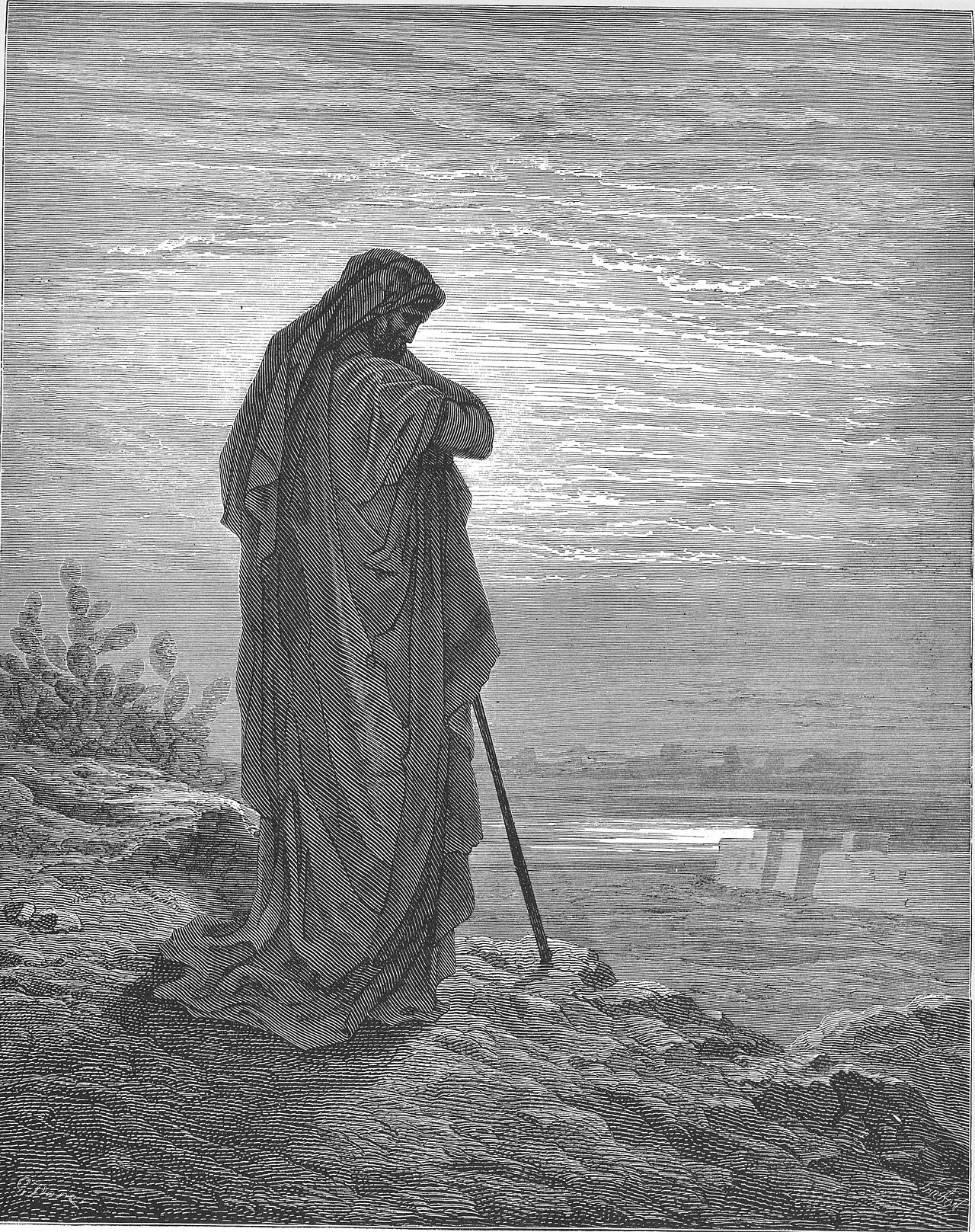
Amoschapter 4
13 verses · Amos · about 760 BC · The Twelve
“Go to Bethel and transgress; rebel even more at Gilgal! Bring your sacrifices every morning, your tithes every three days.
Introduction
Amos, The Twelve, Amos Overview.
This chapter continues the messages Amos gave in the northern kingdom. It speaks first to the wealthy women of the capital and then to the crowds at the northern shrines. His hearers were generous in worship and careless of the poor, and they took their good years as a sign of God's approval. The chapter looks back over hard years they had lived through and asks what those years were for. Listen for the line repeated after each of those disasters. Notice how the chapter closes by naming the God who is speaking.
Context
- Who
- The wealthy women of the capital and the crowds at the festivals
- What
- A charge against the rich women of Samaria, a mocking call to worship at Bethel and Gilgal, and five past warnings Israel ignored.
- Where
- Samaria, and the shrines at Bethel and Gilgal.
- When
- About 760 BC, in the reign of Jeroboam II of Israel; the book gives no exact year.
- Why
- To show that God had warned Israel again and again, and to summon it to meet Him.
Historical context
Bashan was the high plateau east of the Jordan, famous throughout the region for its pasture and for the size of the cattle raised on it. Calling the women of Samaria cows of Bashan was not a joke about weight; it was a comment about being fattened on the best grazing while the herdsmen went hungry.
Show the rest of the historical context, 3 more paragraphs
The invitation to worship is sarcasm with the details right. Bethel and Gilgal were the two main northern shrines, and the practices named, bringing a sacrifice each morning, tithes every three days, a thank offering of leavened bread, freewill offerings loudly announced, describe enthusiastic, generous, above-and-beyond religion. Amos says: come and sin some more, and publish it, for this is what you love.
The five disasters that follow read like a checklist from the covenant curses in the Law, and each is described from the inside. Cleanness of teeth is a polite phrase for nothing to chew. Rain withheld three months from harvest is the latter rain that fills the grain, and rain falling on one city and not another is exactly how spotty a bad year looks. Blight and mildew ruin standing grain, locusts finish the gardens, and plague comes with the armies.
The refrain after each one, yet you did not return to me, is the structure of the chapter. Five warnings, five refusals, and then the summons: prepare to meet your God, O Israel.
Significance
The hearers' religious life was thriving. Attendance was up, giving was generous, festivals were crowded. Amos's charge is that all of it was worship of themselves, offered to a God they had not obeyed in a single matter of justice.
Show the rest of the significance, 1 more paragraph
The last verse names who is speaking, and it is deliberately overwhelming: the one who forms the mountains, creates the wind, and makes the morning darkness. A people who had shrunk God to the size of a shrine were being introduced to him again.
This chapter in Jewish lifeWhat this chapter is in Jewish life and reading.
What is done
No part of this chapter is read in the synagogue. Probed for this lane, the site's table in src/lib/hebraic/readings.ts printed parashot 0 and no Haftarah use for Amos 4, and no festival reading for the book. The same probe printed 54 weekly portions and 6 festival readings in the table as a whole. Amos is heard in the synagogue twice in the year, and neither reading reaches this chapter. The table records Amos 2:6 to 3:8 as the Haftarah of Vayeshev and Amos 9:7 to 9:15 as the Ashkenazi Haftarah of Kedoshim.
The chapter is met more in the study of the Talmud than in the weeks of the Torah. Under the twelfth verse, the call to prepare to meet God, the corpus carries Berakhot 23a:5, Berakhot 51b:8 and Jerusalem Talmud Berakhot 2:3:10. Berakhot is the tractate of blessings and prayer. Under the thirteenth it carries Chagigah 5b:7 and 12b:2, Berakhot 52b:29 and Chullin 87a:6. Under the first, the cows of Bashan, it carries Shabbat 32b:9.
How it is read
Rashi is the one commentator on this chapter whose English the corpus carries, quoted here from The Judaica Press complete Tanach with Rashi, translated by A. J. Rosenberg, which Sefaria reports as CC-BY. The translation is modern, so every quotation from it is fifty words or fewer.
The cows of Bashan are people. "This refers to the wives of the princes and the officers" (Rashi on Amos 4:1:1). Targum Jonathan renders the phrase as wealthy in property. For the fishing boats of the second verse Rashi gives the Mishnaic word for such a boat and names Bava Batra 73a as the place it is used (Rashi on Amos 4:2:2). The corpus carries Bava Batra 73a:7 on the same verse.
The call to come to Bethel and sin Rashi reads as irony. It is the voice of a man who tells a scoundrel, "Do [as you please] until your measure [of sin] is full" (Rashi on Amos 4:4:1). His next note is the longest in the chapter and draws on the Jerusalem Talmud at Avodah Zarah 1:1. The priests of Baal told the people, "Idolatry is liberal and does not impose stringent regulations upon you" (Rashi on Amos 4:4:2). Rashi then sets each phrase of the verse against a law of the Torah. He cites the offering that may not stay overnight in Exodus 34:25, and the offering of lesser sanctity eaten on its day and the next in Leviticus 19:6. He cites the leaven barred from the altar in Leviticus 2:11, and the vow that may not be delayed in Deuteronomy 23:22. The corpus carries Jerusalem Talmud Avodah Zarah 1:1:2 and 1:1:3 on the same verse.
The five blows of the chapter each end on the same words. The store prints "return to Me" in the sixth, eighth, ninth, tenth and eleventh verses of the Berean Standard Bible. Rashi reads the first blow two ways. Cleanness of teeth is either teeth set on edge because there was nothing to eat, or the lack of meat between the teeth, after Numbers 11:33 (Rashi on Amos 4:6:1). The plague after the manner of Egypt is the one sent in the desert, "Just as I sent upon you in the desert when you left Egypt" (Rashi on Amos 4:10:1). The therefore of the twelfth verse he reads as the refrain's sum, "Since you did not return to Me" (Rashi on Amos 4:12:1).
The chapter closes on the God who declares to man his thought. Rashi reads it of the judgment every person meets. "All his deeds are related in detail before him at the time of his death" (Rashi on Amos 4:13:1).
The corpus carries six further notes on this chapter without an English text, each marked linked because Sefaria holds no English version of the ref. They stand cited and unquoted at Ibn Ezra on Amos 4:1:1, 4:6:1, 4:8:1 and 4:11:1, at Rashi on Amos 4:5:2 and at Radak on Amos 4:8:1.
What the rabbis say
The corpus carries forty rabbinic locators on this chapter, fifteen it files under Talmud and twenty-five under Midrash, and the text of none, so each is cited by ref here rather than quoted. On the first verse it holds Ein Yaakov (Glick Edition), Shabbat 2:22, Ein Yaakov, Shabbat 2:29, Midrash Lekach Tov, Deuteronomy 1:1:3, Midrash Lekach Tov, Deuteronomy 33:1:2 and Midrash Tannaim on Deuteronomy 1:1:3. It also holds Midrash Tannaim on Deuteronomy 33:1:4 and Shabbat 32b:9. On the second verse it holds Bava Batra 73a:7 and Midrash Tanchuma, Noach 11:9. On the third verse it holds Kohelet Rabbah 3:8:2, Ruth Rabbah (Lerner) 1:6:1 and Ruth Rabbah, Petichta 6.
On the fourth verse it holds Jerusalem Talmud Avodah Zarah 1:1:2 and Jerusalem Talmud Avodah Zarah 1:1:3. On the sixth verse it holds Ein Yaakov, Niddah 10:1, Midrash Lekach Tov, Exodus 21:28:3 and Niddah 65a:10. On the seventh verse it holds Ein Yaakov (Glick Edition), Sanhedrin 11:41, Ein Yaakov, Taanit 1:19, Jerusalem Talmud Taanit 3:3:1, Jerusalem Talmud Taanit 3:3:2, Midrash Tehillim 17:15 and Pesikta DeRav Kahana 5:9. It also holds Pesikta Rabbati 15:1. On the ninth verse it holds Shabbat 33a:1.
On the tenth verse it holds Midrash Sekhel Tov, Bereshit 34:30:3 and Midrash Sekhel Tov, Shemot 7:18:2. On the twelfth verse it holds Berakhot 23a:5, Berakhot 51b:8, Devarim Rabbah 3:2, Ein Yaakov (Glick Edition), Shabbat 1:2, Ein Yaakov, Berakhot 7:21, Ein Yaakov, Shabbat 1:3 and Jerusalem Talmud Berakhot 2:3:10. On the thirteenth verse it holds Bamidbar Rabbah 18:22, Berakhot 52b:29, Bereshit Rabbah 1:9, Chagigah 12b:2, Chagigah 5b:7 and Chullin 87a:6. What each of them teaches is a saying of the rabbis, and it is reported as theirs wherever this site quotes one. The quotations wait on a fetch that carries the text.
Sources: Rashi, Rashi on Amos 4:1:1 to 4:13:1, The Judaica Press complete Tanach with Rashi, translated by A. J. Rosenberg, reported CC-BY; Ibn Ezra, Ibn Ezra on Amos 4:1:1, 4:6:1, 4:8:1 and 4:11:1, cited by ref because the corpus carries no English text; Rashi (the notes without English), Rashi on Amos 4:5:2, cited by ref because the corpus carries no English text; Radak, Radak on Amos 4:8:1, cited by ref because the corpus carries no English text; The Sefaria corpus, scripts/data/sources/sefaria/amos/4.json, the 40 Talmud and Midrash locators of this chapter; The site's own files, src/lib/hebraic/readings.ts, probed for this chapter and printing parashot 0 and no Haftarah use, with festivalReadingForBook(amos) null.
The heads below are this chapter's scenes. The numbered points under each are its verses.
Cows of Bashan dragged away with hooks
Amos 4:1-3
you cows of Bashan: Amos calls the wealthy women of Samaria "you cows of Bashan," cattle fed fat. They "oppress the poor and crush the needy" and press their husbands for drink. The oath answers with "hooks" and "fishhooks," the women led out "through broken walls, each one straight ahead of her."
Amos 4:1
“Hear this word, ye kine of Bashan,.... Or "cows of Bashan" (n); a country beyond Jordan, inhabited by the tribes of Gad and Reuben, and the half tribe of Manasseh, very fruitful of pasturage, and where abundance of fat cattle were brought up; to whom persons of distinction, and of the first rank, are here compared.”
2 more voices on this verseWhat preachers and commentators have said about this verse, in their own words.
Amos 4:1
“Hear ye this, ye kine of Bashan - The pastures of Bashan were very rich, and it had its name probably from its richness of soil . The Batanea of later times was a province only of the kingdom of Bashan, which, with half of Gilead, was given to the half tribe of Manasseh.”
Amos 4:1
“This accounts for masculine forms in the Hebrew being intermixed with feminine; the latter being figurative, the former the real persons meant. say to their masters--that is, to their king, with whom the princes indulged in potations (Ho 7:5), and whom here they importune for more wine. "Bring" is singular, in the Hebrew implying that one "master" alone is meant.”
Jamieson, Fausset & Brown · Commentary Critical and Explanatory on the Whole Bible (1871)reformed
has sworn by His holiness: The sentence is bound with an oath. John Gill reads swearing by His holiness as swearing by Himself, and sets aside the reading of Aben Ezra and Kimchi, a holy place. Adam Clarke sees two kinds of fishing in the hooks and fishhooks, the captives drawn away like a catch.
Amos 4:2
“The Lord--the same Hebrew as "masters" (Am 4:1). Israel's nobles say to their master or lord, Bring us drink: but "the Lord" of him and them "hath sworn," &c. by his holiness--which binds Him to punish the guilty (Ps 89:35). he will take yon away--that is God by the instrumentality of the enemy. with hooks--literally, "thorns" (compare 2Ch 33:11).”
Jamieson, Fausset & Brown · Commentary Critical and Explanatory on the Whole Bible (1871)reformed
1 more voice on this verse
Amos 4:2
“He will take you away with hooks - Two modes of fishing are here alluded to: 1. Angling with rod, line, and baited hook. 2. That with the gaff, eel-spear, harpoon, or such like; the first used in catching small fish, by which the common people may be here represented; the second, for catching large fish, such as leave the sea, and come up the rivers to deposit their spawn; or such as are caught in the sea, as sharks, whales, dolphins, and even the hippopotamus, to which the more powerful and opulent inhabitants may be likened.”
Adam Clarke · Commentary on the Bible (1810-1826)evangelical
You will go out through broken walls: With the walls broken through, the women go out one by one. Albert Barnes pictures a herd of cows passing single file through a gap in a fence, each looking neither right nor left. Where the Berean text has Harmon, Jamieson, Fausset and Brown follow Calvin in reading the palace.
Amos 4:3
“Ye shall go out through the breaches - Samaria, the place of their ease and confidence, being broken through, they should go forth one by one, “each straight before her,” looking neither to the right nor to the left, as a herd of cows go one after the other through a gap in a fence. Help and hope have vanished, and they hurry pell-mell after one another, reckless and desperate, as the animals whose life of sense they had chosen.”
1 more voice on this verse
Amos 4:3
“Rather, "ye shall cast yourselves into the palace," so as to escape from it out of the city [CALVIN]. The palace, the scene of the princes' riots (Am 3:10, 15; 4:1), is to be the scene of their ignominious flight.”
Jamieson, Fausset & Brown · Commentary Critical and Explanatory on the Whole Bible (1871)reformed
Come to Bethel and transgress: you love it so
Amos 4:4-5
The call "Go to Bethel and transgress; rebel even more at Gilgal" is irony. These were the northern kingdom's shrines, rivals to Jerusalem, and the people bring "tithes every three days" and daily sacrifices, zeal without obedience. The leaven Leviticus 2:11 kept off the altar is offered here.
Amos 4:4
“Come to Bethel and transgress,.... and what follows, are ironic and sarcastic speeches, not giving liberty to sin, but in this way reproving for it: Bethel was one of the places where the calves were placed and worshipped: and here they are bid to go thither, and go on with and continue in their idolatrous worship, by which they transgressed the law of God, and mark what would be the issue of it.”
Offer leavened bread as a thank offering: Jamieson, Fausset and Brown note that the law had leavened bread presented with the peace offering and forbade leaven in a grain offering (Leviticus 2:11). From the calf at Bethel down to the leaven, the service follows Israel's own will. The verse closes on what Israel loves to do.
Amos 4:5
“And offer a sacrifice of thanksgiving with leaven - But amid this boastful service, all was self-will. In little or great, the calf-worship at Bethel, or the use of leaven in the sacrifice, they did as they willed. The prophet seems to have joined purposely the fundamental change, by which Jeroboam substituted the worship of nature for its God, and a minute alteration of the ritual, to show that one and the same temper, self-will, reigned in all, dictated all they did.”
1 more voice on this verse
Amos 4:5
“Though unleavened cakes were to accompany the peace offering sacrifice of animals, leavened bread was also commanded (Le 7:12, 13), but not as a "meat offering" (Le 2:11). this liketh you--that is, this is what ye like.”
Jamieson, Fausset & Brown · Commentary Critical and Explanatory on the Whole Bible (1871)reformed
Yet you have not returned to me
Amos 4:6-8
cleanness of teeth: The first two of five disciplines begin here, each closing on one refrain: "cleanness of teeth," and "lack of bread." "I sent rain on one city but withheld it from another," a drought that stops at a boundary and so shows a hand at work.
Amos 4:6
“Cleanness of teeth - Scarcity of bread, as immediately explained. Ye shall have no trouble in cleaning your teeth, for ye shall have nothing to eat. Yet have ye not returned unto me, saith the Lord - This reprehension is repeated live times in this chapter; and in it are strongly implied God’s longsuffering, his various modes of fatherly chastisement, the ingratitude of the people, and their obstinate wickedness. The famine mentioned here is supposed to be that which is spoken of 2Ki 8:1; but it is most likely to have been that mentioned by Joel, chaps. 1 and 2.”
Adam Clarke · Commentary on the Bible (1810-1826)evangelical
1 more voice on this verse
Amos 4:6
“Or, I have given you emptiness of teeth, nothing to fill your mouths with. " Bread, the staff of life, has been wanting, for you have sown much and brought in little, " as Hag. i. Some think this refers to that seven years' famine that was in Elisha's time, which we read of 2 Kings viii.”
Matthew Henry · Commentary on the Whole Bible (1707-1721)puritan
Rain withheld three months before harvest was the latter rain, which Jerome, cited by Albert Barnes, calls the most needed of all. Matthew Henry reads the rain falling on one city and missing the next as proof that God directed the drought for correction.
Amos 4:7
“And I, I too have withholden the rain - Jerome, dwelling in Palestine, says, that “this rain, when “three months yet remained until harvest,” was the “latter rain,” of the very greatest necessity for the fields of Palestine and the thirsty ground, lest, when the blade is swelling into the crop, and gendering the wheat, it should dry up through lack of moisture.”
1 more voice on this verse
Amos 4:7
“Now, [1.] By this it appeared that the withholding of the rain was not casual, but by a divine direction and disposal, and that the cloud which waters the earth is turned round about by the counsels of God, to do whatsoever he commands it, whether for correction, or for his land, or for his mercy, Job xxxvii.”
Matthew Henry · Commentary on the Whole Bible (1707-1721)puritan
People staggered from city to city: Albert Barnes notes that the word for staggered means to tremble, the reeling walk of people worn out and unsure where to turn. Barnes reads the drought as sent to heal, God pausing to give room to repent, and the refrain records that Israel still did not return.
Amos 4:8
Two or three cities wandered into one city - Those then who were punished, were more than those who were reprieved. The word “wandered” literally, “trembled,” expresses the unsteady reeling gate of those exhausted, in quest of food . They staggered through weakness, and uncertain, amid the general drought, whither to betake themselves. This was done, not in punishment but to heal. God paused, in order to give them opportunity to repent; in deed, His long-suffering only showed to themselves and to others, that they would not; “and ye returned not not Me; saith the Lord.”
Amos 4:9-11
struck you with blight and mildew: The "blight and mildew" take the crop the drought spared, and some are overthrown like Sodom and Gomorrah. Those spared were "like a firebrand snatched from a blaze," a narrow remnant out of a judgment. Each blow ends on the refrain "yet you did not return to Me."
Amos 4:9
“Their vineyards and gardens yielded their increase in great abundance, so did their fig-trees and olive-trees; but the palmer-worm devoured them before the fruits were ripe, and fit to be gathered in. This was either the same judgment with that which we read of Joel i. 4-6 , or a less judgment of the same nature, sent before to give warning of that.”
Matthew Henry · Commentary on the Whole Bible (1707-1721)puritan
2 more voices on this verse
Amos 4:9
“I have smitten you with blasting - Literally, “an exceeding scorching,” such as the hot east wind produced, and “an exceeding mildew,” a blight, in which the ears turn untimely a pale yellow, and have no grain. Both words are doubly intensive. They stand together in the prophecy of Moses Deu 28:22, among the other scourges of disobedience; and the mention of these would awaken, in those who would hear, the memory of a long train of other warnings and other judgments.”
Amos 4:9
“I have smitten you with blasting and mildew,.... "Blasting" is what we commonly call "blights", generally occasioned by an east wind; and so Kimchi interprets the word here used; and the Vulgate Latin version renders it, "a burning wind"; which causes the buds and leaves of trees to shrivel up as if they were burnt with fire.”
Matthew Henry reads the plague as God's messenger, striking as the destroying angel struck Egypt at midnight. Jamieson, Fausset and Brown tie the slain young men and the captured horses to 2 Kings 13:7. Adam Clarke recalls the siege of Samaria, when the city was brought to extreme famine.
Amos 4:10
“I sent death upon you on the way of Egypt, I killed your young men with the captivity of your horses. And I made the stench of your camps go up into your nostrils, and you did not return to me, says the Lord. LXX: I sent death upon you on the way of Egypt, and I killed your young men with the captivity of your horses. And I led your camps in fire in my anger, and yet you did not return to me, says the Lord.”
Jerome · written before 420 · Commentary on Amospatristic
2 more voices on this verse
Amos 4:10
I have given up your young men to be slain, and their horses to be taken by the foe (compare 2Ki 13:7). stink of your camps--that is, of your slain men (compare Isa 34:3; Joe 2:20). to come up unto your nostrils--The Hebrew is more emphatic, "to come up, and that unto your nostrils."
Jamieson, Fausset & Brown · Commentary Critical and Explanatory on the Whole Bible (1871)reformed
Amos 4:10
“The pestilence is God's messenger; this he sent among them, with directions whom to strike dead, and it was done. It was a pestilence after the manner of Egypt; deaths were scattered among them by the hand of a destroying angel at midnight.”
Matthew Henry · Commentary on the Whole Bible (1707-1721)puritan
like a firebrand snatched from a blaze: Albert Barnes reads the overthrow as an earthquake, and Jamieson, Fausset and Brown place it before the earthquake of Uzziah's reign named in 1:1. Matthew Henry suggests lightning or fire, as at Sodom. The firebrand pictures the few pulled from the fire, and even they did not return.
Amos 4:11
“Perhaps they were consumed with lightning, as Sodom was, or the houses were, in some other way, burnt to the ground, and the inhabitants in them. Sodom and Gomorrah are said to be condemned with an overthrow, and so made an example, 2 Pet. ii.”
Matthew Henry · Commentary on the Whole Bible (1707-1721)puritan
2 more voices on this verse
Amos 4:11
“I have overthrown some of you - The earthquake is probably reserved to the last, as being the rarest, and so the most special, visitation. Frequent as earthquakes have been on the borders of Palestine, the greater part of Palestine was not on the line, which was especially shaken by them. The line, chiefly visited by earthquakes, was along the coast of the Mediterranean or parallel to it, chiefly from Tyre to Antioch and Aleppo.”
Amos 4:11
"God" is often repeated in Hebrew instead of "I." The earthquake here apparently alluded to is not that in the reign of Uzziah, which occurred "two years" later (Am 1:1). Traces of earthquakes and volcanic agency abound in Palestine. The allusion here is to some of the effects of these in previous times.
Jamieson, Fausset & Brown · Commentary Critical and Explanatory on the Whole Bible (1871)reformed
Prepare to meet your God, O Israel
Amos 4:12-13
prepare to meet your God: The refrain breaks with "prepare to meet your God, O Israel." The hymn to "He who forms the mountains, who creates the wind" is the first of three, with 5:8-9 and 9:5-6. It closes on the name: "the LORD, the God of Hosts, is His name."
Amos 4:12
“Therefore thus will I do unto thee - I will continue my judgments, I will fight against you; and, because I am thus determined: - Prepare to meet thy God, O Israel - This is a military phrase, and is to be understood as a challenge to come out to battle. As if the Lord had said, I will attack you immediately. Throw yourselves into a posture of defense, summon your idols to your help: and try how far your strength, and that of your gods, will avail you against the unconquerable arm of the Lord of hosts!”
Adam Clarke · Commentary on the Bible (1810-1826)evangelical
He who forms the mountains: Jamieson, Fausset and Brown note the pairing of the mountains, the most solid things seen, with the wind, too subtle to be seen. Albert Barnes observes that Israel's calf worship honored nature, and Amos names its Maker. Ambrose of Milan read the verse of Christ.
Amos 4:13
“The God whom Israel is to "prepare to meet" (Am 4:12) is here described in sublime terms. wind--not as the Margin, "spirit." The God with whom thou hast to do is the Omnipotent Maker of things seen, such as the stupendous mountains, and of things too subtle to be seen, though of powerful agency, as the "wind." declareth unto man . . . his thought-- (Ps 139:2).”
Jamieson, Fausset & Brown · Commentary Critical and Explanatory on the Whole Bible (1871)reformed
2 more voices on this verse
Amos 4:13
“But if any one thinks that the word of the prophet is to be explained with reference to the Holy Spirit, because it is said, "declaring unto men his Christ," he will explain it more easily of the Lord's Sun of justice. For if it troubles you that he said Spirit, and therefore you think that this cannot well be explained of the mystery of the taking of human nature, read on in the Scriptures, and you will find that all agrees most excellently with Christ.”
Ambrose of Milan · written before 397 · On the Holy Spirit, Book 2patristic
Amos 4:13
“For lo, He that formeth the mountains - Their God whom they worshiped was but nature. Amos tells them, who “their God” is, whom they were to prepare to meet. He describes Him as the Creator of that, which to man seems most solid, to go furthest back in times past. Before the everlasting mountains were, God is, for He made them. Yet God is not a Creator in the past alone.”
How this psalm is built
The form: A message in three parts: a charge against the women of Samaria, a mocking call to worship, and five warnings each closed by the same line, as the Berean text of Amos 4, counted classes it.
The patterns in this chapter
| Device | What it does | Where to see it |
|---|---|---|
| Yet you did not return to Me | The same line closes each of the five warnings at verses 6, 8, 9, 10 and 11, each followed by declares the LORD. Hunger, drought, blight and locusts, plague and war, and overthrow like Sodom each end the same way. After the fifth the chapter turns to a summons at verse 12.the Berean text of Amos 4:6 to 11, counted, the store's verses of Amos 4, translation id 3. | Amos 4:6, Amos 4:8, Amos 4:9, Amos 4:10, Amos 4:11 |
The structure
3 more paragraphs on the patterns
Verses 1 to 3 speak to the women of Samaria. Verses 4 and 5 are a call to worship spoken in mockery. Verses 6 to 11 list five warnings, each closed by the same line. Verse 12 draws the conclusion, prepare to meet your God, and verse 13 is a short hymn naming Him.
Where the chapter reaches
The hymn at verse 13 is the first of three in the book, with the others at 5:8 to 9 and 9:5 to 6. Each ends with the words the LORD is His name, or a close form of them.
Keep studying
Sources for this chapter
The summary
Jamieson, Fausset & Brown, Commentary Critical and Explanatory; John Calvin, Commentaries; John Wesley, Notes on the Old Testament and Matthew Henry, Complete Commentary.
The form and classifications
the Berean text of Amos 4, counted, the store's verses of Amos 4, translation id 3.
The exposition
Adam Clarke, Commentary on the Bible; Albert Barnes; Ambrose of Milan, On the Holy Spirit, Book 2; Carl Friedrich Keil, The Twelve Minor Prophets; Edward Bouverie Pusey, The Minor Prophets: A Commentary; Jamieson, Fausset & Brown, Commentary Critical and Explanatory on the Whole Bible; John Gill; John Wesley, Explanatory Notes upon the Old Testament and Matthew Henry, Commentary on the Whole Bible.