
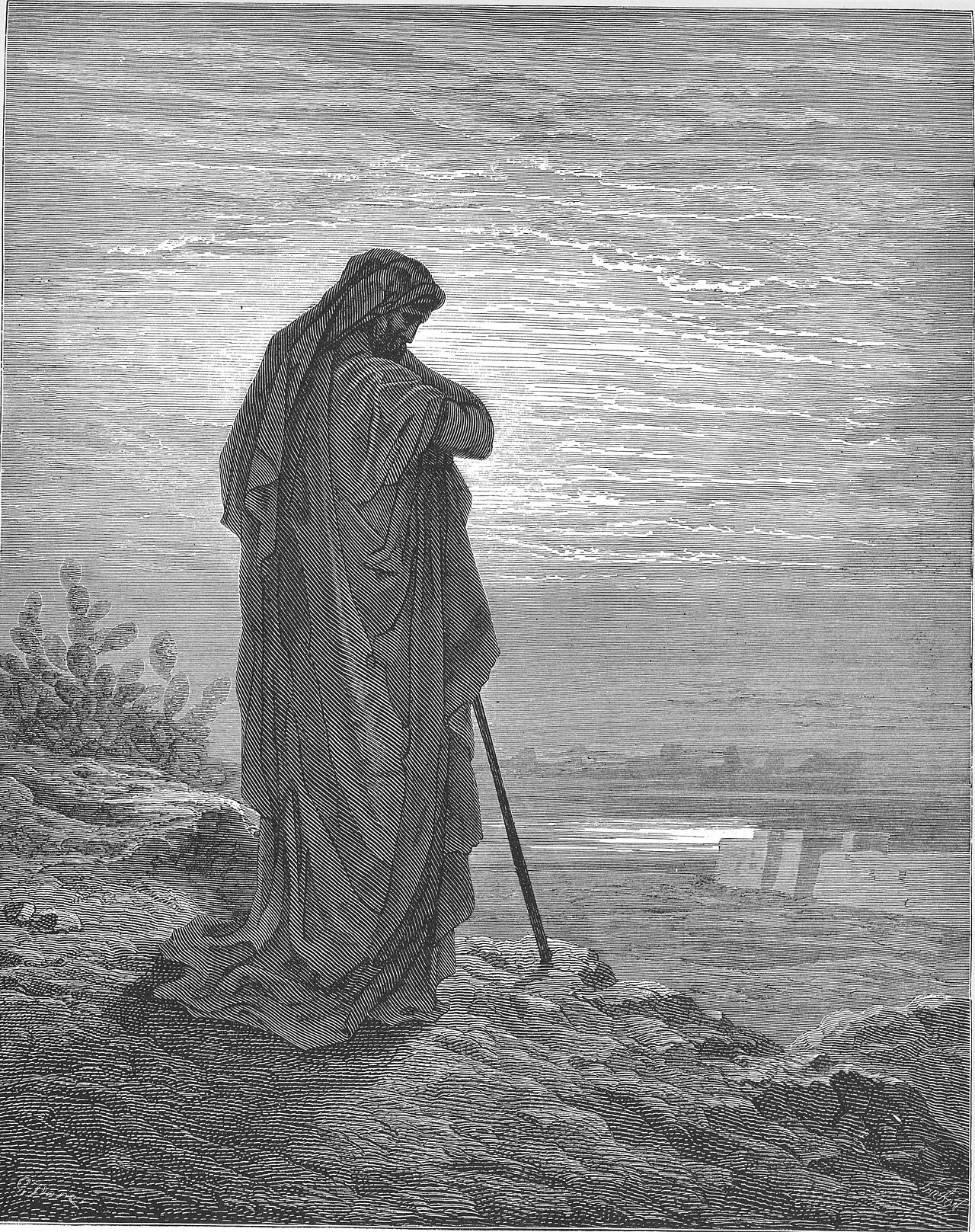
Amoschapter 1
15 verses · Amos · about 760 BC · The Twelve
These are the words of Amos, who was among the sheepherders of Tekoa—what he saw concerning Israel two years before the earthquake, in the days when Uzziah was king of Judah and Jeroboam son of Jehoash was king of Israel.
Introduction
Amos, The Twelve, Amos Overview.
This chapter opens one of the earliest books of the prophets who wrote. It comes from a sheepherder of Tekoa in Judah, a man with no training as a prophet, who was sent north to preach in the kingdom of Israel. He spoke in a time of peace and wealth, to people who felt secure in their shrines and their borders. Every nation he names had fought Israel or traded with it, and his hearers knew them well. Listen for the formula that opens each oracle and the fire that closes it. Notice the order in which the nations come.
Context
- Who
- Israelites who agreed enthusiastically with every word of the first six oracles
- What
- The heading of the book, a cry that the LORD roars from Zion, and five oracles of judgment on Israel's neighbours.
- Where
- Spoken in the northern kingdom of Israel, most likely at Bethel, about Aram, Philistia, Tyre, Edom and Ammon around it.
- When
- About 760 BC, in the reigns of Uzziah of Judah and Jeroboam II of Israel, two years before an earthquake whose year is uncertain.
- Why
- To show that God judges every nation for its cruelty, and to set the standard by which Israel will be judged next.
Historical context
The earthquake in the opening line was real enough to date a book by. It was still being remembered two centuries later by Zechariah, and excavations at Hazor and other northern sites show a destruction layer from roughly this period that archaeologists have linked to a major quake.
Show the rest of the historical context, 3 more paragraphs
Amos came from Tekoa, a hill town about six miles south of Bethlehem in Judah, on the edge of the wilderness. He was a Judean speaking in Israel, which made him a foreigner in the room before he opened his mouth.
The oracles work like a tightening noose, and the geography is the trick. Damascus is far to the north-east, Gaza far to the south-west, Tyre on the north-west coast, Edom to the south-east, a listener in Bethel could watch the circle closing on him and would keep cheering anyway.
The crimes named are specific war atrocities, not general wickedness. Threshing Gilead with sledges of iron describes a real machine: a heavy wooden board studded on its underside with basalt or iron teeth, dragged over grain by oxen to cut the straw and free the kernels. Using it on people is what the words say. Gaza and Tyre are charged with rounding up whole populations and selling them on to Edom, the slave trade again, run through the coastal ports.
Significance
For hearers this was the most agreeable sermon they had heard in years. Every nation on the list had hurt Israel or its neighbours, and the formula, for three transgressions and for four, meant the cup had finally run over.
Show the rest of the significance, 1 more paragraph
That agreement was the trap. Amos was establishing, oracle by oracle, that God holds nations accountable for how they treat people, including nations that never had his law. When the circle closed on Israel in the next chapter, the standard had already been set by the audience's own applause.
This chapter in Jewish lifeWhat this chapter is in Jewish life and reading.
What is done
No part of this chapter is read in the synagogue. Probed for this lane, the site's table in src/lib/hebraic/readings.ts printed parashot 0 and no Haftarah use for Amos 1, and no festival reading for the book. The same probe printed 54 weekly portions and 6 festival readings in the table as a whole. Amos is heard in the synagogue twice in the year, and neither reading reaches this chapter. The table records Amos 2:6 to 3:8 as the Haftarah of Vayeshev and Amos 9:7 to 9:15 as the Ashkenazi Haftarah of Kedoshim.
The chapter is met instead in the study of the Torah, and the corpus shows the joins. Under the first verse it carries Midrash Tannaim on Deuteronomy 1:1:3 and Sifrei Devarim 1:2, which read the opening of Deuteronomy. That verse opens the portion Devarim, which the table records as Deuteronomy 1:1 to 3:22. Under the eleventh verse, where Edom pursues his brother with the sword, the corpus carries Midrash Tanchuma at Ki Teitzei 4:1 and 10:1, and Midrash Tanchuma Buber at Vayetzei 3:3 and Miketz 12:1. A Jewish reader meets the charge against Edom in the weeks of Vayetzei and Miketz and in the week of Ki Teitzei, which the table records as Deuteronomy 21:10 to 25:19.
How it is read
Rashi is the one commentator on this chapter whose English the corpus carries, quoted here from The Judaica Press complete Tanach with Rashi, translated by A. J. Rosenberg, which Sefaria reports as CC-BY. The translation is modern, so every quotation from it is fifty words or fewer.
Rashi opens on the prophet's trade and date. At the first verse he follows Targum Jonathan, "Jonathan renders: who was an owner of livestock", and sets the word beside Mesha the king of Moab in 2 Kings 3:4 (Rashi on Amos 1:1:1). The earthquake he dates by the day Uzziah was struck. The prophecy came "Two years before Uzziah was plagued, the day Isaiah prophesied", and he joins it to Isaiah 6:4 and Zechariah 14:5 (Rashi on Amos 1:1:2). At the Lord's roar from Zion he names the room it comes from. "From the Holy of Holies the speech emanates" (Rashi on Amos 1:2:1).
The refrain of three transgressions and four is read as a measure of patience. Rashi takes it through Job 33:29, twice and three times with a man. God says through the prophet, "I have already behaved toward them according to My standard, to forgive them for three transgressions" (Rashi on Amos 1:3:1). The fourth is where the account is called in, and for Damascus it is the threshing of Gilead (Rashi on Amos 1:3:2). The note names Shem Ephraim as the source of one line of it.
The charges against the nations are read against the history of Israel. At Gaza, the whole captivity means refugees seized on the roads and handed over, so that no one escaped. Rashi carries the charge forward to the destruction of the Second Temple, through the Aggadah of Ha'azinu in Sifre 322. The enemies stood on four sides, "Gaza from the south, Tyre from the north, Damascus from the east, the Arabs from the west" (Rashi on Amos 1:6:2). At Tyre the covenant of brothers is the league of Hiram and Solomon in 1 Kings 5:26. "And they called each other brothers" (Rashi on Amos 1:9:1). At Edom he goes back to Numbers 20:18, where Edom met Israel with the sword. "And he still clings to his anger, keeps his wrath, and has not retracted it" (Rashi on Amos 1:11:1). Bozrah he places between Moab and Edom and ties to Jobab of Bozrah in Genesis 36:33, after Genesis Rabbah 83:3 (Rashi on Amos 1:12:1). Ammon's cruelty in Gilead had a purpose, and Rashi names it: "so that no heir would remain who would contest the inheritance" (Rashi on Amos 1:13:1). He proves the purpose from Jeremiah 49:1.
The corpus carries seven further notes on this chapter without an English text, each marked linked because Sefaria holds no English version of the ref. They stand cited and unquoted at Ibn Ezra on Amos 1:4:1, 1:7:1 and 1:9:1, at Radak on Amos 1:7:1, 1:14:1 and 1:15:1 and at Malbim on Amos 1:10:1.
What the rabbis say
The corpus carries forty rabbinic locators on this chapter, one it files under Talmud and thirty-nine under Midrash, and the text of none, so each is cited by ref here rather than quoted. On the first verse it holds Aggadat Bereshit 14:4, Kohelet Rabbah 1:1:2, Midrash Lekach Tov on Ecclesiastes 1:1:1, Midrash Sekhel Tov, Bereshit 30:32:3, Midrash Tannaim on Deuteronomy 1:1:3 and Seder Olam Rabbah 20:1. It also holds Sifrei Devarim 1:2, Yalkut Shimoni on Nach 515:1 and Yalkut Shimoni on Torah 788:19. On the second verse it holds Midrash Tehillim 104:20. On the third verse it holds Bereshit Rabbati, Parashat Vayishlach 49, Pesikta DeRav Kahana 19:2, Sifrei Devarim 322:7 and Yalkut Shimoni on Torah 945:26.
On the sixth verse it holds Eikhah Rabbah 1:56, Midrash Lekach Tov, Deuteronomy 32:27:1 and Midrash Tannaim on Deuteronomy 32:27:3. On the ninth verse it holds Avot DeRabbi Natan 9:2 and Otzar Midrashim, Baraita of Rabbi Pinchas Ben Yair 1:23. On the eleventh verse it holds Aggadat Bereshit 46:3, Bereshit Rabbah 67:10, Bereshit Rabbah 82:2, Bereshit Rabbati, Parashat Toldot 3, Bereshit Rabbati, Parashat Vayetze 1 and Bereshit Rabbati, Parashat Vayetze 28. It also holds Bereshit Rabbati, Parashat Vayetze 73, Bereshit Rabbati, Parashat Vayishlach 40, Ein Yaakov, Sotah 3:3, Midrash Lekach Tov, Genesis 27:45:1 and Midrash Sekhel Tov, Bereshit 27:45:1. It also holds Midrash Tanchuma Buber, Ki Teitzei 4:1, Midrash Tanchuma Buber, Miketz 12:1, Midrash Tanchuma Buber, Vayetzei 3:3, Midrash Tanchuma, Ki Teitzei 10:1 and Midrash Tanchuma, Ki Teitzei 4:1. It also holds Midrash Tanchuma, Miketz 10:7, Midrash Tehillim 109:1, Pesikta DeRav Kahana 3:1, Pesikta Rabbati 12:1 and Pesikta Rabbati 13:1. What each of them teaches is a saying of the rabbis, and it is reported as theirs wherever this site quotes one. The quotations wait on a fetch that carries the text.
Sources: Rashi, Rashi on Amos 1:1:1 to 1:13:1, The Judaica Press complete Tanach with Rashi, translated by A. J. Rosenberg, reported CC-BY; Ibn Ezra, Ibn Ezra on Amos 1:4:1, 1:7:1 and 1:9:1, cited by ref because the corpus carries no English text; Radak, Radak on Amos 1:7:1, 1:14:1 and 1:15:1, cited by ref because the corpus carries no English text; Malbim, Malbim on Amos 1:10:1, cited by ref because the corpus carries no English text; The Sefaria corpus, scripts/data/sources/sefaria/amos/1.json, the 40 Talmud and Midrash locators of this chapter; The site's own files, src/lib/hebraic/readings.ts, probed for this chapter and printing parashot 0 and no Haftarah use, with festivalReadingForBook(amos) null.
The heads below are this chapter's scenes. The numbered points under each are its verses.
The LORD roars from Zion: the words of a herdsman
Amos 1:1-2
Amos names himself "among the sheepherders of Tekoa," a man of Judah sent to Israel while Jeroboam reigned. He dates his words "two years before the earthquake," and Zechariah 14:5 remembers that earthquake. Verse 2 gives the theme: "The LORD roars from Zion," and "the summit of Carmel withers."
Amos 1:1
“Chapter 1 - Verse 1. The words of Amos, who was among the shepherds of Tekoa, which he saw concerning Israel. However, the Septuagint, wanting to add something, interpreted it as: The words of Amos, who was among the vine-dressers of Tekoa, which he saw for Jerusalem.”
Jerome · written before 420 · Commentary on Amospatristic
3 more voices on this verseWhat preachers and commentators have said about this verse, in their own words.
Amos 1:1
“The words of Amos,.... Not which he spoke of or for himself, but from the Lord; all the prophecies, visions, and revelations made unto him, are intended: who was among the herdsmen of Tekoa; which was not in the tribe of Asher, as Kimchi; nor of Zebulun, as Pseudo-Epiphanius (i); but in the tribe of Judah, 2Ch 11:5. It lay to the south, and was six miles from Bethlehem.”
Amos 1:1
“These two things then, well agree together, -- that the prophecies which follow were the words of Amos and that they were words revealed to him from above; for the word chzh, chese, which Amos uses, properly means, to see by revelation; and these revelations were called prophecies. But he says, that he was among the shepherds of Tekoa.”
John Calvin · Commentaries (1554)reformed
Amos 1:1
“Israel - The kingdom of the ten tribes. Jeroboam - The great grand-son of Jehu. The earth- quake - Of which, only this text, and Zech xiv, 5, make any particular mention.”
John Wesley · Explanatory Notes upon the Old Testament (1765)evangelical
Jamieson, Fausset and Brown note that Zion was the seat of the theocracy Israel had left for the calf shrines of Dan and Bethel. Matthew Henry reads a roar from the place of the mercy seat as judgment tempered by mercy. Adam Clarke adds that Carmel was a fruitful mountain.
Amos 1:2
“The Lord will roar from Zion - It is a pity that our translators had not followed the hemistich form of the Hebrew: - Jehovah from Zion shall roar, And from Jerusalem shall give forth his voice; And the pleasant dwellings of the shepherds shall mourn, And the top of mount Carmel shall wither. Carmel was a very fruitful mountain in the tribe of Judah, Jos 15:56; Isa 35:2. This introduction was natural in the mouth of a herdsman who was familiar with the roaring of lions, the bellowing of bulls, and the lowing of kine.”
Adam Clarke · Commentary on the Bible (1810-1826)evangelical
2 more voices on this verse
Amos 1:2
“Our God, whose special residence is there, will issue out warrants, given at that court, as it were, for the executing of judgments on the land. In Zion was the mercy-seat; thence the Lord roars, intimating that God's acts of justice are consistent with mercy, allayed and mitigated by mercy, nay, as they are warnings, they are really acts of mercy.”
Matthew Henry · Commentary on the Whole Bible (1707-1721)puritan
Amos 1:2
“Whereas Jehovah is there represented roaring in Israel's behalf, here He roars against her (compare Ps 18:13; Jer 25:30). from Zion . . . Jerusalem--the seat of the theocracy, from which ye have revolted; not from Dan and Beth-el, the seat of your idolatrous worship of the calves. habitations . . . mourn--poetical personification.”
Jamieson, Fausset & Brown · Commentary Critical and Explanatory on the Whole Bible (1871)reformed
ConnectionsAmos 3:8
For three transgressions of Damascus, and for four
Amos 1:3-5
The formula "For three transgressions of Damascus, even four" opens each of the eight oracles, a Hebrew idiom for a full measure of guilt. Damascus "threshed Gilead with sledges of iron," Israel's land east of the Jordan, and 2 Kings 13:7 records the king of Aram doing so.
Amos 1:3
“For three - This certain number is put for an uncertain: three, that is, many. Of Damascus - Here Damascus is put for the whole kingdom of Syria. Threshed - Treated it with the utmost cruelty.”
John Wesley · Explanatory Notes upon the Old Testament (1765)evangelical
1 more voice on this verse
Amos 1:3
“The order of God’s threatenings seems to have been addressed to gain the hearing of the people. The punishment is first denounced upon their enemies, and that, for their sins, directly or indirectly, against themselves, and God in them. Then, as to those enemies themselves, the order is not of place or time, but of their relation to God’s people.”
send fire upon the house of Hazael: Hazael and his son Ben-hadad were the Aramean kings who pressed Israel hardest. Adam Clarke reads the fire as the war of Jeroboam II, who took Damascus and Hamath according to 2 Kings 14:28. John Gill carries it on to Hazael's descendants, perhaps Rezin, whom the king of Assyria slew.
Amos 1:4
“But I will send a fire into the house of Hazael,.... For so doing; into his family, his sons' sons, one of whom perhaps was Rezin, that Tiglathpileser king of Assyria slew, as Aben Ezra observes.”
1 more voice on this verse
Amos 1:4
“Ben-hadad - He was son and successor of Hazael. See the cruelties which they exercised upon the Israelites, 2Ki 10:32; 2Ki 13:7, etc., and see especially 2Ki 8:12, where these cruelties are predicted. The fire threatened here is the war so successfully carried on against the Syrians by Jeroboam II., in which he took Damascus and Hamath, and reconquered all the ancient possessions of Israel. See 2Ki 14:25, 2Ki 14:26, 2Ki 14:28.”
Adam Clarke · Commentary on the Bible (1810-1826)evangelical
I will break down the gates of Damascus: Albert Barnes notes that city gates were cased in iron, so the weakest point of a wall became its strongest defense. John Wesley takes Beth-eden as a royal seat of the Syrian kings and Kir as a region of Media. Tiglath-pileser carried the Syrians there, as 2 Kings 16:9 records.
Amos 1:5
“I will also break the bar of Damascus - In the East, every city was fortified; the gates of the stronger cities were cased in iron, that they might not be set on fire by the enemy; they were fastened within with bars of brass 1Ki 4:13 or iron (Psa 107:16; Isa 45:2; compare Isa 48:14; Jer 51:3 O). They were flanked with towers, and built over, so that what was naturally the weakest point and the readiest access to an enemy became the strongest defense.”
1 more voice on this verse
Amos 1:5
“The bar - Literally the bar with which the city gates were shut, and fastened. Of Eden - Some royal seat, of the kings of Syria. Kir - Kir of Media, Isaiah xxii, 6, thither did Tiglath-Pilneser carry the conquered Syrians, 2 Kings xvi, 9, and placed them captives in that barren mountainous country, about fifteen years after it was foretold by Amos.”
John Wesley · Explanatory Notes upon the Old Testament (1765)evangelical
Gaza and Tyre, who sold off whole captivities
Amos 1:6-8
Gaza is charged with a slave trade: "they exiled a whole population, delivering them up to Edom," selling a defeated people as goods. Four Philistine cities are named, Gaza, Ashdod, Ashkelon and Ekron, and Gath is left out; 2 Chronicles 26:6 records that Uzziah tore down its walls.
Amos 1:6
“Gaza--the southernmost of the five capitals of the five divisions of Philistia, and the key to Palestine on the south: hence put for the whole Philistine nation. Uzziah commenced the fulfilment of this prophecy (see 2Ch 26:6). because they carried away . . . the whole captivity--that is, they left none.”
Jamieson, Fausset & Brown · Commentary Critical and Explanatory on the Whole Bible (1871)reformed
1 more voice on this verse
Amos 1:6
“They carried away captive - Gaza is well known to have been one of the five lordships of the Philistines; it lay on the coast of the Mediterranean Sea, near to Egypt. Erkon, Ashdod, and Askelon, were other signories of the same people, which are here equally threatened with Gaza. The captivity mentioned here may refer to inroads and incursions made by the Philistines in times of peace. See 2Ch 21:16. The margin reads, an entire captivity. They took all away; none of them afterwards returned.”
Adam Clarke · Commentary on the Bible (1810-1826)evangelical
send fire upon the walls of Gaza: Gaza is singled out from the Philistine cities. Albert Barnes explains that it was the merchant city, where the caravans passed through, so the sale of captives ran through its markets. He sums up the order of the sentence in a phrase: first in sin, first in punishment.
Amos 1:7
“But - Literally, “and.” Thus had Gaza done, and thus would God do; “I will send a fire upon Gaza.” The sentence on Gaza stands out, probably in that it was first in power and in sin. It was the merchant-city of the five; the caravans parted from it or passed through it; and so this sale of the Jewish captives was ultimately effected through them. First in sin, first in punishment.”
I will cut off the ruler of Ashdod: The sentence moves from Gaza to the other Philistine cities. Albert Barnes gives the meaning of two names, Ashdod the mighty and Ekron the firm-rooted, and recalls that Ashdod's temple of Dagon received the ark. Jamieson, Fausset and Brown note that Uzziah later took Ashdod, as 2 Chronicles 26:6 records.
Amos 1:8
“Ashdod, &c.--Gath alone is not mentioned of the five chief Philistine cities. It had already been subdued by David; and it, as well as Ashdod, was taken by Uzziah (2Ch 26:6). Gath perhaps had lost its position as one of the five primary cities before Amos uttered this prophecy, whence arose his omission of it.”
Jamieson, Fausset & Brown · Commentary Critical and Explanatory on the Whole Bible (1871)reformed
Amos 1:9-10
Tyre shares Gaza's crime, "they delivered up a whole congregation of exiles to Edom," and adds a second charge. They "broke a covenant of brotherhood," and 1 Kings 5:12 records the treaty between Hiram of Tyre and Solomon. At 1 Kings 9:13 Hiram calls Solomon his brother.
Amos 1:9
“The last crowning sin, for which judgment is pronounced on Tyre, is the same as that of Philistia, and probably was enacted in concert with it. In Tyre, there was this aggravation, that it was a violation of a previous treaty and friendship. It was not a covenant only, nor previous friendliness only; but a specific covenant, founded on friendship which they forgat and brake. If they retained the memory of Hiram’s contact with David and Solomon, it was a sin against light too.”
send fire upon the walls of Tyre: John Gill names three possible fulfilments: Shalmaneser of Assyria, of whom Josephus writes, Nebuchadnezzar after a siege of thirteen years, and Alexander after seven months. Adam Clarke joins the last two, pointing to Ezekiel 26:7-14, and adds that the city became a place for fishermen to spread their nets.
Amos 1:10
“But I will send a fire on the wall of Tyrus,.... An enemy to destroy the walls of it: this was done either by Shalmaneser king of the Assyrians, in the times of Eulaeus king of the Tyrians, of whose expedition against it Josephus (s) makes mention: or by Nebuchadnezzar, who took it after thirteen years' siege of it, in the time of Ithobalus (t): or by Alexander, by whom it was taken, as Curtius (u) relates, after it had been besieged seven months: which shall devour the palaces thereof; of the governor, the great men and merchants in it.”
1 more voice on this verse
Amos 1:10
“I will send a fire on the wall of Tyrus - The destructive fire or siege by Nebuchadnezzar, which lasted thirteen years, and ended in the destruction of this ancient city; see on Eze 26:7-14 (note), as above. It was finally ruined by Alexander, and is now only a place for a few poor fishermen to spread their nets upon.”
Adam Clarke · Commentary on the Bible (1810-1826)evangelical
Edom's endless anger and Ammon's cruelty
Amos 1:11-12
Edom "pursued his brother with the sword and stifled all compassion," and the brother is Jacob, since Edom is Esau (Genesis 36:1). The lines "his anger raged continually, and his fury flamed incessantly" describe a settled temper held across generations, more than a single act of war.
Amos 1:11
“Edom - God had impressed on Israel its relation of brotherhood to Edom. Moses expressed it to Edom himself , and, after the suspicious refusal of Edom to allow Israel to march on the highway through his territory, he speaks as kindly of him, as before; “And when we passed by from our brethren, the children of Esau” Deu 2:8. It was the unkindness of worldly politics, and was forgiven.”
send fire upon Teman: Teman took its name from Teman, the son of Eliphaz and grandson of Esau, listed at Genesis 36:11. John Gill notes that the name means the south and here stands for the whole country of Edom. He cites Jerome and Eusebius for a village called Theman, five miles from Petra.
Amos 1:12
“But I will send a fire upon Teman,.... A principal city of Edom or Idumea, so called from Teman a grandson of Esau, Gen 36:11. Jerom (x) says there was in his time a village called Theman, five miles distant from the city Petra, and had a Roman garrison; and so says Eusebius (y); who places it in Arabia Petraea; it is put for the whole country; it signifies the south.”
Amos 1:13-15
Ammon "ripped open the pregnant women of Gilead in order to enlarge their territory," an atrocity. Fire falls on Rabbah "amid war cries on the day of battle," and the king goes into exile, "he and his princes together." With Ammon the oracles have circled Israel's borders.
kindle a fire in the walls of Rabbah: Rabbah, whose name means the Great, was the capital of Ammon, later called Philadelphia. Jamieson, Fausset and Brown read the violent wind on the day of tempest as a picture of the enemy's assault, impossible to resist. Adam Clarke sets the fulfilment under Nebuchadnezzar, pointing to Jeremiah 27:3 and 27:6.
Amos 1:14
Rabbah--the capital of Ammon: meaning "the Great." Distinct from Rabbah of Moab. Called Philadelphia, afterwards, from Ptolemy Philadelphus. tempest--that is, with an onset swift, sudden, and resistless as a hurricane. day of the whirlwind--parallel to "the day of battle"; therefore meaning "the day of the foe's tumultuous assault."
Jamieson, Fausset & Brown · Commentary Critical and Explanatory on the Whole Bible (1871)reformed
1 more voice on this verse
Amos 1:14
“With shouting in the day of battle - They shall be totally subdued. This was done by Nebuchadnezzar. See Jer 27:3, Jer 27:6.”
Adam Clarke · Commentary on the Bible (1810-1826)evangelical
Albert Barnes explains why the king and his princes are taken together: in these nations the king was the center of their strength. John Gill names the king as Baalis, who had a hand in the murder of Gedaliah, and reads his captivity as Babylon's answer.
Amos 1:15
“And their king - The king was commonly, in those nations, the center of their energy. When “he and his princes” were “gone into captivity,” there was no one to make head against the conqueror, and renew revolts. Hence, as a first step in the subdual, the reigning head and those who shared his counsels were removed. Ammon then, savage as it was in act, was no ill-organized horde. On the contrary, barren and waste as all that country now is, it must once have been highly cultivated by a settled and laborious people.”
1 more voice on this verse
Amos 1:15
“And their king shall go into captivity,.... Not only the common people that are left of the sword shall be carried captive, but their king also. This was, Baalis their last king, who was accessary to the murder of Gedaliah, Jer 40:14; whom the king of Babylon had set over the remnant of the Jews left in Judea; which might provoke him to send Nebuzaradan his general against him, who put his country to fire and sword, destroyed his chief city Rabbah, and carried him and his nobles into captivity.”
How this psalm is built
The form: Five oracles against the nations around Israel, each in the same fixed form, the first part of a series of eight that ends at 2:16, as guide classes it.
The patterns in this chapter
| Device | What it does | Where to see it |
|---|---|---|
| For three transgressions, even four | The same opening formula stands over all eight oracles, from Damascus at 1:3 to Israel at 2:6. It names the nation, says three transgressions and then four, and names one crime. The formula builds a pattern the hearers can predict, so the eighth name lands on them.the Berean text of Amos 1:3 to 2:6, counted, and the site's Amos guide, src/components/book/guides/amos/AmosGuide.tsx, the oracles table. | Amos 1:3, Amos 1:6, Amos 1:9, Amos 1:11, Amos 1:13, Amos 2:1, Amos 2:4, Amos 2:6 |
| I will send fire | Seven of the eight oracles close with fire sent on the nation's walls, citadels or cities, the Ammonite one as a fire kindled. The oracle against Israel breaks the pattern. It carries no fire line and runs to eleven verses, the longest in the series.the Berean text of Amos 1:4 to 2:16, counted, and the site's Amos guide, src/components/book/guides/amos/AmosGuide.tsx, the oracles table, which counts eleven verses for Israel. | Amos 1:4, Amos 1:7, Amos 1:10, Amos 1:12, Amos 1:14, Amos 2:2, Amos 2:5 |
The structure
3 more paragraphs on the patterns
Verses 1 and 2 are the heading and a cry that the LORD roars from Zion. Verses 3 to 15 hold five oracles, on Damascus, Gaza, Tyre, Edom and Ammon. Each follows the same order: the formula, one named crime, the fire, and the result.
Where the chapter reaches
The series does not end with the chapter. Moab, Judah and Israel follow at 2:1 to 16, and the oracle against Israel is the longest.
Keep studying
Studies5
Sources for this chapter
The summary
Jamieson, Fausset & Brown, Commentary Critical and Explanatory; John Calvin, Commentaries; John Wesley, Notes on the Old Testament and Matthew Henry, Complete Commentary.
The form and classifications
the site's Amos guide, src/components/book/guides/amos/AmosGuide.tsx, the oracles table.
The exposition
Adam Clarke, Commentary on the Bible; Albert Barnes; Carl Friedrich Keil, The Twelve Minor Prophets; Edward Bouverie Pusey, The Minor Prophets: A Commentary; Jamieson, Fausset & Brown, Commentary Critical and Explanatory on the Whole Bible; Jamieson, Fausset and Brown, Commentary Critical and Explanatory on the Whole Bible; John Calvin, Commentaries on the Twelve Minor Prophets; John Gill; John Wesley, Explanatory Notes upon the Old Testament and Matthew Henry, Commentary on the Whole Bible.