
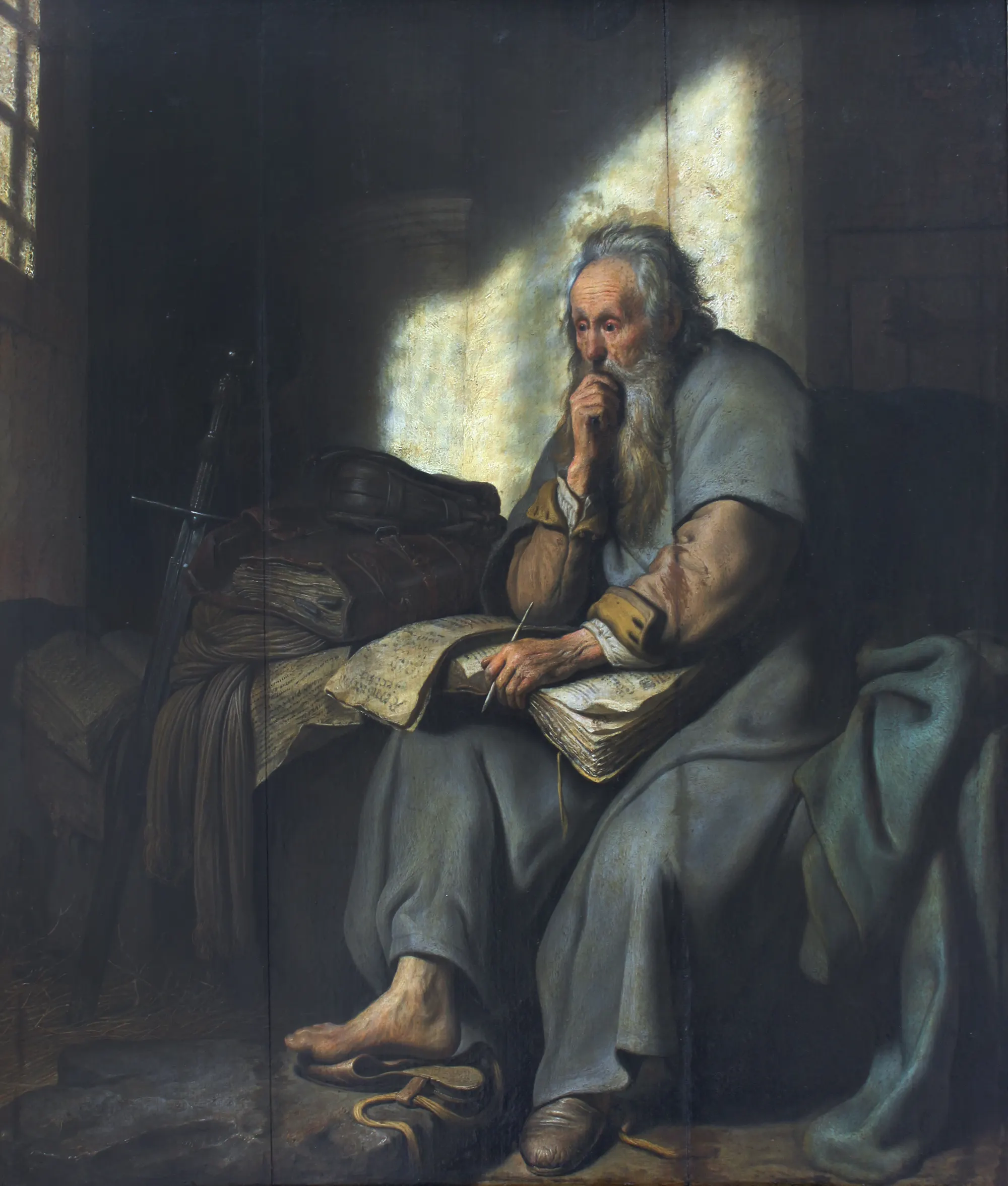
2 Corinthianschapter 12
21 verses · Paul · about AD 56 · Paul's letters
or because of these surpassingly great revelations. So to keep me from becoming conceited, I was given a thorn in my flesh, a messenger of Satan, to torment me.
Introduction
Paul, Paul's letters, 2 Corinthians Overview.
Paul wrote this chapter, with Timothy named beside him in the letter's first verse, to the church of God in Corinth and the saints throughout Achaia. It carries on the boast that Paul began as a fool in chapter 11. Listen for how he speaks of himself as another man, and for what he says he may not tell. Listen above all for the answer he was given in verse 9. Hear it as a word for anyone who has prayed and been refused.
Context
- Who
- Corinthians impressed by rivals who traded on visions and revelations.
- What
- Paul's account of a vision of the third heaven and of the thorn in the flesh given after it, with his plans for a third visit to Corinth.
- Where
- Written from Macedonia to the church at Corinth, about a vision Paul had received fourteen years before at a place he does not name.
- When
- About AD 55 to 56, with the vision dated by Paul himself to fourteen years before the writing.
- Why
- To show that the Lord's power rests on weakness, and to prepare the church to be found in good order when he came.
Historical context
Claims of heavenly ascent were a currency in the religious world of the day, and Jewish apocalyptic writing describes journeys through multiple heavens. Paul enters that arena only under protest, tells the story in the third person, and refuses to report what he heard. That is nearly the opposite of how such experiences were normally used.
Show the rest of the historical context, 3 more paragraphs
The thorn in the flesh is deliberately unspecified. Suggestions have ranged since the church fathers from eye trouble to malaria to persistent opposition, and the text supports none of them decisively. What it does say is that it was given, that he asked three times, and that the answer was no.
The word for "power made perfect in weakness" carries the sense of reaching its intended end. In a culture that measured a patron or philosopher by strength and self-sufficiency, this was an inversion of the whole scale.
His refusal to be a burden on his third visit returns to the money question, and he answers the accusation that he took their money by a trick through his companions, an insinuation that must have been circulating, since he bothers to name and deny it.
Significance
For the first hearers, the sentence that mattered was the Lord's, not Paul's: my grace is sufficient for you, for my power is made perfect in weakness. A church chasing impressiveness was told that God had declined to remove his apostle's humiliation on purpose.
Show the rest of the significance, 1 more paragraph
His closing image is parental and disarming after chapters of combat: children do not save up for their parents, but parents for their children, and he will gladly spend and be spent for their souls.
The heads below are this chapter's scenes. The numbered points under each are its verses.
Caught Up to the Third Heaven
visions and revelations from the Lord: The phrase visions and revelations from the Lord pairs two things, optasiai, visible showings, and apokalypseis, disclosed truths. The account that follows is one mark of a true apostle his rivals cannot match, since it came unbidden from Christ.
2 Corinthians 12:1
“It is not expedient - It is not well; it does not become me. This may either mean that he felt and admitted that it did not become him to boast in this manner; that there was an impropriety in his doing it though circumstances had compelled him, and in this sense it is understood by nearly, or quite, all expositors; or it may be taken ironically. “Such a man as I am ought not to boast. So you say, and so it would seem.”
2 more voices on this verseWhat preachers and commentators have said about this verse, in their own words.
2 Corinthians 12:1
“Paul is afraid, lest this should befall him. The graces conferred by God are, indeed, to be acknowledged, that we may be aroused, -- first, to gratitude for them, and secondly, to the right improvement of them; but to take occasion from them to boast -- that is what cannot be done without great danger.”
John Calvin · Commentaries (1554)reformed
2 Corinthians 12:1
“He proceeds to illustrate the "glorying in infirmities" (2Co 11:30). He gave one instance which might expose him to ridicule (2Co 11:33); he now gives another, but this one connected with a glorious revelation of which it was the sequel: but he dwells not on the glory done to himself, but on the infirmity which followed it, as displaying Christ's power.”
Jamieson, Fausset & Brown · Commentary Critical and Explanatory on the Whole Bible (1871)reformed
2 Corinthians 12:2-4
I know a man in Christ: is Paul's own testimony told with reserve, since only he fits the argument about his thorn. The man was caught up to the third heaven, harpazo, a seizing he did not choose.
2 Corinthians 12:2
“For that there are spiritual creatures in the heavens, all the Scriptures loudly proclaim; and Paul expressly testifies that there are spiritual things when he declares that he was caught up into the third heaven, and again, that he was carried away to paradise, and heard unspeakable words which it is not lawful for a man to utter.”
Irenaeus · written before 202 · Against Heresies Book IIpatristic
3 more voices on this verse
2 Corinthians 12:2
“It was certainly a very extraordinary honour done him: in some sense he was caught up into the third heaven, the heaven of the blessed, above the aërial heaven, in which the fowls fly, above the starry heaven, which is adorned with those glorious orbs: it was into the third heaven, where God most eminently manifests his glory.”
Matthew Henry · Commentary on the Whole Bible (1707-1721)puritan
2 Corinthians 12:2
“But he purposely thus distinguishes between the rapt and glorified person of 2Co 12:2, 4, and himself the infirmity-laden victim of the "thorn in the flesh" (2Co 12:7). Such glory belonged not to him, but the weakness did. Nay, he did not even know whether he was in or out of the body when the glory was put upon him, so far was the glory from being his [ALFORD].”
Jamieson, Fausset & Brown · Commentary Critical and Explanatory on the Whole Bible (1871)reformed
2 Corinthians 12:2
“I knew a man in Christ As he was desirous to restrain himself within bounds, he merely singles out one instance, and that, too, he handles in such a way as to show, that it is not from inclination that he brings it forward; for why does he speak in the person of another rather than in his own?”
John Calvin · Commentaries (1554)reformed
Paul repeats the clause of verse 2 on purpose. John Gill and Albert Barnes read the repetition as a solemn affirmation made more emphatic.
2 Corinthians 12:3
“And I knew such a man,.... The same man, namely himself, is here designed, and the same rapture spoken of, and the condition he was in expressed in the same words: which repetition is made for the more strong affirmation of what he delivered, and to signify the marvellousness of this vision, and how surprising and unaccountable it was.”
1 more voice on this verse
2 Corinthians 12:3
“But since he (Paul) has described that assumption of himself up to the third heaven as something great and pre-eminent, it cannot be that these men ascend above the seventh heaven, for they are certainly not superior to the apostle. If they do maintain that they are more excellent than he, let them prove themselves so by their works, for they have never pretended to anything like [what he describes as occurring to himself].”
Irenaeus · written before 202 · Against Heresies Book IIpatristic
was caught up to Paradise: Paradise names the place of the blessed. John Wesley calls it the seat of happy spirits between death and the resurrection, and Irenaeus places there the righteous who have the Spirit.
2 Corinthians 12:4
“Wherefore also the elders who were disciples of the apostles tell us that those who were translated were transferred to that place (for paradise has been prepared for righteous men, such as have the Spirit; in which place also Paul the apostle, when he was caught up, heard words which are unspeakable as regards us in our present condition), and that there shall they who have been translated remain until the consummation [of all things], as a prelude to immortality.”
Irenaeus · written before 202 · Against Heresies Book Vpatristic
2 more voices on this verse
2 Corinthians 12:4
“He was caught up into paradise - The seat of happy spirits in their separate state, between death and the resurrection. Things which it is not possible for man to utter - Human language being incapable of expressing them. Here he anticipated the joyous rest of the righteous that die in the Lord.”
John Wesley · Explanatory Notes upon the New Testament (1755)evangelical
2 Corinthians 12:4
“Caught up into paradise - The Jewish writers have no less than four paradises, as they have seven heavens; but it is needless to wade through their fables. On the word paradise see the note on Gen 2:8. The Mohammedans call it jennet alferdoos, the garden of paradise, and say that God created it out of light, and that it is the habitation of the prophets and wise men. Among Christian writers it generally means the place of the blessed, or the state of separate spirits.”
Adam Clarke · Commentary on the Bible (1810-1826)evangelical
2 Corinthians 12:5-6
I will boast about such a man: Paul splits himself in two, the man caught up and the man writing. He keeps the vision apart from his apostolic measure: no one will credit me with more than he sees in me or hears from me.
2 Corinthians 12:5
“Of such an one will I glory - Of such a man it would be right to boast. It would be admitted that it is right to exult in such a man, and to esteem him to be uniquely favored by God. I will boast of him as having received special honor from the Lord.”
I would be speaking the truth: Paul's reserve is deliberate. Jamieson, Fausset and Brown, after Bengel, read him as asking to be judged by what Corinth saw of his acts and heard of his teaching.
2 Corinthians 12:6
“I shall not be a fool - Who that had got such honor from God would have been fourteen years silent on the subject? I will say the truth - I speak nothing but truth; and the apostle seems to have intended to proceed with something else of the same kind, but, finding some reason probably occurring suddenly, says, I forbear - I will say no more on this subject.”
Adam Clarke · Commentary on the Bible (1810-1826)evangelical
1 more voice on this verse
2 Corinthians 12:6
“For if I should resolve to glory - Referring to, I might glory of such a glorious Revelation. I should not be a fool - That is, it could not justly be accounted folly to relate the naked truth. But I forbear - I speak sparingly of these things, for fear any one should think too highly of me - O where is this fear now to be found?”
John Wesley · Explanatory Notes upon the New Testament (1755)evangelical
A Thorn, a Refusal, and Strength Made Perfect
because of these surpassingly great revelations: The revelation of verses 2 through 4 has its consequence: I was given a thorn in my flesh, a skolops, a stake or splinter. It was sent to keep Paul from becoming conceited, a mercy against pride.
2 Corinthians 12:7
“The Apostle Paul has, moreover, in the most lucid manner, pointed out that man has been delivered over to his own infirmity, lest, being uplifted, he might fall away from the truth. Thus he says in the second [Epistle] to the Corinthians: "And lest I should be lifted up by the sublimity of the revelations, there was given unto me a thorn in the flesh, the messenger of Satan to buffet me. And upon this I besought the Lord three times, that it might depart from me.”
Irenaeus · written before 202 · Against Heresies Book Vpatristic
3 more voices on this verse
2 Corinthians 12:7
“There was given me - By the wise and gracious providence of God. A thorn in the flesh - A visitation more painful than any thorn sticking in the flesh. A messenger or angel of Satan to buffet me - Perhaps both visibly and invisibly; and the word in the original expresses the present, as well as the past, time.”
John Wesley · Explanatory Notes upon the New Testament (1755)evangelical
2 Corinthians 12:7
“And lest I should be exalted - Lest I should be spiritually proud; lest I should become self-confident and vain, and suppose that I was a special favorite of Heaven. If Paul was in danger of spiritual pride, who is not? If it was necessary for God to adopt some special measures to keep him humble, we are not to be surprised that the same thing should occur in other cases. There is abundant reason to believe that Paul was naturally a proud man. He was by nature self-confident; trusting in his own talents and attainments, and eminently ambitious.”
2 Corinthians 12:7
“The apostle prayed earnestly to God for the removal of this sore grievance. Note, Prayer is a salve for every sore, a remedy for every malady; and when we are afflicted with thorns in the flesh we should give ourselves to prayer. Therefore we are sometimes tempted that we may learn to pray.”
Matthew Henry · Commentary on the Whole Bible (1707-1721)puritan
2 Corinthians 12:8-9
Three times I pleaded with the Lord: , Paul writes, three definite petitions to Christ. The answer is a present promise: My grace is sufficient for you, arkei, sufficient now and continually.
2 Corinthians 12:8
“If the Father gives us everything we ask in the name of the Son, what then does it mean that Paul asked the Lord three times and did not deserve to be heard, but it was said to him: "My grace is sufficient for you, for power is made perfect in weakness"? Did not that most excellent preacher ask in the name of the Son? Why then did he not receive what he asked?”
Gregory the Dialogist · written before 604 · Forty Gospel Homilies, Homily 27patristic
4 more voices on this verse
2 Corinthians 12:8
“I besought the Lord - That is, Christ, as the next verse absolutely proves, and the Socinians themselves confess. And if Christ be an object of prayer in such a case as this, or indeed in any case, it is a sure proof of his divinity; for only an omniscient Being can be made an object of prayer.”
Adam Clarke · Commentary on the Bible (1810-1826)evangelical
2 Corinthians 12:8
“I have felt this thorn in the flesh, 2 Cor. xii. 8, 9, the very mercy of God to me.”
John Bunyan · Grace Abounding to the Chief of Sinners (1666)English Puritan
2 Corinthians 12:8
“The thorn seems (from 2Co 12:9, and Greek, 2Co 12:7, "that he may buffet me") to have continued with Paul when he wrote, lest still he should be "overmuch lifted up." the Lord--Christ. Escape from the cross is not to be sought even indirectly from Satan (Lu 4:7). "Satan is not to be asked to spare us" [BENGEL].”
Jamieson, Fausset & Brown · Commentary Critical and Explanatory on the Whole Bible (1871)reformed
2 Corinthians 12:8
“Christ himself prayed to his Father thrice. As troubles are sent to teach us to pray, so they are continued to teach us to continue instant in prayer. We have an account of the answer given to the apostle's prayer, that, although the trouble was not removed, yet an equivalent should be granted: My grace is sufficient for thee.”
Matthew Henry · Commentary on the Whole Bible (1707-1721)puritan
The answer to the prayer came as a promise. John Wesley notes that grace may be present with the sharpest sense of pain. He reads the word rest as Christ's power covering Paul like a tent.
2 Corinthians 12:9
“The Lord puts the words into Paul's mouth, that following them up he might say, "O Lord, Thy grace is sufficient for me" [BENGEL]. my strength--Greek, "power." is made perfect--has its most perfect manifestation. in weakness--Do not ask for sensible strength, FOR My power is perfected in man's "strengthlessness" (so the Greek).”
Jamieson, Fausset & Brown · Commentary Critical and Explanatory on the Whole Bible (1871)reformed
3 more voices on this verse
2 Corinthians 12:9
“We see there may be grace where there is the quickest sense of pain. My strength is more illustriously displayed by the weakness of the instrument. Therefore I will glory in my weaknesses rather than my Revelations, that the strength of Christ may rest upon me - The Greek word properly means, may cover me all over like a tent.”
John Wesley · Explanatory Notes upon the New Testament (1755)evangelical
2 Corinthians 12:9
“Long-suffering therefore was God, when man became a defaulter, as foreseeing that victory which should be granted to him through the Word. For, when strength was made perfect in weakness, it showed the kindness and transcendent power of God.”
Irenaeus · written before 202 · Against Heresies Book IIIpatristic
2 Corinthians 12:9
PAUL, when buffeted by the messenger of Satan, addressed his prayer to the Lord Jesus Christ and not, as he usually did, to the heavenly Father. This is a somewhat remarkable fact, but it is clear from the passage before us. He says, "For this thing I besought the Lord thrice," and that the Lord, here, is the Lord Jesus is pretty clear from the fact that he says in the next verse, "that the power of Christ may rest upon me."
I delight in weaknesses: When I am weak, then I am strong is the letter's paradox at its summit, the thread run from 1:9 through 4:7. It compresses the epistle's teaching on ministry, Christ's strength displacing the minister's own once he has none left.
2 Corinthians 12:10
“This is a Christian paradox: when we are weak in ourselves, then we are strong in the grace of our Lord Jesus Christ; when we see ourselves weak in ourselves, then we go out of ourselves to Christ, and are qualified to receive strength from him, and experience most of the supplies of divine strength and grace.”
Matthew Henry · Commentary on the Whole Bible (1707-1721)puritan
1 more voice on this verse
2 Corinthians 12:10
“Not in the amount of money, not in the pride of power, not in the height of glory is victory gained, but the Lord freely gives his help to those who seek him through excessive affliction. Such was Paul, who made his afflictions his boast. Therefore he was able to say, "When I am weak, then I am strong." … Do you see where affliction leads you? To hope that does not disappoint..”
Basil of Caesarea · written before 379 · Homily 20 on Psalm 59patristic
Signs of an Apostle: and the Wrong Paul Did You
I have become a fool: , but you drove me to it, Paul says, closing the boast begun in chapter 11. He places the blame on the Corinthians' silence before the false apostles' claims.
2 Corinthians 12:11
"I am become a fool." He sounds a retreat [BENGEL]. ye--emphatic. "It is YE who have compelled me; for I ought to have been commended by you," instead of having to commend myself. am I behind--rather as Greek, "was I behind" when I was with you? the very chiefest--rather, as in 2Co 11:5, "those overmuch apostles." though I be nothing--in myself (1Co 15:9, 10).
Jamieson, Fausset & Brown · Commentary Critical and Explanatory on the Whole Bible (1871)reformed
2 more voices on this verse
2 Corinthians 12:11
“I am become a fool in glorying - The meaning of this expression I take to be this. “I have been led along in speaking of myself until I admit I appear foolish in this kind of boasting. It is folly to do it, and I would not have entered on it unless I had been driven to it by my circumstances and the necessity which was imposed on me of speaking of myself.” Paul doubtless desired that what he had said of himself should not be regarded as an example for others to follow.”
2 Corinthians 12:11
“THE Divine discipline had succeeded well with the Apostle Paul. There was danger of his being exalted above measure by the abundance of the Revelation which he received and, therefore, there was given him a thorn in the flesh, a messenger of Satan to buffet him—this trial fully answered its purpose and Paul remained a lowly-minded servant of Jesus Christ. His humility comes out in the incident before us. He was compelled to defend himself and prove his Apostleship and this he does very thoroughly but very modestly.”
2 Corinthians 12:12-13
The one point of Corinthian inferiority Paul will grant is bitter irony: except that I was not a burden to you. His rivals had turned his financial independence into an accusation, and he answers: Forgive me this wrong!
2 Corinthians 12:12
“The signs of an apostle were wrought among you - Though I have been reputed as nothing, I have given the fullest proof of my Divine mission by various signs, wonders, and miracles, and by that patience which I have manifested towards you: though I had power from God to inflict punishment on the transgressors, I have in every case forborne to do it. Is the man nothing who wrought such miracles among you?”
Adam Clarke · Commentary on the Bible (1810-1826)evangelical
Forgive me this wrong!: The request for pardon is irony. Albert Barnes repeats Bloomfield's judgment that Demosthenes has nothing sharper, since the church's only lack was the burden of supporting its apostle. Adam Clarke draws a plain lesson from it, that supporting the ministry of the gospel is a privilege of the churches.
2 Corinthians 12:13
“For what is it ... - This verse contains a striking mixture of sarcasm and irony, not exceeded, says Bloomfield, by any example in Demosthenes. the sense is,” I have given among you the most ample proof of my apostolic commission. I have conferred on you the highest favors of the apostolic office. In these respects you are superior to all other churches. In one respect only are you inferior - it is in this, that you have not been burdened with the privilege of supporting me. If you had had this, you would have been inferior to no others.”
Coming a Third Time, Afraid of What He'll Find
2 Corinthians 12:14-15
ready to come to you a third time: Paul restates his policy with a family figure, since parents should save up for their children. Dapanao and ekdapanao picture total expenditure: I will most gladly spend my money and myself.
2 Corinthians 12:14
“The context here implies nothing of a third preparation to come; but, "I am coming, and the third time, and will not burden you this time any more than I did at my two previous visits" [ALFORD]. not yours, but you-- (Php 4:17). children . . . parents--Paul was their spiritual father (1Co 4:14, 15).”
Jamieson, Fausset & Brown · Commentary Critical and Explanatory on the Whole Bible (1871)reformed
1 more voice on this verse
2 Corinthians 12:14
“He sought not to enrich himself, but to save their souls: he did not desire to make a property of them to himself, but to gain them over to Christ, whose servant he was. Note, Those who aim at clothing themselves with the fleece of the flock, and take no care of the sheep, are hirelings, and not good shepherds.”
Matthew Henry · Commentary on the Whole Bible (1707-1721)puritan
I will most gladly spend my money and myself: Jamieson, Fausset and Brown divide the phrase into spending all Paul has and being spent in all he is. Matthew Henry pictures a candle that burns itself away to give light to others.
2 Corinthians 12:15
“And I will very gladly spend - I am willing to spend my strength, and time, and life, and all that I have, for your welfare, as a father cheerfully does for his children. Any expense which may be necessary to promote your salvation I am willing to submit to. The labor of a father for his children is cheerful and pleasant. Such is his love for them that he delights in toil for their sake, and that he may make them happy. The toil of a pastor for his flock should be cheerful.”
1 more voice on this verse
2 Corinthians 12:15
“Now Paul is openly expressing the love and affection which he had for them, since he is prepared not only to spend lavishly on their behalf but even to die for the salvation of their souls.”
Ambrosiaster · written before 384 · Commentary on Paul's Epistlespatristic
2 Corinthians 12:16-18
I was not a burden to you: Paul voices the charge that his refusal of support hid gain by other means: crafty as I am, I caught you by trickery. He appeals to a record any Corinthian could check: the visit of Titus and the brother sent with him.
2 Corinthians 12:16
“I did not burden you--The "I" in the Greek is emphatic. A possible insinuation of the Corinthians is hereby anticipated and refuted: "But, you may say, granted that I did not burden you myself; nevertheless, being crafty, I caught you (in my net) with guile"; namely, made a gain of you by means of others (1Th 2:3).”
Jamieson, Fausset & Brown · Commentary Critical and Explanatory on the Whole Bible (1871)reformed
Did I exploit you: Paul answers the slander with a question of fact. John Wesley stresses that Paul denies the charge of guile outright, so the verse gives no ground for any plea that guile is lawful. Albert Barnes explains the verb as taking advantage of someone for unlawful gain.
2 Corinthians 12:17
“Did I make a gain ... - In refuting this slander, Paul appeals boldly to the facts, and to what they knew. “Same the man,” says he, “who has thus defrauded you under my instructions. If the charge is well-founded, let him be specified, and let the mode in which it was done be distinctly stated.” The phrase “make a gain” (from πλεονεκτέω pleonekteō), means properly to have an advantage; then to take advantage, to seek unlawful gain. Here Paul asks whether he had defrauded them by means of anyone whom he had sent to them.”
1 more voice on this verse
2 Corinthians 12:17
“I answer this lying accusation by appealing to plain fact. Did I make a gain of you by Titus - Or any other of my messengers? It should be carefully observed, that St. Paul does not allow, but absolutely denies, that he had caught them with guile; so that the common plea for guile, which has been often drawn from this text, is utterly without foundation.”
John Wesley · Explanatory Notes upon the New Testament (1755)evangelical
I urged Titus to visit you: Titus had already been among them. Albert Barnes notes that the Corinthians had welcomed him with affection and sent him away with every sign of trust, as 7:7 records.
2 Corinthians 12:18
“I desired Titus - I never sent any to you but Titus and another brother; 2Co 8:6, 2Co 8:18. And did Titus make a gain of you? Did he get any thing from you, either for himself or for me? You know he did not. He was actuated by the same spirit, and he walked in the same steps.”
Adam Clarke · Commentary on the Bible (1810-1826)evangelical
making a defense to you?: Paul names the court he answers to: We speak before God in Christ. The purpose of every hard word in the letter is oikodome, building up: all of this, beloved, is to build you up.
2 Corinthians 12:19
“Again, think ye that we excuse ourselves unto you? - see the note on 2Co 5:12. The sense is, Do not suppose that this is said from mere anxiety to obtain your favor, or to ingratiate ourselves into your esteem. This is said doubtless to keep himself from the suspicion of being actuated by improper motives. He had manifested great solicitude certainly in the previous chapter to vindicate his character; but he here says that it was not from a mere desire to show them that his conduct was right; it was from a desire to honor Christ.”
2 Corinthians 12:20-21
I may not find you as I wish: Paul names the fear behind the letter, that his visit will find quarreling, jealousy, rage, rivalry, slander, gossip, arrogance, and disorder. The list echoes the works of the flesh in Galatians 5, which his earlier letter also addressed.
2 Corinthians 12:20
“I fear, lest, when I come - I think the present time is used here for the past; the apostle seems most evidently to be giving them the reason why he had not come to them according to his former purposes, and why he sent Titus and his companion.”
Adam Clarke · Commentary on the Bible (1810-1826)evangelical
1 more voice on this verse
2 Corinthians 12:20
“Ambitious self-seeking; from a Greek root, "to work for hire." backbitings, whisperings--open "slanderings," and "whispering backbitings" (Ga 5:20). swellings--arrogant elation; puffing up of yourselves.”
Jamieson, Fausset & Brown · Commentary Critical and Explanatory on the Whole Bible (1871)reformed
my God will humble me before you: The humbling Paul fears is grief over his own converts. Albert Barnes reads it as the pain of having to discipline people he had counted as the fruit of his ministry.
2 Corinthians 12:21
“And lest, when I come again, my God will humble me ... - Lest I should be compelled to inflict punishment on those whom I suppose to have been converted under my ministry. I had rejoiced in them as true converts: I had counted them as among the fruit of my ministry. Now to be compelled to inflict punishment on them as having no religion would mortify me and humble me. The infliction of punishment on members of the church is a sort of punishment to him who inflicts it as well as to him who is punished.”
2 more voices on this verse
2 Corinthians 12:21
“If these have not, as yet, grace to mourn and lament their own case, their case is the more lamentable; and those who love God, and love them, should mourn for them.”
Matthew Henry · Commentary on the Whole Bible (1707-1721)puritan
2 Corinthians 12:21
“The faithful pastor is "humbled" at, and "bewails" the falls of his people, as though they were his own. sinned already--before my last coming [BENGEL], that is, before the second visit which he paid, and in which he had much at Corinth to rebuke. have not repented--shall not have repented [ALFORD]. uncleanness--for example, of married persons (1Th 4:7). fornication--among the unmarried.”
Jamieson, Fausset & Brown · Commentary Critical and Explanatory on the Whole Bible (1871)reformed
How this psalm is built
The form: A second instance of glorying in weakness, a glorious revelation told for the sake of the weakness that followed it and the power of Christ it displayed, as Jamieson, Fausset & Brown classes it.
The patterns in this chapter
| Device | What it does | Where to see it |
|---|---|---|
| A man in Christ | Paul tells the vision of a man in Christ at verse 2, of this man at verse 3, and of such a man at verse 5, and he repeats whether in the body or out of it I do not know at verses 2 and 3. At verse 7 the first person returns, with the thorn given to me. Adam Clarke reads the third person as modesty, since the account can be understood of no one else.Adam Clarke, Commentary on the Bible, on 2 Corinthians 12:5. | 2 Corinthians 12:2, 2 Corinthians 12:3, 2 Corinthians 12:5, 2 Corinthians 12:7 |
| Weak and strong | Weak or weakness stands five times, once in verse 5 and twice each in verses 9 and 10. The Lord's answer joins power to weakness at verse 9, and verse 10 ends with For when I am weak, then I am strong. Matthew Henry calls it a Christian paradox: when we are weak in ourselves, we are strong in the grace of Christ.Matthew Henry, Commentary on the Whole Bible, on 2 Corinthians 12:10. | 2 Corinthians 12:5, 2 Corinthians 12:9, 2 Corinthians 12:10 |
| The list of verse 10 | Verse 10 names five things Paul delights in for Christ's sake: weaknesses, insults, hardships, persecutions and difficulties. Jamieson, Fausset and Brown read weaknesses as the general heading, followed by two pairs, some from Satan's messenger and some from men.Jamieson, Fausset & Brown, Commentary Critical and Explanatory on the Whole Bible, on 2 Corinthians 12:10. | 2 Corinthians 12:10 |
| The list of verse 20 | Verse 20 names eight sins Paul fears to find: quarreling, jealousy, rage, rivalry, slander, gossip, arrogance and disorder. Verse 21 adds impurity, sexual immorality and debauchery. Jamieson, Fausset and Brown set the slander and gossip of verse 20 beside the works of the flesh in Galatians 5:20.Jamieson, Fausset & Brown, Commentary Critical and Explanatory on the Whole Bible, on 2 Corinthians 12:20. | 2 Corinthians 12:20, 2 Corinthians 12:21 |
How the chapter is built
7 more paragraphs on the patterns
Verses 1 to 6 tell of the man caught up to the third heaven and to Paradise. Verses 7 to 10 tell of the thorn, the three prayers, and the Lord's answer. Verses 11 to 13 close the fool's boast and point to the signs of an apostle done among them. Verses 14 to 18 announce the third visit and answer the charge that Paul took their money by others' hands. Verses 19 to 21 state the purpose of the whole defence, to build them up, and name Paul's fear of what he may find.
Where it stands in the letter
Chapter 11 ended the list of sufferings with the escape from Damascus in a basket. Chapter 12 completes the boast with visions and the thorn, and verses 20 and 21 hand on the fear of the coming visit. Chapter 13 takes that up with a plain warning and a call to examine themselves.
The debated reading: why the prayer was refused
Gregory the Dialogist asks why Paul, praying in the name of the Son, did not receive what he asked (Forty Gospel Homilies, Homily 27, on 2 Corinthians 12:8). Augustine of Hippo answers that even Paul did not know what he ought to pray for, and the Lord's reply showed why it was better that the thorn stay (Letter 130, To Proba, on 2 Corinthians 12:7). John Chrysostom teaches that failing to gain what we ask, when God wills it, is no worse than succeeding (Homilies on Genesis 30.16, on 2 Corinthians 12:8).
The debated reading: the third time
Adam Clarke and Albert Barnes read verse 14 as the third time Paul had resolved to come, after two plans that failed (Commentary on the Bible, and Notes, Explanatory and Practical, on the Old and New Testaments, on 2 Corinthians 12:14). John Chrysostom reads it as a third visit, Paul having come twice already (Homily 27 on 2 Corinthians, on 2 Corinthians 12:14), and Jamieson, Fausset and Brown agree (Commentary Critical and Explanatory on the Whole Bible, on 2 Corinthians 12:14).
Keep studying
Studies7
People and groups1
Words12
Sources for this chapter
The summary
Jamieson, Fausset & Brown, Commentary Critical and Explanatory; John Calvin, Commentaries; John Wesley, Explanatory Notes Upon the New Testament and Matthew Henry, Complete Commentary.
The context
Charles Hodge, An Exposition of 2 Corinthians and Charles Spurgeon, My Grace Is Sufficient (sermon).
The form and classifications
Albert Barnes, Notes, Explanatory and Practical, on the Old and New Testaments, on 2 Corinthians 12:1; Jamieson, Fausset & Brown, Commentary Critical and Explanatory on the Whole Bible, on 2 Corinthians 12:1 and John Chrysostom, Homily 26 on 2 Corinthians, on 2 Corinthians 12:1.
The exposition
Adam Clarke, Commentary on the Bible; Albert Barnes; Alexander Maclaren, Expositions of Holy Scripture, Corinthians; Charles Hodge, An Exposition of the Second Epistle to the Corinthians; Charles Spurgeon, My Grace Is Sufficient; Cyprian, Epistle LI; Frederic Godet, Commentary on the Epistles to the Corinthians; Irenaeus; James Denney, The Second Epistle to the Corinthians; Jamieson, Fausset & Brown, Commentary Critical and Explanatory on the Whole Bible; John Chrysostom; John Gill; John Wesley, Explanatory Notes upon the New Testament; Matthew Henry, Commentary on the Whole Bible and Tertullian, On Modesty.