
1 Samuelchapter 18
30 verses · Samuel, Nathan and Gad, by tradition · 10th century BC · History
And it came to pass, when he had made an end of speaking unto Saul, that the soul of Jonathan was knit with the soul of David, and Jonathan loved him as his own soul.
Introduction
Samuel, Nathan and Gad, by tradition, History, 1 Samuel Overview.
This chapter moves the story from the battlefield into the king's own house. It was written for readers who lived under David's dynasty and wanted to know how its founder came to the throne without seizing it. A prince makes a covenant, the women make a song, and a king makes plans. Listen for the sentence repeated about David and the LORD, and for what each member of Saul's family does with it. Watch how Saul's fear grows while his words stay polite. The chapter traces a jealousy from its first day.
Context
- Who
- Israelites who knew what a robe meant and how a bride price was paid
- What
- An account of Jonathan's covenant with David, the women's song, Saul's growing fear, and his plans to have David killed by the Philistines.
- Where
- Saul's court at Gibeah, the roads where the women met the army, and the Philistine frontier.
- When
- About 1023 to 1020 BC, between the valley of Elah and David's flight, on the traditional reckoning.
- Why
- To show that the LORD was with David and that Saul's fear of him grew from that fact.
Historical context
The chapter belongs to Saul's household, where Jonathan is the crown prince and heir and Michal and Merab are the king's daughters. David is the new commander over the men of war, a musician in the king's house who has just become the most talked about soldier in Israel.
Show the rest of the historical context, 4 more paragraphs
The place is the court at Gibeah, with two journeys out of it: the roads where the women meet the returning army, and the Philistine border where Saul keeps sending David. The occasion is the victory of the previous chapter and the song the women make of it.
A first hearer knew what Jonathan did at verse 4, since covenants between men of unequal standing were sealed in that world with exchanged garments and weapons. A crown prince handing over his robe, his sword, his bow and his belt was making a public transfer of rank that the whole court could read.
He knew the welcome as well, since women coming out with tambourines and dancing was the standard greeting for a returning army and their songs were how a reputation was made. He knew that a couplet naming thousands against ten thousands was the ordinary way of building a Hebrew verse rather than a tally.
He knew the bride price too, since a groom normally paid the bride's family in silver or livestock and a landless young man could pay in service as Jacob had. Saul asking for a hundred Philistine foreskins is a war errand dressed as a dowry, set at a price he expects to kill the man paying it.
Significance
The line the first hearers were meant to track is that the LORD was with him. It is stated again and again in this chapter, and it is given as the reason Saul was afraid of him.
Show the rest of the significance, 1 more paragraph
Saul throws a spear at David inside his own house and then, having failed, tries to arrange his death on the border. The chapter shows how a man who will not repent moves from grief to jealousy to attempted murder while calling every step of it something else.
This chapter in Jewish lifeWhat this chapter is in Jewish life and reading.
How it is read
Rashi reads this chapter as the turning of a king's mind, and he works the small words that show it. On the women who met the returning army he renders the instrument with Targum Yonoson as cymbals (Rashi on I Samuel 18:6:1, the Metsudah Tanach series, Lakewood, N.J., CC-BY). He notes Radak's suggestion there of a three-stringed harp (same ref). On Saul's complaint about the song he supplies the unspoken question, what more the young man could still need to acquire (Rashi on I Samuel 18:8:1, same edition). The look Saul then gives David he glosses in two words, "With an envious glance" (Rashi on I Samuel 18:9:1, same edition). On the spirit that came the next day he follows the Targum in reading the verb as raving. He sets the two states side by side, since "A prophet and a madman speak in unintelligible hints" (Rashi on I Samuel 18:10:1, same edition). On the spear he reads the king's intent as one blow meant to pin David and the wall together, so the death would look accidental (Rashi on I Samuel 18:11:1, same edition). On the offer of a daughter he takes the Hebrew as one of two, citing Maseches Sanhedrin 19b and Targum Yonoson (Rashi on I Samuel 18:21:1, same edition). On the elder daughter he reports that the appointed time came and she had been given to Adriel (Rashi on I Samuel 18:19:1, same edition). Three commentators stand as citations, because the corpus holds no English version of them. Radak comments at I Samuel 18:1:1, 18:4:1, 18:5:1, 18:7:1, 18:12:1, 18:13:1, 18:18:1, 18:22:1 and 18:23:1. Metzudat David comments at 18:2:1, 18:3:1, 18:20:1 and 18:25:1, and Malbim at 18:15:1 and 18:16:1.
What the rabbis say
The corpus records forty rabbinic locators on this chapter, thirty-seven of them Midrash and three Talmud, each a locator without text. The binding of Jonathan's soul to David's draws Midrash Tanchuma Buber, Vayeshev 19:2, Midrash Tehillim 59:1 and Shir HaShirim Rabbah 8:6:4. The women's song draws the largest cluster of the chapter, because the rabbis read it beside the song at the sea. It draws Mekhilta DeRabbi Shimon Ben Yochai 15:1, Mekhilta DeRabbi Yishmael, Tractate Shirah 1:11, Midrash Lekach Tov, Exodus 15:1:5, Yalkut Shimoni on Torah 242:1 and Tractate Soferim 7:4. Its refrain of thousands and ten thousands draws Midrash Lekach Tov, Exodus 15:21:2, Midrash Sekhel Tov, Shemot 15:21:1 and Midrash Tehillim 36:1. The taunting song of Numbers 21 is read beside it at Midrash Lekach Tov, Numbers 21:27:1. Saul's envious eye draws Seder Olam Rabbah 13:1 and Seder Olam Rabbah 13:2. It also draws Otzar Midrashim, Midrashim on Megilat Esther, Midrash on the Megillah (of Esther) 3. David's success in all his ways draws Bereshit Rabbah 42:3, Bamidbar Rabbah 10:5, Megillah 10b:7, Midrash Tehillim 32:1 and Midrash Tehillim 52:6. It draws Midrash Tanchuma, Shmini 9:1, Esther Rabbah, Petichta 10 and Esther Rabbah, Petichta 11. The love of Israel and Judah for him draws Shemot Rabbah 31:3, Midrash Tehillim 41:3, Midrash Tanchuma, Mishpatim 8:5 and Sifrei Zuta 27:17:1. Merab given to Adriel draws Sanhedrin 19b:7, Bamidbar Rabbah 8:4 and Midrash Tehillim 119:35. The bride price of the Philistines draws Bamidbar Rabbah 13:14 and Midrash Sekhel Tov, Bereshit 29:21:1. The chapter's close draws Midrash Shmuel 22:2. The rabbis teach in these places, and this site reports them as their teaching rather than as a rule of the text.
Sources: Rashi, Rashi on I Samuel 18:6:1, 18:8:1, 18:9:1, 18:10:1, 18:11:1, 18:19:1 and 18:21:1, the Metsudah Tanach series, Lakewood, N.J., CC-BY; Radak, Radak on I Samuel 18:1:1, 18:4:1, 18:5:1, 18:7:1, 18:12:1, 18:13:1, 18:18:1, 18:22:1 and 18:23:1, cited only, no English version in the corpus; Metzudat David, Metzudat David on I Samuel 18:2:1, 18:3:1, 18:20:1 and 18:25:1, cited only; Malbim, Malbim on I Samuel 18:15:1 and 18:16:1, cited only.
The heads below are this chapter's scenes. The numbered points under each are its verses.
Soul knit to soul: and Saul eyes David from that day
1 Samuel 18:1-4
Jonathan is heir to Saul’s throne, and his love falls on the man Samuel has anointed to take it. He gives David his robe, tunic, sword, bow and belt, the king’s son handing over the tokens of a throne. Older writers read the scene as a figure of self-emptying love, a reading that belongs to the commentators, and the covenant sworn here holds through 20:14 to 15 and beyond.
1 Samuel 18:1
“Was knit with the soul of David - The same forcible phrase occurs of Jacob’s love for Benjamin (marginal reference). Jonathan’s truly heroic character is shown in this generous love of David, and admiration of his great deed.”
1 more voice on this verseWhat preachers and commentators have said about this verse, in their own words.
1 Samuel 18:1
“None had so much reason to dislike David as Jonathan had, because he was to put him by the crown, yet none regards him more. Those that are governed in their love by principles of wisdom and grace will not suffer their affections to be alienated by any secular regards or considerations: the greater thoughts will swallow up and overrule the less.”
Matthew Henry · Commentary on the Whole Bible (1707-1721)puritan
At 17:15 David still went back and forth between Saul's camp and his father's sheep at Bethlehem. From this day he lives at Saul's court for good. Matthew Henry notes that the dutiful son of Jesse now proves an equally dutiful servant to Saul.
Jamieson, Fausset and Brown describe such a covenant as a bond of brothers, made before witnesses and sworn for life. Saul's own son makes this covenant with David. Jonathan loved David as himself, and the verse gives that love as its one reason.
1 Samuel 18:3
“Then Jonathan and David made a covenant--Such covenants of brotherhood are frequent in the East. They are ratified by certain ceremonies, and in presence of witnesses, that the persons covenanting will be sworn brothers for life.”
Jamieson, Fausset & Brown · Commentary Critical and Explanatory on the Whole Bible (1871)reformed
At 17:38 and 39 David removed the armor Saul gave him. Here he accepts the robe, sword and bow of Saul's son. Matthew Henry reads the gift as showing all Israel that David was Jonathan's second self.
1 Samuel 18:4
“Jonathan stripped himself of the robe that was upon him, and gave it to David--To receive any part of the dress which had been worn by a sovereign, or his eldest son and heir, is deemed, in the East, the highest honor which can be conferred on a subject (see on Es 6:8).”
Jamieson, Fausset & Brown · Commentary Critical and Explanatory on the Whole Bible (1871)reformed
2 more voices on this verse
1 Samuel 18:4
“When Saul put these marks of honour on David he put them off again, because he would first earn them and then wear them; but, now that he had given proofs of the spirit of a prince and a soldier, he was not ashamed to wear the habits of a prince and a soldier. David is seen in Jonathan's clothes, that all may take notice he is a Jonathan's second self.”
Matthew Henry · Commentary on the Whole Bible (1707-1721)puritan
1 Samuel 18:4
“Jonathan stripped himself - Presents of clothes or rich robes, in token of respect and friendship, are frequent in the East. And how frequently arms and clothing were presented by warriors to each other in token of friendship, may be seen in Homer and other ancient writers.”
Adam Clarke · Commentary on the Bible (1810-1826)evangelical
David's own wisdom is stated here and named twice more before the chapter ends, at verses 14 and 15, a repetition too heavy to be filler. Saul sets him over the men of war on the strength of it, and both the people and Saul's own servants receive him well. Gill reads the repeated word as more than tact, a shadow of the Servant who shall deal prudently in Isaiah 52:13.
1 Samuel 18:5
“He had approved himself a dutiful son to Jesse his father, and now a dutiful servant to Saul his master; those that are good in one relation it is to be hoped will be so in another. That Jonathan, who was heir to the crown, entered into covenant with him, God so ordering it, that David's way might be the clearer when his rival was his friend.”
Matthew Henry · Commentary on the Whole Bible (1707-1721)puritan
1 Samuel 18:6-7
The women's refrain, "Saul has slain his thousands, and David his tens of thousands," is Hebrew parallelism raising the second line for effect, the pattern of such songs rather than a tally. Saul hears the count, not the poetry, and it becomes the seed of everything that follows. The line lodges so deep in Israel's memory that the Philistines quote it back at 21:11 and 29:5.
1 Samuel 18:6
“The Hebrew women, therefore, were merely paying the customary gratulations to David as the deliverer of their country, but they committed a great indiscretion by praising a subject at the expense of their sovereign.”
Jamieson, Fausset & Brown · Commentary Critical and Explanatory on the Whole Bible (1871)reformed
Adam Clarke reads the song as a count of the forces each man faced, Saul fighting thousands and David facing the whole Philistine army at once. Basil of Caesarea made Saul his example of envy. David's service to Saul became Saul's reason to hate him.
1 Samuel 18:7
“Saul hath slain his thousands - As it cannot literally be true that Saul had slain thousands, and David ten thousands; it would be well to translate the passage thus: Saul hath smitten or fought against thousands; David against tens of thousands. “Though Saul has been victorious in all his battles; yet he has not had such great odds against him as David has had; Saul, indeed, has been opposed by thousands; David, by ten thousands.””
Adam Clarke · Commentary on the Bible (1810-1826)evangelical
1 more voice on this verse
1 Samuel 18:7
“Why do you grieve, my friend, when you yourself have suffered no misfortune? Why are you hostile to someone who is enjoying prosperity, when he has in no way caused your own possessions to decrease? If you are vexed even upon receiving a kindness [from the object of your spite], are you not quite clearly envious of your own good? Saul is an example of this. He made David's great favors to himself a motive for enmity with him.”
Basil of Caesarea · written before 379 · CONCERNING ENVYpatristic
1 Samuel 18:8-9
Saul’s arithmetic is envy’s arithmetic, two lines of a folk song read as a claim on his crown. Barnes takes his complaint about what more David can have but the kingdom as Saul naming his own fear before anyone else does. Verse 9 marks the turn in one clause, "from that day forward Saul kept a jealous eye on David," a watchfulness that runs the length of the book.
1 Samuel 18:8
What can he have ... - Rather, “There is only the kingdom left for him.” Compare for the same sentiment, 1Ki 2:22. “A kingdom (says Camden) brooketh no companion, and majesty more heavily taketh injuries to heart.”
1 more voice on this verse
1 Samuel 18:8
“It may be, he that composed the song only used a poetic liberty, and intended not any invidious comparison between Saul and David; or, if he did, it was below the great mind of a prince to take notice of such a reflection upon his personal honour, when it appeared that the glory of the public was sincerely intended.”
Matthew Henry · Commentary on the Whole Bible (1707-1721)puritan
Matthew Henry held that the song meant no insult to the king and that a prince of great mind would have let it pass. Saul keeps the line in his memory instead. The watch he begins here turns to a spear the next day.
1 Samuel 18:9
“And Saul eyed David from that day and forward.”
The javelin twice, and all Israel loving him
1 Samuel 18:10-11
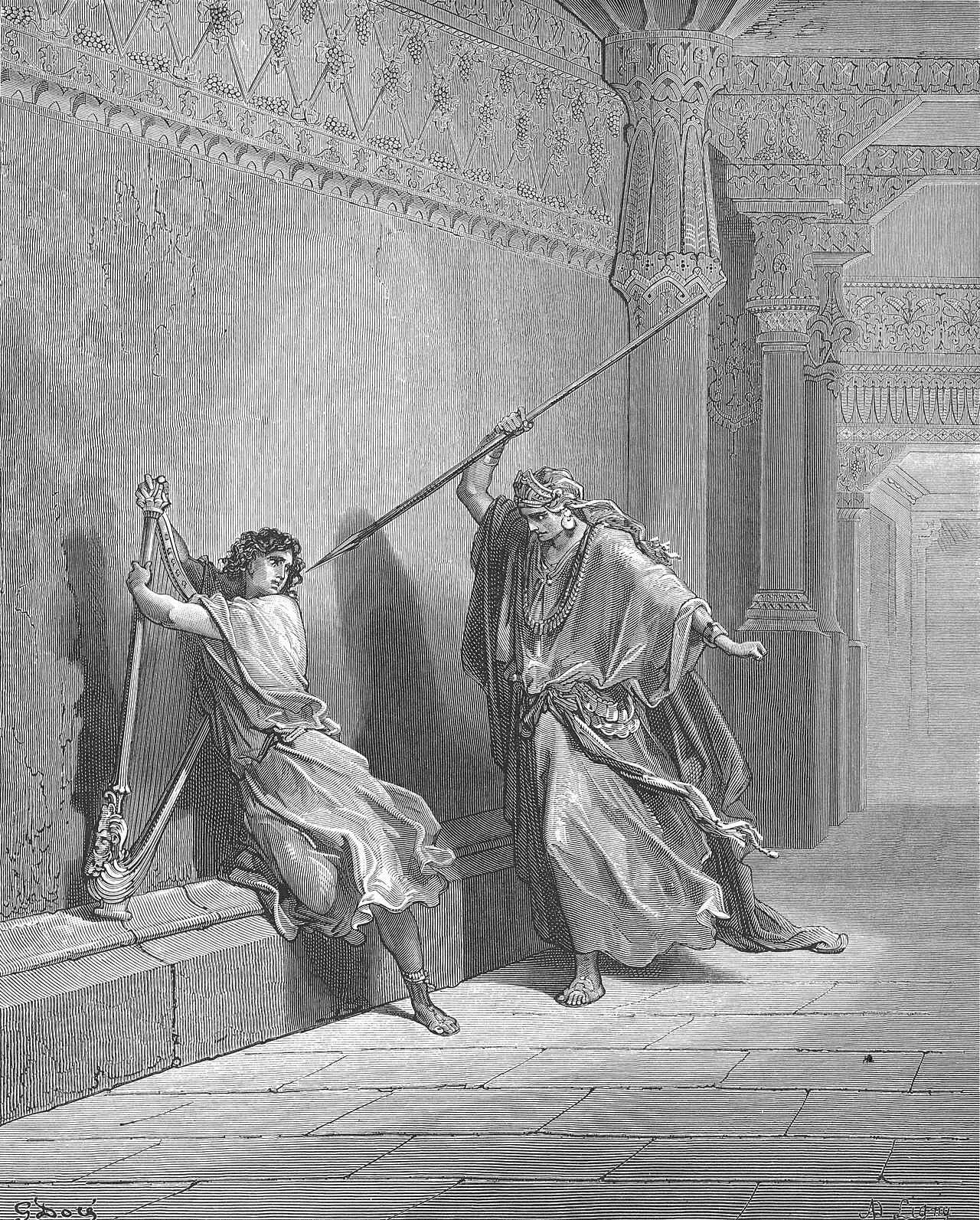
The spirit of distress from God comes upon Saul a second time, following 16:14, and the text does not soften the phrase. Wesley reads it as permission, God allowing what He does not author, while Clarke notes an old tradition of outright possession behind the words "he prophesied" here. The spear appears in Saul’s hand and stays there, hurled at David again at 19:10 and at Jonathan at 20:33.
1 Samuel 18:10
“The evil spirit from God - See on 1Sa 16:14 (note), etc. He prophesied in the midst of the house - He was beside himself; made prayers, supplications, and incoherent imprecations: “God preserve my life,” “Destroy my enemies,” or such like prayers, might frequently escape from him in his agitated state. The Arabic intimates that he was actually possessed by an evil spirit, and that through it he uttered a sort of demoniacal predictions.”
Adam Clarke · Commentary on the Bible (1810-1826)evangelical
2 more voices on this verse
1 Samuel 18:10
“The very next day after he conceived envy at David, the evil spirit was permitted by God to seize him again. Such is the fruit of envy and uncharitableness. Prophesied - That is, he used uncouth gestures, and signs, as the prophets often did.”
John Wesley · Explanatory Notes upon the Old Testament (1765)evangelical
1 Samuel 18:10
“No life is thought too precious to be sacrificed to malice. If a grateful sense of the great service David had done to the public could not assuage Saul's fury, yet one would think he should have allowed himself to consider the kindness David was now doing him, in relieving him, as no one else could, against the worst of troubles.”
Matthew Henry · Commentary on the Whole Bible (1707-1721)puritan
Adam Clarke notes that a king kept his spear at hand as the sign of his rule, and Justin records that early kings held a spear in place of a crown. Saul hurls the sign of the king at the servant who played the harp for him. The harp and the spear stand in one house.
1 Samuel 18:11
“Saul cast the javelin - The javelin or spear was the emblem of regal authority; kings always had it at hand, and in ancient monuments they are always represented with it. In ancient times, says Justin, kings used a spear instead of a diadem: Per ea tempora reges hastas pro diademate habebant, Hist. lib. xliii. And as spears were the emblems of supreme power, hence they were reputed as attributes of the Divinity, and were worshipped as representatives of the gods.”
Adam Clarke · Commentary on the Bible (1810-1826)evangelical
Fear of David becomes this chapter's refrain, spoken again at 18:15 and 18:29. The verse states its own reason in one breath, the Lord with David and the Lord departed from Saul, the two halves of 16:13-14 set side by side. Henry reads the fear as proof Saul already knows, in his own conscience, what the anointing at Ramah settled.
1 Samuel 18:12
“Perhaps he pretended to be afraid that David would do himself mischief, to force his way to the crown. Those that design ill against others are commonly willing to have it thought that others design ill against them.”
Matthew Henry · Commentary on the Whole Bible (1707-1721)puritan
1 Samuel 18:13-16
Saul’s promotion is exile dressed as honor, sending David into the field where a Philistine sword might do what Saul will not. David prospers "because the LORD was with him," and "all Israel and Judah loved David" answers Saul’s fear with the nation’s verdict. Gill notes that the Vatican copy of the Septuagint lacks some of these verses, a point named without weight resting on it.
1 Samuel 18:13
“Therefore Saul removed him from him--sent him away from the court, where the principal persons, including his own son, were spellbound with admiration of the young and pious warrior. made him captain over a thousand--gave him a military commission, which was intended to be an honorable exile.”
Jamieson, Fausset & Brown · Commentary Critical and Explanatory on the Whole Bible (1871)reformed
1 more voice on this verse
1 Samuel 18:13
“Made him his captain - This was under pretense of doing him honor, when it was in effect only to rid himself of the object of his envy.”
Adam Clarke · Commentary on the Bible (1810-1826)evangelical
John Gill notes that the word for prosper also means to act wisely, and David did both at court and in battle. The Targum reads the LORD with him as the Word of the LORD for his help. Saul sees this in the next verse and is afraid.
1 Samuel 18:14
“And David behaved himself wisely in all his ways,.... Both in the court and in the camp, in whatsoever service he was employed; or "prospered" (u), as the word also signifies; for, generally speaking, those that behave wisely succeed well; in this he was a type of Christ, Isa 52:13; the reason of it follows: and the Lord was with him; from whom he had his wisdom and success; the Targum is,"the Word of the Lord was for his help.'' (u) משכיל "prospere admodum res gerebat", Vatablus; "secundabatur", Junius & Tremellius, Piscator; so the Targum and Jarchi.”
1 more voice on this verse
1 Samuel 18:14
“2 , where it is David's promise, I will behave myself wisely; and that promise he here performed; and it is his prayer, O, when wilt thou come unto me? And that prayer God here answered: The Lord was with him.”
Matthew Henry · Commentary on the Whole Bible (1707-1721)puritan
The command Saul gave David to remove him from court makes David more admired. Matthew Henry observes that wise conduct earns fear from enemies and love from friends, and the chapter shows both at once. Saul fears him here, and Israel loves him in verse 16.
1 Samuel 18:15
“Wherefore when Saul saw that he behaved himself very wisely,.... So that he could get no advantage against him, and he succeeded and was prosperous in all his enterprises, and was more and more in favour with the people: he was afraid of him; lest the time was drawing near that the kingdom should be rent from him, and given to David.”
1 more voice on this verse
1 Samuel 18:15
“He was afraid of him - He saw that, by his prudent conduct, he was every day gaining increasing influence.”
Adam Clarke · Commentary on the Bible (1810-1826)evangelical
all Israel and Judah loved David: John Gill notes that the verb loved is singular in Hebrew, marking every one of the tribes. Israel and Judah are named apart. They will make David king apart as well, Judah at Hebron in 2 Samuel 2:4 and the elders of Israel in 2 Samuel 5:3.
1 Samuel 18:16
“And all Israel and Judah loved David,.... The verb is singular, and denotes that everyone of them loved him in all the tribes of Israel, as well as in Judah his own tribe; in such general esteem was he, and so much had he got the hearts and affections of the people: because he went out and came in before them; the people, as in 1Sa 18:13; so the Septuagint version, in which, according to the Vatican copy, the verses 1Sa 18:17 are wanting.”
A bride priced in Philistine foreskins
1 Samuel 18:17-19
fight the Lord’s battles: Saul dresses the marriage offer in pious words, "fight the LORD’s battles," while thinking "let the hand of the Philistines be against him" instead of his own. Merab is given instead to Adriel of Meholah, and Wesley and Barnes note that her five sons are the men handed to the Gibeonites at 2 Samuel 21:8 to 9. David answers humbly, asking who he is to become the king’s son-in-law.
1 Samuel 18:17
“Saul had not hitherto fulfilled the promise of which David had heard (marginal reference); nor was it unnatural that Saul should delay to do so, until the shepherd’s boy had risen to a higher rank.”
1 more voice on this verse
1 Samuel 18:17
“But the fickle and perfidious monarch broke his pledge at the time when the marriage was on the eve of being celebrated, and bestowed Merab on another man (see on 2Sa 21:8); an indignity as well as a wrong, which was calculated deeply to wound the feelings and provoke the resentment of David. Perhaps it was intended to do so, that advantage might be taken of his indiscretion.”
Jamieson, Fausset & Brown · Commentary Critical and Explanatory on the Whole Bible (1871)reformed
Albert Barnes notes that the king's daughter was already owed to the man who killed Goliath, by the promise reported at 17:25. David claims nothing. John Wesley reads his modesty as wisdom as well, showing Saul how far David was from reaching for the kingdom.
1 Samuel 18:18
“What is my life - How little is my life worth, that by the exposing of that to some hazard, I should purchase a king's daughter! In these expressions David sheweth not only his humility, but also his wisdom, in discovering so deep a sense of his own meanness, that Saul might see how far he was from aspiring at the kingdom.”
John Wesley · Explanatory Notes upon the Old Testament (1765)evangelical
Matthew Henry reads the broken promise of Merab as bait, an insult meant to draw an angry word from David that Saul could use against him at law. Jamieson, Fausset and Brown agree. David gives Saul nothing, and in the next verse Saul's daughter Michal is offered in her place.
1 Samuel 18:19
“Adriel - The son of Bar-zillai, as he is called, 2 Sam. xxi, 8. This was an act of great injustice; and accordingly this marriage was accursed by God, and the children begotten in it, were, by God's appointment cut off, 2 Sam. xxi, 8, 9.”
John Wesley · Explanatory Notes upon the Old Testament (1765)evangelical
1 more voice on this verse
1 Samuel 18:19
“This was as great an affront as he could possibly put upon him, and touched him both in his honour and in his love. He therefore thought David's resentment of it would break out in some indecency or other, in word or deed, which might give him an advantage against him to take him off by the course of law.”
Matthew Henry · Commentary on the Whole Bible (1707-1721)puritan
1 Samuel 18:20-21
Michal is the one woman in Scripture the text says loved a man. Saul hears it and turns her love into a weapon, "so that she may be a snare to him," his second attempt after Merab to use a daughter against David. The word snare marks Saul's whole strategy in this chapter, since he cannot strike David himself and keeps building traps for other hands to spring.
1 Samuel 18:20
“The thing pleased him - It partly relieved him from the charge of breaking his faith.”
The Berean reads for a second time now, the rendering Albert Barnes records, counting the broken match with Merab as the first. Michal becomes his rescuer instead. John Gill notes that she is the one who saves David's life at 19:11 and 12.
1 Samuel 18:21
“And Saul said, I will give him her, that she may be a snare to him,.... The cause and occasion of his fall and ruin, by means of what he should propose to him as the condition of marriage; but instead of proving a snare to him, as he hoped, she was the means of his deliverance, when Saul sent messengers to slay him, 1Sa 19:11, and that the hand of the Philistines may be against him; provoked by what he should put him upon doing to them.”
1 more voice on this verse
1 Samuel 18:21
“In the one of the twain - Some prefer “the second time” Job 33:14. The first contract had been broken by giving Merab to Adriel.”
1 Samuel 18:22-25
Saul has his servants speak to David privately, so the offer looks like the court’s idea and not a trap. David calls himself "a poor man and lightly esteemed," and Saul names his price, "a hundred Philistine foreskins," intending David’s death "at the hands of the Philistines" in the attempt. Barnes reads the payment as a jab at the people Scripture calls uncircumcised, the label fixed on them at 14:6.
I am a poor man, and lightly esteemed?: Albert Barnes reads poor as a matter of money. The son-in-law of the king owed a dowry fit for a princess, and David had none to give. Saul answers that exact difficulty in verse 25 by naming a price paid in Philistine lives.
1 Samuel 18:23
“A poor man and lightly esteemed - Compare Psa 119:141. Poor, and therefore unable to pay a sufficient dowry. See 1Sa 18:25.”
1 more voice on this verse
1 Samuel 18:23
“Though his king was but an upstart, in his original as mean as himself, in his management no better than he should be, yet, being a crowned head, he speaks of him and the royal family with all due respect. Note, Religion is so far from teaching us to be rude and unmannerly that it does not allow us to be so. We must render honour to whom honour is due.”
Matthew Henry · Commentary on the Whole Bible (1707-1721)puritan
Every word between Saul and David now passes through servants. The arrangement keeps the king's own voice off the offer and lets him shape his answer to David's objection. Matthew Henry notes that David spoke of the royal house with full respect, and that report is what reaches Saul.
1 Samuel 18:24
“And the servants of Saul told him, saying, on this manner spake David. Such and such words were spoken by him, to this purpose; the sum and substance of them were expressive of his unworthiness to be a king's son-in-law, and of his inability to bring a dowry suitable to her quality.”
Jamieson, Fausset and Brown note that the terms looked generous. Saul waived a payment David could never make and set a price that seemed to honor a king's daughter. The court heard a favor, and the narrator reveals the trap.
1 Samuel 18:25
“Saul's willingness to accept a public service had an air of liberality, while his choice of so difficult and hazardous a service seemed only putting a proper value on gaining the hand of a king's daughter. But he covered unprincipled malice against David under this proposal, which exhibited a zeal for God and the covenant of circumcision.”
Jamieson, Fausset & Brown · Commentary Critical and Explanatory on the Whole Bible (1871)reformed
1 more voice on this verse
1 Samuel 18:25
“An hundred foreskins - This is merely another expression of the spirit which led to the constant application of the epithet uncircumcised to the Philistines 1Sa 14:6.”
1 Samuel 18:26-27
David moves before the wedding day arrives and brings back two hundred foreskins, double the number required. Clarke notes that the Septuagint reads a hundred, matching Saul’s demand and David’s own count at 2 Samuel 3:14, and takes the doubled figure as a copying variant. Either way the price is paid in full, and Saul is bound by his own word to give him Michal.
1 Samuel 18:26
“The days were not expired - David was so rapid in his attack upon the Philistines that he was able to bring the required dowry within the time, and to receive his wife (Michal), before the time had expired within which he was to receive Merab.”
Jamieson, Fausset and Brown read the doubled count as David binding Saul to his pledge, leaving the king no room to break it as he had with Merab. Michal is given at once. Matthew Henry says David wanted to earn the honor before he wore it.
1 Samuel 18:27
“Slew - two hundred men - The Septuagint has only one hundred men. Saul covenanted with David for a hundred; and David himself says, 2Sa 3:14, that he espoused Michal for a hundred: hence it is likely that one hundred is the true reading.”
Adam Clarke · Commentary on the Bible (1810-1826)evangelical
1 more voice on this verse
1 Samuel 18:27
“David was then pleased with the thoughts of being the king's son-in-law when he found the honour set at this high price, being more solicitous how to merit it than how to obtain it; nor could he wear it with satisfaction till he had won it. Even after he was married he continued his good services to Israel.”
Matthew Henry · Commentary on the Whole Bible (1707-1721)puritan
1 Samuel 18:28-29
Saul sees plainly what the chapter has said three times, that the LORD is with David, and the seeing hardens his fear into settled policy. Verse 29 states the change precisely, "from then on Saul was David’s enemy," a move from fits of jealousy to a fixed course. Gill reads the shift as the difference between a feeling and a decision.
1 Samuel 18:28
“1 And it came to pass, when he had made an end of speaking unto Saul, that the soul of Jonathan was knit with the soul of David, and Jonathan loved him as his own soul. 2 And Saul took him that day, and would let him go no more home to his father's house. 3 Then Jonathan and David made a covenant, because he loved him as his own soul.”
Matthew Henry · Commentary on the Whole Bible (1707-1721)puritan
The marriage made Saul even more afraid. Jamieson, Fausset and Brown note that the daughter Saul gave as a snare made David the king's son-in-law and brought him close to the kingdom. Matthew Henry adds that this made David's rule easier for Israel to accept after Saul.
1 Samuel 18:29
“And Saul was yet the more afraid of David,.... Because the Lord was with him, and his wife loved him; so that he feared he should never be able to accomplish his designs, and that this marriage, which he intended as the means of his ruin, would pave the way for his ascending the throne: and Saul became David's enemy continually; was every day giving fresh evidence of his enmity against him; before it was by fits, and at certain times, there were some intervals; but now enmity was rooted and habituated, and was constant and continually showing itself.”
2 more voices on this verse
1 Samuel 18:29
“Saul was yet the more afraid of David--because Providence had visibly favored him, by not only defeating the conspiracy against his life, but through his royal alliance paving his way to the throne.”
Jamieson, Fausset & Brown · Commentary Critical and Explanatory on the Whole Bible (1871)reformed
1 Samuel 18:29
“Men think the way to be feared is to hector and threaten, which makes them feared by fools only, but despised by the wise and good; whereas the way to be both feared and loved, feared by those to whom we would wish to be a terror and loved by those to whom we would wish to be a delight, is to behave ourselves wisely.”
Matthew Henry · Commentary on the Whole Bible (1707-1721)puritan
The chapter closes as its middle section did, David's wisdom set once more against every other name in Saul's court, his own name honored above them all. The pattern the chapter has laid down, David succeeding and Saul fearing him for it, carries forward into the chapters that follow rather than resolving here. Clarke reads the unnamed war against the Philistine princes as further proof that skill, not chance, is what the narrator keeps describing.
1 Samuel 18:30
“Then the princes of the Philistines went forth - Probably to avenge themselves on David and the Israelites: but of this war we know no more than that David was more skillful and successful in it than any of the other officers of Saul. His military skill was greater, and his success was proportionate to his skill and courage; hence it is said, he behaved himself more wisely than all the servants of Saul.”
Adam Clarke · Commentary on the Bible (1810-1826)evangelical
1 more voice on this verse
1 Samuel 18:30
“Observe how God brought good to David out of Saul's project against him. Saul gave him his daughter to be a snare to him, but in this respect that marriage was a kindness to him, that his being Saul's son-in-law made his succeeding him much the less invidious, especially when so many of his sons were slain with him, ch. xxxi.”
Matthew Henry · Commentary on the Whole Bible (1707-1721)puritan
How this psalm is built
The form: A court narrative in prose, carried by two refrains that run against each other, David's wisdom and Saul's fear, as 18 classes it.
The patterns in this chapter
| Device | What it does | Where to see it |
|---|---|---|
| The tokens of an heir, handed over one by one | Verse 4 lists what Jonathan takes off and gives away: the robe, the garments, the sword, the bow and the girdle. Jonathan is heir to the throne, and his love falls on the man Samuel has already anointed to take it. The king's own son hands over the tokens of a throne with his own hands.The site's drafted exposition note on 1 Samuel 18:1 to 4, data/commentary/1-samuel-18-exposition.json, catchword "the soul of Jonathan was knit with the soul of David", citing Matthew Henry, Commentary on the Whole Bible, and Jamieson, Fausset and Brown, Commentary Critical and Explanatory on the Whole Bible. | 1 Samuel 18:1, 1 Samuel 18:3, 1 Samuel 18:4 |
| The women's couplet | The refrain at verse 7, that Saul has slain his thousands and David his ten thousands, is Hebrew poetic parallelism doubling the second line for effect. Adam Clarke reads it as the pattern of such songs rather than as an exact tally. Saul hears the count instead of the poetry, and the line lodges deep enough in Israel's memory that the Philistines quote it back at David at 21:11 and 29:5.The site's drafted exposition note on 1 Samuel 18:6 to 7, data/commentary/1-samuel-18-exposition.json, catchword "singing and dancing, to meet king Saul", citing Adam Clarke, Commentary on the Bible, and Matthew Henry, Commentary on the Whole Bible. | 1 Samuel 18:7, 1 Samuel 21:11, 1 Samuel 29:5 |
| The wisdom stated and the fear stated | David's wise behaviour is named at verses 5, 14, 15 and 30, and Saul's fear of him at verses 12, 15 and 29. Verse 12 gives the reason in one breath, the LORD with David and the LORD departed from Saul, which sets the two halves of 16:13 and 16:14 side by side. The two refrains rise together through the chapter, and verse 29 turns the fear into settled policy.The site's drafted exposition notes on 1 Samuel 18:5, 18:12 and 18:28 to 29, data/commentary/1-samuel-18-exposition.json, catchwords "behaved himself wisely", "Saul was afraid of David, because the Lord was with him, and was departed from Saul" and "the Lord was with David", citing Matthew Henry, Commentary on the Whole Bible, John Gill, Exposition of the Old Testament, and Keil and Delitzsch, Biblical Commentary on the Books of Samuel. | 1 Samuel 18:5, 1 Samuel 18:12, 1 Samuel 18:14, 1 Samuel 18:15, 1 Samuel 18:29, 1 Samuel 18:30 |
| The narrator gives the king's real purpose | Saul speaks pious words at verse 17, that David should fight the LORD's battles. The narrator tells the reader in the same verse that his aim is that the hand of the Philistines should be on him. The same double is given again at verse 21 over Michal, and at verse 25 over the bride price. The reader is told the purpose behind every offer before David hears the offer.The site's drafted exposition notes on 1 Samuel 18:17 to 19 and 18:20 to 21, data/commentary/1-samuel-18-exposition.json, catchwords "fight the Lord's battles" and "Michal Saul's daughter loved David", citing John Wesley, Explanatory Notes upon the Old Testament, Albert Barnes, Notes on the Old Testament, and John Gill, Exposition of the Old Testament. | 1 Samuel 18:17, 1 Samuel 18:21, 1 Samuel 18:25 |
The structure of the chapter in the book's argument
12 more paragraphs on the patterns
The guide draws this book as one crossing, with Saul's standing and David's plotted against each other from chapter 8 to chapter 31, and the lines crossing at the secret anointing of chapter 16. This chapter is where the crossing becomes visible inside Saul's own house. The king's son gives away his tokens, the king's daughter loves the man her father fears, and the nation sings a couplet that puts David first.
Chapter 17 handed this chapter a victor the court could not ignore. This chapter hands chapter 19 an open order to kill, since the private javelin of verses 10 and 11 becomes the spoken command of 19:1. The drafted exposition records the javelin as a fixture of Saul's hand, thrown at David here, at David again at 19:10 and at Jonathan at 20:33.
The covenant of verse 3 outlasts the chapter and outlasts Jonathan. The drafted exposition follows it to Jonathan's request at 20:14 and 20:15. The dossier's word ladder carries the word behind it, chesed at Strong's h2617, as the loyalty a covenant binds a man to keep. That is the clause David honours when he looks for Saul's grandson years later.
The historical value
The site's published historical layer for this chapter carries the marriage customs it turns on, drawn from Roland de Vaux, Ancient Israel: Its Life and Institutions, and from John H. Walton, Victor H. Matthews and Mark W. Chavalas, The IVP Bible Background Commentary: Old Testament. A bride price paid in silver or livestock was ordinary, service in place of silver was known, and the price Saul names is a war errand.
The same layer records the victory welcome, women coming out with tambourines and dancing to meet a returning army. It records the exchange of garments and weapons as the seal of a covenant between men of unequal rank. Those two customs carry the first half of the chapter between them.
The chapter also names the two halves of the kingdom before there is a division to name, since verse 16 says that all Israel and Judah loved him. The drafted exposition notes the pairing.
Where the chapter reaches
Merab's marriage to Adriel the Meholathite at verse 19 reaches into the next book. John Wesley and Albert Barnes both record that the five sons of that marriage are the men given over to the Gibeonites at 2 Samuel 21:8 and 21:9.
The women's couplet reaches the enemy camp. The Philistine lords quote it back at David at 21:11 and again at 29:5, so a song sung in Israel's roads becomes the reason he is distrusted in Gath.
John Gill reads David's repeated wise behaviour as more than tact, and sets it beside the Servant who shall deal prudently at Isaiah 52:13. The reading is his, and the drafted exposition records it as his.
Michal's love at verse 20 is recorded by the drafted exposition as the one place in Scripture where the text says a woman loved a man. Her two rescues in chapter 19 follow from it, and the marriage itself is argued over again at 2 Samuel 3:14.
Keep studying
Sources for this chapter
The summary
Jamieson, Fausset & Brown, Commentary Critical and Explanatory; John Wesley, Notes on the Old Testament and Matthew Henry, Complete Commentary.
The form and classifications
The site's drafted exposition for 1 Samuel 18, data/commentary/1-samuel-18-exposition.json, the file's own header note, which names the fear refrain at 18:12, 18:15 and 18:29 and the Merab to Michal dowry sequence; The site's published dossier for 1 Samuel, src/components/book/dossier-content/1-samuel.ts, the timeline entry anchored on 1 Samuel 18:4 and The site's published guide for the book of 1 Samuel, src/components/book/guides/1-samuel/Book1SamuelGuide.tsx, the act entry keyed david.
The exposition
Adam Clarke, Commentary on the Bible; Albert Barnes; Basil of Caesarea, CONCERNING ENVY; Jamieson Fausset and Brown, Commentary Critical and Explanatory on the Whole Bible; Jamieson, Fausset & Brown, Commentary Critical and Explanatory on the Whole Bible; John Gill; John Wesley, Explanatory Notes upon the Old Testament; Keil and Delitzsch, Biblical Commentary on the Books of Samuel and Matthew Henry, Commentary on the Whole Bible.