
1 Samuel 18:7
in 1 Samuel 18And as the women danced, they sang out: “Saul has slain his thousands, and David his tens of thousands.”
BSB
The same verse in ASV and KJV ▾
ASV
And the women sang one to another as they played, and said, Saul hath slain his thousands, And David his ten thousands.
KJV
And the women answered one another as they played, and said, Saul hath slain his thousands, and David his ten thousands.
⋯
This verse in 1 Samuel 18
Commentary
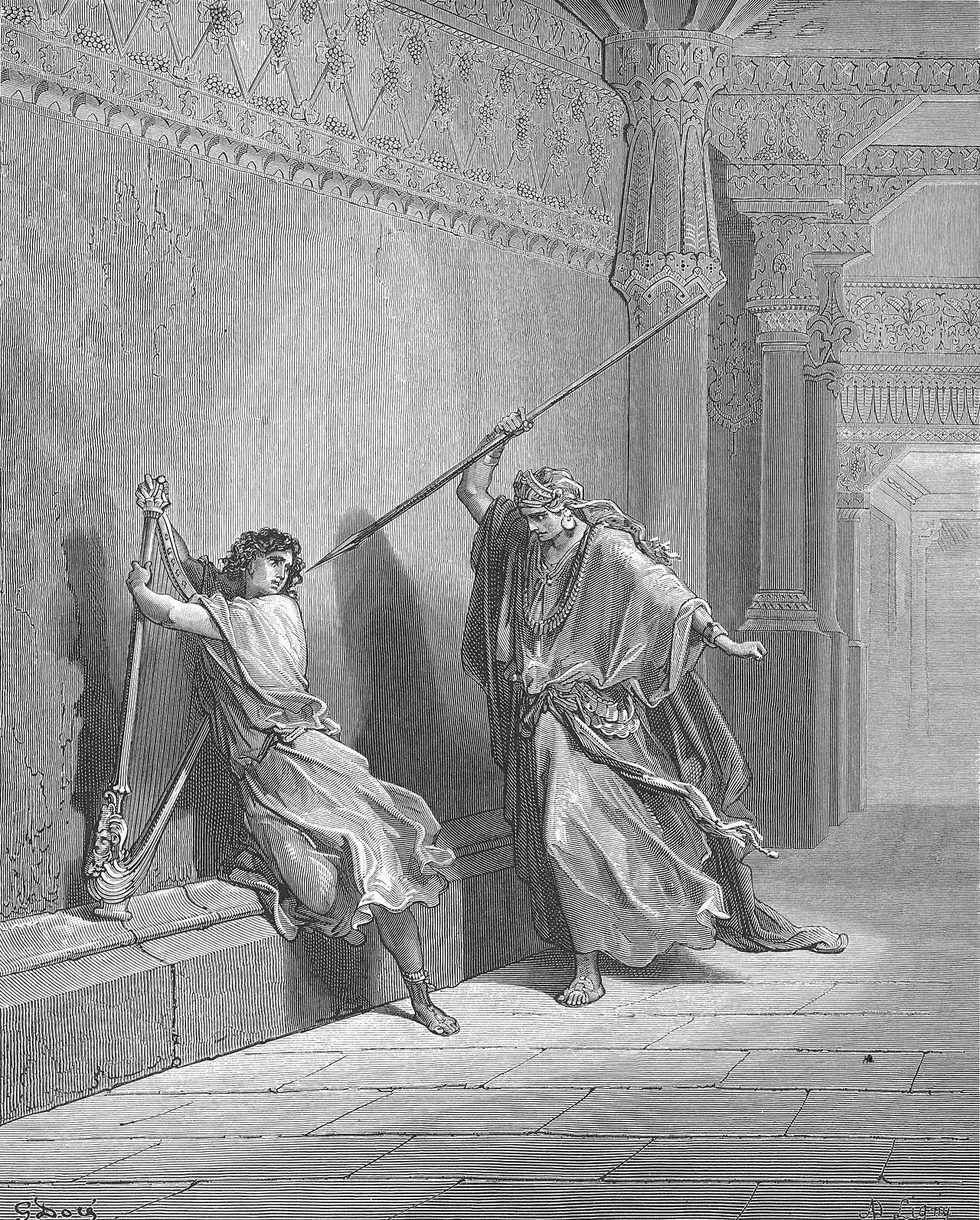
11 notes on this verseWhy do you grieve, my friend, when you yourself have suffered no misfortune? Why are you hostile to someone who is enjoying prosperity, when he has in no way caused your own possessions to decrease? If you are vexed even upon receiving a kindness [from the object of your spite], are you not quite clearly envious of your own good? Saul is an example of this. He made David's great favors to himself a motive for enmity with him.
This site's exposition
the women came out of all the cities of Israel to meet King Saul with singing and dancing
on 1 Samuel 18:6-7
The women's refrain, "Saul has slain his thousands, and David his tens of thousands," is Hebrew parallelism raising the second line for effect. Saul hears the count, not the poetry. The line lodges so deep in Israel's memory that the Philistines quote it back at 21:11 and 29:5.
This site's exposition
Saul has slain his thousands
Adam Clarke reads the song as a count of the forces each man faced, Saul fighting thousands and David facing the Philistine army at once. Basil of Caesarea made Saul his example of envy. David's service to Saul became Saul's reason to hate him.
The record, by era
The Church Fathers3 voices
But now notice in this incident how much trouble the passion of envy caused: when the king saw this young man enjoying such popularity and the dancing crowds calling out, "Saul's conquests ran into thousands, David's into tens of thousands," he didn't take kindly to their words … but overwhelmed by envy, he now repaid his benefactor with the opposite treatment, and the one whom he should have recognized as his savior and benefactor he endeavored to do away with. What an extraordinary degree of frenzy! What excess of madness! The man who had won him the gift of life and had freed his whole army from the foreigner's rage he now suspected as an enemy, and, instead of the man's good deeds remaining fresh in his memory and prevailing over passion, the clarity of his thinking was dulled with envy as though by a kind of drunkenness, and he regarded his benefactor as his enemy.That is what the evil of this passion is like, you see: it first has a bad effect on the person giving birth to it.
For envy is a fearful, a fearful thing, and persuades men to despise their own salvation. In this way did both Cain destroy himself, and again, before his time, the devil who was the destroyer of his father. So did Saul invite an evil demon against his own soul; and when he had invited, he again envied his physician. For such is the nature of envy; he knew that he was saved, yet he would rather have perished than see him that saved him had in honor. What can be more grievous than this passion? One cannot err in calling it the devil's offspring. And in it is contained the fruit of vainglory, or rather its root also; for both these evils are wont mutually to produce each other. And thus in truth it was that Saul even thus envied, when they said, "David smote by ten thousands," than which what can be more senseless? For why dost thou envy? tell me! `Because such an one praised him?' Yet surely thou oughtest to rejoice; besides, thou dost not know even whether the praise be true. And dost thou therefore grieve because without being admirable he hath been praised as such? And yet thou oughtest to feel pity. For if he be good, thou oughtest not to envy him when praised, but thyself to praise along with those that speak well of him; but if not such, why art thou galled? why thrust the sword against thyself?
A commentator
Apostolic ConstitutionsCONSTITUTIONS OF THE HOLY APOSTLES 7.5 · Written before 380.
proposed
You shall not be a hypocrite, lest your "portion be with them." You shall not be ill-natured or proud, for "God resists the proud." "You shall not accept persons in judgment; for the judgment is the Lord's." "You shall not hate any man; you shall surely reprove your brother, and not become guilty on his account"; and, "Reprove a wise man, and he will love you." Eschew all evil, and all that is like it: for he says, "Abstain from injustice, and trembling shall not come close to you." Do not grow angry quickly, or spiteful, or passionate, or furious or daring, lest you undergo the fate of Cain, and of Saul and of Joab. The first of these killed his brother Abel, because Abel was found to be preferred before him with God, and because Abel's sacrifice was preferred; the second persecuted holy David, who had slain Goliath the Philistine, being envious of the praises of the women who danced; the third killed two generals of armies—Abner of Israel and Amasa of Judah.
The Medieval Church1 voice
When David returned after striking down the Philistine, etc., the Lord, having returned after defeating the ancient enemy through His suffering and appearing in the glory of resurrection to His chosen ones, the glory of this triumph having been spread throughout Judea, the lowly souls, …
The Puritans and the Awakening1 voice
And the women answered one another as they played,....
3 more voices on this verse
The Puritans and the Awakening1 voice
The allays of his triumphs. This is the vanity that accompanies even a right work, that "for it a man is envied," Eccl. iv. He hated him, and sought to kill him himself,
The Nineteenth Century2 voices
Saul hath slain his thousands - As it cannot literally be true that Saul had slain thousands, and David ten thousands; it would be well to translate the passage thus: Saul hath smitten or fought against thousands; David against tens of thousands. “Though Saul has been victorious in all his battles; yet he has not had such great odds against him as David has had; Saul, indeed, has been opposed by thousands; David, by ten thousands.” We may here remark that the Philistines had drawn out their whole forces at this time: and when Goliath was slain, they were totally discomfited by the Israelites, led on chiefly by David.
A commentator
Albert Barnes1798–1870
Notes, Explanatory and Practical, on the Old and New Testaments (1832-1869)
proposed
As they played - Or danced with vocal and instrumental music (see Jdg 16:25 note).
The words behind it
9 Hebrew wordsEvery Hebrew word of this verse in the order it stands, with what it means and the door to its own study. The last column counts the times a word stands in the whole Bible: the rarer the word, the more the places it appears belong together.
| Hebrew | Sound | Meaning | Word study | In the Bible |
|---|---|---|---|---|
| וַֽתַּעֲנֶ֛ינָה | vataaneinah | and they sang | H6030 → | 331 times |
| הַנָּשִׁ֥ים | hanashim | the women | H802 → | 781 times |
| הַֽמְשַׂחֲק֖וֹת | hamsachakot | who were playing | H7832 → | |
| וַתֹּאמַ֑רְןָ | vatomarna | and they said | H559 → | 5305 times |
| הִכָּ֤ה | hikah | he has struck down | H5221 → | 499 times |
| שָׁאוּל֙ | shaul | Saul | H7586 → | 402 times |
| בַּאֲלָפָ֔יו | baelfov | <on> thousands his | H505 → | 505 times |
| וְדָוִ֖ד | vedavid | and David | H1732 → | 999 times |
| בְּרִבְבֹתָֽיו׃ | berivotav | <on> ten thousands his | H7233 → | 16 times |
וַֽתַּעֲנֶ֛ינָהand they sang
vataaneinahH6030 →331 times
הַנָּשִׁ֥יםthe women
hanashimH802 →781 times
הַֽמְשַׂחֲק֖וֹתwho were playing
hamsachakotH7832 →
וַתֹּאמַ֑רְןָand they said
vatomarnaH559 →5305 times
הִכָּ֤הhe has struck down
hikahH5221 →499 times
שָׁאוּל֙Saul
shaulH7586 →402 times
בַּאֲלָפָ֔יו<on> thousands his
baelfovH505 →505 times
וְדָוִ֖דand David
vedavidH1732 →999 times
בְּרִבְבֹתָֽיו׃<on> ten thousands his
berivotavH7233 →16 times
A shaded row is a word that stands 400 times or fewer in the Bible.
The walk
8 stopsEach card is a verse this one points to, and under it the verses that one points to in turn. Where several paths arrive at the same place, that place is listed first: the text keeps returning to it.
Through
Exodus 15:21And Miriam sang back to them: “Sing to the LORD, for He is highly exalted; the horse and rider He has thrown into the sea.”
it leads to
- Exodus 15:1
Then Moses and the Israelites sang this song to the LORD: “I will sing to the LORD, for He is highly exalted. The horse and rider He has thrown into the sea.
- Revelation 7:10–12
And they cried out in a loud voice: “Salvation to our God, who sits on the throne, and to the Lamb!”
- Revelation 15:3
and they sang the song of God’s servant Moses and of the Lamb: “Great and wonderful are Your works, O Lord God Almighty! Just and true are Your ways, O King of the nations!
- Exodus 15:1
Through
1 Samuel 21:11But the servants of Achish said to him, “Is this not David, the king of the land? Did they not sing about him in their dances, saying: ‘Saul has slain his thousands, and David…
it leads to
- 1 Samuel 29:5
Is this not the David about whom they sing in their dances: ‘Saul has slain his thousands, and David his tens of thousands’?”
- Psalms 56:1–13
Be merciful to me, O God, for men are hounding me; all day they press their attack.
- 1 Samuel 29:5
Through
1 Samuel 29:5Is this not the David about whom they sing in their dances: ‘Saul has slain his thousands, and David his tens of thousands’?”
it leads to
- 1 Samuel 21:11
But the servants of Achish said to him, “Is this not David, the king of the land? Did they not sing about him in their dances, saying: ‘Saul has slain his thousands, and David…
- Proverbs 27:14
If one blesses his neighbor with a loud voice early in the morning, it will be counted to him as a curse.
- 1 Samuel 18:6–7
As the troops were returning home after David had killed the Philistine, the women came out of all the cities of Israel to meet King Saul with singing and dancing, with joyful songs, and…
- 1 Samuel 21:11
Where this verse is studied
On this page
Studies5
On this verse
On this chapter
About 1 Samuel
Who and where
2 names in this verse with a page on the site.
- PersonUnited MonarchyDavidSecond king of united Israel, shepherd-turned-monarch, ancestor of the Messiah, and traditional author of many Psalms.
- PersonUnited monarchySaulIsrael's first king, head and shoulders above the people; began in humility, ended in rejection — sparing what God devoted, consul…
This page draws on 9 works. Open the list of works
This page draws on Adam Clarke, Commentary on the Bible; Albert Barnes, Notes, Explanatory and Practical, on the Old and New Testaments (1832-1869); Apostolic Constitutions, CONSTITUTIONS OF THE HOLY APOSTLES 7.5; Basil of Caesarea, CONCERNING ENVY; Bede, Commentary on Samuel; John Chrysostom, HOMILIES ON GENESIS 46.13-14; John Chrysostom, HOMILIES ON 2 CORINTHIANS 24.4; John Gill, Exposition of the Old Testament (1748-1763) and Matthew Henry, Commentary on the Whole Bible.