
1 Samuel 18:29
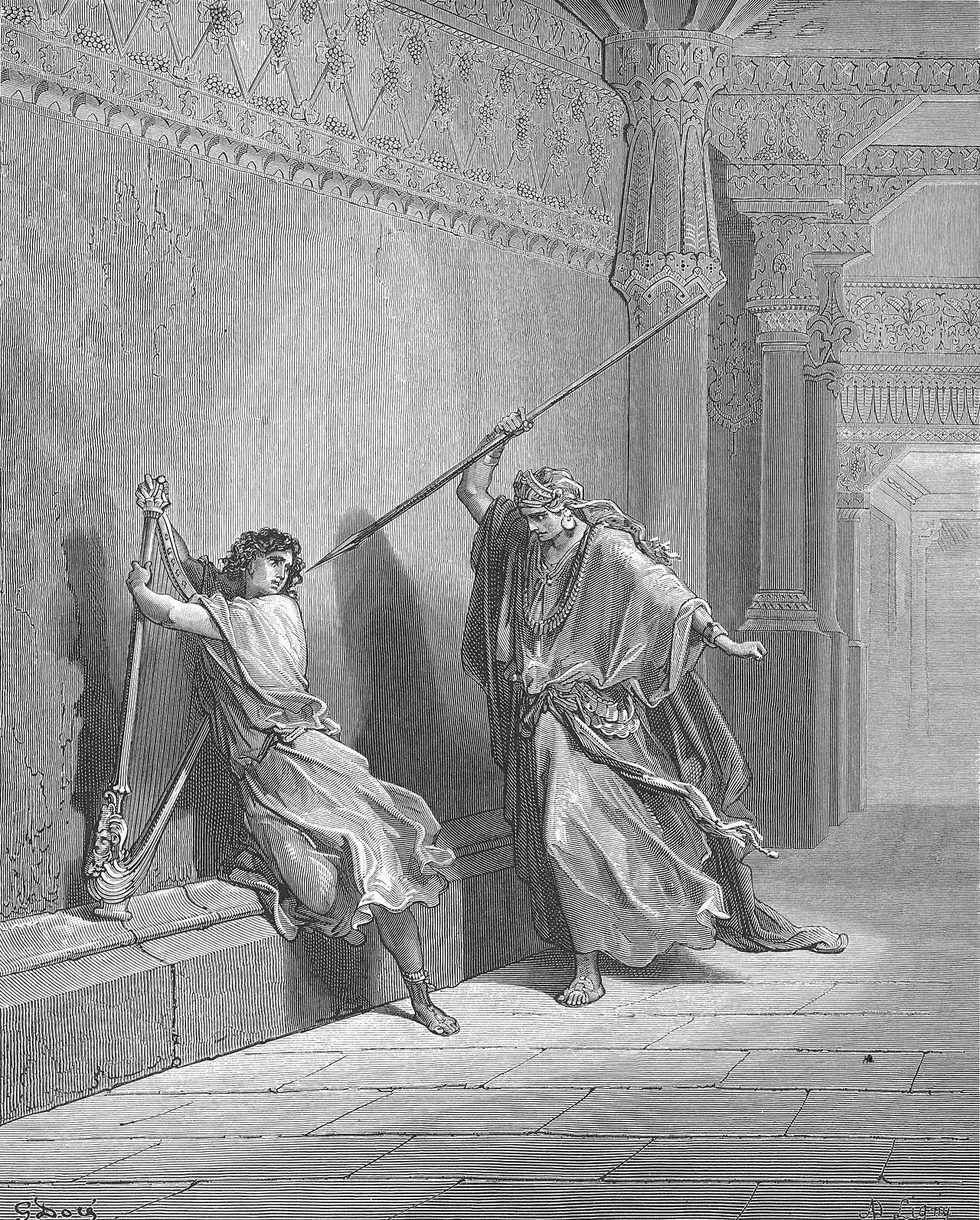
in 1 Samuel 18he grew even more afraid of David. So from then on Saul was David’s enemy.
BSB
The same verse in ASV and KJV ▾
ASV
And Saul was yet the more afraid of David; and Saul was David’s enemy continually.
KJV
And Saul was yet the more afraid of David; and Saul became David’s enemy continually.
⋯
This verse in 1 Samuel 18
Commentary
6 notes on this verseAnd Saul was yet the more afraid of David,.... Because the Lord was with him, and his wife loved him; so that he feared he should never be able to accomplish his designs, and that this marriage, which he intended as the means of his ruin, would pave the way for his ascending the throne: and Saul became David's enemy continually; was every day giving fresh evidence of his enmity against him; before it was by fits, and at certain times, there were some intervals; but now enmity was rooted and habituated, and was constant and continually showing itself.
This site's exposition
When Saul realized that the LORD was with David
on 1 Samuel 18:28-29
Saul sees what the chapter has said three times, that the LORD is with David, and the seeing hardens his fear into settled policy. Verse 29 states the change, "from then on Saul was David’s enemy." Gill reads the shift as the difference between a feeling and a decision.
This site's exposition
Saul was David’s enemy
The marriage made Saul even more afraid. Jamieson, Fausset and Brown note that the daughter Saul gave as a snare made David the king's son-in-law and brought him close to the kingdom. Matthew Henry adds that this made David's rule easier for Israel to accept after Saul.
The record, by era
The Puritans and the Awakening2 voices
Men think the way to be feared is to hector and threaten, which makes them feared by fools only, but despised by the wise and good; whereas the way to be both feared and loved, feared by those to whom we would wish to be a terror and loved by those to whom we would wish to be a delight, is to behave ourselves wisely.
1 And it came to pass, when he had made an end of speaking unto Saul, that the soul of Jonathan was knit with the soul of David, and Jonathan loved him as his own soul. 2 And Saul took him that day, and would let him go no more home to his father's house. 3 Then Jonathan and David made a covenant, because he loved him as his own soul.
quarantine:scripture (2026-07-29) — verbatim-scripture
The Nineteenth Century1 voice
A commentator
Jamieson, Fausset & Brown1802–1910
Commentary Critical and Explanatory on the Whole Bible (1871)
Saul was yet the more afraid of David--because Providence had visibly favored him, by not only defeating the conspiracy against his life, but through his royal alliance paving his way to the throne.
The words behind it
13 Hebrew wordsEvery Hebrew word of this verse in the order it stands, with what it means and the door to its own study. The last column counts the times a word stands in the whole Bible: the rarer the word, the more the places it appears belong together.
| Hebrew | Sound | Meaning | Word study | In the Bible |
|---|---|---|---|---|
| וַיֹּ֣אסֶף | vaiyosef | and he increased | H3254 → | 212 times |
| שָׁא֗וּל | shaul | Saul | H7586 → | 402 times |
| לֵרֹ֛א | lero' | to be afraid | H3372 → | 315 times |
| מִפְּנֵ֥י | mipenei | of <the face of> | H6440 → | 2123 times |
| דָוִ֖ד | david | David | H1732 → | 999 times |
| ע֑וֹד | od | again | H5750 → | 490 times |
| וַיְהִ֥י | vayhi | and he was | H1961 → | 3559 times |
| שָׁא֛וּל | shaul | Saul | H7586 → | 402 times |
| אֹיֵ֥ב | ʾoyev | an enemy | H341 → | 282 times |
| אֶת־ | ʾet- | <obj.> | H853 → | 10935 times |
| דָּוִ֖ד | david | David | H1732 → | 999 times |
| כָּל־ | kol- | all | H3605 → | 5413 times |
| הַיָּמִֽים׃ ס | haiyamim | the days | H3117 → | 2304 times |
וַיֹּ֣אסֶףand he increased
vaiyosefH3254 →212 times
שָׁא֗וּלSaul
shaulH7586 →402 times
לֵרֹ֛אto be afraid
lero'H3372 →315 times
מִפְּנֵ֥יof <the face of>
mipeneiH6440 →2123 times
דָוִ֖דDavid
davidH1732 →999 times
ע֑וֹדagain
odH5750 →490 times
וַיְהִ֥יand he was
vayhiH1961 →3559 times
שָׁא֛וּלSaul
shaulH7586 →402 times
אֹיֵ֥בan enemy
ʾoyevH341 →282 times
אֶת־<obj.>
ʾet-H853 →10935 times
דָּוִ֖דDavid
davidH1732 →999 times
כָּל־all
kol-H3605 →5413 times
הַיָּמִֽים׃ סthe days
haiyamimH3117 →2304 times
A shaded row is a word that stands 400 times or fewer in the Bible.
The walk
8 stopsEach card is a verse this one points to, and under it the verses that one points to in turn. Where several paths arrive at the same place, that place is listed first: the text keeps returning to it.
Through
James 2:19You believe that God is one. Good for you! Even the demons believe that—and shudder.
it leads to
- Luke 4:34
“Ha! What do You want with us, Jesus of Nazareth? Have You come to destroy us? I know who You are—the Holy One of God!”
- Mark 1:24
“What do You want with us, Jesus of Nazareth? Have You come to destroy us? I know who You are—the Holy One of God!”
- Matthew 8:29
“What do You want with us, Son of God?” they shouted. “Have You come here to torture us before the appointed time?”
- Acts 16:17
This girl followed Paul and the rest of us, shouting, “These men are servants of the Most High God, who are proclaiming to you the way of salvation!”
- Deuteronomy 6:4
Hear, O Israel: The LORD our God, the LORD is One.
- Luke 4:34
Through
Ecclesiastes 4:4I saw that all labor and success spring from a man’s envy of his neighbor. This too is futile and a pursuit of the wind.
it leads to
- 1 John 3:12
Do not be like Cain, who belonged to the evil one and murdered his brother. And why did Cain slay him? Because his own deeds were evil, while those of his brother were righteous.
- Ecclesiastes 1:14
I have seen all the things that are done under the sun, and have found them all to be futile, a pursuit of the wind.
- 1 John 3:12
Through
1 Samuel 18:12So Saul was afraid of David, because the LORD was with David but had departed from Saul.
it leads to
- 1 Samuel 18:15
When Saul saw that David was very successful, he was afraid of him.
- 1 Samuel 18:15
Where this verse is studied
About 1 Samuel
Who and where
2 names in this verse with a page on the site.
- PersonUnited MonarchyDavidSecond king of united Israel, shepherd-turned-monarch, ancestor of the Messiah, and traditional author of many Psalms.
- PersonUnited monarchySaulIsrael's first king, head and shoulders above the people; began in humility, ended in rejection — sparing what God devoted, consul…
This page draws on Jamieson Fausset and Brown, Commentary Critical and Explanatory on the Whole Bible; Jamieson, Fausset & Brown, Commentary Critical and Explanatory on the Whole Bible; John Gill, Exposition of the Old Testament (1748-1763); John Gill, Exposition of the Old Testament and Matthew Henry, Commentary on the Whole Bible.