
1 Samuel 18:13
in 1 Samuel 18Therefore Saul sent David away and gave him command of a thousand men. David led the troops out to battle and back,
BSB
The same verse in ASV and KJV ▾
ASV
Therefore Saul removed him from him, and made him his captain over a thousand; and he went out and came in before the people.
KJV
Therefore Saul removed him from him, and made him his captain over a thousand; and he went out and came in before the people.
⋯
This verse in 1 Samuel 18
Commentary
5 notes on this verseSaul therefore removed him from himself, etc. Just as those who are in charge of fifty soldiers are called centurions; so they are called chiliarchs in Greek, who are in charge of a thousand soldiers, whom the Latin custom delights in calling tribunes rather than …
This site's exposition
Therefore Saul sent David away and gave him command of a thousand men
on 1 Samuel 18:13-16
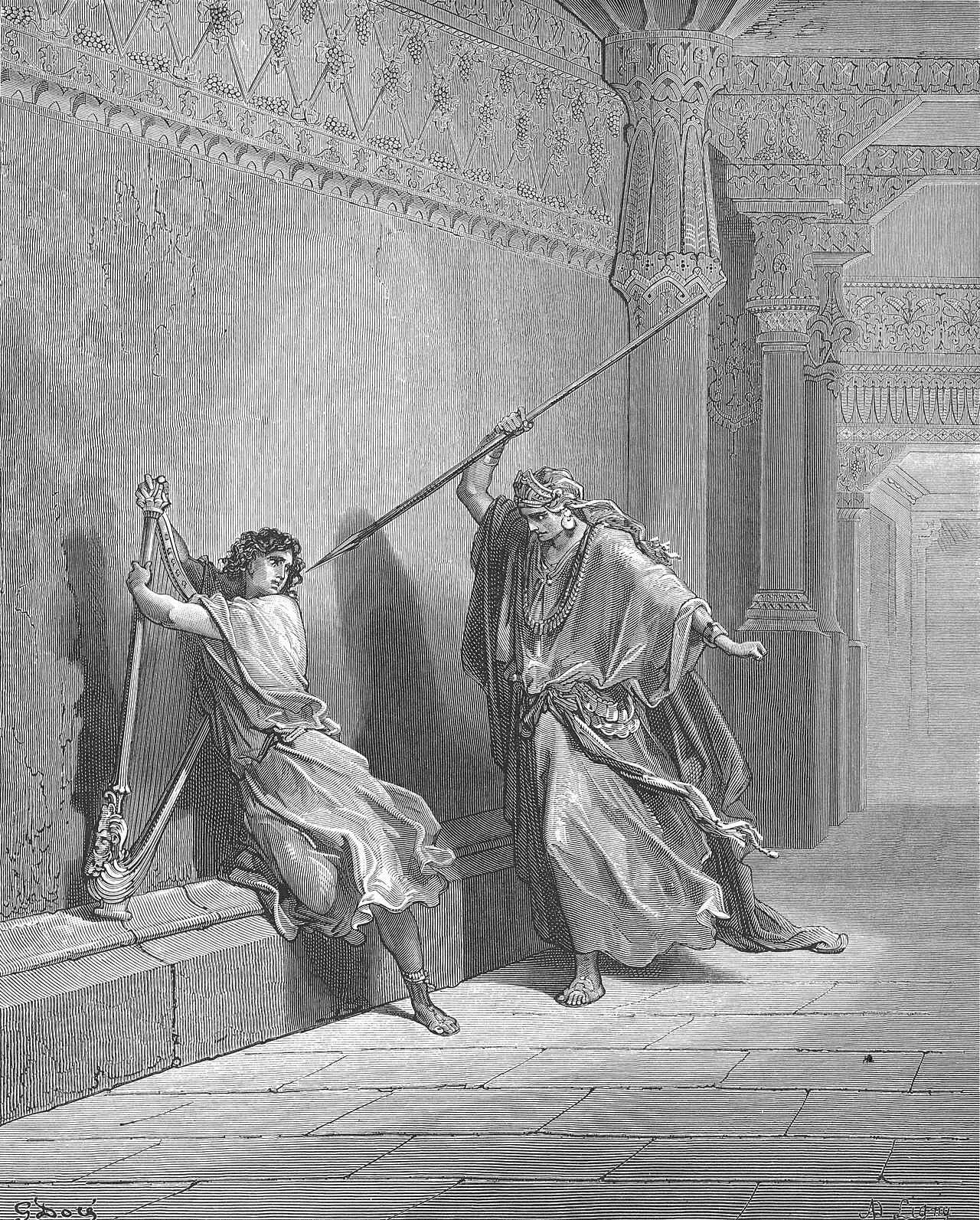
Saul’s promotion is exile dressed as honor, sending David into the field where a Philistine sword might do what Saul will not. David prospers "because the LORD was with him," and "all Israel and Judah loved David" answers Saul’s fear with the nation’s verdict. Gill notes that the Vatican copy of the Septuagint lacks some of these verses, a point named without weight resting on it.
The record, by era
The Puritans and the Awakening1 voice
Therefore Saul removed him from him,....
The Nineteenth Century2 voices
Made him his captain - This was under pretense of doing him honor, when it was in effect only to rid himself of the object of his envy.
A commentator
Jamieson, Fausset & Brown1802–1910
Commentary Critical and Explanatory on the Whole Bible (1871)
Therefore Saul removed him from him--sent him away from the court, where the principal persons, including his own son, were spellbound with admiration of the young and pious warrior. made him captain over a thousand--gave him a military commission, which was intended to be an honorable exile.
How the passage was read
What the Jewish commentators add
On the verses either side of this one
Succeeded. Succeeded. 3 Although ‘ שֵׂבֶל ’ usually indicates wisdom, here it is used to indicate success.
This section is reception history: how the passage was read and kept in the Jewish tradition. Where a reading parts from an essential of the Christian faith, the section says so at that point.
Texts and citation data: Sefaria; each excerpt follows its version’s licence. 5 further sources are cited on this chapter that carry no English text this site may quote or only restate the verse.
The words behind it
11 Hebrew wordsEvery Hebrew word of this verse in the order it stands, with what it means and the door to its own study. The last column counts the times a word stands in the whole Bible: the rarer the word, the more the places it appears belong together.
| Hebrew | Sound | Meaning | Word study | In the Bible |
|---|---|---|---|---|
| וַיְסִרֵ֤הוּ | vaysirehu | and he removed him | H5493 → | 299 times |
| שָׁאוּל֙ | shaul | Saul | H7586 → | 402 times |
| מֵֽעִמּ֔וֹ | meimo | from with <the> him | H5973 → | 1050 times |
| וַיְשִׂמֵ֥הוּ | vaysimehu | and he appointed him | H7760 → | 584 times |
| ל֖וֹ | lo | for <the> himself | ||
| שַׂר־ | sar- | a commander of | H8269 → | 421 times |
| אָ֑לֶף | ʾalef | a thousand | H505 → | 505 times |
| וַיֵּצֵ֥א | vaiyetze' | and he went out | H3318 → | 1067 times |
| וַיָּבֹ֖א | vaiyavo' | and he came | H935 → | 2568 times |
| לִפְנֵ֥י | lifnei | <to> before | H6440 → | 2123 times |
| הָעָֽם׃ פ | haam | the people | H5971 → | 1873 times |
וַיְסִרֵ֤הוּand he removed him
vaysirehuH5493 →299 times
שָׁאוּל֙Saul
shaulH7586 →402 times
מֵֽעִמּ֔וֹfrom with <the> him
meimoH5973 →1050 times
וַיְשִׂמֵ֥הוּand he appointed him
vaysimehuH7760 →584 times
ל֖וֹfor <the> himself
lo
שַׂר־a commander of
sar-H8269 →421 times
אָ֑לֶףa thousand
ʾalefH505 →505 times
וַיֵּצֵ֥אand he went out
vaiyetze'H3318 →1067 times
וַיָּבֹ֖אand he came
vaiyavo'H935 →2568 times
לִפְנֵ֥י<to> before
lifneiH6440 →2123 times
הָעָֽם׃ פthe people
haamH5971 →1873 times
A shaded row is a word that stands 400 times or fewer in the Bible.
The walk
8 stopsEach card is a verse this one points to, and under it the verses that one points to in turn. Where several paths arrive at the same place, that place is listed first: the text keeps returning to it.
Through
Psalms 121:8The LORD will watch over your coming and going, both now and forevermore.
it leads to
- Deuteronomy 28:6
You will be blessed when you come in and blessed when you go out.
- Proverbs 3:6
in all your ways acknowledge Him, and He will make your paths straight.
- Proverbs 2:8
to guard the paths of justice and protect the way of His saints.
- Psalms 113:2
Blessed be the name of the LORD both now and forevermore.
- Ezra 8:31
On the twelfth day of the first month we set out from the Ahava Canal to go to Jerusalem, and the hand of our God was upon us to protect us from the hands…
- Deuteronomy 28:6
Through
2 Samuel 5:2Even in times past, while Saul was king over us, you were the one who led Israel out and brought them back. And to you the LORD said, ‘You will shepherd My people Israel,…
it leads to
- Matthew 2:6
‘But you, Bethlehem, in the land of Judah, are by no means least among the rulers of Judah, for out of you will come a ruler who will be the shepherd of My people…
- Micah 5:4
He will stand and shepherd His flock in the strength of the LORD, in the majestic name of the LORD His God. And they will dwell securely, for then His greatness will extend to…
- Ezekiel 34:23
I will appoint over them one shepherd, My servant David, and he will feed them. He will feed them and be their shepherd.
- Matthew 2:6
Where this verse is studied
On this page
About 1 Samuel
Who and where
2 names in this verse with a page on the site.
- PersonUnited MonarchyDavidSecond king of united Israel, shepherd-turned-monarch, ancestor of the Messiah, and traditional author of many Psalms.
- PersonUnited monarchySaulIsrael's first king, head and shoulders above the people; began in humility, ended in rejection — sparing what God devoted, consul…
This page draws on Adam Clarke, Commentary on the Bible; Bede, Commentary on Samuel; Jamieson Fausset and Brown, Commentary Critical and Explanatory on the Whole Bible; Jamieson, Fausset & Brown, Commentary Critical and Explanatory on the Whole Bible; John Gill, Exposition of the Old Testament and John Gill, Exposition of the Old Testament (1748-1763).