
1 Samuel 18:21
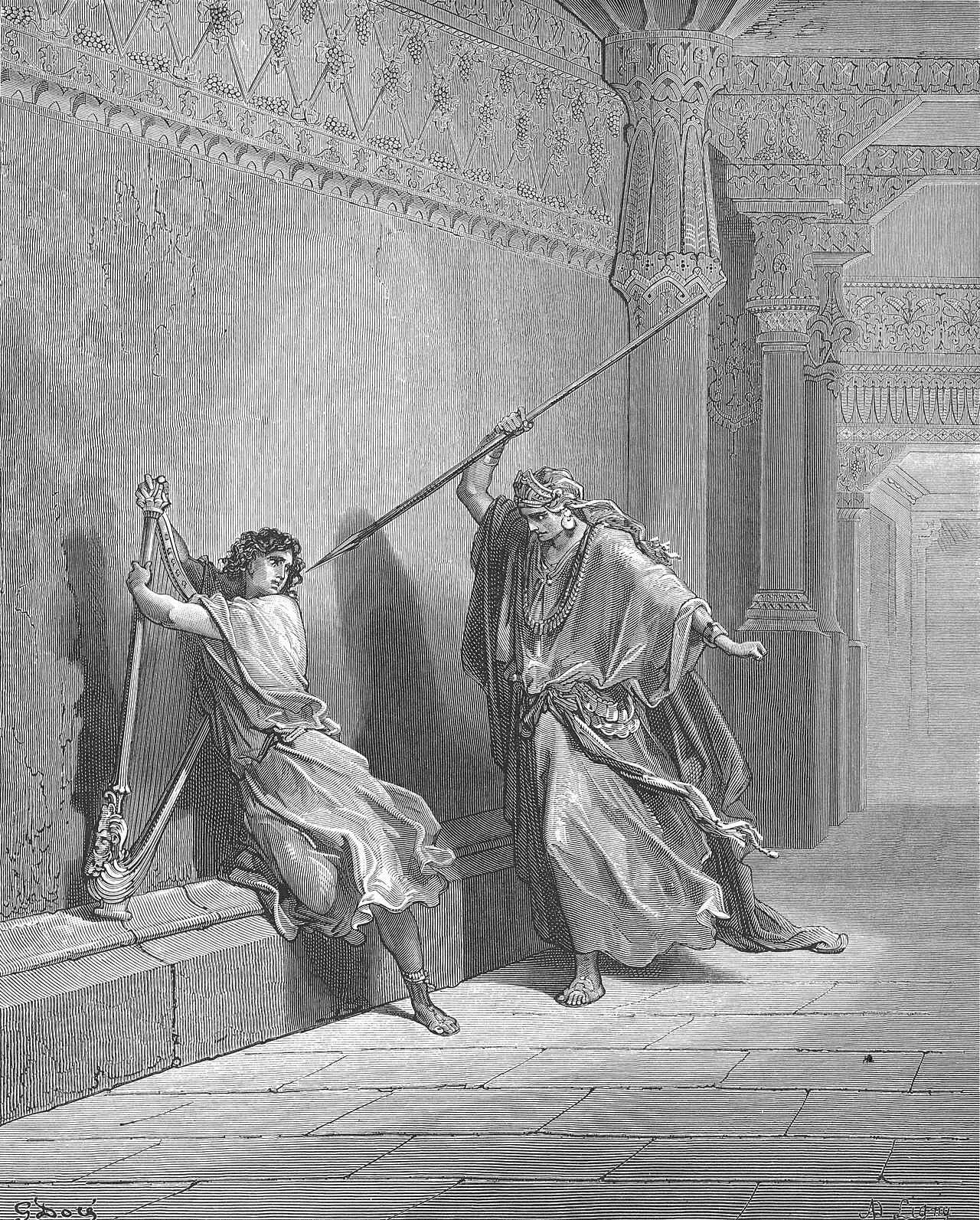
in 1 Samuel 18“I will give her to David,” Saul thought, “so that she may be a snare to him, and the hand of the Philistines may be against him.” So Saul said to David, “For a second time now you can be my son-in-law.”
BSB
The same verse in ASV and KJV ▾
ASV
And Saul said, I will give him her, that she may be a snare to him, and that the hand of the Philistines may be against him. Wherefore Saul said to David, Thou shalt this day be my son-in-law a second time.
KJV
And Saul said, I will give him her, that she may be a snare to him, and that the hand of the Philistines may be against him. Wherefore Saul said to David, Thou shalt this day be my son in law in the one of the twain.
⋯
This verse in 1 Samuel 18
Commentary
8 notes on this verseAnd Saul said, I will give him her, that she may be a snare to him,.... The cause and occasion of his fall and ruin, by means of what he should propose to him as the condition of marriage; but instead of proving a snare to him, as he hoped, she was the means of his deliverance, when Saul sent messengers to slay him, 1Sa 19:11, and that the hand of the Philistines may be against him; provoked by what he should put him upon doing to them.
This site's exposition
Now Saul’s daughter Michal loved David
on 1 Samuel 18:20-21
Michal is the one woman in Scripture the text says loved a man. Saul hears it and turns her love into a weapon, "so that she may be a snare to him," his second attempt after Merab to use a daughter against David. The word snare marks Saul's whole strategy in this chapter, since he cannot strike David himself and keeps building traps for other hands to spring.
This site's exposition
so that she may be a snare to him
The Berean reads for a second time now, the rendering Albert Barnes records, counting the broken match with Merab as the first. Michal becomes his rescuer instead. John Gill notes that she is the one who saves David's life at 19:11 and 12.
The record, by era
The Medieval Church2 voices
Why did Saul seek to apprehend and kill David whom he had formerly honored as himself and greatly loved as a benefactor? Was it by nature or out of an evil will? Obviously it was out of ill will. No one is born evil by …
Therefore Saul said to David: "In two things you will be my son-in-law today," etc. Ignoring the words of Saul, which clearly signify the hypocrisy of scribes and Pharisees with their deceit and fraud, by which they sought to entrap the Lord, let us instead …
The Puritans and the Awakening1 voice
Perhaps David refers to this when ( Ps. lv. 21 ) he speaks of his enemy as one whose words were smoother than butter, but war was in his heart. It is probable that Saul's employing his servants to persuade David to enter into a treaty of a match with his daughter Michal (
quarantine:debris (2026-07-29) — unbalanced-parens
The Nineteenth Century2 voices
A commentator
Albert Barnes1798–1870
Notes, Explanatory and Practical, on the Old and New Testaments (1832-1869)
In the one of the twain - Some prefer “the second time” Job 33:14. The first contract had been broken by giving Merab to Adriel.
That she may be a snare to him - Saul had already determined the condition on which he would give his daughter to David; viz., that he should slay one hundred Philistines: this he supposed he would undertake for the love of Michal, and that he must necessarily perish in the attempt; and thus Michal would become a snare to him.
The words behind it
19 Hebrew wordsEvery Hebrew word of this verse in the order it stands, with what it means and the door to its own study. The last column counts the times a word stands in the whole Bible: the rarer the word, the more the places it appears belong together.
| Hebrew | Sound | Meaning | Word study | In the Bible |
|---|---|---|---|---|
| וַיֹּ֨אמֶר | vaiyomer | and he said | H559 → | 5305 times |
| שָׁא֜וּל | shaul | Saul | H7586 → | 402 times |
| אֶתְּנֶ֤נָּה | ʾettenenah | I will give her | H5414 → | 2011 times |
| לּוֹ֙ | lo | to <the> him | ||
| וּתְהִי־ | utehi- | so she may become | H1961 → | 3559 times |
| ל֣וֹ | lo | for <the> him | ||
| לְמוֹקֵ֔שׁ | lemokesh | <into> a snare | H4170 → | |
| וּתְהִי־ | utehi- | so it may be | H1961 → | 3559 times |
| ב֖וֹ | vo | on <the> him | ||
| יַד־ | yad- | [the] hand of | H3027 → | 1618 times |
| פְּלִשְׁתִּ֑ים | pelishtim | [the] Philistines | H6430 → | 287 times |
| וַיֹּ֤אמֶר | vaiyomer | and he said | H559 → | 5305 times |
| שָׁאוּל֙ | shaul | Saul | H7586 → | 402 times |
| אֶל־ | ʾel- | to | H413 → | 5510 times |
| דָּוִ֔ד | david | David | H1732 → | 999 times |
| בִּשְׁתַּ֛יִם | bishtayim | in two [times] | H8147 → | 768 times |
| תִּתְחַתֵּ֥ן | titchaten | you will be a son-in-law | H2859 → | 33 times |
| בִּ֖י | bi | to me | ||
| הַיּֽוֹם׃ | haiyom | this day | H3117 → | 2304 times |
וַיֹּ֨אמֶרand he said
vaiyomerH559 →5305 times
שָׁא֜וּלSaul
shaulH7586 →402 times
אֶתְּנֶ֤נָּהI will give her
ʾettenenahH5414 →2011 times
לּוֹ֙to <the> him
lo
וּתְהִי־so she may become
utehi-H1961 →3559 times
ל֣וֹfor <the> him
lo
לְמוֹקֵ֔שׁ<into> a snare
lemokeshH4170 →
וּתְהִי־so it may be
utehi-H1961 →3559 times
ב֖וֹon <the> him
vo
יַד־[the] hand of
yad-H3027 →1618 times
פְּלִשְׁתִּ֑ים[the] Philistines
pelishtimH6430 →287 times
וַיֹּ֤אמֶרand he said
vaiyomerH559 →5305 times
שָׁאוּל֙Saul
shaulH7586 →402 times
אֶל־to
ʾel-H413 →5510 times
דָּוִ֔דDavid
davidH1732 →999 times
בִּשְׁתַּ֛יִםin two [times]
bishtayimH8147 →768 times
תִּתְחַתֵּ֥ןyou will be a son-in-law
titchatenH2859 →33 times
בִּ֖יto me
bi
הַיּֽוֹם׃this day
haiyomH3117 →2304 times
A shaded row is a word that stands 400 times or fewer in the Bible.
The walk
8 stopsEach card is a verse this one points to, and under it the verses that one points to in turn. Where several paths arrive at the same place, that place is listed first: the text keeps returning to it.
Through
Jeremiah 9:8Their tongues are deadly arrows; they speak deception. With his mouth a man speaks peace to his neighbor, but in his heart he sets a trap for him.
it leads to
- Psalms 28:3
Do not drag me away with the wicked, and with the workers of iniquity, who speak peace to their neighbors while malice is in their hearts.
- Proverbs 26:24–26
A hateful man disguises himself with his speech, but he lays up deceit in his heart.
- Psalms 120:3
What will He do to you, and what will be added to you, O deceitful tongue?
- 2 Samuel 3:27
When Abner returned to Hebron, Joab pulled him aside into the gateway, as if to speak to him privately, and there Joab stabbed him in the stomach. So Abner died on account of the…
- Psalms 28:3
Through
1 Samuel 18:17Then Saul said to David, “Here is my older daughter Merab. I will give her to you in marriage. Only be valiant for me and fight the LORD’s battles.” But Saul was thinking, “I…
it leads to
- 1 Samuel 17:25
Now the men of Israel had been saying, “Do you see this man who keeps coming out to defy Israel? To the man who kills him the king will give great riches. And he…
- 1 Samuel 25:28
Please forgive your servant’s offense, for the LORD will surely make a lasting dynasty for my lord, because he fights the LORD’s battles. May no evil be found in you as long as you…
- 1 Samuel 18:25
Saul replied, “Say to David, ‘The king desires no other dowry but a hundred Philistine foreskins as revenge on his enemies.’” But Saul intended to cause David’s death at the hands of the Philistines.
- 1 Samuel 17:25
Through
Exodus 10:7Pharaoh’s officials asked him, “How long will this man be a snare to us? Let the people go, so that they may worship the LORD their God. Do you not yet realize that Egypt…
it leads to
- Ecclesiastes 7:26
And I find more bitter than death the woman who is a snare, whose heart is a net, and whose hands are chains. The man who pleases God escapes her, but the sinner is…
- Ecclesiastes 7:26
Where this verse is studied
On this page
About 1 Samuel
Who and where
2 names in this verse with a page on the site.
- PersonUnited MonarchyDavidSecond king of united Israel, shepherd-turned-monarch, ancestor of the Messiah, and traditional author of many Psalms.
- PersonUnited monarchySaulIsrael's first king, head and shoulders above the people; began in humility, ended in rejection — sparing what God devoted, consul…
This page draws on Adam Clarke, Commentary on the Bible; Albert Barnes, Notes, Explanatory and Practical, on the Old and New Testaments (1832-1869); Bede, Commentary on Samuel; Jamieson Fausset and Brown, Commentary Critical and Explanatory on the Whole Bible; John Gill, Exposition of the Old Testament (1748-1763); John Gill, Exposition of the Old Testament; Matthew Henry, Commentary on the Whole Bible and Symeon the New Theologian, DISCOURSES 4.2.