
Skip to content
mannafest.faith
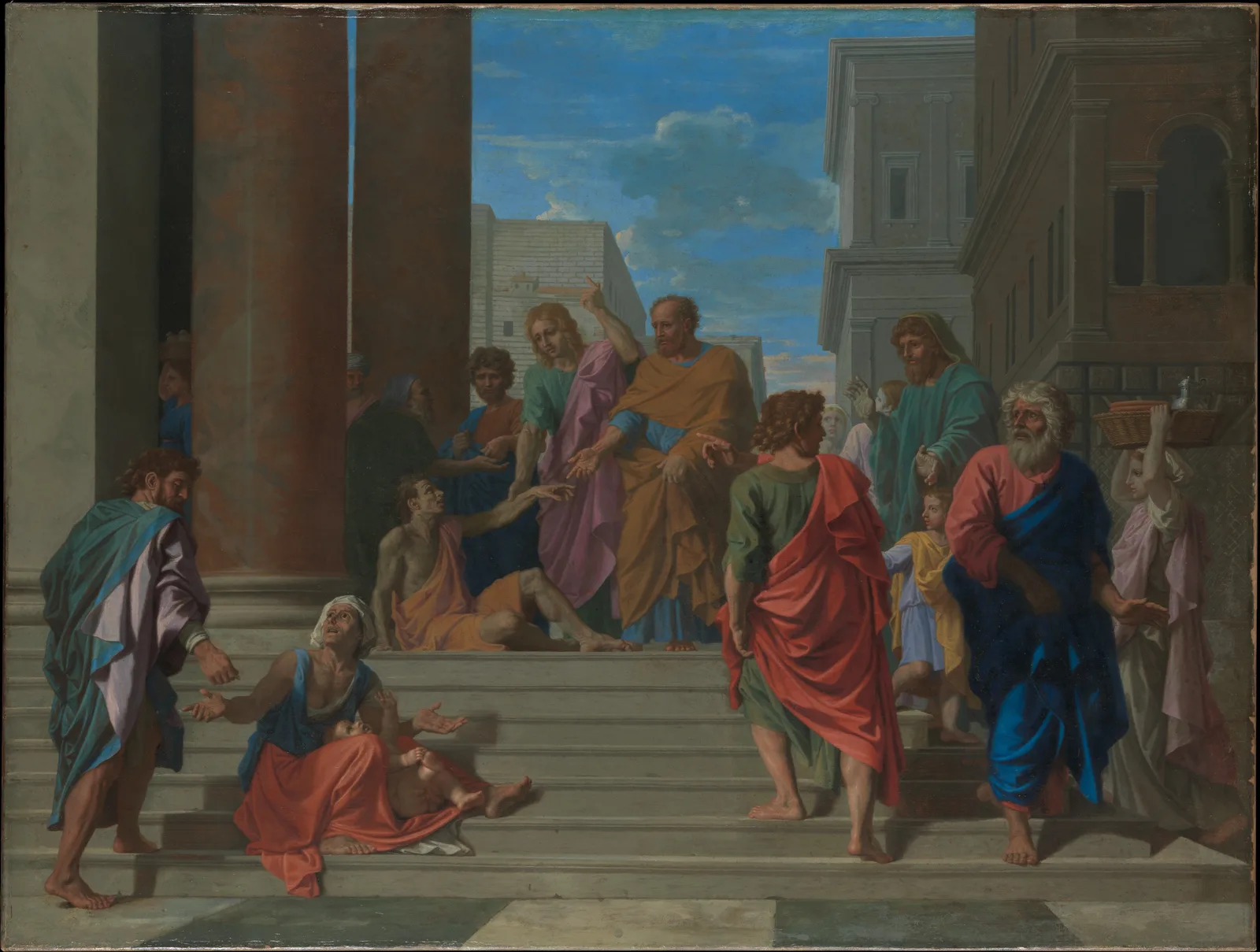
Saints Peter and John Healing the Lame Man, Nicolas Poussin, 1655, The Metropolitan Museum of Art

Saints Peter and John Healing the Lame Man, Nicolas Poussin, 1655, The Metropolitan Museum of Art. Public domain.

A movement of the canon · the New Testament

The General Epistles

Seven letters written between AD 44 and 95, which the church has long read as the work of James, Peter, John and Jude.

What are the General Epistles?

Summary

These seven letters were written to strengthen believers who faced suffering from outside the church and false teaching from within it.

  • Five of the seven name no single church as their readers, and 2 John and 3 John go to one household and to one man.
  • James was written first, in the 40s, and the three letters of John last, near the end of the first century.
  • James and 1 Peter teach believers how to live under trial, and 2 Peter and Jude warn them against false teachers.
  • The letters of John hold together the truth about Christ, obedience to his commands and love for one another.

The General Epistles are seven short letters that stand after the letters of Paul and Hebrews and before Revelation. In the canon they run James, 1 and 2 Peter, the three letters of John, and Jude. Paul's letters take their names from the churches and the men who received them, and these seven take theirs from the men the church has named as their writers.

Four names stand over the shelf. James and Jude carry the names of two brothers, since Jude calls himself the brother of James. Peter was the leader of the twelve apostles, and John is the apostle the church has named as the elder who wrote the three letters. Who wrote James, 2 Peter, the letters of John and Jude is argued, so each of those entries names its writer by tradition, and each book's dossier sets out the positions held.

Several of the letters lean on one another. 2 Peter and Jude share much of their wording, and both draw their warnings from the same judgments of the past. 2 John repeats in a few lines the two charges of 1 John, to love one another and to hold to the truth about the Son. 2 Peter calls itself the second letter its writer has sent to the same readers.

When was each letter written?

Each letter is placed under its writer, and the three letters of John share one span of years.

The 7 General Epistles on one line of years, AD 44 to 95

A bar is a date the table gives as a span of years.
Year AD
  1. The letter of James

    1. JamesAD 44 to 49

  2. The letter of Jude

    1. JudeAD 50 to 65

  3. The letters of Peter

    1. 1 PeterAD 62 to 64, from Rome

    2. 2 PeterAD 64 to 68, from Rome

  4. The letters of John

    1. 1 JohnAD 85 to 95

    2. 2 JohnAD 85 to 95

    3. 3 JohnAD 85 to 95

Each letter stands on one scale of years at the date this site's authorship table gives. A place of writing stands beside a letter only where its dossier names one, which is Rome for 1 Peter and 2 Peter.

The 7 letters of the shelf, in canon order

Each entry tells what happens in the letter from its first chapter to its last and lists the feature pages that open on it.

Saint James the Younger, El Greco, 1600. Public domain.

Book 1 of 7 on the shelf

James

James, by tradition AD 44 to 49 To the twelve tribes of the Dispersion (James 1:1) 5 chapters

James opens with joy in trials, because the testing of faith produces perseverance. Temptation comes from a man's own desire, while every good gift comes down from the Father of the heavenly lights. So the readers must do the word they hear, and care for orphans and widows.

In chapter 2 James rebukes a church that gives the rich man the good seat and makes the poor man stand, and he shows that faith with no deeds is dead, as Abraham and Rahab prove. Chapter 3 warns teachers about the tongue, which no man can tame, and sets the wisdom from above against the wisdom of the earth. Chapter 4 traces their quarrels to pride and calls them to submit to God. Chapter 5 warns the rich who cheat their workers, urges patience until the Lord comes, and tells the sick to call the elders to pray over them.

Open the book pageRead James 1

Feature pages on James3

St. Peter in Prison (The Apostle Peter Kneeling), Rembrandt, 1631. Public domain.

Book 2 of 7 on the shelf

1 Peter

Peter AD 62 to 64 To the elect who are exiles of the Dispersion throughout Pontus, Galatia, Cappadocia, Asia, and Bithynia (1 Peter 1:1) 5 chapters

Peter opens by blessing God for his readers' new birth into a living hope and for an inheritance kept in heaven, and he tells them that their trials test their faith as fire tests gold. They were ransomed by the precious blood of Christ, so they are to be holy, as God is holy.

In chapter 2 they come to Christ, the living stone, and are built into a spiritual house, a people God has made his own. Peter then teaches them how to live among their neighbours as citizens, as servants and as wives and husbands, repaying insult with blessing. Chapter 4 tells them not to be surprised by the fiery trial, since to suffer for the name of Christ is to share his sufferings. Chapter 5 charges the elders to shepherd the flock and closes with greetings from the church in Babylon.

Open the book pageRead 1 Peter 1

The Transfiguration, Giovanni Bellini, about 1478 to 1479, Museo e Real Bosco di Capodimonte. Public domain.

Book 3 of 7 on the shelf

2 Peter

Peter, by tradition AD 64 to 68 To those who through the righteousness of our God and Savior Jesus Christ have received a faith as precious as ours (2 Peter 1:1) 3 chapters

Peter writes knowing that his death is near, so that his readers will remember his teaching. God's power has given them everything they need for life and godliness, and they are to add to their faith virtue, knowledge, self-control and the rest, up to love. His message rests on what he saw on the holy mountain, where he heard the Father's voice.

Chapter 2 warns that false teachers will come among them, greedy men who deny the Master who bought them. God judged the angels who sinned, the ancient world in the flood and Sodom, and he rescued Noah and Lot, so he knows how to rescue the godly. Chapter 3 answers scoffers who ask where the promised coming is. With the Lord a day is like a thousand years, and his delay is patience. The day of the Lord will come like a thief, and the letter ends with a charge to grow in grace.

Open the book pageRead 2 Peter 1

Feature pages on 2 Peter3

Saint John the Evangelist, El Greco and workshop, about 1605, Museo del Prado. Public domain.

Book 4 of 7 on the shelf

1 John

John, by tradition AD 85 to 95 5 chapters

The letter opens with what the writer and those with him heard, saw and touched, the Word of life, and they write so that their readers may share their fellowship with the Father and the Son. God is light, so those who walk with him confess their sins. Those who know him keep his commandments and love their brothers. Some have left the church denying that Jesus is the Christ, and the writer calls them antichrists.

Chapter 3 rejoices that believers are called children of God and sets two families side by side, the children of God and the children of the devil, with Cain as the warning. Chapter 4 tells the readers to test the spirits, and says that God is love, shown in the Son he sent, so his children love one another. Chapter 5 says that whoever has the Son has life, and the letter closes with a warning to keep away from idols.

Open the book pageRead 1 John 1

Saint John the Evangelist, Frans Hals, about 1625 to 1628, J. Paul Getty Museum. Public domain.

Book 5 of 7 on the shelf

2 John

John, by tradition AD 85 to 95 To the chosen lady and her children (2 John 1:1) 1 chapter

The elder writes to a household he loves in the truth, as do all who know the truth. He rejoices that some of her children are walking in the truth, as the Father commanded, and he asks the household to love one another. They have had that commandment from the beginning, and love means walking according to God's commandments.

Then he gives the reason for the letter. Many deceivers have gone out into the world who refuse to confess that Jesus Christ came in the flesh. The household must watch itself so that it keeps what has been worked for. Whoever remains in the teaching of Christ has both the Father and the Son, and a teacher who brings another teaching is to be refused the house and the greeting. The elder has much more to say, and he hopes to come and speak with them face to face, so that their joy may be complete.

Open the book pageRead 2 John 1

Feature pages on 2 John1

St John the Theologian writing his Revelations on an open scroll, Andreas Ritzos, 1449 to 1450. Public domain.

Book 6 of 7 on the shelf

3 John

John, by tradition AD 85 to 95 To the beloved Gaius (3 John 1:1) 1 chapter

The elder writes to Gaius, whom he loves in the truth, and prays that he is in good health. Travelling brothers have come back and told how Gaius holds to the truth, and the elder has no greater joy than to hear that his children walk in it. Gaius has welcomed these brothers into his home, though they were strangers to him. The elder asks him to send them on their way in a manner worthy of God, because they went out for the sake of the Name and took nothing from the Gentiles.

Diotrephes, who loves to be first, has refused the elder's letter, spread slander about him, turned the brothers away and put out of the church anyone who welcomed them. The elder tells Gaius to imitate what is good, and he commends Demetrius, of whom everyone speaks well. He hopes to see Gaius soon and to talk with him face to face.

Open the book pageRead 3 John 1

Feature pages on 3 John

No feature page opens on this letter yet.

The Fall of the Rebel Angels, Pieter Brueghel the Elder, 1562. Public domain.

Book 7 of 7 on the shelf

Jude

Jude, by tradition AD 50 to 65 To those who are called, loved by God the Father, and kept in Jesus Christ (Jude 1:1) 1 chapter

Jude meant to write about the salvation they shared, and he wrote instead to urge them to contend for the faith entrusted once for all to the saints. Certain men have slipped in among them unnoticed. They turn the grace of God into a license for immorality and deny the only Master and Lord.

Jude reminds his readers how God has judged before. The Lord destroyed the unbelievers he had brought out of Egypt, he keeps the angels who left their place in chains for judgment, and he made Sodom and Gomorrah an example of eternal fire. These men have gone the way of Cain, Balaam and Korah. Then Jude turns to the beloved. They are to build themselves up in the faith, pray in the Holy Spirit, keep themselves in the love of God and show mercy to those who doubt. The letter closes with praise to the God who is able to keep them from stumbling.

Open the book pageRead Jude 1

Feature pages on Jude1

Sources for this page

The author, the date and the recipient of each letter come from this site's authorship table, and each recipient is the wording of that letter's own greeting. 1 John names no readers in its opening, so its entry prints none. The storylines are written from the dossier of each book on the shelf and from the chapter summaries this site publishes for each chapter. The paintings, in the order the page shows them, are Saints Peter and John Healing the Lame Man, Nicolas Poussin, 1655, The Metropolitan Museum of Art; Saint James the Younger, El Greco, 1600; St. Peter in Prison (The Apostle Peter Kneeling), Rembrandt, 1631; The Transfiguration, Giovanni Bellini, about 1478 to 1479, Museo e Real Bosco di Capodimonte; Saint John the Evangelist, El Greco and workshop, about 1605, Museo del Prado; Saint John the Evangelist, Frans Hals, about 1625 to 1628, J. Paul Getty Museum; St John the Theologian writing his Revelations on an open scroll, Andreas Ritzos, 1449 to 1450; The Fall of the Rebel Angels, Pieter Brueghel the Elder, 1562. Every one of them is in the public domain.