
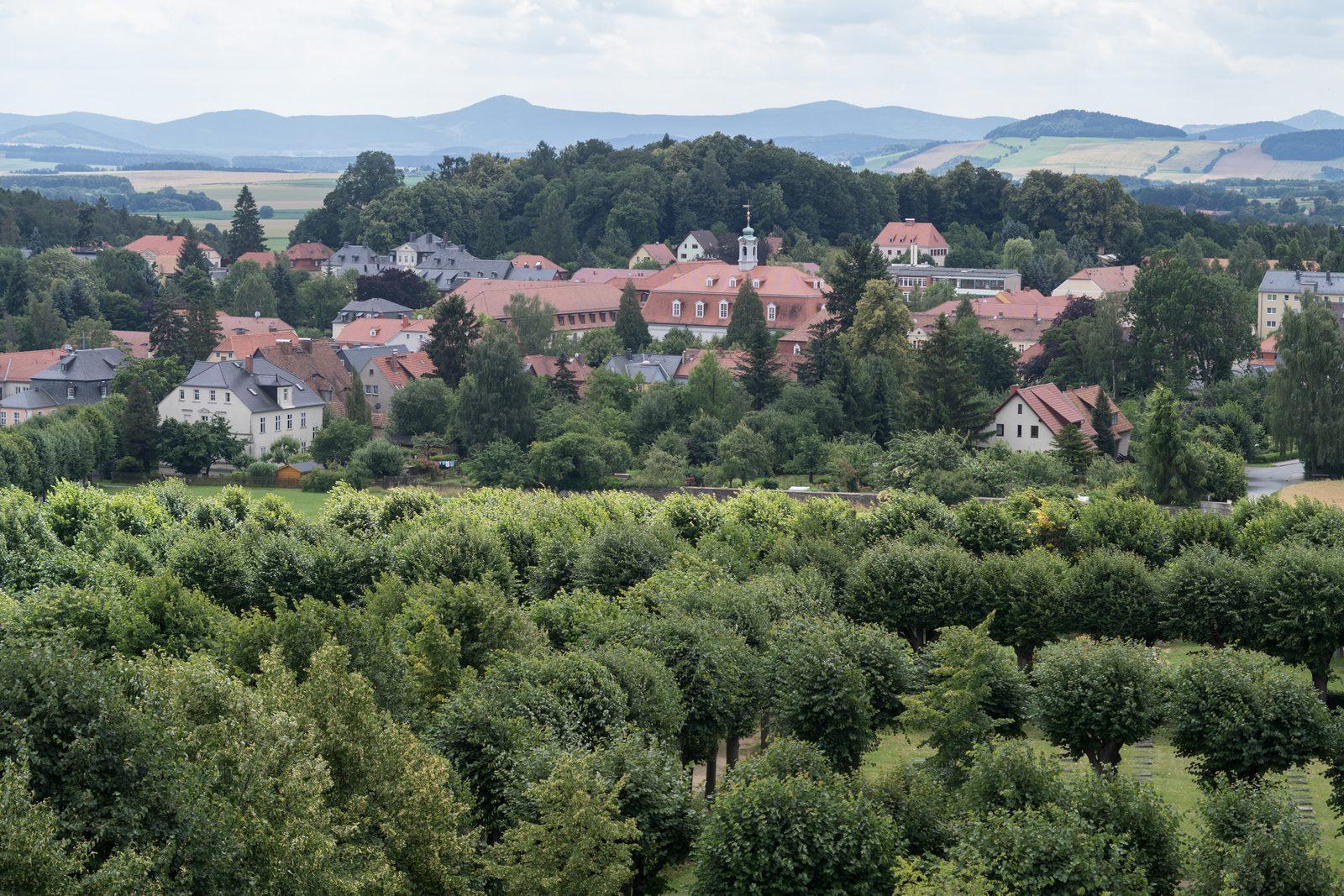
heyeje, View of Herrnhut with Zittau Mountains, 2016. CC BY-SA 2.0.
1415 to 1913 · Subject · Featured Study
The Web of Witnesses
Thirteen dated threads from Hus to Herrnhut, Wesley, Wales, Azusa Street, Korea, Chile and Africa, each with the record that states it.
- Books
- 2 Timothy, Hebrews
- Hold in memory
- 2 Timothy 2:2, Hebrews 12:1
In February 1520 Luther wrote to Spalatin that he had held the opinions of Hus unawares, and that they were all Hussites without knowing it.
Therefore, since we are surrounded by such a great cloud of witnesses, let us throw off every encumbrance and the sin that so easily entangles, and let us run with endurance the race set out for us.
Summary
The revivals of the church did not stand apart. A teacher, a letter, a book or a report passed from one to the next, and a dated record states each passing.
- Hus's teaching reached Luther, and the Brethren of Hus's land rebuilt their church at Herrnhut.
- Moravians taught John Wesley on the voyage to Georgia and in London.
- News from Wales reached Los Angeles, Seoul and Mukti in India within two years.
- Each thread here is a link the estate holds with its page and its source.
The Verses of the Handing On
Paul's charge to pass on what was taught, and the letter's cloud of witnesses.
Handing on
And the things that you have heard me say among many witnesses, entrust these to faithful men who will be qualified to teach others as well.
Paul tells Timothy to entrust what he heard to faithful men who will teach others in turn.
Thirteen Threads, 1415 to 1913
Each step is one passing from an earlier witness to a later one, in date order, with its year.
From Hus to the revivals of the twentieth century, each witness was taught, reached or sent by an earlier one, and a record of the time states each step.
- What passed
- The Hussite teaching reached Wittenberg
- What passed
- Comenius prayed for a Hidden Seed of the Brethren in their old home
- What passed
- In Georgia Spangenberg asked Wesley whether the Spirit bore witness that he was a child of God
- What passed
- In London a Moravian told Wesley to preach faith till he had it
5Luther to Wesley, 24 May 1738
- What passed
- Luther's preface to Romans was read in Aldersgate Street
- What passed
- The evangelist met the printer in Philadelphia
- What passed
- News of the American revival reached Ulster
- What passed
- News from Wales reached Pandita Ramabai's mission in India
- What passed
- Seymour came to Parham's Bible lessons at Houston
- What passed
- Bartleman wrote to Evan Roberts and printed his replies
- What passed
- Johnston told the Seoul Bible Conference of Wales and India
- What passed
- Two Christians sent to Korea came back on fire
- What passed
- A booklet from India reached Willis Hoover at Valparaíso
A chain of dated threads from the estate's register of links. Each step is a door to the later page.
New York to Ulster, 1858, Wales to Mukti, January 1905, Topeka to Azusa Street, 1905, Wales to Los Angeles, 1905, Wales to Korea, 1906, Korea to China, 1908, India to Chile, 1909
The Threads in Turn
The threads fall into three runs: from Hus to Herrnhut, from Herrnhut to the Wesleys and Whitefield, and from Wales to the world.
From Hus to Herrnhut1415 to 1727
Jan Hus was burned at Constance on 6 July 1415, and the Brethren who kept his teaching settled at Kunwald in 1457 or 1458. After the battle of the White Hill in 1620 their church was crushed in Bohemia.
In 1628 Comenius led the last of their ministers into Poland, and Hutton writes that he prayed for a Hidden Seed in the old home. From 1722 refugees from Moravia brought the church back to life at Herrnhut.
Read The Moravian Church 12 sections, 11 verses set out
From Herrnhut to the Wesleys and Whitefield1736 to 1770
In Georgia Spangenberg asked John Wesley whether the Spirit bore witness that he was a child of God. In London in February 1738 Peter Böhler told him to preach faith till he had it.
On 24 May Wesley heard Luther's preface to the Epistle to the Romans read at a society in Aldersgate Street. That August he went to see the Moravians at Herrnhut.
George Whitefield met Benjamin Franklin in Philadelphia in 1739, and the two men wrote to each other for almost thirty years. Franklin wrote to his brother of Whitefield, “He is a good man, and I love him.”
Read Aldersgate, 1738 11 sections, 4 verses set out
From Wales to the world1905 to 1913
In January the news from Wales reached Pandita Ramabai's mission at Mukti in India, where seventy volunteers began to meet for prayer. That year Frank Bartleman wrote to Evan Roberts from Los Angeles and printed three replies.
At Houston in 1905 William Seymour came to Charles Parham's Bible lessons. In the autumn of 1906 Howard Agnew Johnston told the Seoul Bible Conference of the work of the Spirit in Wales and in India.
From Manchuria in 1908 George Douglas wrote that he had sent two Christians to Korea, and they came back on fire. On Willis Hoover's word, a booklet from India reached his church at Valparaíso before the revival of 4 July 1909.
In Liberia, William Wade Harris had been converted at about twenty-one in the Methodist church at Harper, during a revival.
Read The Welsh Revival 14 sections, 10 verses set out
From Herrnhut to the Wesleys and Whitefield (1736 to 1770), From Wales to the world (1905 to 1913)
In Their Own Words
Jan Hus (1372 to 1415)
Letter 64, to all the people of Bohemia, letter 64, 10 June 1415, page 231
Hus charged his people to keep the truth he had taught.
“I entreat you to hold fast the truth of God, which I have written and preached to you from the Holy Scriptures and the utterances of His saints.”
Pre-Reformation reformer
About this saying1 paragraph
He wrote to his own people in June 1415, less than a month before he was burned.
John Wesley (1703 to 1791)
The Journal of the Rev. John Wesley, Curnock's Standard Edition, volume 1 (1909), pages 475 to 476
Wesley felt his heart strangely warmed.
“About a quarter before nine, while he was describing the change which God works in the heart through faith in Christ, I felt my heart strangely warmed. I felt I did trust in Christ, Christ alone for salvation; and an assurance was given me that He had taken away my sins, even mine, and saved me from the law of sin and death.”
Evangelical
About this saying1 paragraph
His journal for that night in 1738 sets down the hour and what he felt.
Pandita Ramabai (1858 to 1922)
A letter on the revival, in Helen S. Dyer, Revival in India, the chapter on Mukti
Ramabai gave up ruling the meetings.
“I wanted to be proper and conduct meetings in our old civilised ways. But God would have none of it.”
Christian
About this saying1 paragraph
She wrote of trying to set rules for the prayer meetings at Mukti in 1905.
Willis Collins Hoover (1858 to 1936)
"The Wonderful Works of God in Chili", The Latter Rain Evangel (1911), April, part one
Hoover read of the baptism of the Spirit.
“One day in 1907 I opened a little roll that came in the mail and read with wonder and a little questioning, Miss Minnie F. Abrams' little story, ‘The Baptism of the Holy Ghost and Fire.’”
Methodist Pentecostal
About this saying1 paragraph
In 1907 the booklet made him ask whether the Christian life had three steps where he had been taught two.
Evan Roberts (1878 to 1951)
His words to W. T. Stead, in W. T. Stead, The Welsh Revival, the chapter on Evan Roberts
Evan Roberts gave the revival to God.
“The movement is not of me, it is of God. I would not dare to try to direct it.”
Welsh revival
About this saying1 paragraph
He said this to W. T. Stead during the awakening in Wales, and Stead printed it in 1905.
Benjamin Franklin
Autobiography, page 253
Franklin watched Philadelphia change after Whitefield came.
“From being thoughtless or indifferent about religion, it seem'd as if all the world were growing religious, so that one could not walk thro' the town in an evening without hearing psalms sung in different families of every street.”
Philadelphia printer
About this saying1 paragraph
He described the town after Whitefield's preaching there in 1739, writing many years later.
Report or Cause
The records show that news passed between revivals, and readers differ on how much the news did.
Some writers credit one revival with kindling the next. Harford's The Keswick Convention claims that the convention's prayer circles helped bring about the awakenings in Wales.
The records themselves state that news arrived, and they leave the cause open. Stead dates the first stirring in Wales to a girl who spoke at New Quay in February 1904, in a meeting of the young.
Books to Read Next
A History of the Moravian Church
J. E. Hutton · 1909
It follows the Brethren from Hus's death to Herrnhut and its missions, and tells of Comenius's prayer.
Free at Project GutenbergThe Life and Letters of Martin Luther
Preserved Smith · 1911
It gives Luther's letter of 1520 owning the opinions of Hus.
Free at the Internet ArchiveHow Pentecost Came to Los Angeles
Frank Bartleman · 1925
An eyewitness of the Los Angeles mission tells how the news of Wales reached it.
One Cloud of Witnesses
Each thread was a person, a letter, a book or a piece of news. Through them the faith Hus taught at Prague was preached five centuries later at Valparaíso and Harper.
Sources
Scripture is the Berean Standard Bible.
- The Holy Bible, Berean Standard Bible (read 2026)
- J. E. Hutton, A History of the Moravian Church, second edition (1909)
- John Wesley, Journal, ed. Curnock (1909)
- The Autobiography of Benjamin Franklin, ed. Bigelow (1868), and Luke Tyerman, The Life of the Rev. George Whitefield (1876)
- W. C. Hoover, "The Wonderful Works of God in Chili", The Latter Rain Evangel (April 1911)
- W. T. Stead, The Welsh Revival (Boston: Pilgrim Press, 1905)
- David S. Schaff, History of the Christian Church, volume 6 (1910)
- Jan Hus, The Letters of John Hus, translated by Herbert B. Workman and R. Martin Pope (London: Hodder and Stoughton, 1904), letter 64, page 231.
- John Wesley, The Journal of the Rev. John Wesley, ed. Nehemiah Curnock, Standard Edition, volume 1 (1909), pages 475 to 476.
- Benjamin Franklin, Autobiography of Benjamin Franklin, ed. John Bigelow (Philadelphia: J. B. Lippincott, 1868), page 253.
- W. T. Stead, The Welsh Revival (Boston: Pilgrim Press, 1905), the chapter on Evan Roberts.
- Helen S. Dyer, Revival in India: Years of the Right Hand of the Most High (1907; the Internet Archive's record of the scan names New York: Gospel Publishing), the chapter on Mukti.
- W. C. Hoover, "The Wonderful Works of God in Chili", The Latter Rain Evangel (April 1911), part one.
Keep Studying
People and groups3
Church history16