
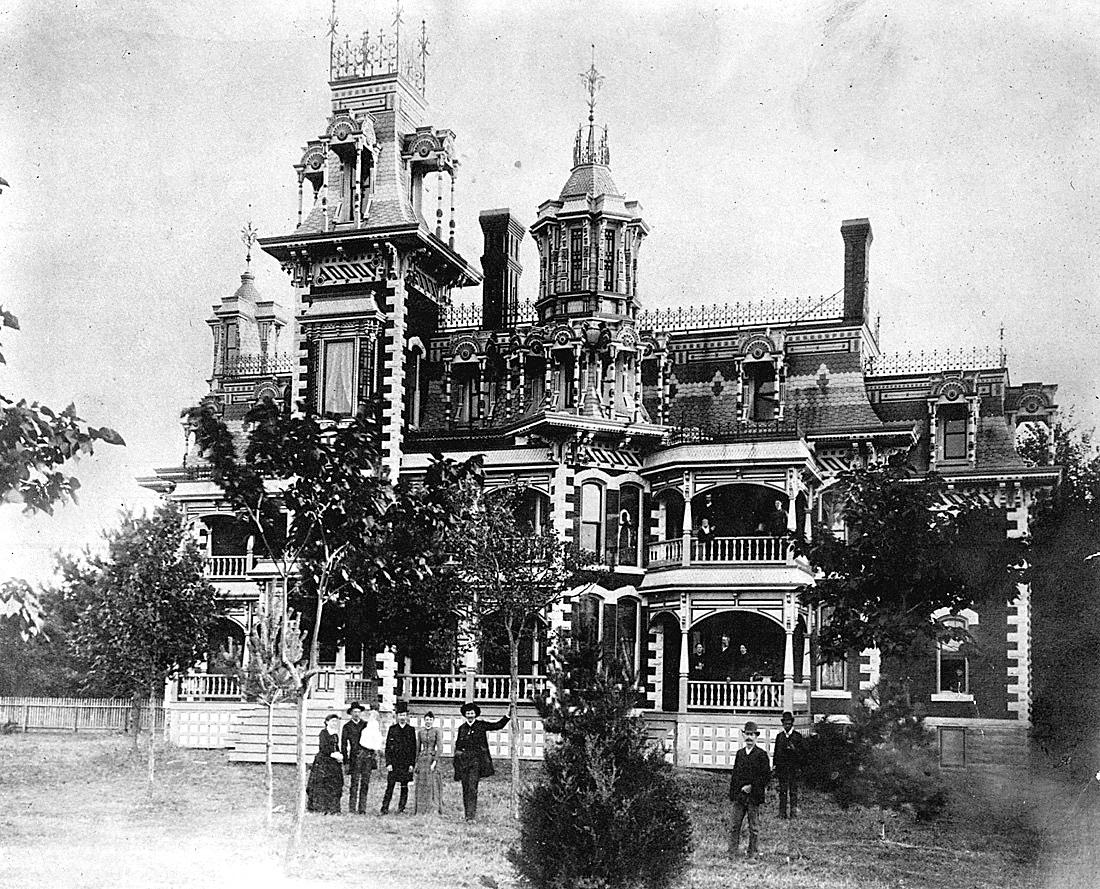
Bethel Bible College, Topeka, about 1900. CC BY-SA 2.0.
Bethel Bible School, Topeka · Story · Featured Study
Topeka, 1901
Charles Parham's Bible school met in a brick mansion that the town called Stone's Folly.
- Where
- Topeka
- Who
- Charles Parham, Agnes Ozman, S. J. Riggins
- When
- October 1900 to August 1901
A reporter watched Agnes Ozman finish her letters, and then she announced that “her hands utterly refused to write the characters of the English language.”
And when Paul laid his hands on them, the Holy Spirit came upon them, and they spoke in tongues and prophesied.
Summary
Charles Parham opened a Bible school at Topeka, Kansas, in October 1900. That winter its students began to speak in what they held to be foreign languages, and the town's paper came to see.
- Agnes Ozman spoke first, and the first reporter called within about a week.
- Parham taught that his students would preach abroad without studying the languages.
- Two students left that month and told the paper they did not believe it.
- Parham's later record holds his teaching on race and an arrest at San Antonio.
The Texts Beside the School
The paper names one chapter, and Parham's promise stands beside one verse of Matthew.
The paper wrote that the school believed it had the gift of tongues of the second chapter of Acts.
And they were all filled with the Holy Spirit and began to speak in other tongues as the Spirit enabled them.
The school held that this first outpouring was being given to it again.
Acts 2:4BSB
And this gospel of the kingdom will be preached in all the world as a testimony to all nations, and then the end will come.
Parham told the paper his students would go to every nation, the reach this verse promises.
The Tellings of the First Days
The papers of that winter printed the first reports, and The Apostolic Faith printed its telling five years later.
The tellings disagree on the day, the hour and the number.
| The telling | Printed | The first days | How many |
|---|---|---|---|
| The Journal at Topeka | 7 January | “About a week ago” | About fifteen |
| The Journal at Topeka | 9 January | “About two weeks”, with nearly a week before the others, Parham says | 15 to 20 |
| Kansas City Journal, reprinted at Topeka | 23 January | It names the Friday following New Year's Day | Seven |
| Kansas City Times, reprinted at Topeka | 31 January | Ozman speaking “since January 1” | Not given |
| The Apostolic Faith, Los Angeles | September 1906 | A sister “after three months”, and twelve “three nights afterward” | Twelve |
| The Apostolic Faith, Los Angeles | October 1906 | 3 January, with Parham away | Twelve |
| Ozman's own book | No date | New Year's night, “near eleven o'clock” | Not given |
| Ozman in Sarah Parham's book | 1930 | “nearly seven o'clock” on 1 January | Not given |
Ozman's own book, Ozman in Sarah Parham's book
The School at Stone's Folly
A nurseryman's ruined mansion became a school run on prayer and gifts.
Parham had pastored an Apostolic congregation in Topeka and had worked for a time with Frank Sandford, whose Bible school stood at Shiloh, Maine. He came back and began a school on the same lines. His book dates the opening to 15 October 1900.
The school took a three-story brick house a mile west of Washburn College. E. B. Stone, a nurseryman, had built it and lost his fortune, and the town called it Stone's Folly.
The Bible was the only textbook, the paper wrote. The students kept the house, the barn and the grounds, and someone stayed in a prayer tower at all hours. The paper counted forty students on 9 January, and Charles Shumway's thesis of 1919 gives thirty-four.
The class had been reading Acts, and the students wanted tongues so that they could “go as missionaries to foreign countries” without first learning the language in a school. Ozman was the first to speak.
S. J. Riggins left on Saturday 5 January after telling the others why, and he called the school a “fake”. Riggins wrote to Ralph Herrin's parents, they sent money for him to leave, and Herrin left on 14 January. Those who stayed said that Riggins was possessed of a devil.
On 21 January Parham, his wife and six others, by the paper's list, set out on a tour of the United States and Canada. They stopped at Kansas City. The next night none of them spoke in tongues before a local reporter. They told him that to “satisfy the curiosity of others” would bring God's anger.
What the Reporters Saw
The papers printed the speech and described the marks, and none of them tells of a test.
On 7 January a State Journal reporter heard about fifteen students speak “outlandish words”, which they said they did not understand until the Lord gave the meaning.
On 9 January the paper described Ozman writing, her hand “jerking back and forth”, and it said she did not interpret the marks. It printed one student's syllables with the meanings the school gave them, among them “God is love”.
Herrin took a pencil for the reporter of 15 January and drew marks that the paper said “greatly resembled” Ozman's.
Ozman told that reporter that she had addressed a restaurant keeper in Topeka in German. She named French, Bohemian, Japanese and Chinese among her languages. No foreigner is named or quoted in these reports.
The book by his widow, Sarah Parham, says that reporters brought professors of languages and government interpreters. Their findings are not known. The same book says Ozman wrote Chinese, and the paper of 9 January says she “was not able to state which” language her marks were.
From Topeka to Houston, and Parham's Record
Parham moved on from Kansas, and his printed words and a court case are part of his record.
By 2 August the paper reported the building given up. It burned that year, under what James Goff calls “somewhat mysterious” circumstances, and the day is not known.
In January 1902 the paper had Parham preparing an expedition to recover the Ark of the Covenant, and no departure is reported. At a meeting of February 1902 no one at the opening received the gift. His widow's book dates a revival at Galena, Kansas, to the fall of 1903.
At Houston in 1905 William Seymour came to Parham's Bible lessons. Parham's widow wrote that in Texas “the colored people are not allowed to mix with the white people” and that he “was given a place in the class”. Cecil Robeck has Parham give him a place in the hallway. Of Topeka she wrote, “No colored people were ever in the school.”
His reprinted books teach a created race before Adam, a Flood sent to destroy man “with all the half-breeds” from intermarriage, and “the Anglo-Saxon and other peoples” as the lost ten tribes. He later wrote of “spiritualistic controls” at Azusa, and Robeck quotes his paper of March 1927 calling the Klan “these splendid men”.
He and a young man named Jourdan were arrested at San Antonio on 19 July 1907, on an affidavit charging “an unnatural offense”. His meetings stopped. He was freed on bond, and a friend reported that he blamed Voliva and the Chicago followers of John Alexander Dowie, with whom he had split at Zion City. His widow wrote that “the case was never called”, and no verdict is known. Parham died on 29 January 1929.
Languages for the Mission Field
Parham taught that the gift would replace language study, and those who went abroad tested the teaching.
Gary McGee traces the idea to before Topeka, in a paper of 1899 and at Shiloh, where Parham went in June 1900.
A dispatch of May 1901 has Parham call the gift “the first step in the evangelization of the world.”
The summer's missionary tours went across Kansas. Ozman's book tells of a woman who went to South America in the summer of 1901, and the line does not name her. Parham's book says “We have several missionaries in the field who have the gift of tongues”, and that line names none of them.
McGee calls preaching at will the “flaw” in Parham's doctrine, corrected in the practice of mission. A. G. Garr, writing from Hong Kong in 1908 of his time in India, reported that he had “not seen any one who is able to preach to the natives in their own tongue”.
How the Key Verse Was Taught
Three writers of three centuries on the tongues at Ephesus.
Matthew Henry (1662 to 1714)
Commentary on the Whole Bible
Matthew Henry tied the gift to the first ministers of the church at Ephesus.
“This was intended to introduce the gospel at Ephesus, and to awaken in the minds of men an expectation of some great things from it; and some think that it was further designed to qualify these twelve men for the work of the ministry, and that these twelve were the elders of Ephesus, to whom Paul committed the care and government of that church.”
on Acts 19:6Puritan
Adam Clarke (1762 to 1832)
Commentary on the Bible
Adam Clarke took the verse as the school later took it, as speech in real languages.
“They received the miraculous gift of different languages; and in those languages they taught to the people the great doctrines of the Christian religion”
Methodist
A. J. Tomlinson (1865 to 1943)
The Last Great Conflict
A. J. Tomlinson drew this rule in 1913 from the verses of Acts.
“with all these Scriptures as proof we are on solid footing when we say that speaking in tongues as the Spirit gives utterance is the evidence of the baptism with the Holy Ghost.”
Church of God
In Their Own Words
The teacher, the first to speak and the two who left, as the paper printed them.
Charles Fox Parham (1873 to 1929)
Topeka State Journal
All the nations
“We have for long believed that the power of the Lord would be manifested in our midst, and that power would be given us to speak other languages, and that the time will come when we will be sent to go into all the nations and preach the gospel”
Pentecostal
About this saying1 paragraph
In 1901 Parham gave the paper this as the purpose of the gift.
Agnes N. Ozman (1870 to 1937)
Interview in the State Journal
The language unknown
“The Lord inspired me with the words and I did not know at the time I was talking, what the next word I uttered would be. I do not know what language I was talking”
American Pentecostal city missionary
About this saying1 paragraph
In 1901 Ozman gave this as her own explanation of the speech.
S. J. Riggins
Topeka State Journal
A kind of gibberish
“They began to claim the gift of tongues and the gift of discernment, and each talked a different kind of gibberish, claiming to be inspired by God”
student who left Bethel Bible School
About this saying1 paragraph
Riggins said this to the paper two days after he left the school.
Ralph Herrin
Interview in the State Journal
Funny marks
“As for the writing, I can make as many funny marks as Miss Ozman.”
student who left Bethel Bible School
About this saying1 paragraph
Herrin said this to the paper the day after he left the school.
Where Historians Disagree
Historians differ on where the movement begins, and the record leaves the other questions open.
Where does the movement begin?2 paragraphs
James Goff gives Parham the first place, “more than Seymour”, and Vinson Synan calls him its “doctrinal father”. Gary McGee writes that Topeka sparked the beginning and that Houston shaped Seymour.
Cecil Robeck calls Topeka a “short-term Bible school” and gives the story to Azusa, and Allan Anderson names Topeka as where “many historians start”, among several places. Robeck doubts that anyone at Azusa but Seymour knew Parham's teaching when the outpouring came in April 1906.
Were the tongues languages?2 paragraphs
Parham and Ozman held that they were, and Ozman said that foreigners told her so. Those are their claims.
Riggins and Herrin said they were not. Shumway wrote in 1919 that most of it was “mere gibberish”, and he allowed fragments of actual languages in a very few cases and gave no source for that.
What became of the charge of 1907?1 paragraph
Goff calls the lack of any record of an indictment in the Bexar County Courthouse “proof enough”. The Religion in Kansas exhibit answers that “he was never officially declared innocent”.
Books to Read Next
A Critical History of Glossolalia
Charles W. Shumway · 1919
Shumway's Boston University thesis is an early outside account of Topeka and Houston.
Read Shumway free at the Internet ArchiveFields White Unto Harvest
James R. Goff · 1988
Goff's study traces the missionary origins of Pentecostalism to Parham.
In print: find it wherever books are sold.
What Topeka Left
Its teaching reached Azusa through William Seymour, whom Parham taught at Houston.
Sources
Scripture is the Berean Standard Bible.
- The Holy Bible, Berean Standard Bible (read 2026)
- Topeka State Journal, 7, 9, 15, 21, 23 and 31 January, 15 March, 9 July and 2 August 1901, and 31 January and 10 February 1902.
- Kansas City Journal, January 1901, reprinted in the Topeka State Journal, 23 January 1901, page 8.
- Hawaiian Gazette, 31 May 1901, page 8, a dispatch from Topeka.
- The Apostolic Faith (Los Angeles), September and October 1906.
- Sarah E. Parham, The Life of Charles F. Parham (1930; Garland reprint, 1985)
- The Sermons of Charles F. Parham (Garland, 1985), reprinting A Voice Crying in the Wilderness (1902) and The Everlasting Gospel.
- Agnes N. O. LaBerge, What God Hath Wrought (Chicago: Herald Publishing, no date; Garland reprint, 1985)
- Charles W. Shumway, A Critical History of Glossolalia (thesis, Boston University, 1919), pages 113 to 115.
- James R. Goff, Fields White Unto Harvest (Fayetteville: University of Arkansas Press, 1988)
- Gary B. McGee, in the Asian Journal of Pentecostal Studies 6:1 (2003), page 138, and 9:1 (2006), pages 118 to 119, and his entry on Parham in the Biographical Dictionary of Christian Missions (1998)
- Cecil M. Robeck, The Azusa Street Mission and Revival (2006), and his article in the Cyberjournal for Pentecostal-Charismatic Research 14 (2005), note on the Klan citing The Apostolic Faith (Baxter Springs) 3:3 (March 1927), page 5.
- Allan Anderson, An Introduction to Pentecostalism (2004)
- Vinson Synan, "Parham, Charles Fox", Encyclopedia of the Great Plains.
- San Antonio Light, 19, 20 and 24 July 1907.
- Matthew Henry, Commentary on the Whole Bible (1710), with Adam Clarke, Commentary on the Bible, and A. J. Tomlinson, The Last Great Conflict (1913)
- The Roots of Pentecostalism in Kansas, Religion in Kansas Project exhibit.
Keep Studying
People and groups5
Subjects1