
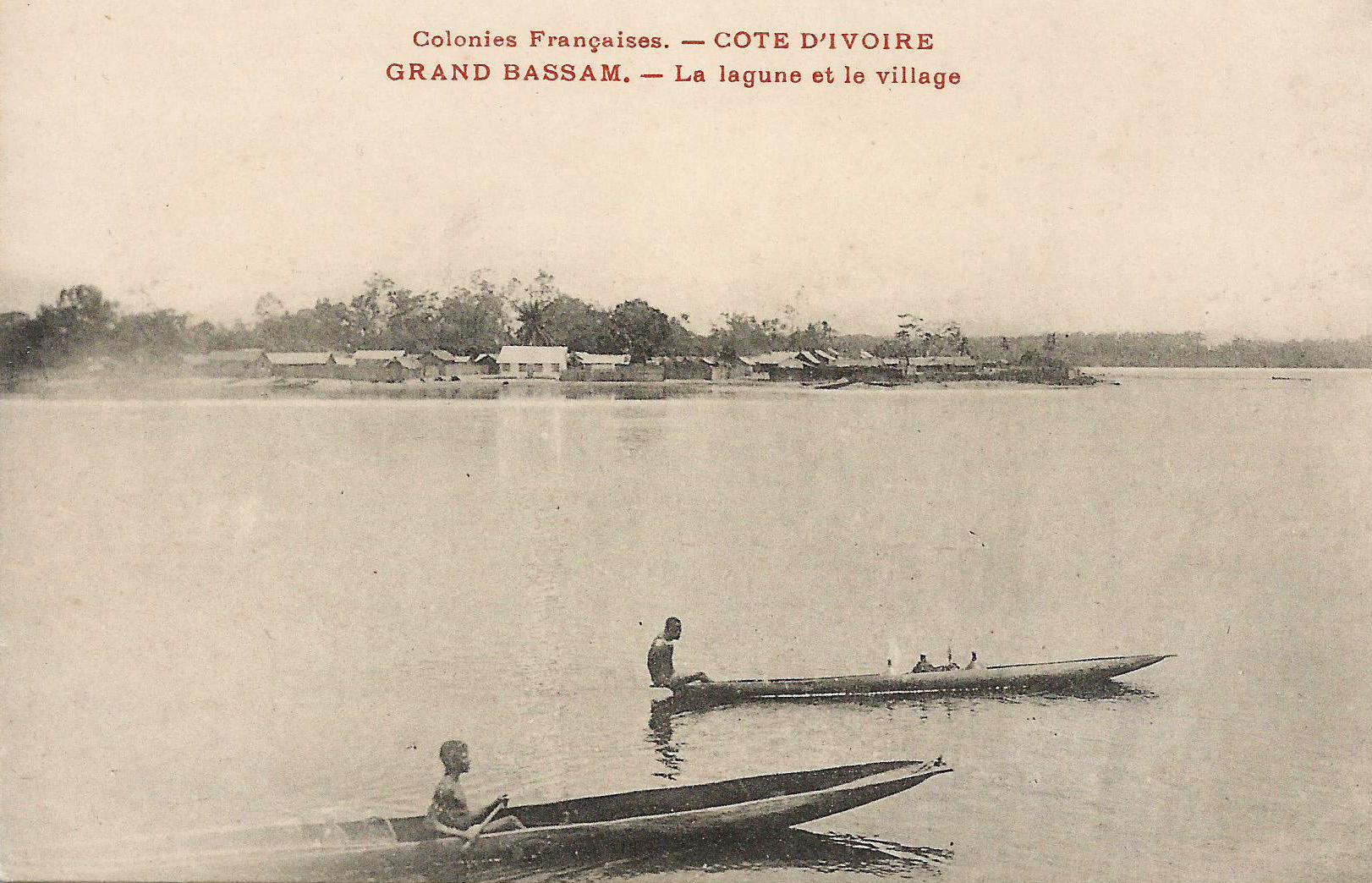
Unknown photographer, a postcard of between 1892 and 1920, public domain, File:Grand Bassam-La lagune et le village.jpg
Liberia to Axim and Grand Bassam, from 1913 · Story · Featured Study
William Wadé Harris, 1913
A Glebo preacher walked the West African coast with a cross and a Bible, and the missions came after him.
- Where
- Cape Palmas, Grand Bassam, Axim, Bingerville
- Who
- Harris, Helen Valentine, Jonas Ahui, W. J. Platt
- When
- 27 July 1913 to April 1929
Mgr Moury, the Catholic vicar apostolic, reported in 1914 that “a whole people” had destroyed its fetishes and “invades our churches en masse.”
Therefore go and make disciples of all nations, baptizing them in the name of the Father, and of the Son, and of the Holy Spirit,
Summary
William Wadé Harris, a Glebo preacher from Liberia, left Cape Palmas on 27 July 1913. He walked east as a prophet. The French put him out of the Ivory Coast about eighteen months later.
- The estimates of his baptisms start at tens of thousands and run past 100,000.
- British Wesleyans found his congregations still standing in 1924.
- The Methodists and the Harrist church both claim him.
- His witnesses disagree on whether he tolerated polygamy or preached it.
The Texts He Carried
His witnesses name a few passages, and David Shank sets Matthew 28:19 first as the commission he maintained.
E. W. Thompson of the Wesleyan mission writes that Harris baptized in the Triune Name.
Therefore, keep in mind how far you have fallen. Repent and perform the deeds you did at first. But if you do not repent, I will come to you and remove your lampstand from its place.
Shank writes that a Liberian preacher converted Harris at Harper with the summons of this verse.
Behold, I will send you Elijah the prophet before the coming of the great and awesome Day of the LORD.
Shank writes that Harris saw himself as the Elijah of this chapter, and his last message named it.
Malachi 4:5BSB
You shall have no other gods before Me.
This verse opens the Ten Commandments, which Shank says Harris taught to those he baptized.
Exodus 20:3BSB
So then, this is how you should pray: ‘Our Father in heaven, hallowed be Your name.
This verse opens the Lord's Prayer, which Shank names with the commandments.
Matthew 6:9BSB
Malachi 4:5, Exodus 20:3, Matthew 6:9
The Road from Cape Palmas
French officers date his coming to the year after Shank has him leaving Liberia.
His road ran east to Axim and back to Grand Bassam, and he lived fourteen more years after the French put him out.
| When | Where | What happened | The witness |
|---|---|---|---|
| 27 July 1913 | Cape Palmas, Liberia | Harris set out east along the coast | Shank (1986) |
| The start of 1914 | The Ivory Coast | French officers date his arrival | Joseph (1917); Marty (1922) |
| July 1914 | Axim, the Gold Coast | J. E. Casely Hayford spoke with him at length | Shank (1986) |
| After July 1914 | Grand Bassam and Bingerville | The masses flocked to him for baptism | Shank (1986) |
| January 1915 | The Ivory Coast | He and his women were beaten and expelled | Shank (1986) |
| 1917, 1919 and 1921 | Sierra Leone | He walked there three times to preach | Shank (1986) |
| May 1924 | The Ivory Coast | W. J. Platt toured the coast and met the congregations | Thompson (1928) |
| 1926 | Liberia | Pierre Benoît of the Methodist mission visited him | Shank (1986) |
| December 1928 | Liberia | Disappointed with Methodist control, he charged Jonas Ahui, a young Ebrié chorister, to begin again | Shank (1986) |
| April 1929 | Spring Hill, Liberia | He died in poverty at close to seventy | Shank (1986) |
May 1924, 1926, December 1928, April 1929
From the Cell to the Coast
A paid church agent became a prisoner for treason, and he left the prison with a new calling.
Shank reckons that Harris was born around 1860 in a Glebo village east of Cape Palmas, Lipschutz and Rasmussen give 1865, and Britannica gives about 1850. At about twenty-one he was converted in the Methodist church at Harper during a revival.
He then served the Episcopal church as a paid agent for more than fifteen years, until the end of 1908. Shank, who defends him, also records that in 1908 he used threats, violence and the occult to move Glebo chiefs toward the British.
In February 1909 he flew the Union Jack at Cape Palmas in expectation of a British takeover. He was condemned for treason, fined 500 dollars and given two years, and he was back in prison when war broke out in January 1910.
Around June 1910, in that prison, he received what Shank calls a trance-visitation of the angel Gabriel in a wave of light, by his own later report as Shank tells it. He was told to put on a white robe, destroy fetishes and preach baptism.
Gaston Joseph, a French colonial officer, printed a short form of the same account in 1917, with the angel guiding him toward the animist lands.
Who walked with him1 paragraph
He travelled with women whom Shank calls his singers, three of them when the French arrested him, and Joseph saw two dressed in white.
Thompson writes that Harris commanded his hearers to throw their fetishes into the water or burn them. He had them take hold of the staff of his cross, sprinkled them, and laid his Bible on each head.
Joseph found that he took only his food and his laundry from the people. The officer put the fall of the fetish priests down to hypnotism, and that explanation is the officer's own.
Shank says the Methodists at Axim faced more than 8,000 people who asked for membership, and he names no counter. At Grand Bassam, Father Joseph Hartz asked him to stop baptizing, and Harris brought him hundreds to baptize himself.
When Hartz asked that they wait for instruction, his diary has Harris answer, “God will do that.”
World War I came that August, and the missionary priests and officials were called up. Shank says Harris and his three women were arrested and severely beaten, and that one of the singers, Helen Valentine, died of her injuries back in Liberia soon after.
Thompson records that French officials ordered the churches destroyed and the congregations dispersed, and he says many buildings were burned.
The years in Liberia3 paragraphs
Shank counts eight attempts to return to the Ivory Coast. He suffered a stroke in 1925, and Walter B. Williams, a Methodist superintendent who opposed him, read it as God's judgment.
Lipschutz and Rasmussen say that he kept preaching in Liberia and no longer drew a large following.
Shank says he had just baptized over 500 when Benoît came in 1926, and he names no counter.
The Count of the Baptized
Thompson says the number cannot be estimated exactly, and no witness here cites a register from the time.
The estimates run higher than the registers, and the registers came a decade later.
| Figure | Who gives it | Year | What it counts |
|---|---|---|---|
| From 100,000 to 120,000 | Élie Allégret of the Paris Mission | 1923 | Those under his influence, with no method named |
| Tens of thousands | E. W. Thompson | 1928 | Converts and followers, with no count behind it |
| More than 100,000 in eighteen months | David Shank | 1986 | The baptized, with no counter named |
| More than 32,000 names in more than 160 chapels | David Shank, on the Wesleyans' first sixteen months | 1986 | Names on church registers |
| Close upon forty thousand | E. W. Thompson | 1928 | Those the mission had enrolled |
The Book on the Desk
Thompson describes chapels of woven mat and thatch and others of stone or concrete.
Thompson says his disciples were to look for a white missionary who would open the Book to them. They waited nearly ten years. Fanti traders from the Gold Coast, some of them Wesleyan lay preachers, procured English Bibles for the reading desks, and Thompson says the Bibles lay closed to a people who could not read.
Thompson tells of a French lawyer who told W. J. Platt of the Wesleyans that a deputation of Harris Christians had laid money on his table for him to fetch missionaries from Europe.
Other missions gained from the same years, and a mission count gives the Catholic church there 13,000 members and over 10,000 catechumens by 1923.
Platt was stationed at Porto Novo in Dahomey, and a press report of 1925 gives him 12,000 worshippers at one meeting and names no counter.
How the Key Verse Was Taught
Three writers of three eras on the command to baptize and to teach.
Tertullian (died 220)
On Baptism
Tertullian set this verse beside the saying on rebirth of water and Spirit to argue that baptism is necessary.
“For the law of baptizing has been imposed, and the formula prescribed: ‘Go,’ He saith, ‘teach the nations, baptizing them into the name of the Father, and of the Son, and of the Holy Spirit.’ The comparison with this law of that definition, ‘Unless a man have been reborn of water and Spirit, he shall not enter into the kingdom of the heavens,’ has tied faith to the necessity of baptism.”
on Matthew 28:19Patristic
John Chrysostom (died 407)
Homily on the Gospel of Matthew 90
Chrysostom noticed what the charge leaves unsaid about the Jews and the failures of the disciples.
“‘Go ye, make disciples of all nations, baptizing them in the name of the Father, and of the Son, and of the Holy Ghost: teaching them to observe all things whatsoever I have commanded you;’ giving the one charge with a view to doctrine, the other concerning commandments. And of the Jews He makes no mention, neither brings forward what had been done, nor upbraids Peter with his denial, nor any one of the others with their flight, but having put into their hands a summary of the doctrine, that expressed by the form of baptism, commands them to pour forth over the whole world.”
on Matthew 28:19Patristic
John Wesley (1703 to 1791)
Explanatory Notes upon the New Testament, on Matthew 28:19
Wesley put the whole commission under the first command, to make disciples.
“Make them my disciples. This includes the whole design of Christ's commission. Baptizing and teaching are the two great branches of that general design.”
Evangelical
In Their Own Words
Shank counts a half-dozen short dictated messages from Harris, so nearly every saying comes through a listener.
William Wadé Harris (died 1929)
Message from retirement, in E. W. Thompson, The Ivory Coast: A Study in Modern Missionary Method, The International Review of Missions 17 (1928)
Burn them all
“All the fetishes, koubos and jujus, must be destroyed. Burn them all in the fire.”
Harrist
About this saying1 paragraph
Thompson printed this in 1928 as part of a message Harris sent to his followers from retirement near Cape Palmas.
William Wadé Harris
his last charge, taken down by P. Benoit at the end of 1926, in E. W. Thompson, The Ivory Coast: A Study in Modern Missionary Method, International Review of Missions, volume 17 (London: Humphrey Milford, Oxford University Press, 1928), page 641
Read the Bible
“Read the Bible; it is the word of God. . . . Search out the light in the Bible. Learn your letters that you may be able to read the Bible; it will be your guide.”
Harrist
About this saying1 paragraph
Thompson calls this his last charge to his former disciples, and the Methodist mission that gained from it brought it back from Liberia in 1926. Harris dictated a later message before he died.
William Wadé Harris
Dictated message of December 1928, in D. A. Shank, The Legacy of William Wadé Harris, International Bulletin of Missionary Research 10:4 (1986)
Many tribulations
“If you say you are for God you have to suffer many tribulations.”
Harrist
About this saying1 paragraph
Harris dictated this in December 1928 for the father of Jonas Ahui, the village chief at Petit Bassam, as Shank gives it.
J. E. Casely Hayford
William Waddy Harris, the West African Reformer, as D. A. Shank quotes it in The Legacy of William Wadé Harris, International Bulletin of Missionary Research 10:4 (1986)
A soul of fire
“It seems as if God made the soul of Harris a soul of fire”
Gold Coast barrister and writer
About this saying1 paragraph
J. E. Casely Hayford, the Gold Coast barrister who met him at Axim, printed this in 1915, and Shank quotes the passage.
Attributed to him
The sayings2 paragraphs
Attributed to Harris by G. van Bulck, in print in 1961, from a priest's diary of 1914, in Shank's translation: “I am a prophet above all religions and freed from the control of men.”
Attributed to Harris by Walter B. Williams, a Methodist who opposed him, in a letter printed in 1929: “Jesus Christ had twelve, disciples, and they were men. I shall have fourteen disciples, and they will be women. This polygamy talk is white man's mouth.”
What the Witnesses Dispute
Each question has more than one telling, and the holders had their own reasons to tell it their way.
On the expulsion, Shank gives January 1915 and a beating. Thompson, writing for the mission that had to work under the French, says Harris was peaceably removed in April 1915.
On the reason, Allégret writes of a fear that he was anglicizing the colony, and Thompson of a fear of hidden politics in wartime. Joseph points to false sons of God and a rumour that the whites would leave.
On polygamy, Joseph wrote that he tolerated it and spoke against adultery, and Shank says he accepted it as a fact of African life. Williams wrote that he preached it and lived in it.
The church that bears his name keeps traditional marriage practices, and its preachers have one wife each, by Shank's account of 1986.
On his knowledge of Scripture, F. Deaville Walker of the Methodists called it almost nil, and Edwin Smith wrote that as far as the records go he did not quote the Bible. Shank writes of a deep biblical culture begun under the Methodist John C. Lowrie, and the Missionary Herald of 1927 says he had a good knowledge of the Bible.
On who inherits him, Thompson's article makes the Methodists his heirs, and Benoît brought back a testament that Shank calls Methodist-inspired. The Harrist church rests on his charge to Jonas Ahui, which it knows from its own memory of a meeting in December 1928. It took shape in 1931, and Shank gives it perhaps 200,000 adherents in the text reprinted in 1994.
The Catholic mission first called him a charlatan in a Protestant plot, and its report of 1925 credited him with beginning the salvation of the Ivory Coast. Both lines come through Shank, who defends him.
Books to Read Next
The Legacy of William Wadé Harris
David A. Shank · 1986
Shank traces the whole life in a short article, and he reads Harris as a defender.
Read Shank free at the Dictionary of African Christian BiographyThe Ivory Coast: A Study in Modern Missionary Method
E. W. Thompson · 1928
This article gives the mission's side, with the fetishes, the Bibles and the registers.
Read Thompson free at the Internet ArchiveLa Côte d'Ivoire: le pays, les habitants
Gaston Joseph · 1917
This French book gives the officers' side of the expulsion.
Read Joseph free at the Internet ArchiveWhat Harris Left
Thompson says the people came together again after the burning and restored their chapels.
Sources
Scripture is the Berean Standard Bible.
- The Holy Bible, Berean Standard Bible (read 2026)
- David A. Shank, The Legacy of William Wadé Harris, International Bulletin of Missionary Research 10:4 (1986), pages 170 to 176, as reprinted from Mission Legacies (1994)
- E. W. Thompson, The Ivory Coast: A Study in Modern Missionary Method, The International Review of Missions 17 (1928)
- Gaston Joseph, La Côte d'Ivoire: le pays, les habitants (Paris: Émile Larose, 1917), pages 155 to 160.
- Élie Allégret, The Missionary Question in the French Colonies, The International Review of Missions 12 (1923), translating Paul Marty (1922)
- Walter B. Williams, letter in The Record of Christian Work 49:4 (April 1929), pages 199 to 200.
- Edwin W. Smith, The Christian Mission in Africa (1926), page 42 and its note.
- F. Deaville Walker, as quoted in The International Review of Missions 16 (1927)
- Mark R. Lipschutz and R. Kent Rasmussen, Dictionary of African Historical Biography, second edition (1986), the entry on Harris.
- The Missionary Herald 123:11 (Boston, November 1927), page 396.
- Encyclopaedia Britannica, Harris movement, undated.
- The press report of 1925 in the Tuskegee Institute News Clippings File, missions, foreign.
Keep Studying
Studies1
People and groups5
Church history6
Trials of life1