
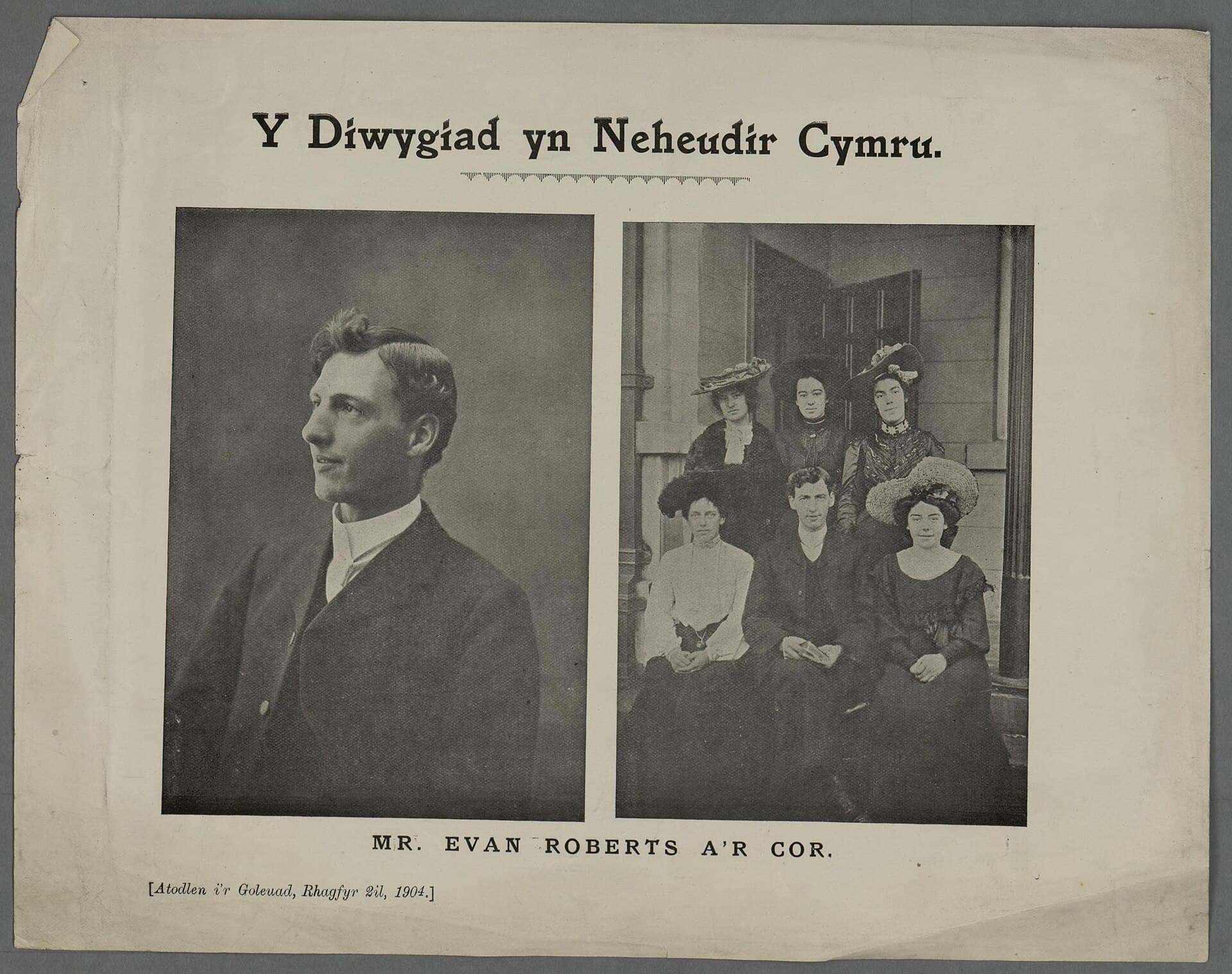
The story
It started with a sentence, not a sermon. In February 1904, at a young people's meeting in New Quay, Cardiganshire, the minister Joseph Jenkins asked what those present had to say about the Lord Jesus. A teenage girl named Florrie Evans stood and said she loved the Lord Jesus Christ with all her heart. The room broke, and something spread through the chapels of that coast for months before anyone gave it a name.
The pivot came on September 29, 1904, at a convention in Blaenannerch. Seth Joshua, an evangelist of the Calvinistic Methodist Forward Movement, prayed in Welsh, "Plyg ni, O Arglwydd", bend us, O Lord. A twenty-six-year-old student in the meeting could not hold still; sweating and shaking, Evan Roberts cried out, "Plyg fi", bend me. He said afterward that everything he later did came out of that hour.
If we confess our sins, He is faithful and just to forgive us our sins and to cleanse us from all unrighteousness.Point one of the four: confess every known sin. The revival began where this verse begins, with naming things, not with feeling things.
Roberts was not a scholar or a celebrity. He had gone down the pit at Loughor at about twelve when his father was injured, worked years as a collier, then apprenticed to his uncle as a blacksmith, and was only then preparing for the ministry. He had been praying for revival for around thirteen years. For months before Blaenannerch he was waking near one in the morning and staying awake with God until dawn, his own account, given to the papers when they asked.
On Monday, October 31, 1904, back home at Moriah Chapel in Loughor, he asked the minister whether he could speak to anyone who would stay after the regular service. About seventeen young people stayed. They met again the next night, and the next; within two weeks the chapel could not hold the crowd, and the Western Mail in Cardiff had sent a reporter to find out what was happening in a colliery village nobody had heard of.
The revival ledger's two lines: what marked the outpouring and what it left standing.
| The ledger | What the record holds |
|---|---|
| What marked it | A teenage girl named Florrie Evans stood up in a New Quay meeting and said she loved the Lord Jesus with all her heart, and the room broke. Evan Roberts, a young collier and blacksmith, had been praying for years and began holding meetings with four plain points: confess every known sin, put away every doubtful thing, obey the Spirit promptly, confess Christ publicly. There was almost no preaching, the meetings ran on singing, testimony, and open prayer, and often went past midnight. Roberts refused to control them, saying the Spirit was leading. |
| What was left standing | About one hundred thousand converts within a year is the figure widely reported at the time and repeated since, it comes from contemporary press and church counts, not an audit. Newspapers reported taverns closing, debts repaid, and magistrates handed white gloves for sessions with no cases to try; the story that pit ponies stopped working because the miners had stopped swearing is much loved and hard to verify. The revival’s reports circulated worldwide and helped prepare the ground for what happened in Los Angeles two years later. |
When the papers asked what he was preaching, Roberts gave four points, and they are the whole of his method: confess to God every sin in your past that you have not confessed, and put right anything you have done wrong to anyone else; put away anything doubtful; obey the Spirit promptly; and confess Christ publicly. No new doctrine, nothing dramatic, four things any believer could do that evening.
The meetings looked like nothing the chapels were used to. There was often no sermon at all. People sang, "Dyma Gariad Fel y Moroedd," "Here Is Love, Vast as the Ocean," became the revival's own hymn, and prayed aloud, sometimes many at once, and stood to testify, and went on past midnight and sometimes till dawn. Young women, above all the singers who traveled with Roberts, carried as much of the meetings as he did. Roberts would sit down and refuse to direct it, saying the Spirit was leading and he would not get in front.
The 5 people and groups the revival ledger names, in its order.
| Who the ledger names |
|---|
| Evan Roberts; Seth Joshua; Joseph Jenkins; Florrie Evans; Sidney Evans |
This is the revival historians can actually check, because Wales had a press. The Western Mail ran its correspondent "Awstin" through the valleys and collected the reports in pamphlets as they went. W. T. Stead, a famous London editor and no easy mark, came down in late 1904, sat in the meetings, and published a narrative of facts. He judged it the way Jesus said to judge a thing, by its fruit (Matthew 7:16), and came away saying plainly that what he had seen was good. Reporters, skeptics, and foreign visitors filed accounts week after week, which is why we know more about Loughor in 1904 than about almost any other outpouring.
The fruits were reported in the courts and the collieries, not only in the chapels. Magistrates were handed white gloves for sessions with no cases to try, the old token of a clean list. Arrests for drunkenness fell, taverns closed, and debts long written off were repaid. The best-loved story, that the pit ponies stopped working because the colliers had stopped swearing at them and the animals no longer recognized the commands, is told here as the era told it about itself: it was printed widely at the time and has never been verified, and it survives because it captures something the numbers cannot.
If you love Me, you will keep My commandments.Points two and three, obedience to the Spirit and putting away what is doubtful, come straight out of Jesus tying love to keeping His commandments.
About a hundred thousand converts within a year is the figure the press and the church returns produced, repeated ever since; it is a contemporary estimate, not an audit, and honest accounts add that Welsh chapel membership peaked around 1905 and then slid, so retention was real but partial. What did not fade was what went out from Wales: reports of Loughor were read in Los Angeles before Azusa Street in 1906, in Korea before Pyongyang in 1907, and in the Khasi Hills of India, where the Welsh mission saw its own outpouring in 1905.
that if you confess with your mouth, “Jesus is Lord,” and believe in your heart that God raised Him from the dead, you will be saved.Point four: confess Christ publicly. Meetings full of ordinary people standing up and saying it out loud is this verse practiced rather than preached.
The ebb should be told as plainly as the flood. In January 1905 the Rev. Peter Price of Dowlais published a letter in the Western Mail claiming there were two revivals in Wales, a real one and Roberts's sham, and it wounded him badly. Roberts was already exhausted, he had been holding meetings almost nightly for months, sometimes falling silent in them for long stretches. In 1906 he withdrew to the home of Jessie Penn-Lewis in England, and apart from co-authoring War on the Saints with her in 1912 he never returned to public ministry. He lived quietly until his death in 1951 and was buried at Moriah, where it started. A revival that ran on one man's health showed exactly what happens when that man's health goes.
And afterward, I will pour out My Spirit on all people. Your sons and daughters will prophesy, your old men will dream dreams, your young men will see visions.The text every report reached for, sons and daughters, young and old, the Spirit poured out on all flesh. In Wales the daughters and the young men led.
Romans 10:9, Joel 2:28