
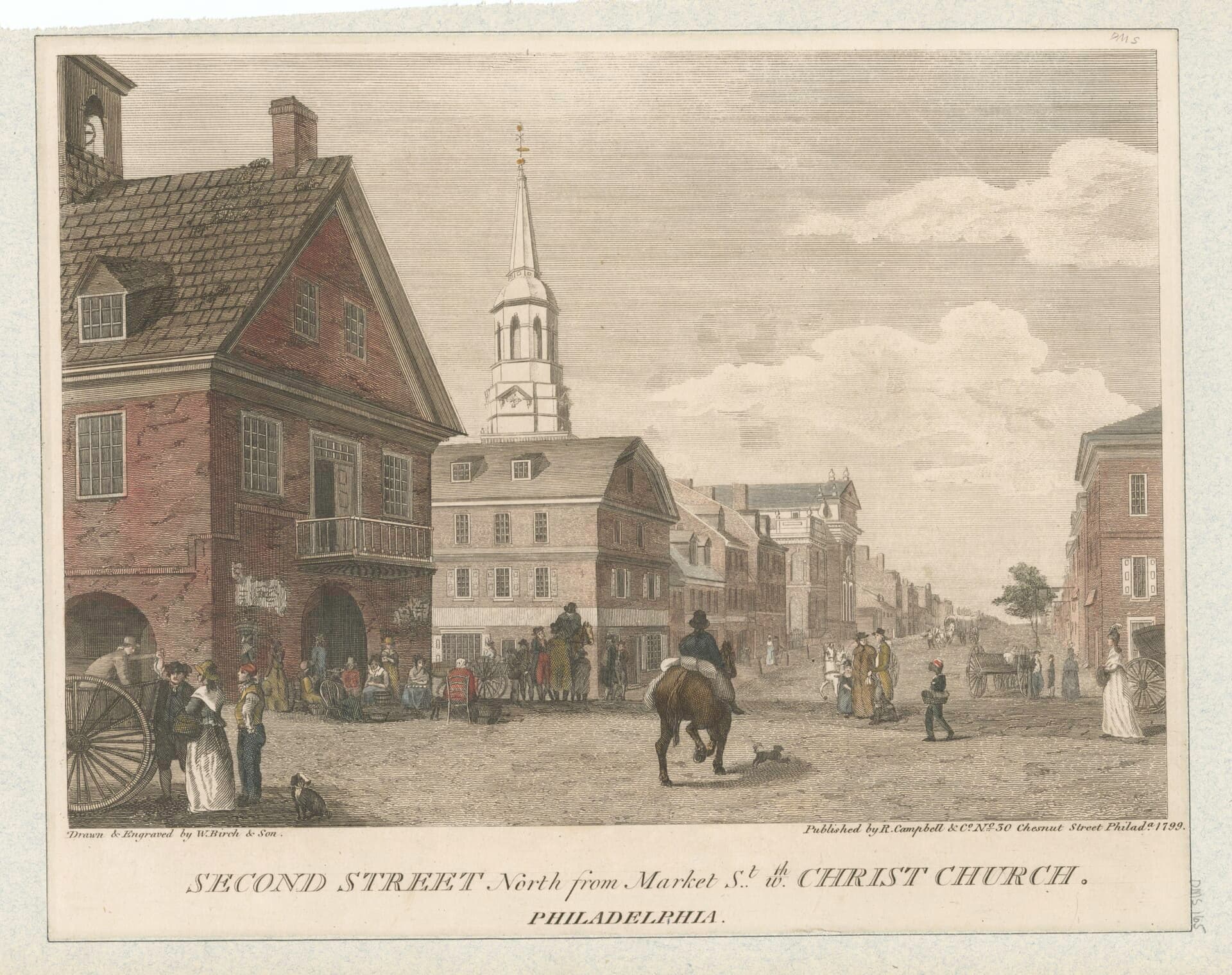
Second Street north from Market Street, with Christ Church, Philadelphia, 1799. Public domain.
The evangelist and the printer · Story · Featured Study
Whitefield and Franklin
Benjamin Franklin printed George Whitefield's journals and sermons, though he never shared the preacher's faith.
- When
- 1739 to 1770
Franklin wrote that a missionary sent by the Mufti of Constantinople “would find a pulpit at his service” in the hall built for Whitefield.
Jesus replied, “Truly, truly, I tell you, no one can see the kingdom of God unless he is born again.”
Summary
George Whitefield met Benjamin Franklin in Philadelphia, and the two men wrote to each other for almost thirty years.
- Franklin wrote to his brother, “He is a good man, and I love him.”
- Tyerman says Franklin set up a college in Whitefield's old meeting-house.
- Whitefield died at Newburyport, near Boston, on Sunday 30 September 1770.
The Offer of a Room
Franklin's offer of his house drew from Whitefield a promise of Christ's reward and from Franklin a joke.
When Whitefield wrote that he knew of nowhere to lodge in Philadelphia, Franklin answered, “You know my house; if you can make shift with its scanty accommodations, you will be most heartily welcome.”
Whitefield replied that if Franklin made the offer for Christ's sake he would not miss of a reward. Franklin returned, “Don't let me be mistaken; it was not for Christ's sake, but for your sake.”
Indeed, if anyone gives you even a cup of water because you bear the name of Christ, truly I tell you, he will never lose his reward.Whitefield's reply rests on the reward Jesus promises here to a kindness done in His name.
If anyone desires to do His will, he will know whether My teaching is from God or whether I speak on My own.Whitefield's letter from Reedy Island told Franklin to be willing to do the divine will and he would know it, the condition Jesus sets in this verse.
The Letters Between Them
Seven letters show what each man wrote to the other over almost thirty years.
Whitefield's letters press the new birth on Franklin, and Franklin's answer with virtue, the colonies and his own hope.
| Date | Writer | What the letter says |
|---|---|---|
| 26 November 1740, Reedy Island | Whitefield | It gives Franklin leave to print his life and promises the corrected sermons. |
| 6 July 1749, Philadelphia | Franklin | It asks for some method to make the reformation of the great lasting. |
| 26 February 1750, Plymouth | Whitefield | It says Franklin's plan for an academy wants something of Christ in it. |
| 17 August 1752, London | Whitefield | It turns from Franklin's electricity to the study of the new birth. |
| 2 July 1756, New York | Franklin | It wishes the two men could settle a colony on the Ohio for the Crown. |
| 19 June 1764, Philadelphia | Franklin | It rests his hope of the future on the favours of the past. |
| 21 January 1768, Tottenham Court | Whitefield | It prays that both men will cry Amen when time ends. |
From Philadelphia to the Last Meeting in London
Franklin's Autobiography tells the friendship from the first sermons to their last talk.
Franklin wrote, “In 1739 arrived among us from Ireland the Reverend Mr. Whitefield.” The clergy soon refused him their pulpits, and he preached in the fields.
Franklin, who went to hear him, saw the town change. It seemed “as if all the world were growing religious,” and psalms were sung in the evenings in families of every street.
Money was soon gathered for a house to preach in, one hundred feet long and seventy broad.
Whitefield went preaching south to Georgia and planned an orphan house there. Franklin advised building it in Philadelphia, was refused, and resolved that Whitefield “should get nothing from me.”
At a sermon soon after, Franklin had in his pocket a handful of coppers, three or four silver dollars and five pistoles in gold. He decided on the coppers, then on the silver, and at the end “empty'd my pocket wholly into the collector's dish, gold and all.”
A member of Franklin's club named Hopkinson had emptied his pockets at home. When he tried to borrow, his neighbour refused him, saying he seemed to be out of his right senses.
When enemies said Whitefield kept the collections, Franklin held him “a perfectly honest man.”
Whitefield sometimes prayed for his conversion, Franklin wrote, “but never had the satisfaction of believing that his prayers were heard.”
One evening Whitefield preached from the top of the Courthouse steps in Market Street at Second Street. Franklin walked back down Market Street toward the river until a noise in Front Street hid the voice.
Allowing two square feet a hearer in a half circle, he computed that Whitefield “might well be heard by more than thirty thousand.”
Franklin last saw him in London, where Whitefield asked his advice on turning the orphan house into a college.
Whitefield and the Enslaved
The man Franklin called honest rebuked the planters and later set out to buy slaves for Georgia.
In 1740 Franklin printed Whitefield's letter to the inhabitants of Maryland, Virginia, and North and South Carolina, “concerning their Negroes,” which charged them with cruelty.
On 15 March 1747 Whitefield wrote that the people of Georgia could not live “without the use of slaves,” and added, “One negro has been given me. Some more I purpose to purchase this week.”
To the Georgia Trustees on 6 December 1748 he wrote, “Georgia never can be a flourishing province, unless negroes are employed.”
In the year Whitefield died, the orphan house that Franklin's coins had helped to build counted fifty negroes in its family, the children among them “all employed as far as their strength permitted.”
The Printer's Notice
The Gazette set out the volumes and their price that first winter.
On 15 November 1739 Franklin's Pennsylvania Gazette announced that Whitefield had given him copies of his Journals and Sermons “with leave to print the same,” in four volumes at two shillings each.
On 28 November Whitefield wrote that one of the printers had taken above two hundred subscriptions, and Tyerman takes the printer to be Franklin.
Hildeburn's catalogue of 1885 lists the Journal of a Voyage from Gibraltar to Georgia as printed and sold by Franklin in Market Street that year, and the journals that followed it.
What the Record Leaves Unsaid
The Autobiography leaves two things undated and uncounted.
Franklin gives the evening of the Market Street sermon no year, and neither Franklin nor Tyerman counts the works of Whitefield's that Franklin printed.
Neither the letters of the two men nor Franklin's Autobiography ties their friendship to the founding documents of the United States.
What Franklin Made of the Preacher
Franklin judged the preaching better than the printing.
By hearing him often, Franklin learned to tell a new sermon from one often preached. The old ones gave “a pleasure of much the same kind with that receiv'd from an excellent piece of musick.”
The printed sermons, he thought, gave Whitefield's critics their weapons, since “litera scripta manet,” the written letter remains.
Had Whitefield never written anything, Franklin judged, “he would have left behind him a much more numerous and important sect.”
How the Key Verse Was Taught
Four voices from the early church to 1924 take up John 3:3.
John Chrysostom (died 407)
Homilies on the Gospel of John, Homily 24
A homily of the early church says what Jesus' answer told Nicodemus of where he stood.
“Unless thou art born again and receivest the right doctrines, thou art wandering somewhere without, and art far from the Kingdom of heaven.”
Patristic
John Wesley (1703 to 1791)
Explanatory Notes upon the New Testament
Wesley wrote this note in the years of the letters, on what it is to see the kingdom.
“Otherwise thou canst not see, that is, experience and enjoy, either the inward or the glorious kingdom of God.”
Evangelical
Jamieson, Fausset & Brown (1802 to 1910)
Commentary Critical and Explanatory on the Whole Bible
A commentary of 1871 weighs the hopes Nicodemus brought with him.
“Instead of this, he is virtually told that he has raised a question which he is not in a capacity to solve, and that before approaching it, his spiritual vision required to be rectified by an entire revolution on his inner man.”
Evangelical
Smith Wigglesworth (1859 to 1947)
Ever Increasing Faith, Chapter 2: "Deliverance to the Captives"
An evangelist of 1924 says what Nicodemus needed beyond the signs he had seen.
“Nicodemus was impressed by the miracles wrought and Jesus pointed out the necessity of a miracle being wrought with every man who would see the kingdom. When the man is born of God, is brought from darkness to light, a mighty miracle is wrought.”
on John 3:3British Pentecostal
Jamieson, Fausset & Brown, Smith Wigglesworth
In Their Own Words
Franklin's words on the friendship, on providence and on the man stand here with the preacher's one reply.
George Whitefield (1714 to 1770)
Note on Franklin's letter of 1769, as printed by Belcher, chapter on Whitefield's last labours in Great Britain
Whitefield's reply
“Uncomfortable indeed! and, blessed be God, unscriptural; for we are fully assured that 'the Lord reigneth,' and are directed to cast all our own care on him, because he careth for us.”
Calvinistic Methodist
About this saying1 paragraph
Whitefield answered in 1769 in his own hand, at the foot of the page Franklin sent.
Benjamin Franklin
Autobiography, the chapter on Whitefield
The friendship in one sentence
“Ours was a mere civil friendship, sincere on both sides, and lasted to his death.”
Philadelphia printer
About this saying1 paragraph
Franklin gave his last word on the friendship in the Autobiography he began in 1771.
Benjamin Franklin
Letter to George Whitefield, 1769, as printed by Belcher, chapter on Whitefield's last labours in Great Britain
Soldiers in Boston
“I see with you that our affairs are not well managed by our rulers here below; I wish I could believe with you, that they are well attended to by those above.”
Philadelphia printer
About this saying1 paragraph
Franklin wrote from London in 1769, as troops were sent to Boston, to a man who trusted providence more than he did.
Benjamin Franklin
Letter to a gentleman in Georgia, after Whitefield's death, as printed by Belcher, chapter on Whitefield's death
After his death
“I knew him intimately upwards of thirty years; his integrity, disinterestedness, and indefatigable zeal in prosecuting every good work, I have never seen equalled, I shall never see excelled.”
Philadelphia printer
About this saying1 paragraph
Franklin set down this judgment after Whitefield died in 1770.
Benjamin Franklin, Benjamin Franklin
Where Historians Disagree
Franklin's measure of the crowd and the friendship's hold on his faith have each been weighed.
How many could hear Whitefield?3 paragraphs
Braxton Boren and Agnieszka Roginska wrote in 2013 that Franklin's method of estimating the voice's range “was actually fairly accurate.”
They called his density, which crowd estimators name “mosh pit” conditions, his “primary error.”
Of Whitefield's crowds in London, which Franklin never attended, they judged a density of about half a square metre a person more likely.
Did the friendship move Franklin's faith?3 paragraphs
Tyerman wrote in 1876, “Franklin disbelieved the chief doctrines Whitefield preached; but he respected the good intentions, the zeal, the benevolence, the honesty of the man.”
Belcher wrote in 1857 that “even in this connection Franklin could not conceal his scepticism.”
Whitefield wrote otherwise in 1740, “I do not despair of your seeing the reasonableness of Christianity.”
Books to Read Next
Autobiography of Benjamin Franklin
John Bigelow, editor · 1868
Franklin's chapter on Whitefield gives the hall, the collection and the walk in his own words.
Free at the Internet ArchiveThe Life of the Rev. George Whitefield, volume 2
Luke Tyerman · 1876
Tyerman prints the letters between the two men from 1740 to 1768.
Free at the Internet ArchiveThe Works of Benjamin Franklin, volume VII
Jared Sparks, editor · 1840
Sparks prints Franklin's letter of 1764 on his own hope.
Free at the Internet ArchiveWhat the Friendship Left
The friendship left Franklin's measure of Whitefield's voice and a printer's testimony to the preacher's honesty.
Sources
Scripture is the Berean Standard Bible.
- The Holy Bible, Berean Standard Bible (read 2026)
- Autobiography of Benjamin Franklin, ed. John Bigelow (Philadelphia: J. B. Lippincott, 1868), and ed. F. W. Pine (New York: Henry Holt, 1916), the chapter on Whitefield.
- Luke Tyerman, The Life of the Rev. George Whitefield, two volumes (London: Hodder and Stoughton, 1876), the letters of 1740, 1747 to 1752, 1756 and 1768, the Gazette notice of 15 November 1739 and the account of the orphan house in 1770.
- Jared Sparks, ed., The Works of Benjamin Franklin, volume VII (Boston: Hilliard, Gray, 1840), the letter to Whitefield of 19 June 1764 and the note on the letter of 6 August 1747.
- Joseph Belcher, George Whitefield: A Biography (New York: American Tract Society, 1857), the chapter on his last labours in Great Britain.
- Charles R. Hildeburn, A Century of Printing: The Issues of the Press in Pennsylvania, volume 1 (Philadelphia, 1885)
- Braxton Boren and Agnieszka Roginska, the lay paper of their talk 1aAA4 at the 166th meeting of the Acoustical Society of America (2013)
- John Chrysostom, Homilies on the Gospel of John, Homily 24, in Nicene and Post-Nicene Fathers, first series, volume 14, ed. Philip Schaff (Edinburgh: T. and T. Clark; the translation's preface dated May 1877)
- John Wesley, Explanatory Notes upon the New Testament (1755), on John 3:3.
- Jamieson, Fausset & Brown, Commentary Critical and Explanatory on the Whole Bible (1871), on John 3:3.
- Smith Wigglesworth, Ever Increasing Faith (1924), chapter 2.
Keep Studying
Studies4
People and groups7
Church history2