
Jonah 3:9
in Jonah 3Who knows? God may turn and relent; He may turn from His fierce anger, so that we will not perish.”
BSB
The same verse in ASV and KJV ▾
ASV
Who knoweth whether God will not turn and repent, and turn away from his fierce anger, that we perish not?
KJV
Who can tell if God will turn and repent, and turn away from his fierce anger, that we perish not?
⋯
This verse in Jonah 3
Commentary
13 notes on this verseLook here then, say you: I discover a self-incriminating case in the matter of the Ninevites, when the book of Jonah declares, "And God repented of the evil that He had said that He would do unto them; and He did it not." In accordance with which Jonah himself says unto the Lord, "Therefore I fled before unto Tarshish; for I knew that Thou art a gracious God and merciful, slow to anger, and of great kindness, and repentest Thee of the evil."
This site's exposition
Let neither man nor beast, herd nor flock, taste any thing
on Jonah 3:7-9
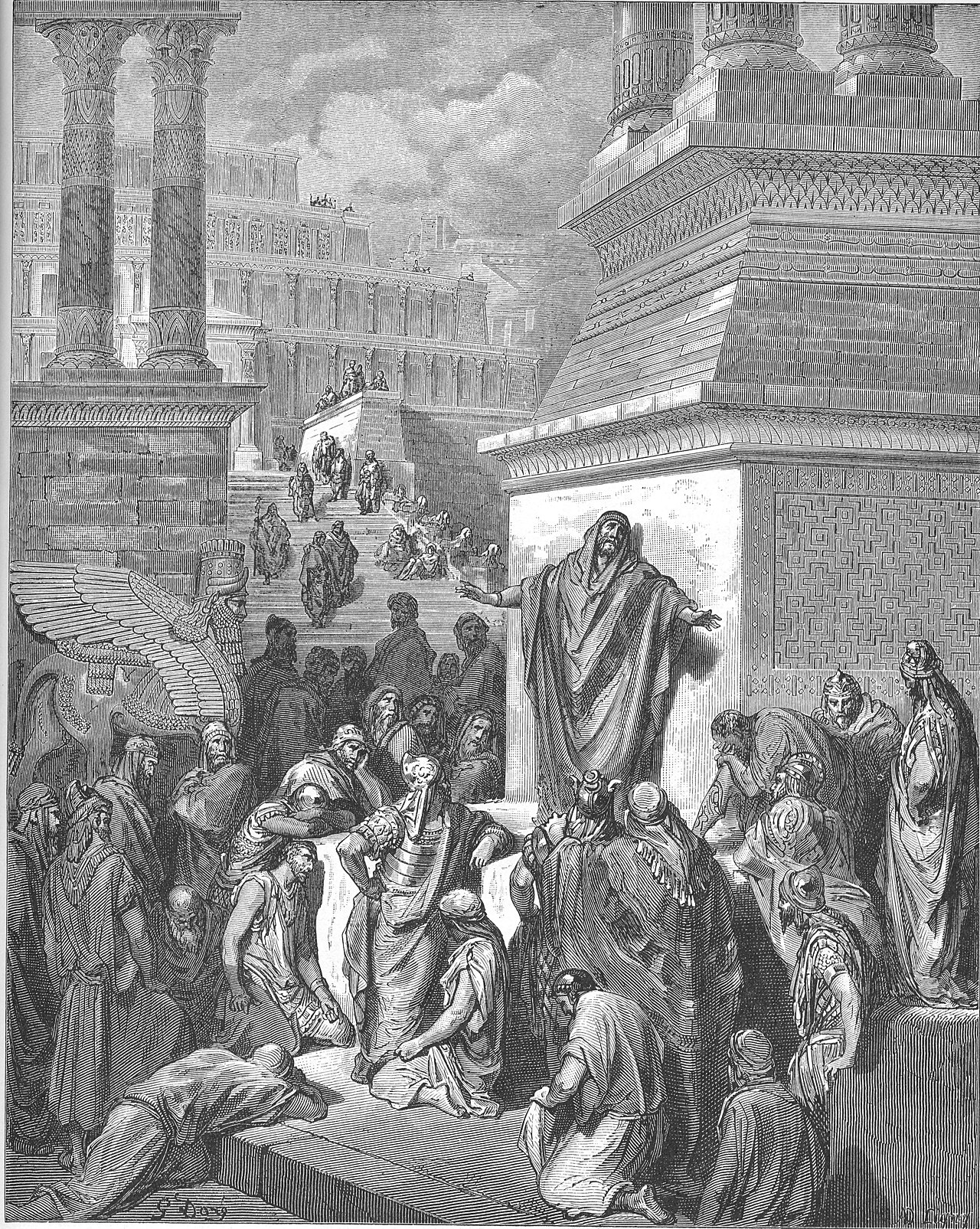
Let neither man nor beast, herd nor flock, taste any thing extends the fast even to the city's animals, a detail without parallel elsewhere in Scripture that the commentators read as eastern custom rather than an invented flourish, since classical writers record similar mourning practices among other Near Eastern peoples. The decree goes past ritual, commanding that man and beast cry mightily unto God and that every one turn from his evil way and from the violence that is in their hands, naming violence specifically as the sin Nineveh must abandon. The king's own uncertainty, who can tell if God will turn and repent, and turn away from his fierce anger, that we perish not, asks for mercy without presuming it, and Henry and Pusey both read this as the humility the book commends against Jonah's own presumption that he already knew how God would act.
The record, by era
The Church Fathers2 voices
A commentator
John ChrysostomHOMILIES ON LAZARUS AND THE RICH MAN 6 · Written in the 5th century.
proposed
Consider, if God had chosen to demolish everything [in a recent earthquake], what we would have suffered. I say this, so that the fear of these events may remain sharp in you and may keep everyone's resolution firm. He shook us, but he did not destroy us. If he had wished to destroy us, he would not have shaken us. But since he did not wish to destroy us, the earthquake came in advance like a herald, forewarning everyone of the anger of God, in order that we might be improved by fear and prevent the actual retribution.He has done this even for foreign nations. "Yet three days, and Nineveh shall be overthrown." Why do you not overcome the city? You threaten to destroy it. Why do you not destroy it? "Because I do not wish to destroy, for this very reason I threaten." So what is the Lord saying? "Lest I enact my impending judgment, let my word go in advance and prevent my acting." Yet three days, and Nineveh shall be overthrown. Then the prophet spoke. Today these walls speak. I say this, and I do not cease saying it, both to the poor and to the rich: consider how great is God's anger. Consider how simple his requirement: let us abstain from evil! In a brief moment of time he shattered the mind and resolution of each one of us. He shook the foundations of our hearts.
"For word came unto the king of Nineveh, and he arose from his throne, and he laid his robe from him, and covered him with sackcloth, and sat in ashes.
The Medieval Church1 voice
God is said 'to change His mind,' metaphorically, inasmuch as He bears Himself after the manner of one who repents, by 'changing His sentence, although He does not change His plan.
The Puritans and the Awakening2 voices
They cannot object against the equity of the judgment, they pretend not to set it aside by appealing to a higher court, but hope in God himself, that he will repent, and that his own mercy (to which they fly) shall rejoice against judgment.
Who can tell,....
6 more voices on this verse
The Puritans and the Awakening1 voice
In prayer we must cry mightily, with a fixedness of thought, firmness of faith, and fervour of pious and devout affections. By crying mightily we wrestle with God; we take hold of him; and we are concerned to do so when he is not only departing from us as a friend, but coming forth against us as an enemy. It therefore concerns us in prayer to stir up all that is within us.
The Nineteenth Century5 voices
A commentator
Albert Barnes1798–1870
Notes, Explanatory and Practical, on the Old and New Testaments (1832-1869)
Who can tell if God will turn and repent? - The Ninevites use the same form of words, which God suggested by Joel to Judah. Perhaps He would thereby indicate that He had Himself put it into their mouths. “In uncertainty they repented, and obtained certain mercy” . “It is therefore left uncertain, that men, being doubtful of their salvation, may repent the more vehemently and the more draw down on themselves the mercy of God” . “Most certain are the promises of God, whereby He has promised pardon to the penitent.
A commentator
Jamieson, Fausset & Brown1802–1910
Commentary Critical and Explanatory on the Whole Bible (1871)
The only ground which their ready faith rested on, was the fact of God sending one to warn them, instead of destroying them at once; this suggested the thought of a possibility of pardon. Hence they are cited by Christ as about to condemn in the judgment those who, with much greater light and privileges, yet repent not (Mt 12:41).
A commentator
Charles Spurgeon1834–1892
The New Park Street Pulpit, Sermon No. 275: “Who Can Tell?” (lightly modernized text, CCEL edition) (1859)
proposed
THIS WAS THE FORLORN HOPE of the Ninevites: “Who can tell if God will turn and repent, and turn away from his fierce anger, that we perish not?” The book of Jonah should be exceedingly comfortable to those who are despairing because of the wickedness of their times. Nineveh was a city as great in its wickedness as in its power. If any of us with little faith had been bidden to go round about her, and “tell the towers thereof, and mark well her bulwarks;” if we had been commanded to go through her streets and behold her both in the blaze of the sun and in the light of the moon as her inhabitants indulged in vice, we should have said. “Alas! Alas! the city is wholly given into idolatry, and it is girt about with a wall of sin, as stupendous as its wall of stone.” Suppose that the problem had been given to us to solve—how shall this city be moved to repentance? How shall its vice be forsaken and the God of Israel worshipped by all its inhabitants from the highest to the lowest? If we had not been paralyzed with despair, which is the most probable, we should, nevertheless, have sat down carefully to consider our plans. We should have parcelled it out into missionary districts; we should have needed at least several hundreds, it not thousands, of able ministers; at once, expenses would have to be incurred, and we should have considered ourselves bound to contemplate the erection of innumerable structures in which the Word of God might be preached. Our machinery would necessarily become cumbrous; we should find that we, unless we had the full resources of an empire, could not even begin the work. But what saith the Lord concerning this? Putting aside the judgments of reason, and all the plans and schemes which flesh and blood so naturally do follow, he raises up one man. By a singular providence he qualifies that one man for his mission.
A commentator
Charles Spurgeon1834–1892
The New Park Street Pulpit, Sermon No. 275: “Who Can Tell?” (lightly modernized text, CCEL edition) (1859)
proposed
THIS WAS THE FORLORN HOPE of the Ninevites: “Who can tell if God will turn and repent, and turn away from his fierce anger, that we perish not?” The book of Jonah should be exceedingly comfortable to those who are despairing because of the wickedness of their times. Nineveh was a city as great in its wickedness as in its power.
Who can tell if God will turn and repent - There is at least a peradventure for our salvation. God may turn towards us, change his purpose, and save us alive. While there is life there is hope; God has no pleasure in the death of sinners; he is gracious and compassionate. Himself has prescribed repentance; if we repent, and turn to him from our iniquities, who knows then whether God will not turn, etc.
How the passage was read
What the Jewish commentators add
On the verses either side of this one
and God will relent —He will think about the evil to repent of it.
This section is reception history: how the passage was read and kept in the Jewish tradition. Where a reading parts from an essential of the Christian faith, the section says so at that point.
Texts and citation data: Sefaria; each excerpt follows its version’s licence. 2 further sources are cited on this chapter that carry no English text this site may quote or only restate the verse.
The words behind it
10 Hebrew wordsEvery Hebrew word of this verse in the order it stands, with what it means and the door to its own study. The last column counts the times a word stands in the whole Bible: the rarer the word, the more the places it appears belong together.
| Hebrew | Sound | Meaning | Word study | In the Bible |
|---|---|---|---|---|
| מִֽי־ | mi- | who? | H4310 → | 423 times |
| יוֹדֵ֣עַ | yodea' | [is] knowing | H3045 → | 945 times |
| יָשׁ֔וּב | yashuv | he will turn | H7725 → | 1056 times |
| וְנִחַ֖ם | venicham | and he will relent | H5162 → | 108 times |
| הָאֱלֹהִ֑ים | haelohim | <the> God | H430 → | 2601 times |
| וְשָׁ֛ב | veshav | and he will turn back | H7725 → | 1056 times |
| מֵחֲר֥וֹן | mecharon | from [the] burning of | H2740 → | |
| אַפּ֖וֹ | ʾapo | anger his | H639 → | |
| וְלֹ֥א | velo' | and not | H3808 → | 5168 times |
| נֹאבֵֽד׃ | noved | we will perish | H6 → | 184 times |
מִֽי־who?
mi-H4310 →423 times
יוֹדֵ֣עַ[is] knowing
yodea'H3045 →945 times
יָשׁ֔וּבhe will turn
yashuvH7725 →1056 times
וְנִחַ֖םand he will relent
venichamH5162 →108 times
הָאֱלֹהִ֑ים<the> God
haelohimH430 →2601 times
וְשָׁ֛בand he will turn back
veshavH7725 →1056 times
מֵחֲר֥וֹןfrom [the] burning of
mecharonH2740 →
אַפּ֖וֹanger his
ʾapoH639 →
וְלֹ֥אand not
velo'H3808 →5168 times
נֹאבֵֽד׃we will perish
novedH6 →184 times
A shaded row is a word that stands 400 times or fewer in the Bible.
The walk
8 stopsEach card is a verse this one points to, and under it the verses that one points to in turn. Where several paths arrive at the same place, that place is listed first: the text keeps returning to it.
Through
Jonah 1:6The captain approached him and said, “How can you sleep? Get up and call upon your God. Perhaps this God will consider us, so that we may not perish.”
it leads to
- Psalms 107:28–29
Then they cried out to the LORD in their trouble, and He brought them out of their distress.
- 2 Samuel 12:22
David answered, “While the child was alive, I fasted and wept, for I said, ‘Who knows? The LORD may be gracious to me and let him live.’
- Ephesians 5:14
So it is said: “Wake up, O sleeper, rise up from the dead, and Christ will shine on you.”
- Mark 4:37–41
Soon a violent windstorm came up, and the waves were breaking over the boat, so that it was being swamped.
- Psalms 107:28–29
Through
Psalms 106:45And He remembered His covenant with them, and relented by the abundance of His loving devotion.
it leads to
- Psalms 105:8
He remembers His covenant forever, the word He ordained for a thousand generations—
- 2 Kings 13:23
But the LORD was gracious to Israel and had compassion on them, and He turned toward them because of His covenant with Abraham, Isaac, and Jacob. And to this day, the LORD has been…
- Lamentations 3:32
Even if He causes grief, He will show compassion according to His abundant loving devotion.
- Judges 2:18
Whenever the LORD raised up a judge for the Israelites, He was with that judge and saved them from the hands of their enemies while the judge was still alive; for the LORD was…
- Psalms 105:8
Where this verse is studied
About Jonah
This page draws on 11 works. Open the list of works
This page draws on Adam Clarke, Commentary on the Bible; Albert Barnes, Notes, Explanatory and Practical, on the Old and New Testaments (1832-1869); Charles Spurgeon, The New Park Street Pulpit, Sermon No. 275: “Who Can Tell?” (lightly modernized text, CCEL edition); Edward Bouverie Pusey, The Minor Prophets: A Commentary; Jamieson, Fausset & Brown, Commentary Critical and Explanatory on the Whole Bible; Jerome, Commentary on Jonah, Chapter 3; John Chrysostom, HOMILIES ON LAZARUS AND THE RICH MAN 6; John Gill, Exposition of the Old Testament (1748-1763); Matthew Henry, Commentary on the Whole Bible; Tertullian, Against Marcion Book II and Thomas Aquinas, Commentary (church-history corpus).