
Micah 1:10
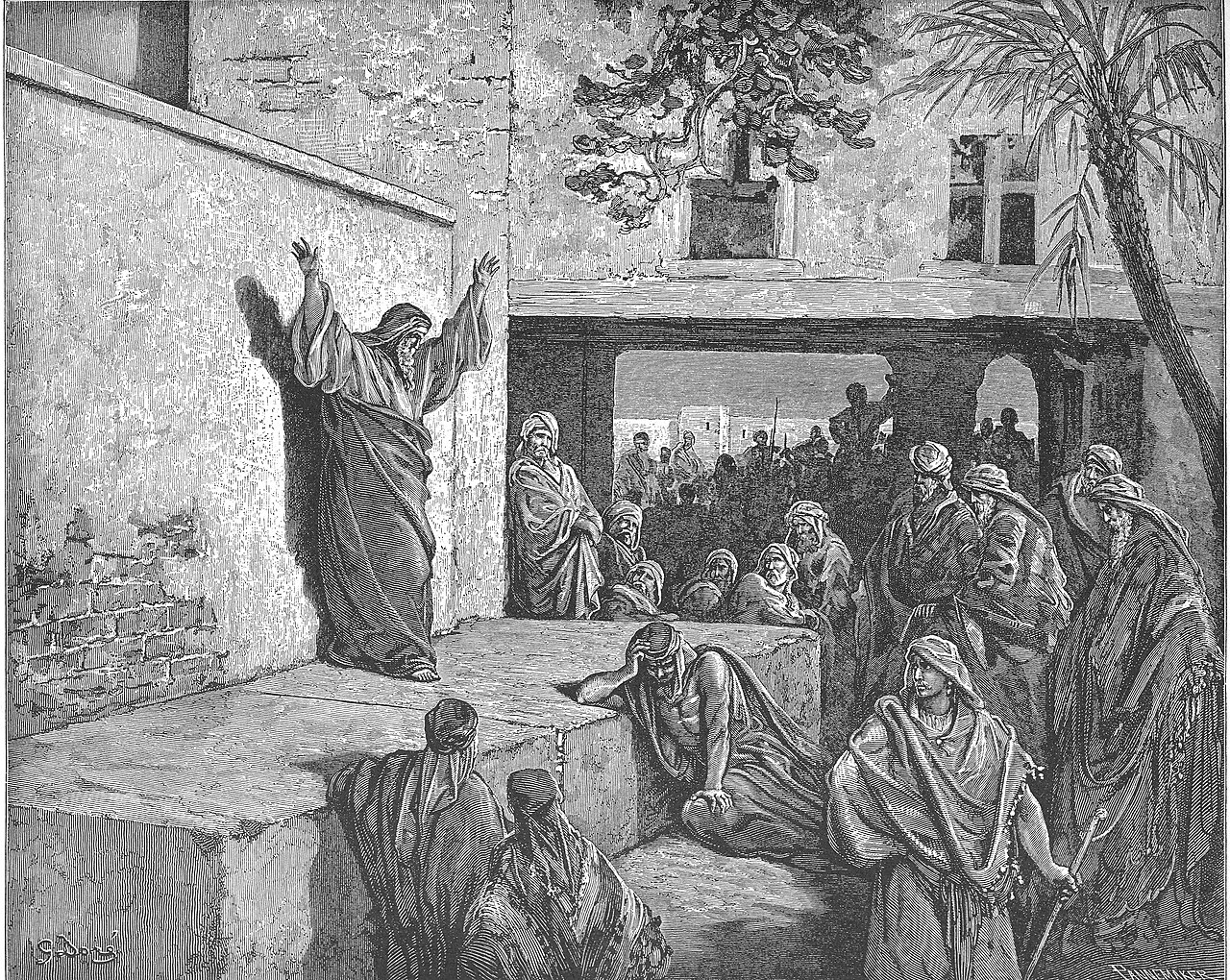
in Micah 1Do not tell it in Gath; do not weep at all. Roll in the dust in Beth-leaphrah.
BSB
The same verse in ASV and KJV ▾
ASV
Tell it not in Gath, weep not at all: at Beth-le-aphrah have I rolled myself in the dust.
KJV
Declare ye it not at Gath, weep ye not at all: in the house of Aphrah roll thyself in the dust.
⋯
This verse in Micah 1
Commentary
8 notes on this verse(Vers. 10 seq.) In Geth, do not announce, do not weep with tears, sprinkle yourselves with dust in the house of dust: pass by, you inhabitants of Saphir (Beautiful), confused with disgrace, she who dwells in Sennan (Exit) has not come out. The lament of the house of Asel (Neighboring) will receive you: she who stood for herself, because she is weakened in good, she who dwells in Maroth (Bitterness): for evil descends from the Lord to the gate of Jerusalem.
This site's exposition
Declare ye it not at Gath
on Micah 1:10-13
The oracle turns to a string of town names along the Shephelah, Sennacherib's likely invasion route in 701 BC, each name played on in Hebrew for the fate it suits: do not tell it in Gath echoes David's own lament over Saul, Aphrah's name plays on dust for rolling in the dust, and Saphir, meaning beautiful, goes out in naked shame. Zaanan sounds like going out for a town that stays put in fear, Beth-ezel's neighborly help fails, and Maroth waited for good and got evil at Jerusalem's own gate. Lachish is told to harness the chariot to the swift beast, a city the commentators identify from the Assyrian reliefs at Sennacherib's own palace as one of the campaign's real conquests, and it is named the beginning of the sin to the daughter of Zion, the readings naming an early alliance with the calf worship of the north.
The record, by era
The Puritans and the Awakening3 voices
): Declare it not in Gath; this is borrowed from David's lamentation for Saul and Jonathan ( 2 Sam. i. 20 ), Tell it not in Gath, for the uncircumcised will triumph in Israel's tears. Note, One would not, if it could be helped, gratify those that make themselves and their companions merry with the sins or with the sorrows of God's Israel.
quarantine:debris (2026-07-29) — leading-punctuation+unbalanced-parens
4 And the mountains shall be molten under him, and the valleys shall be cleft, as wax before the fire, and as the waters that are poured down a steep place. 5 For the transgression of Jacob is all this, and for the sins of the house of Israel. What is the transgression of Jacob? is it not Samaria? and what are the high places of Judah? are they not Jerusalem?
quarantine:scripture (2026-07-29) — verbatim-scripture
Declare ye it not at Gath,....
The Nineteenth Century2 voices
Declare ye it not at Gath - Do not let this prediction be known among the Philistines, else they will glory over you. House of Aphrah - Or, Beth-aphrah. This place is mentioned Jos 18:23, as in the tribe of Benjamin. There is a paronomasia, or play on words, here: בבית לעפרה עפר bebeith leaphrah aphar, “Roll thyself in the dust in the house of dust.”
A commentator
Jamieson, Fausset & Brown1802–1910
Commentary Critical and Explanatory on the Whole Bible (1871)
Acco's inhabitants would, therefore, like Gath's, rejoice at Israel's disaster. Thus the parallelism is best carried out in all the three clauses of the verse, and there is a similar play on sounds in each, in the Hebrew Gath, resembling in sound the Hebrew for "declare";
1 more voice on this verse
The Nineteenth Century1 voice
A commentator
Albert Barnes1798–1870
Notes, Explanatory and Practical, on the Old and New Testaments (1832-1869)
proposed
Tell it not in Gath - Gath had probably now ceased to be; at least, to be of any account . It shows how David’s elegy lived in the hearts of Judah, that his words are used as a proverb, (just as we do now, in whose ears it is yearly read), when, as with us, its original application was probably lost. True, Gath, reduced itself, might rejoice the more maliciously over the sufferings of Judah. But David mentions it as a chief seat of Philistine strength ; now its strength was gone. The blaspheming of the enemies of God is the sorest part of His chastisements. Whence David prays “let not mine enemies exult over me” Psa 25:2; and the sons of Korah, “With a sword in my bones, mine enemies reproach me, while they say daily unto me, where is thy God?” Psa 42:10; and Ethan; “Thou hast made all his enemies to rejoice. Remember, Lord, the reproach of Thy servant” Psa 89:42, Psa 89:50 - wherewith Thine enemies have reproached, O Lord, wherewith they have reproached the footsteps of Thine anointed. It is hard to part with home, with country, to see all desolate, which one ever loved. But far, far above all, is it, if, in the disgrace and desolation, God’s honor seems to be injured. The Jewish people was then God’s only home on earth. If it could be extinguished, who remained to honor Him? Victories over them seemed to their pagan neighbors to be victories over Him. He seemed to be dishonored without, because they had first dishonored Him within. Sore is it to the Christian, to see God’s cause hindered, His kingdom narrowed, the empire of infidelity advanced. Sorer in one way, because he knows the price of souls, for whom Jesus died. But the world is now the Church’s home. “The holy church throughout all the world doth acknowledge Thee!” Then, it was girt in within a few miles of territory, and sad indeed it must have been to the prophet, to see this too hemmed in. […]
How the passage was read
What the Jewish commentators add
Do not declare it in Gath —lest the Philistines rejoice about us.
This section is reception history: how the passage was read and kept in the Jewish tradition. Where a reading parts from an essential of the Christian faith, the section says so at that point.
Texts and citation data: Sefaria; each excerpt follows its version’s licence. 6 further sources are cited on this chapter that carry no English text this site may quote or only restate the verse.
The words behind it
10 Hebrew wordsEvery Hebrew word of this verse in the order it stands, with what it means and the door to its own study. The last column counts the times a word stands in the whole Bible: the rarer the word, the more the places it appears belong together.
| Hebrew | Sound | Meaning | Word study | In the Bible |
|---|---|---|---|---|
| בְּגַת֙ | begat | in Gath | H1661 → | |
| אַל־ | ʾal- | may not | H408 → | 724 times |
| תַּגִּ֔ידוּ | tagidu | you tell | H5046 → | 370 times |
| בָּכ֖וֹ | bakho | at all <weep> | H1058 → | |
| אַל־ | ʾal- | may not | H408 → | 724 times |
| תִּבְכּ֑וּ | tivku | you weep | H1058 → | |
| בְּבֵ֣ית | beveit | in Beth | H1036 → | |
| לְעַפְרָ֔ה | leafrah | Leaphrah | H1036 → | |
| עָפָ֖ר | ʾafar | dust | H6083 → | |
| הִתְפַּלָּֽשִׁי׃ | hitpalasheti | roll yourself | H6428 → |
בְּגַת֙in Gath
begatH1661 →
אַל־may not
ʾal-H408 →724 times
תַּגִּ֔ידוּyou tell
tagiduH5046 →370 times
בָּכ֖וֹat all <weep>
bakhoH1058 →
אַל־may not
ʾal-H408 →724 times
תִּבְכּ֑וּyou weep
tivkuH1058 →
בְּבֵ֣יתin Beth
beveitH1036 →
לְעַפְרָ֔הLeaphrah
leafrahH1036 →
עָפָ֖רdust
ʾafarH6083 →
הִתְפַּלָּֽשִׁי׃roll yourself
hitpalashetiH6428 →
A shaded row is a word that stands 400 times or fewer in the Bible.
The walk
8 stopsEach card is a verse this one points to, and under it the verses that one points to in turn. Where several paths arrive at the same place, that place is listed first: the text keeps returning to it.
Through
Job 2:8And Job took a piece of broken pottery to scrape himself as he sat among the ashes.
it leads to
- Job 42:6
Therefore I retract my words, and I repent in dust and ashes.”
- Jonah 3:6
When word reached the king of Nineveh, he got up from his throne, took off his royal robe, covered himself with sackcloth, and sat in ashes.
- Ezekiel 27:30
They will raise their voices for you and cry out bitterly. They will throw dust on their heads and roll in ashes.
- Matthew 11:21
“Woe to you, Chorazin! Woe to you, Bethsaida! For if the miracles that were performed in you had been performed in Tyre and Sidon, they would have repented long ago in sackcloth and ashes.
- Job 42:6
Through
Amos 6:10And when the relative who is to burn the bodies picks them up to remove them from the house, he will call to one inside, “Is anyone else with you?” “None,” that person will…
it leads to
- 1 Samuel 31:12
all their men of valor set out, journeyed all night, and retrieved the bodies of Saul and his sons from the wall of Beth-shan. When they arrived at Jabesh, they burned the bodies there.
- Amos 8:3
“In that day,” declares the Lord GOD, “the songs of the temple will turn to wailing. Many will be the corpses, strewn in silence everywhere!”
- 1 Samuel 31:12
Through
Jeremiah 6:26O daughter of my people, dress yourselves in sackcloth and roll in ashes. Mourn with bitter wailing, as you would for an only son, for suddenly the destroyer will come upon us.
it leads to
- Jeremiah 4:8
So put on sackcloth, mourn and wail, for the fierce anger of the LORD has not turned away from us.”
- Zechariah 12:10
Then I will pour out on the house of David and on the people of Jerusalem a spirit of grace and prayer, and they will look on Me, the One they have pierced. They…
- Jeremiah 4:8
Where this verse is studied
On this page
About Micah
This page draws on Adam Clarke, Commentary on the Bible; Albert Barnes, Notes, Explanatory and Practical, on the Old and New Testaments (1832-1869); Carl Friedrich Keil, The Twelve Minor Prophets; Jamieson, Fausset & Brown, Commentary Critical and Explanatory on the Whole Bible; Jerome, Commentary on Micah; John Gill, Exposition of the Old Testament; John Gill, Exposition of the Old Testament (1748-1763) and Matthew Henry, Commentary on the Whole Bible.