
Matthew 17:14
in Matthew 17When they came to the crowd, a man came up to Jesus and knelt before Him.
BSB
The same verse in ASV and KJV ▾
ASV
And when they were come to the multitude, there came to him a man, kneeling to him, and saying,
KJV
And when they were come to the multitude, there came to him a certain man, kneeling down to him, and saying,
⋯
This verse in Matthew 17
Commentary
12 notes on this verse(Vers. 14, 15.) Lord, have mercy on my son, for he is a lunatic and suffers greatly: for he often falls into fire and frequently into water. And I brought him to your disciples, but they could not heal him. This is why the devil, observing the course of the moon, seizes upon men and strives to defame the Creator through His creatures, as we have said above.
This site's exposition
knelt before Him
on Matthew 17:14-16
The Greek behind He has seizures is selenizetai, moonstruck. The father's report that he often falls into the fire or into the water matches what medicine would later call epilepsy. The text names a cause, and John Gill notes that Scripture elsewhere lets a demon's work show as bodily illness.
The record, by era
The Church Fathers2 voices
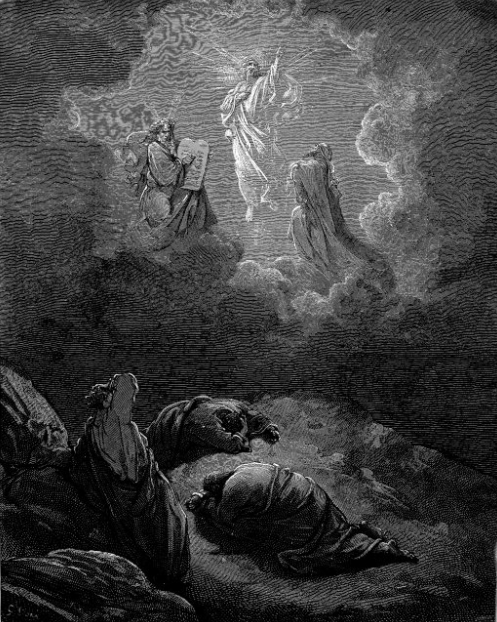
Peter, anxious for such desirable life, and preferring his own benefit to that of many, had said, It is good for us to be here. But since charity seeks not her own, Jesus did not this which seemed good to Peter, but descended to the multitude, as it were from the high mount of His divinity, that He might be of use to such as could not ascend because of the weakness of their souls; whence it is said, And when he was come to the multitude; for if He had not gone to the multitude with His elect disciples, there would not have come near to Him the man of whom it is added, There came to him a man kneeling down, and saying, Lord, have mercy on my son. Consider here, that sometimes those that are themselves the sufferers believe and entreat for their own healing, sometimes others for them, as he who kneels before Him praying for his son, and sometimes the Saviour heals of Himself unasked by any. First, let us see what this means that follows, For he is lunatic, and sore vexed. Let the physicians talk as they list, for they think it no unclean spirit, but some bodily disorder, and say, that the humours in the head are governed in their motions by sympathy with the phases of the moon, whose light is of the nature of humours. But we who believe the Gospel say that it is an unclean spirit that works such disorders in men. The spirit observes the moon's changes, that it may cheat men into the belief that the moon is the cause of their sufferings, and so prove God's creation to be evil; as other dæmons lay wait for men following the times and courses of the stars, that they may speak wickedness in high places, calling some stars malignant, others benign; whereas no star was made by God that it should produce evil...
"And when they were come to the multitude, there came to Him a man, kneeling down to Him, and saying, Lord, have mercy on my son, for he is lunatic, and sore vexed; for ofttimes he falleth into the fire, and oft into the water. And I brought him unto Thy disciples, and they could not cure him." This man the Scripture signifies to be exceedingly weak in faith; and this is many ways evident; from Christ's saying, "All things are possible to him that believeth;" from the saying of the man himself that approached, "Help Thou mine unbelief:" from Christ's commanding the devil to "enter no more into him;" and from the man's saying again to Christ, "If Thou canst." "Yet if his unbelief was the cause," it may be said, "that the devil went not out, why doth He blame the disciples?" Signifying, that even without persons to bring the sick in faith, they might in many instances work a cure. For as the faith of the person presenting oftentimes availed for receiving the cure, even from inferior ministers; so the power of the doers oftentimes sufficed, even without belief in those who came to work the miracle. And both these things are signified in the Scripture. For both they of the company of Cornelius by their faith drew unto themselves the grace of the Spirit; and in the case of Eliseus again, when none had believed, a dead man rose again. For as to those that cast him down, not for faith but for cowardice did they cast him, unintentionally and by chance, for fear of the band of robbers, and so they fled: while the person himself that was cast in was dead, yet by the mere virtue of the holy body the dead man arose. Whence it is clear in this case, that even the disciples were weak; but not all; for the pillars were not present there. […]
The Medieval Church2 voices
And when he had come: here he foretells the tranquility of glory, which is assailed by the oppression of demons and the disturbance of men. And first he foretells the cessation of the first through the healing of the lunatic; secondly, the second. And concerning …
And when they were come to the multitude, there came to Him a certain man, kneeling down to Him, and saying, Lord, have mercy on my son: for he is lunatic, and sore vexed: for ofttimes he falleth into the fire, and oft into the …
The Puritans and the Awakening1 voice
A melancholy representation of the case of this child, made to Christ by the afflicted father. This was immediately upon his coming down from the mountain where he was transfigured. Note, Christ's glories do not make him unmindful of us and of our wants and miseries.
5 more voices on this verse
The Puritans and the Awakening1 voice
And when they were come to the multitude,....
The Nineteenth Century4 voices
When they were come to the multitude - It appears that a congregation had been collected during our Lord’s stay on the mount: how great must have been the desire of these people to hear the words of Christ! The assembly is self-collected, and no delay on the preacher’s side discourages them - they continue to wait for him. In the present day how rare is this zeal!
We read in this passage another of our Lord’s great miracles. He heals a young man lunatic and possessed with a devil. The first thing we see in these verses is a lively emblem of the awful influence sometimes exercised by Satan over the young. We are told of a certain man’s son, who was “lunatic and sore vexed.” We are told of the evil spirit pressing him on to the destruction of body and soul: “Oftimes he falleth into the fire and oft into the water.”
We read in this passage another of our Lord’s great miracles. He heals a young man lunatic and possessed with a devil. The first thing we see in these verses is a lively emblem of the awful influence sometimes exercised by Satan over the young. We are told of a certain man’s son, who was “lunatic and sore vexed.” We are told of the evil spirit pressing him on to the destruction of body and soul: “Oftimes he falleth into the fire and oft into the water.” It was one of those cases of Satanic possession which, however common in our Lord’s times, in our own day is rarely seen; but we can easily imagine that, when they did occur, they must have been peculiarly distressing to the relations of the afflicted. It is painful enough to see the bodies of those we love wracked by disease: how much more painful must it have been to see body and mind completely under the influence of the devil! “Out of hell,” says Bishop Hall, “there could not be greater misery.” But we must not forget that there are many instances of Satan’s spiritual dominion over young people which are quite as painful, in their way, as the case described in this passage. There are thousands of young men who seem to have wholly given themselves up to Satan’s temptations, and to be led “captive at his will” (2 Timothy ). They cast off all fear of God, and all respect for his commandments; they serve divers lusts and pleasures; they run wildly into every excess of riot; they refuse to listen to the advice of parents, teachers or ministers; they fling aside all regard for health, character or worldly respectability. They do all that lies in their power to ruin themselves, body and soul, for time and eternity: they are willing bond-slaves of Satan. Who has not seen such young men? They are to be seen in town and in country; they are to be found among rich and among poor.
A commentator
Albert Barnes1798–1870
Notes, Explanatory and Practical, on the Old and New Testaments (1832-1869)
proposed
And when they were come to the multitude - This took place on the day following the transfiguration, Luk 9:37. This multitude was probably composed of persons who had attended on his ministry, many of whom were his real disciples. With them, as Mark Mar 9:15 informs us, were “scribes questioning with them.” That is, they were probably professedly making inquiries about the Saviour, but really attempting to introduce their own sentiments, and to draw them off from him. They probably artfully asked them many questions about his birth, his family, his appearance, his manner of life, and his instructions, all which were contrary to the general expectation respecting the Messiah, and they intended, therefore, to insinuate that such a person could not be the Christ. The people were persuaded that he was the Messiah. and it would not have done to have attacked their opinions openly, but they attempted to gain the same point by sly insinuations. Error is always subtle, and often puts on the appearance of calm and honest inquiry. Well had he compared them to leavens, Mat 16:11-12. The multitude, seeing Jesus coming down, left the scribes, and ran to meet him (Mark). They were amazed, probably because they had not expected to see him there. In their joy at meeting him in this unexpected manner, they “saluted” him (Mark); that is, probably they prostrated themselves before him after the manner of salutation in Eastern countries. See the notes at Luk 10:4. Jesus, seeing the scribes and their artful design, reproved them by asking them why they questioned thus with his disciples, Mar 9:16. Conscious of their guilt and their base purpose, they returned no answer. A certain man kneeling down to him - That is, saluting him, or showing high regard for him. See the notes at Luk 10:4. It did not imply religious homage, but merely high respect and earnest entreaty.
The words behind it
10 Greek wordsEvery Greek word of this verse in the order it stands, with what it means and the door to its own study. The last column counts the times a word stands in the whole Bible: the rarer the word, the more the places it appears belong together.
| Greek | Sound | Meaning | Word study | In the Bible |
|---|---|---|---|---|
| Καὶ | kai | And | G2532 → | 9120 times |
| ἐλθόντων | elthonton | when were coming | G2064 → | 628 times |
| πρὸς | pros | to | G4314 → | 700 times |
| τὸν | ton | the | G3588 → | 19766 times |
| ὄχλον | ochlon | crowd | G3793 → | 175 times |
| προσῆλθεν | proselthen | came | G4334 → | 86 times |
| αὐτῷ | auto | to Him | G846 → | 5565 times |
| ἄνθρωπος | anthropos | a man | G444 → | 549 times |
| γονυπετῶν | gonupeton | kneeling down | G1120 → | |
| αὐτὸν | auton | [to] Him | G846 → | 5565 times |
ΚαὶAnd
kaiG2532 →9120 times
ἐλθόντωνwhen were coming
elthontonG2064 →628 times
πρὸςto
prosG4314 →700 times
τὸνthe
tonG3588 →19766 times
ὄχλονcrowd
ochlonG3793 →175 times
προσῆλθενcame
proselthenG4334 →86 times
αὐτῷto Him
autoG846 →5565 times
ἄνθρωποςa man
anthroposG444 →549 times
γονυπετῶνkneeling down
gonupetonG1120 →
αὐτὸν[to] Him
autonG846 →5565 times
A shaded row is a word that stands 400 times or fewer in the Bible.
The walk
8 stopsEach card is a verse this one points to, and under it the verses that one points to in turn. Where several paths arrive at the same place, that place is listed first: the text keeps returning to it.
Through
Mark 10:17As Jesus started on His way, a man ran up and knelt before Him. “Good Teacher,” he asked, “what must I do to inherit eternal life?”
it leads to
- Matthew 19:16–30
Just then a man came up to Jesus and inquired, “Teacher, what good thing must I do to obtain eternal life?”
- Luke 18:18–30
Then a certain ruler asked Him, “Good Teacher, what must I do to inherit eternal life?”
- Romans 2:7
To those who by perseverance in doing good seek glory, honor, and immortality, He will give eternal life.
- John 6:27–28
Do not work for food that perishes, but for food that endures to eternal life, which the Son of Man will give you. For on Him God the Father has placed His seal of…
- Luke 10:25
One day an expert in the law stood up to test Him. “Teacher,” he asked, “what must I do to inherit eternal life?”
- Matthew 19:16–30
Through
Mark 1:40Then a leper came to Jesus, begging on his knees: “If You are willing, You can make me clean.”
it leads to
- Luke 5:12–14
While Jesus was in one of the towns, a man came along who was covered with leprosy. When he saw Jesus, he fell facedown and begged Him, “Lord, if You are willing, You can…
- Matthew 8:2–4
Suddenly a leper came and knelt before Him, saying, “Lord, if You are willing, You can make me clean.”
- Leviticus 13:1–14
Then the LORD said to Moses and Aaron,
- Luke 5:12–14
Where this verse is studied
On this page
Studies11
About Matthew
This page draws on 11 works. Open the list of works
This page draws on Adam Clarke, Commentary on the Bible; Albert Barnes, Notes, Explanatory and Practical, on the Old and New Testaments (1832-1869); J.C. Ryle, Expository Thoughts on the Gospels: Matthew; Jerome, Commentary on Matthew; John Chrysostom, Homily on the Gospel of Matthew 57; John Gill, Exposition of the New Testament; John Gill, Exposition of the New Testament (1746-1748); Matthew Henry, Commentary on the Whole Bible; Origen of Alexandria, Catena Aurea by Aquinas; Theophylact of Ohrid, Commentary on Matthew and Thomas Aquinas, Commentary on Matthew.