
Judges 16:5
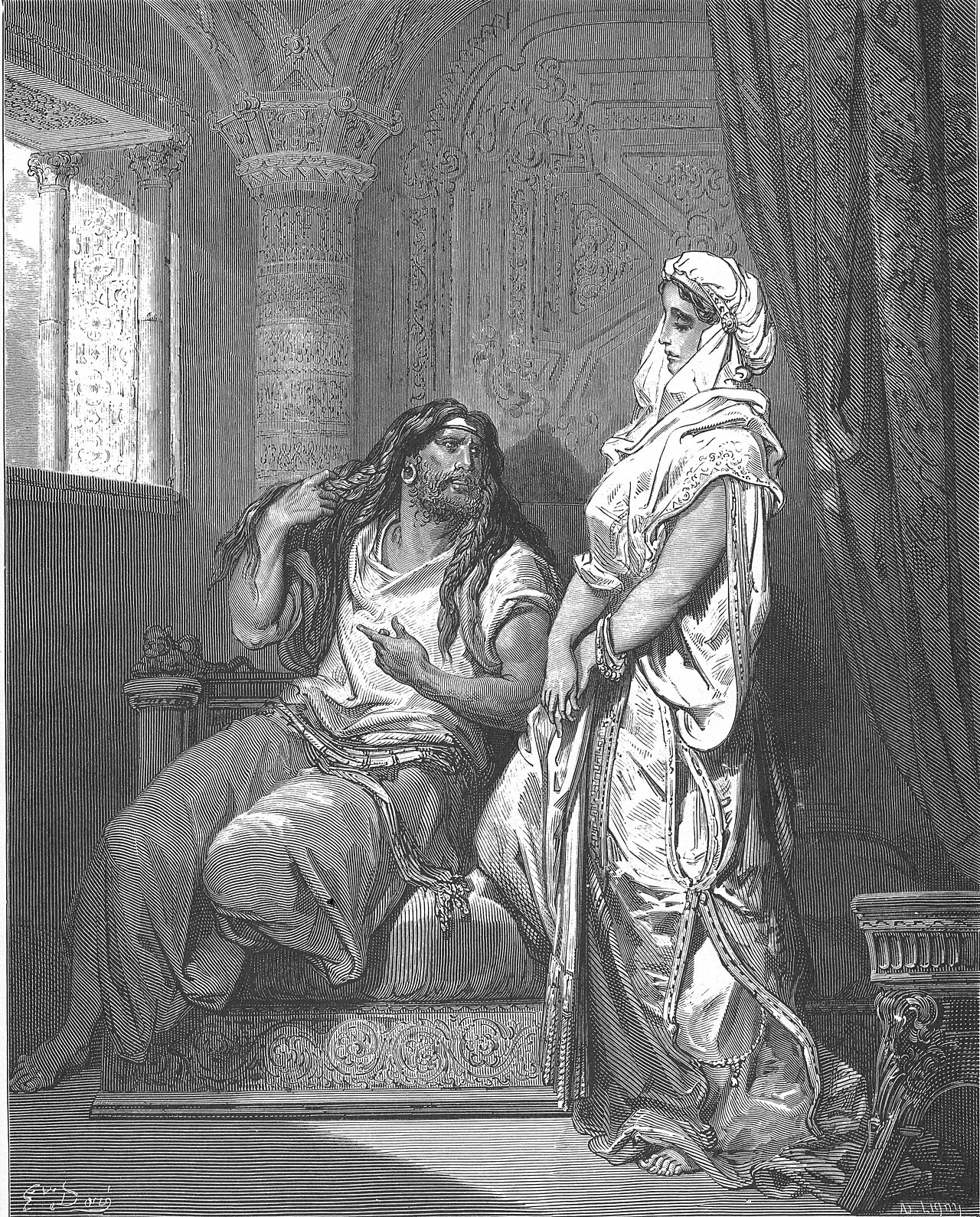
in Judges 16The lords of the Philistines went to her and said, “Entice him and find out the source of his great strength and how we can overpower him to tie him up and subdue him. Then each one of us will give you eleven hundred shekels of silver.”
BSB
The same verse in ASV and KJV ▾
ASV
And the lords of the Philistines came up unto her, and said unto her, Entice him, and see wherein his great strength lieth, and by what means we may prevail against him, that we may bind him to afflict him: and we will give thee every one of us eleven hundred pieces of silver.
KJV
And the lords of the Philistines came up unto her, and said unto her, Entice him, and see wherein his great strength lieth, and by what means we may prevail against him, that we may bind him to afflict him: and we will give thee every one of us eleven hundred pieces of silver.
⋯
This verse in Judges 16
Commentary
11 notes on this verseA commentator
Albert Barnes1798–1870
Notes, Explanatory and Practical, on the Old and New Testaments (1832-1869)
And the lords of the Philistines - See Jdg 3:3 note. His great strength lieth - Rather, “wherein his strength is great.” Eleven hundred pieces of silver - The greatness of the bribe offered to Delilah, 5,500 shekels of silver, nearly two talents (Exo 38:24, note), shows the importance attached to Samson’s capture.
This site's exposition
the Valley of Sorek
on Judges 16:4-5
Delilah is the only woman in the Samson account given a name, and this is the first time the text says Samson loved anyone. The lords tell her to “Entice him”, the word used to the woman of Timnah at 14:15, where the lever was fire rather than money. The fee of “eleven hundred shekels of silver” turns up again at 17:2 as the sum Micah took from his mother.
This site's exposition
find out the source of his great strength
The lords of the Philistines come to Delilah expecting a charm behind strength that great, as Jamieson, Fausset and Brown suppose. Each of the five lords pledged eleven hundred shekels of silver. Barnes totals the bribe at 5,500 shekels, near two talents.
The record, by era
The Church Fathers2 voices
Overcome by love of money, Achan led to destruction all the people of the fathers. So Joshua the son of Nun, who could stay the sun from setting, could not stay the love of money in people from creeping on. At the sound of his voice the sun stood still, but love of money stayed not. When the sun stood still, Joshua completed his triumph, but when love of money went on, he almost lost the victory.Why? Did not the woman Delilah's love of money deceive Samson, the bravest man of all?
But now his licence transgressed the limits not only of his paternal territory, but of good morals, such as ancient discipline had prescribed, and this brought upon him destruction in the end. For although he had experienced in his first marriage the treachery of a foreign wife, and ought to have avoided it in future, he did not shun connecting himself with the harlot Delilah, and by his passionate love of her opened a way for the craft of his enemies to assail him. For the Philistines came up to her, and promised each of them to give her eleven hundred pieces of silver if she would disclose to them wherein his assurance of strength lay, that by means of this knowledge they might entrap and take him.
The Puritans and the Awakening3 voices
But first, it is probable, that Samson had in some measure repented of his sin, and begged of God pardon and assistance. 2.This singular strength and courage was not in itself a grace, but a gift, and it was such a gift as did not so much depend on the disposition of his mind, but on the right ordering of his body, by the rule given to him, and others of that order.
Afflict - To chastise him for his injuries done to us. They mean to punish him severely, but they express it in mild words, lest it might move her to pity him. Pieces of silver - Shekels, as that phrase is commonly used.
And the lords of the Philistines came up unto her,.... Having heard that Samson kept company with her, she being a noted strumpet, like Lais among the Grecians.
3 more voices on this verse
The Puritans and the Awakening1 voice
And so much conscience it should seem they made of this promise that even then, when he lay ever so much at their mercy, they would not kill him, no, not when the razor that cut his hair might sooner and more easily have cut his throat. That which they desired, in order hereunto, was to know where his great strength lay, and by what means he might be bound.
The Nineteenth Century2 voices
A commentator
Jamieson, Fausset & Brown1802–1910
Commentary Critical and Explanatory on the Whole Bible (1871)
Entice him, and see wherein his great strength lieth--They probably imagined that he carried some amulet about his person, or was in the possession of some important secret by which he had acquired such herculean strength; and they bribed Delilah, doubtless by a large reward, to discover it for them.
See wherein his great strength lieth - They saw that his stature was not remarkable: and that, nevertheless, he had most extraordinary strength; therefore they supposed that it was the effect of some charm or amulet. The lords of the Philistines were the five following: Gaza, Gath, Askelon, Ekron, and Ashdod. All these considered Samson as a public enemy; and they promised this bad woman a large sum of money if she would obtain from him the important secret wherein his strength lay, that, depriving him of this supernatural power, they might be able to reduce him to bondage.
The words behind it
24 Hebrew wordsEvery Hebrew word of this verse in the order it stands, with what it means and the door to its own study. The last column counts the times a word stands in the whole Bible: the rarer the word, the more the places it appears belong together.
| Hebrew | Sound | Meaning | Word study | In the Bible |
|---|---|---|---|---|
| וַיַּעֲל֨וּ | vaiyaalu | and they went up | H5927 → | 890 times |
| אֵלֶ֜יהָ | ʾeleiha | to her | H413 → | 5510 times |
| סַרְנֵ֣י | sarnei | [the] rulers of | H5633 → | 22 times |
| פְלִשְׁתִּ֗ים | felishtim | [the] Philistines | H6430 → | 287 times |
| וַיֹּ֨אמְרוּ | vaiyomeru | and they said | H559 → | 5305 times |
| לָ֜הּ | lah | to <the> her | ||
| פַּתִּ֣י | pati | entice | H6601 → | |
| אוֹת֗וֹ | ʾoto | <obj.> him | H853 → | 10935 times |
| וּרְאִי֙ | urei | and see | H7200 → | 1300 times |
| בַּמֶּה֙ | bameh | <in> how? | H4100 → | 752 times |
| כֹּח֣וֹ | kocho | [is] strength his | H3581 → | 126 times |
| גָד֔וֹל | gadol | great | H1419 → | 526 times |
| וּבַמֶּה֙ | uvameh | and <in> how? | H4100 → | 752 times |
| נ֣וּכַל | nukhal | will we prevail | H3201 → | 194 times |
| ל֔וֹ | lo | to <the> him | ||
| וַאֲסַרְנֻ֖הוּ | vaasarnuhu | and we will bind him | H631 → | 72 times |
| לְעַנֹּת֑וֹ | leanoto | to humble him | H6031 → | 82 times |
| וַאֲנַ֙חְנוּ֙ | vaanachnu | and we | H587 → | 120 times |
| נִתַּן־ | nitan- | we will give | H5414 → | 2011 times |
| לָ֔ךְ | lakh | to <the> you | ||
| אִ֕ישׁ | ʾish | each | H376 → | 1663 times |
| אֶ֥לֶף | ʾelef | one thousand | H505 → | 505 times |
| וּמֵאָ֖ה | umeah | and one hundred | H3967 → | 581 times |
| כָּֽסֶף׃ | kasef | silver | H3701 → | 403 times |
וַיַּעֲל֨וּand they went up
vaiyaaluH5927 →890 times
אֵלֶ֜יהָto her
ʾeleihaH413 →5510 times
סַרְנֵ֣י[the] rulers of
sarneiH5633 →22 times
פְלִשְׁתִּ֗ים[the] Philistines
felishtimH6430 →287 times
וַיֹּ֨אמְרוּand they said
vaiyomeruH559 →5305 times
לָ֜הּto <the> her
lah
פַּתִּ֣יentice
patiH6601 →
אוֹת֗וֹ<obj.> him
ʾotoH853 →10935 times
וּרְאִי֙and see
ureiH7200 →1300 times
בַּמֶּה֙<in> how?
bamehH4100 →752 times
כֹּח֣וֹ[is] strength his
kochoH3581 →126 times
גָד֔וֹלgreat
gadolH1419 →526 times
וּבַמֶּה֙and <in> how?
uvamehH4100 →752 times
נ֣וּכַלwill we prevail
nukhalH3201 →194 times
ל֔וֹto <the> him
lo
וַאֲסַרְנֻ֖הוּand we will bind him
vaasarnuhuH631 →72 times
לְעַנֹּת֑וֹto humble him
leanotoH6031 →82 times
וַאֲנַ֙חְנוּ֙and we
vaanachnuH587 →120 times
נִתַּן־we will give
nitan-H5414 →2011 times
לָ֔ךְto <the> you
lakh
אִ֕ישׁeach
ʾishH376 →1663 times
אֶ֥לֶףone thousand
ʾelefH505 →505 times
וּמֵאָ֖הand one hundred
umeahH3967 →581 times
כָּֽסֶף׃silver
kasefH3701 →403 times
A shaded row is a word that stands 400 times or fewer in the Bible.
The walk
8 stopsEach card is a verse this one points to, and under it the verses that one points to in turn. Where several paths arrive at the same place, that place is listed first: the text keeps returning to it.
Through
Judges 14:15So on the fourth day they said to Samson’s wife, “Entice your husband to explain the riddle to us, or we will burn you and your father’s household to death. Did you invite us…
it leads to
- Judges 15:6
“Who did this?” the Philistines demanded. “It was Samson, the son-in-law of the Timnite,” they were told. “For his wife was given to his companion.” So the Philistines went up and burned her and…
- Micah 7:5
Do not rely on a friend; do not trust in a companion. Seal the doors of your mouth from her who lies in your arms.
- Proverbs 6:26
For the levy of the prostitute is poverty, and the adulteress preys upon your very life.
- Judges 12:1
Then the men of Ephraim assembled and crossed the Jordan to Zaphon. They said to Jephthah, “Why have you crossed over to fight the Ammonites without calling us to go with you? We will…
- Judges 15:6
Through
Joshua 13:3All the territory of the Philistines and the Geshurites, from the Shihor east of Egypt to the territory of Ekron on the north (considered to be Canaanite territory)—that of the five Philistine rulers of…
it leads to
- Judges 3:3
the five rulers of the Philistines, all the Canaanites, the Sidonians, and the Hivites who lived in the mountains of Lebanon from Mount Baal-hermon to Lebo-hamath.
- Jeremiah 2:18
Now what will you gain on your way to Egypt to drink the waters of the Nile? What will you gain on your way to Assyria to drink the waters of the Euphrates?
- Deuteronomy 2:23
And the Avvim, who lived in villages as far as Gaza, were destroyed by the Caphtorites, who came out of Caphtor and settled in their place.)
- Genesis 10:6
The sons of Ham: Cush, Mizraim, Put, and Canaan.
- Judges 3:3
About Judges
This page draws on 10 works. Open the list of works
This page draws on Adam Clarke, Commentary on the Bible; Albert Barnes, Notes, Explanatory and Practical, on the Old and New Testaments (1832-1869); Albert Barnes, Notes, Explanatory and Practical, on the Old and New Testaments; Ambrose of Milan, On the Duties of the Clergy 2.26.130-32; Ambrose of Milan, Letter 19; Jamieson, Fausset & Brown, Commentary Critical and Explanatory on the Whole Bible; John Gill, Exposition of the Old Testament (1748-1763); John Wesley, Explanatory Notes upon the Old Testament; Keil and Delitzsch, Biblical Commentary on the Old Testament: Joshua, Judges, Ruth and Matthew Henry, Commentary on the Whole Bible.