
Judges 16:14
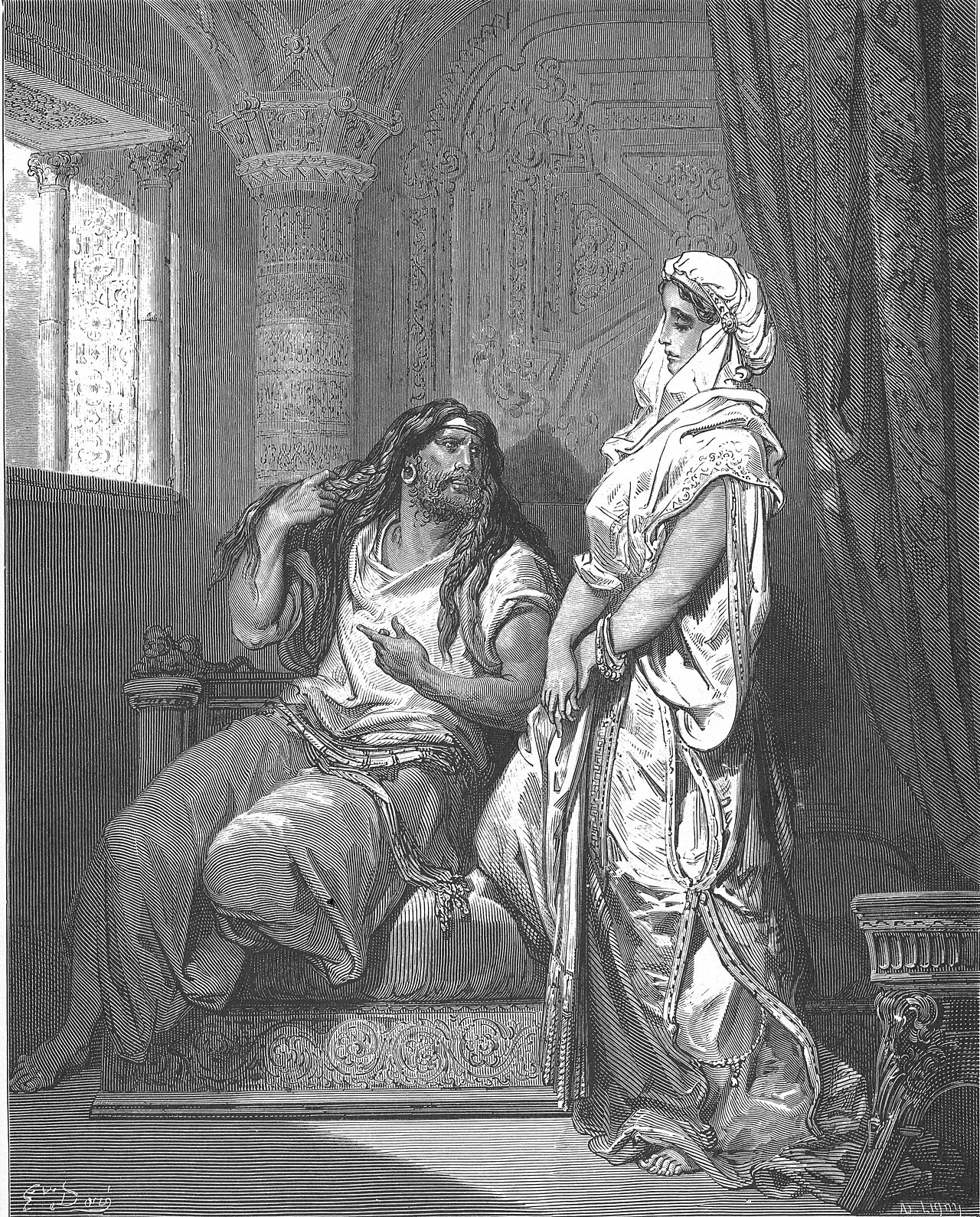
in Judges 16So while he slept, Delilah took the seven braids of his hair and wove them into the web. Then she tightened it with a pin and called to him, “Samson, the Philistines are here!” But he awoke from his sleep and pulled out the pin with the loom and the web.
BSB
The same verse in ASV and KJV ▾
ASV
And she fastened it with the pin, and said unto him, The Philistines are upon thee, Samson. And he awaked out of his sleep, and plucked away the pin of the beam, and the web.
KJV
And she fastened it with the pin, and said unto him, The Philistines be upon thee, Samson. And he awaked out of his sleep, and went away with the pin of the beam, and with the web.
⋯
This verse in Judges 16
Commentary
7 notes on this verseA commentator
Albert Barnes1798–1870
Notes, Explanatory and Practical, on the Old and New Testaments (1832-1869)
And she fastened it with the pin ... - The meaning of the verses seems to be that the seven long plaits, in which Samson’s hair was arranged, were to be woven as a woof into the threads of a warp which stood prepared on a loom in the chamber, which loom Delilah fastened down with a pin, so as to keep it firm and immoveable. But Samson, when he awoke, tore up the pin from its socket, and went away with the loom and the pin fastened to his hair.
This site's exposition
Hitherto thou hast mocked me
on Judges 16:13-14
The seven locks are named here, and the hair enters the bargaining while the vow behind it stays hidden. The Hebrew of verse 13 stops at the web and gives no instruction about the pin, so the King James reader meets an act at verse 14 that verse 13 never proposed. The Septuagint carries a longer reading that supplies the missing clause, and it is the largest textual difference in the chapter. Adam Clarke sets the longer reading out in full, and Keil and Delitzsch treat the shorter Hebrew as usable as it stands.
The record, by era
The Church Fathers3 voices
The third time he disclosed part of the secret, and now drawing nearer to his fall, told her that, if the seven locks of his head were unfastened and woven to about a cubit's length, his strength would depart from him. But herein also he deluded those who were plotting against his life.
What was the meaning of Samson? If I say he signified Christ, it seems to me that I speak the truth. However, the thought immediately occurs to anyone who reflects: Was Christ overcome by the flattery of a woman? How is Christ understood to have …
Like the famed Samson, whose power lay in the strength of his hair, whose locks were endowed with sacred might, he must throttle and bring low the lion by means of the strong arms of prayers and pluck the sweet fruit of notable victory from …
The Puritans and the Awakening2 voices
But first, it is probable, that Samson had in some measure repented of his sin, and begged of God pardon and assistance. 2.This singular strength and courage was not in itself a grace, but a gift, and it was such a gift as did not so much depend on the disposition of his mind, but on the right ordering of his body, by the rule given to him, and others of that order.
And she fastened it with the pin,....
The words behind it
15 Hebrew wordsEvery Hebrew word of this verse in the order it stands, with what it means and the door to its own study. The last column counts the times a word stands in the whole Bible: the rarer the word, the more the places it appears belong together.
| Hebrew | Sound | Meaning | Word study | In the Bible |
|---|---|---|---|---|
| וַתִּתְקַע֙ | vatitka' | and she thrust | H8628 → | 69 times |
| בַּיָּתֵ֔ד | baiyated | with the pin | H3489 → | 25 times |
| וַתֹּ֣אמֶר | vatomer | and she said | H559 → | 5305 times |
| אֵלָ֔יו | ʾelav | to him | H413 → | 5510 times |
| פְּלִשְׁתִּ֥ים | pelishtim | [the] Philistines | H6430 → | 287 times |
| עָלֶ֖יךָ | ʾaleikha | [are] on you | H5921 → | 5755 times |
| שִׁמְשׁ֑וֹן | shimshon | O Samson | H8123 → | 38 times |
| וַיִּיקַץ֙ | vaiyikatz | and he awoke | H3364 → | |
| מִשְּׁנָת֔וֹ | mishenato | from sleep his | H8142 → | |
| וַיִּסַּ֛ע | vaiyisa' | and he pulled out | H5265 → | 146 times |
| אֶת־ | ʾet- | <obj.> | H853 → | 10935 times |
| הַיְתַ֥ד | haytad | the pin of | H3489 → | 25 times |
| הָאֶ֖רֶג | haereg | the loom | H708 → | |
| וְאֶת־ | veet | and <obj.> | H853 → | 10935 times |
| הַמַּסָּֽכֶת׃ | hamasakhet | the web | H4545 → |
וַתִּתְקַע֙and she thrust
vatitka'H8628 →69 times
בַּיָּתֵ֔דwith the pin
baiyatedH3489 →25 times
וַתֹּ֣אמֶרand she said
vatomerH559 →5305 times
אֵלָ֔יוto him
ʾelavH413 →5510 times
פְּלִשְׁתִּ֥ים[the] Philistines
pelishtimH6430 →287 times
עָלֶ֖יךָ[are] on you
ʾaleikhaH5921 →5755 times
שִׁמְשׁ֑וֹןO Samson
shimshonH8123 →38 times
וַיִּיקַץ֙and he awoke
vaiyikatzH3364 →
מִשְּׁנָת֔וֹfrom sleep his
mishenatoH8142 →
וַיִּסַּ֛עand he pulled out
vaiyisa'H5265 →146 times
אֶת־<obj.>
ʾet-H853 →10935 times
הַיְתַ֥דthe pin of
haytadH3489 →25 times
הָאֶ֖רֶגthe loom
haeregH708 →
וְאֶת־and <obj.>
veetH853 →10935 times
הַמַּסָּֽכֶת׃the web
hamasakhetH4545 →
A shaded row is a word that stands 400 times or fewer in the Bible.
The walk
5 stopsEach card is a verse this one points to, and under it the verses that one points to in turn. Where several paths arrive at the same place, that place is listed first: the text keeps returning to it.
Through
Psalms 106:43Many times He rescued them, but they were bent on rebellion and sank down in their iniquity.
it leads to
- Judges 2:16–18
Then the LORD raised up judges, who saved them from the hands of those who plundered them.
- Psalms 81:12
So I gave them up to their stubborn hearts to follow their own devices.
- Psalms 1:1
Blessed is the man who does not walk in the counsel of the wicked, or set foot on the path of sinners, or sit in the seat of mockers.
- 1 Samuel 12:9–11
But they forgot the LORD their God, and He sold them into the hand of Sisera the commander of the army of Hazor, and into the hands of the Philistines and the king of…
- Psalms 106:29
So they provoked the LORD to anger with their deeds, and a plague broke out among them.
- Judges 2:16–18
About Judges
Who and where
1 name in this verse with a page on the site.
This page draws on Adam Clarke, Commentary on the Bible; Albert Barnes, Notes, Explanatory and Practical, on the Old and New Testaments (1832-1869); Ambrose of Milan, Letter 19; Caesarius of Arles, SERMON 118.3; John Gill, Exposition of the Old Testament (1748-1763); John Wesley, Explanatory Notes upon the Old Testament; Keil and Delitzsch, Biblical Commentary on the Old Testament: Joshua, Judges, Ruth and Paulinus of Nola, POEM 24.529-581.