
1 Samuel 2:32
in 1 Samuel 2You will see distress in My dwelling place. Despite all that is good in Israel, no one in your house will ever again reach old age.
BSB
The same verse in ASV and KJV ▾
ASV
And thou shalt behold the affliction of my habitation, in all the wealth which God shall give Israel; and there shall not be an old man in thy house for ever.
KJV
And thou shalt see an enemy in my habitation, in all the wealth which God shall give Israel: and there shall not be an old man in thine house for ever.
⋯
This verse in 1 Samuel 2
Commentary
8 notes on this verseThou shalt see an enemy in my habitation - Every version and almost every commentator understands this clause differently. The word צר tsar, which we translate an enemy, and the Vulgate aemulum, a rival, signifies calamity; and this is the best sense to understand it in here. The calamity which he saw was the defeat of the Israelites, the capture of the ark, the death of his wicked sons, and the triumph of the Philistines. All this he saw, that is, knew to have taken place, before he met with his own tragical death.
This site's exposition
I will cut off your strength
on 1 Samuel 2:31-33
The sentence falls in the words “I will cut off your strength”, the loss of strength and posterity together, so that “no older man will be left in your house”. Verses 32 and 33 add what the rest of the book unfolds, distress seen in the LORD's dwelling place and a house grieved by every man left alive. The judgment stretches over generations.
This site's exposition
You will see distress in My dwelling place
Adam Clarke takes the distress as the defeat of chapter 4, when the ark was captured and Eli's sons died. Albert Barnes links the good in Israel to Solomon's reign, when Abiathar of Eli's line was removed and Zadok took his place, at 1 Kings 2. Barnes calls the Hebrew obscure.
The record, by era
The Medieval Church3 voices
A commentator
Gregory the DialogistCommentary on 1 Kings, Book 2, Chapter 2 · Written before 604.
proposed
33. For he sees his rival within the temple, because he himself has already been cast out. For who else is the rival of the old priesthood, if not the order of the new preachers? Who indeed, while striving to equal the zealous efforts of the ancient and chosen fathers by their manner of living and teaching, assuredly emulates the good things of Eli in a good way. Hence Paul admonishes, saying: "Be zealous for good in all good things" (Gal. 4:18). And what are the prosperous things of Israel to be understood as, if not the felicities of this passing age, in which Israel according to the flesh greatly rejoiced? Therefore, in all the prosperous things of Israel, he sees his rival—that is, he who beholds the preachers of truth in the holy Church prospering both in abundance of resources and in the eminence of their dignity. What is also asserted about his being seen in the temple is made clear by a more perfect understanding. For in all prosperous things the rival is in the temple, because the order of preachers arranges everything that serves them from temporal happiness in the contemplation of eternity. There follows: (Verse 33.) "Yet I will not entirely remove from you a man from my altar."
And you will see your rival in the temple, etc. Your descendants will see the people of the nations, beloved in the faith, spiritually using the Scriptures and promises of Israel from the temple.
A commentator
Gregory the DialogistCommentary on 1 Kings, Book 2, Chapter 3 · Written before 604.
proposed
This scorner also, to the increase of his punishment, sees his rival in the temple amid all the prosperity of Israel. For the temple of God is the heavenly homeland, of which it is also said through the Prophet: "The Lord is in his holy temple; the Lord's throne is in heaven" (Ps. 11:4). And by Israel, which is interpreted as "seeing God," is signified that blessed multitude of angels, of whom the Lord says in the Gospel: "Their angels always behold the face of my Father who is in heaven" (Matt. 18:10).
The Puritans and the Awakening1 voice
And thou shalt see an enemy in my habitation,....
The Nineteenth Century1 voice
A commentator
Albert Barnes1798–1870
Notes, Explanatory and Practical, on the Old and New Testaments (1832-1869)
proposed
The original text is rather obscure and difficult of construction, but the King James Version probably gives the sense of it. The margin gives another meaning. In all the wealth ... - The allusion is particularly to Solomon’s reign, when Zadok was made priest instead of Abiathar, 1Ki 2:26-27. (See 1Ki 4:20 ff) The enormous number of sacrifices then offered must have been a great source of wealth to the priests 1Ki 8:63-66.
The words behind it
14 Hebrew wordsEvery Hebrew word of this verse in the order it stands, with what it means and the door to its own study. The last column counts the times a word stands in the whole Bible: the rarer the word, the more the places it appears belong together.
| Hebrew | Sound | Meaning | Word study | In the Bible |
|---|---|---|---|---|
| וְהִבַּטְתָּ֙ | vehibbata | and you will look at | H5027 → | 69 times |
| צַ֣ר | tzar | [the] distress of | H6862 → | |
| מָע֔וֹן | maon | a dwelling place | H4583 → | |
| בְּכֹ֥ל | bekhol | in all | H3605 → | 5413 times |
| אֲשֶׁר־ | ʾasher- | that | H834 → | 5497 times |
| יֵיטִ֖יב | yeitiv | he will do good to | H3190 → | 117 times |
| אֶת־ | ʾet- | <obj.> | H853 → | 10935 times |
| יִשְׂרָאֵ֑ל | yisrael | Israel | H3478 → | 2507 times |
| וְלֹֽא־ | velo'- | and not | H3808 → | 5168 times |
| יִהְיֶ֥ה | yihyeh | he will be | H1961 → | 3559 times |
| זָקֵ֛ן | zaken | an old [man] | H2205 → | 178 times |
| בְּבֵיתְךָ֖ | beveitekha | in house your | H1004 → | 2046 times |
| כָּל־ | kol- | all | H3605 → | 5413 times |
| הַיָּמִֽים׃ | haiyamim | the days | H3117 → | 2304 times |
וְהִבַּטְתָּ֙and you will look at
vehibbataH5027 →69 times
צַ֣ר[the] distress of
tzarH6862 →
מָע֔וֹןa dwelling place
maonH4583 →
בְּכֹ֥לin all
bekholH3605 →5413 times
אֲשֶׁר־that
ʾasher-H834 →5497 times
יֵיטִ֖יבhe will do good to
yeitivH3190 →117 times
אֶת־<obj.>
ʾet-H853 →10935 times
יִשְׂרָאֵ֑לIsrael
yisraelH3478 →2507 times
וְלֹֽא־and not
velo'-H3808 →5168 times
יִהְיֶ֥הhe will be
yihyehH1961 →3559 times
זָקֵ֛ןan old [man]
zakenH2205 →178 times
בְּבֵיתְךָ֖in house your
beveitekhaH1004 →2046 times
כָּל־all
kol-H3605 →5413 times
הַיָּמִֽים׃the days
haiyamimH3117 →2304 times
A shaded row is a word that stands 400 times or fewer in the Bible.
The walk
8 stopsEach card is a verse this one points to, and under it the verses that one points to in turn. Where several paths arrive at the same place, that place is listed first: the text keeps returning to it.
Through
1 Samuel 4:11The ark of God was captured, and Eli’s two sons, Hophni and Phinehas, died.
it leads to
- 1 Samuel 2:34
And this sign shall come to you concerning your two sons Hophni and Phinehas: They will both die on the same day.
- Psalms 78:64
His priests fell by the sword, but their widows could not lament.
- Isaiah 3:11
Woe to the wicked; disaster is upon them! For they will be repaid with what their hands have done.
- 1 Samuel 2:34
Through
Zechariah 8:4This is what the LORD of Hosts says: “Old men and old women will again sit along the streets of Jerusalem, each with a staff in hand because of great age.
it leads to
- Isaiah 65:20–22
No longer will a nursing infant live but a few days, or an old man fail to live out his years. For the youth will die at a hundred years, and he who fails…
- Job 42:17
And so Job died, old and full of years.
- Lamentations 5:11–15
Women have been ravished in Zion, virgins in the cities of Judah.
- Hebrews 12:22
Instead, you have come to Mount Zion, to the city of the living God, the heavenly Jerusalem. You have come to myriads of angels
- Isaiah 65:20–22
Through
1 Samuel 4:22“The glory has departed from Israel,” she said, “for the ark of God has been captured.”
it leads to
- John 2:17
His disciples remembered that it is written: “Zeal for Your house will consume Me.”
- John 2:17
Where this verse is studied
About 1 Samuel
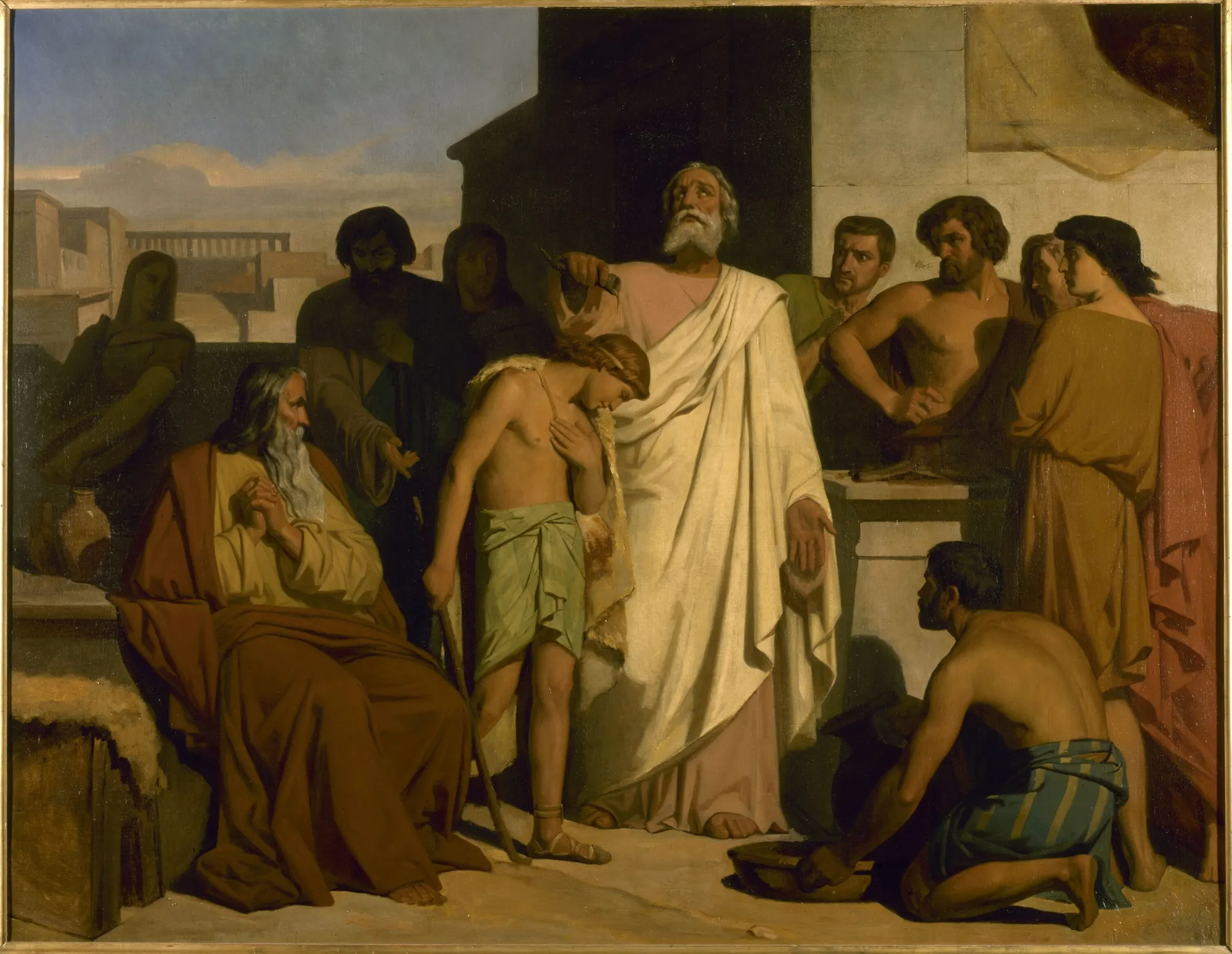
This page draws on Adam Clarke, Commentary on the Bible; Albert Barnes, Notes, Explanatory and Practical, on the Old and New Testaments (1832-1869); Bede, Commentary on Samuel; Gregory the Dialogist, Commentary on 1 Kings, Book 2, Chapter 2; Gregory the Dialogist, Commentary on 1 Kings, Book 2, Chapter 3; John Gill, Exposition of the Old Testament (1748-1763) and Keil and Delitzsch, Biblical Commentary on the Books of Samuel.