
1 Samuel 16:3
in 1 Samuel 16Then invite Jesse to the sacrifice, and I will show you what you are to do. You are to anoint for Me the one I indicate.”
BSB
The same verse in ASV and KJV ▾
ASV
And call Jesse to the sacrifice, and I will show thee what thou shalt do: and thou shalt anoint unto me him whom I name unto thee.
KJV
And call Jesse to the sacrifice, and I will shew thee what thou shalt do: and thou shalt anoint unto me him whom I name unto thee.
⋯
This verse in 1 Samuel 16
Commentary
6 notes on this verse5. What is shown by these words, except that the cunning and cruelty of tyrants must sometimes be eluded by pious deception? For by the Lord's command a calf is taken from the herd, a sacrifice is simulated, and the royal anointing is reached, because when tyrants desire to do harm, certain things which they may believe must be set before them, so that they find no opening to do harm. Thus tyrants must be eluded in such a way that the guilt of lying is avoided.
This site's exposition
Then invite Jesse to the sacrifice
on 1 Samuel 16:3-5
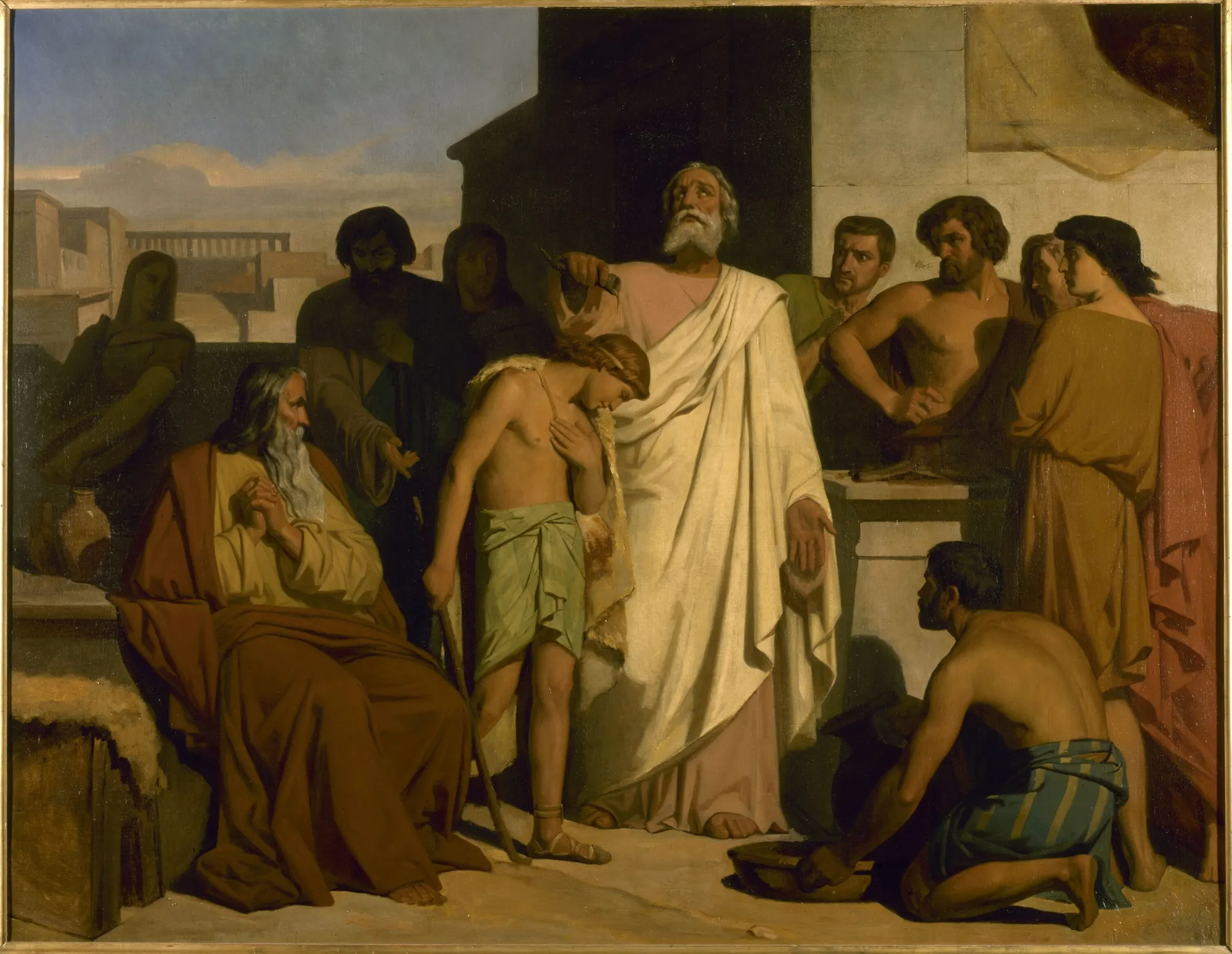
Samuel is told only what the next step requires, to invite Jesse to the sacrifice and anoint "the one I indicate" when the time comes. The elders of Bethlehem tremble at his coming, a small town’s fear of a prophet arriving unannounced, and Samuel answers that he comes in peace to sacrifice. Jesse and his sons are consecrated for the feast before any of them knows why.
The record, by era
The Medieval Church1 voice
A commentator
Gregory the DialogistCommentary on 1 Kings, Book 6, Chapter 3 · Written before 604.
proposed
6. But now it is better handled if we consider what these things signify spiritually. What does it mean, then, that the prophet takes a calf in his hand, and so arrives to anoint the king? But what is the calf, if not the splendor of the image of the Redeemer? For since he strives to make the one he chooses conformed to the Redeemer, when he preaches the very form of the Redeemer, he carries, as it were, a calf in his hand.
The Puritans and the Awakening1 voice
And call Jesse to the sacrifice,....
The Nineteenth Century2 voices
A commentator
Jamieson, Fausset & Brown1802–1910
Commentary Critical and Explanatory on the Whole Bible (1871)
proposed
call Jesse to the sacrifice--that is, the social feast that followed the peace offering. Samuel, being the offerer, had a right to invite any guest he pleased.
quarantine:debris (2026-07-29) — starts-lowercase
Call Jesse to the sacrifice - The common custom was, after the blood of the victim had been poured out to God, and the fat burnt, to feast on the flesh of the sacrifice. This appears to have been the case in all, except in the whole burnt-offering; this was entirely consumed.
The words behind it
14 Hebrew wordsEvery Hebrew word of this verse in the order it stands, with what it means and the door to its own study. The last column counts the times a word stands in the whole Bible: the rarer the word, the more the places it appears belong together.
| Hebrew | Sound | Meaning | Word study | In the Bible |
|---|---|---|---|---|
| וְקָרָ֥אתָ | vekarata | and you will invite | H7121 → | 733 times |
| לְיִשַׁ֖י | leyishai | <to> Jesse | H3448 → | 42 times |
| בַּזָּ֑בַח | bazavach | at the sacrifice | H2077 → | 162 times |
| וְאָֽנֹכִ֗י | veanokhi | and I | H595 → | 359 times |
| אוֹדִֽיעֲךָ֙ | ʾodiakha | I will make known to you | H3045 → | 945 times |
| אֵ֣ת | ʾet | <obj.> | H853 → | 10935 times |
| אֲשֶֽׁר־ | ʾasher- | [that] which | H834 → | 5497 times |
| תַּעֲשֶׂ֔ה | taaseh | you will do | H6213 → | 2628 times |
| וּמָשַׁחְתָּ֣ | umashachta | and you will anoint | H4886 → | 70 times |
| לִ֔י | li | for <the> me | ||
| אֵ֥ת | ʾet | <obj.> | H853 → | 10935 times |
| אֲשֶׁר־ | ʾasher- | [the one] whom | H834 → | 5497 times |
| אֹמַ֖ר | ʾomar | I will say | H559 → | 5305 times |
| אֵלֶֽיךָ׃ | ʾeleikha | to you | H413 → | 5510 times |
וְקָרָ֥אתָand you will invite
vekarataH7121 →733 times
לְיִשַׁ֖י<to> Jesse
leyishaiH3448 →42 times
בַּזָּ֑בַחat the sacrifice
bazavachH2077 →162 times
וְאָֽנֹכִ֗יand I
veanokhiH595 →359 times
אוֹדִֽיעֲךָ֙I will make known to you
ʾodiakhaH3045 →945 times
אֵ֣ת<obj.>
ʾetH853 →10935 times
אֲשֶֽׁר־[that] which
ʾasher-H834 →5497 times
תַּעֲשֶׂ֔הyou will do
taasehH6213 →2628 times
וּמָשַׁחְתָּ֣and you will anoint
umashachtaH4886 →70 times
לִ֔יfor <the> me
li
אֵ֥ת<obj.>
ʾetH853 →10935 times
אֲשֶׁר־[the one] whom
ʾasher-H834 →5497 times
אֹמַ֖רI will say
ʾomarH559 →5305 times
אֵלֶֽיךָ׃to you
ʾeleikhaH413 →5510 times
A shaded row is a word that stands 400 times or fewer in the Bible.
The walk
8 stopsEach card is a verse this one points to, and under it the verses that one points to in turn. Where several paths arrive at the same place, that place is listed first: the text keeps returning to it.
Through
1 Samuel 9:16“At this time tomorrow I will send you a man from the land of Benjamin, and you are to anoint him leader over My people Israel; he will save them from the hand of…
it leads to
- 1 Samuel 10:1
Then Samuel took a flask of oil, poured it on Saul’s head, kissed him, and said, “Has not the LORD anointed you ruler over His inheritance?
- Psalms 25:18
Consider my affliction and trouble, and take away all my sins.
- Psalms 106:44
Nevertheless He heard their cry; He took note of their distress.
- Exodus 3:7–9
The LORD said, “I have indeed seen the affliction of My people in Egypt. I have heard them crying out because of their oppressors, and I am aware of their sufferings.
- 1 Samuel 15:1
Then Samuel said to Saul, “The LORD sent me to anoint you king over His people Israel. Now therefore, listen to the words of the LORD.
- 1 Samuel 10:1
Through
Exodus 4:15You are to speak to him and put the words in his mouth. I will help both of you to speak, and I will teach you what to do.
it leads to
- Isaiah 51:16
I have put My words in your mouth, and covered you with the shadow of My hand, to establish the heavens, to found the earth, and to say to Zion, ‘You are My people.’”
- Luke 21:15
For I will give you speech and wisdom that none of your adversaries will be able to resist or contradict.
- Isaiah 51:16
Through
Acts 9:6“Now get up and go into the city, and you will be told what you must do.”
it leads to
- Acts 22:10
Then I asked, ‘What should I do, Lord?’ ‘Get up and go into Damascus,’ He told me. ‘There you will be told all that you have been appointed to do.’
- Acts 22:10
Where this verse is studied
On this page
About 1 Samuel
This page draws on Adam Clarke, Commentary on the Bible; Gregory the Dialogist, Commentary on 1 Kings, Book 6, Chapter 3; Jamieson, Fausset & Brown, Commentary Critical and Explanatory on the Whole Bible; John Gill, Exposition of the Old Testament and John Gill, Exposition of the Old Testament (1748-1763).