
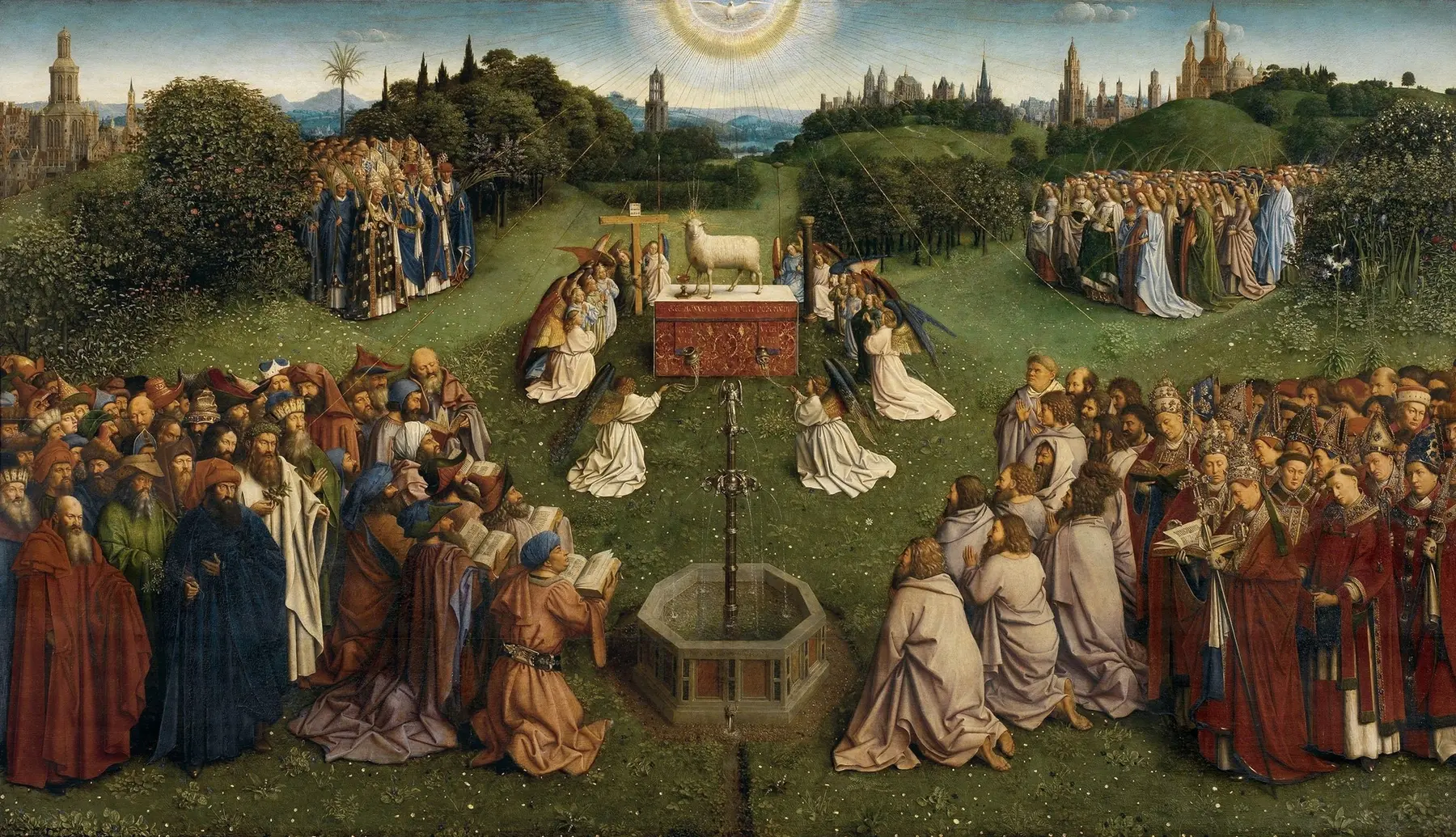
Revelationchapter 14
20 verses · John, by tradition · AD 95 or 96 · Revelation
Then I looked and saw the Lamb standing on Mount Zion, and with Him 144,000 who had His name and His Father’s name written on their foreheads.
Introduction
John, by tradition, Revelation, Revelation Overview.
John wrote this book in exile on Patmos for seven churches in Asia that were pressed to honor Caesar as lord. This chapter follows the darkest vision of the book, and it answers that darkness before the next series of judgments begins. It moves quickly between heaven and earth, and between comfort and warning. Listen for who stands with the Lamb and who drinks from which cup. Listen also for the language of the farm, since the prophets used the grain field and the vineyard for the end of an age. Read it as the chapter that shows where both roads end.
Context
- Who
- Believers who had just been shown a beast that seemed to win everything
- What
- A vision of the Lamb and the 144,000 on Mount Zion, three angels' messages to the earth, a blessing on the faithful dead, and two harvests of the earth.
- Where
- John saw it on the island of Patmos and wrote it to the seven churches of the Roman province of Asia.
- When
- About AD 95 under the emperor Domitian on the common dating, with an earlier date under Nero, about AD 68, held by others.
- Why
- To steady believers facing the beast's demand for worship by showing its end and the reward of those who refuse it.
Historical context
The chapter opens by putting a Lamb where the beast had been standing, and the 144,000 have His name and His Father's name on their foreheads, a direct counter to the mark of the previous chapter. Two marks, two owners.
Show the rest of the historical context, 3 more paragraphs
Then three angels fly through mid-heaven making announcements, which is how public proclamations worked: a herald in a public place, saying it out loud so no one can claim not to have heard. The first carries an everlasting gospel to every nation, tribe, tongue, and people. The second announces that Babylon is fallen. The third warns against worshiping the beast.
"Babylon" was already code. Jewish and Christian writers used the name of the empire that destroyed the first temple for the empire that destroyed the second, and 1 Peter appears to sign off from "Babylon" the same way. Nobody had to be told which city was meant.
The harvest imagery at the end came from everyday work. Grain was cut with a sickle when it was ripe; grapes were cut and thrown into a stone trough where people trod them, and the juice ran out through a channel. Winepresses cut into bedrock survive all over the region. That is why a winepress of wrath, with what flows out of it, is such a violent picture, the readers had stood in one.
Significance
The middle of the chapter contains the line these churches most needed: "Blessed are the dead which die in the Lord from henceforth… that they may rest from their labours; and their works do follow them."
Show the rest of the significance, 1 more paragraph
Chapter 13 said believers might be killed. Chapter 14 says the ones who are killed are blessed, their work goes with them, and the empire that killed them is already announced as fallen. That ordering was the whole comfort.
The heads below are this chapter's scenes. The numbered points under each are its verses.
The Lamb on Mount Zion With a New Song
the Lamb standing on Mount Zion: The Lamb stands on Mount Zion with the 144,000 of chapter 7, who had His name and His Father’s name written on their foreheads. Their seal answers the beast's mark on the forehead in 13:16.
Revelation 14:1
“How Christ appears: as a Lamb standing upon mount Zion. Mount Zion is the gospel church. Christ is with his church and in the midst of her in all her troubles, and therefore she is not consumed.”
Matthew Henry · Commentary on the Whole Bible (1707-1721)puritan
2 more voices on this verseWhat preachers and commentators have said about this verse, in their own words.
Revelation 14:1
“THE SCENE of this marvellous and magnificent vision is laid upon Mount Sion; by which we are to understand, not Mount Sion upon earth, but Mount Sion which is above, “Jerusalem, the mother of us all.” To the Hebrew mind Mount Sion was a type of heaven, and very justly so. Among all the mountains of the earth none was to be found so famous as Sion.”
Revelation 14:1
“As the 144,000 of Israel are "the first-fruits" (Re 14:4), so "the harvest" (Re 14:15) is the general assembly of Gentile saints to be translated by Christ as His first act in assuming His kingdom, prior to His judgment (Re 16:17-21, the last seven vials) on the Antichristian world, in executing which His saints shall share.”
Jamieson, Fausset & Brown · Commentary Critical and Explanatory on the Whole Bible (1871)reformed
Revelation 14:2-3
like the roar of many waters: The sound joins the roar of many waters, the loud rumbling of thunder and harpists strumming their harps. The text says no one could learn the song except the 144,000 who had been redeemed from the earth, the company whose deliverance it sings.
Revelation 14:2
“The voice of many waters - That is, of multitudes of various nations. The voice of harpers - Though the sounds were many and apparently confused, yet both harmony and melody were preserved.”
Adam Clarke · Commentary on the Bible (1810-1826)evangelical
they sang a new song: The new song recalls the new song of 5:9, sung for the Lamb's redemption. No one could learn it except those who had been redeemed, the ones who know what they were redeemed from.
Revelation 14:3
“The song was new, suited to the new covenant, and unto that new and gracious dispensation of Providence under which they now were; and their song was a secret to others, strangers intermeddled not with their joy; others might repeat the words of the song, but they were strangers to the true sense and spirit of it.”
Matthew Henry · Commentary on the Whole Bible (1707-1721)puritan
Revelation 14:4-5
not been defiled with women: In the prophets and at 2:20-22 idolatry is harlotry, so their purity is from the beast's worship. They are firstfruits, aparche, the first sheaf of the harvest, and no lie was found in their mouths, as with the remnant of Zephaniah 3:13.
Revelation 14:4
“These are they which were not defiled with women - They are pure from idolatry, and are presented as unspotted virgins to their Lord and Savior Christ. See 2Co 11:2. There may be an allusion here to the Israelites committing idolatry, through the means of their criminal connection with the Midianitish women. See Num 25:1-4; Num 31:16. Follow the Lamb whithersoever he goeth - They go through good and through evil report, bear his reproach, and love not their lives even to the death.”
Adam Clarke · Commentary on the Bible (1810-1826)evangelical
1 more voice on this verse
Revelation 14:4
“These are they who had not been defiled with women - It seems that the deepest defilement, and the most alluring temptation, is put for every other. They are virgins - Unspotted souls; such as have preserved universal purity.”
John Wesley · Explanatory Notes upon the New Testament (1755)evangelical
they are blameless: Jamieson, Fausset and Brown guard the word blameless from a wrong reading. These men are counted blameless on the ground of Christ's righteousness, in whom they trusted and whom they served, and never as sinless in themselves. Their truthful speech is the fruit of that trust.
Three Angels: Fear God, Babylon Is Fallen, Refuse the Mark
Revelation 14:6-7
with the eternal gospel to proclaim: The angel carries the eternal gospel to every nation and tribe and tongue and people. Its call to worship the One who made the heavens and the earth and the sea takes up the Creator language of Exodus 20:11.
Revelation 14:6
“Flying - Going on swiftly. In the midst of heaven - Breadthways. Having an everlasting gospel - Not the gospel, properly so called; but a gospel, or joyful message, which was to have an influence on all ages.”
John Wesley · Explanatory Notes upon the New Testament (1755)evangelical
1 more voice on this verse
Revelation 14:6
“The gospel is the great means whereby men are brought to fear God, and to give glory to him. Natural religion is not sufficient to keep up the fear of God, nor to secure to him glory from men; it is the gospel that revives the fear of God, and retrieves his glory in the world.”
Matthew Henry · Commentary on the Whole Bible (1707-1721)puritan
The call answers chapter 13, where the whole earth worshiped the dragon and the beast. Albert Barnes reads fear God as a summons away from the beast and its image to the only true God. Jamieson, Fausset and Brown read the hour as a fixed time.
Revelation 14:7
“Fear God--the forerunner to embracing the love of God manifested in the Gospel. Repentance accompanies faith. give glory to him--and not to the beast (compare Re 13:4; Jer 13:16). the hour of his judgment--"The hour" implies the definite time.”
Jamieson, Fausset & Brown · Commentary Critical and Explanatory on the Whole Bible (1871)reformed
1 more voice on this verse
Revelation 14:7
“Saying with a loud voice - As if all the nations were summoned to hear. Fear God - That is, reverence, honor, obey God. Render homage not to the beast, to his image, or to any idol, but to the only true God. This is the substance of the gospel - its end and design - to turn people from all forms of idol worship and superstition, to the worship of the only true God.”
The doubled cry Fallen, fallen is Babylon the great comes from Isaiah 21:9, spoken over historical Babylon. The fall is announced before chapters 17 and 18 tell it, and the wine of the passion of her immorality anticipates the woman.
Revelation 14:8
“A, Vulgate, Syriac, and ANDREAS support the second "is fallen." But B, C, and Coptic omit it. that great city--A, B, C, Vulgate, Syriac, and Coptic omit "city." Then translate, "Babylon the great." The ulterior and exhaustive fulfilment of Isa 21:9. because--So ANDREAS.”
Jamieson, Fausset & Brown · Commentary Critical and Explanatory on the Whole Bible (1871)reformed
1 more voice on this verse
Revelation 14:8
“Babylon is fallen, is fallen - This is generally understood to be a prediction concerning Rome; and it is certain that Rome, in the rabbinical writings, is termed Babylon. That great city - Among the same writers this city is styled קרתא רבתא karta rabbetha, the great city; and רומי רבתא Romi rabbetha, the great Rome. But which Rome is meant? Pagan or Papal Rome? Some parts of the description apply best to the former.”
Adam Clarke · Commentary on the Bible (1810-1826)evangelical
Revelation 14:9-11
Whoever worships the beast will drink the wine of God’s anger, poured undiluted into the cup of His wrath. The Greek akratou means unmixed, and forever and ever is the formula that measures the devil's sentence at 20:10.
Revelation 14:9
“Saying, If any one worship the wild beast - This worship consists, partly in an inward submission, a persuasion that all who are subject to Christ must be subject to the beast or they cannot receive the influences of divine grace, or, as their expression is, there is no salvation out of their church; partly in a suitable outward reverence to the beast himself, and consequently to his image.”
John Wesley · Explanatory Notes upon the New Testament (1755)evangelical
poured undiluted into the cup: The cup answers verse 8, where Babylon made the nations drink her wine. Adam Clarke traces the fire and sulfur to the judgment of Sodom.
Revelation 14:10
“The wine of the wrath of God - As they have drunk the intoxicating wine of idolatry or spiritual fornication, they shall now drink the wine of God’s wrath, which is poured out into the cup of his indignation. This is an allusion to the poisoned cup, which certain criminals were obliged to drink, on which ensued speedy death. See on Heb 2:9 (note). Shall be tormented with fire and brimstone - An allusion to the punishment of Sodom and Gomorrha for their unnatural crimes.”
Adam Clarke · Commentary on the Bible (1810-1826)evangelical
2 more voices on this verse
Revelation 14:10
“In all the scripture there is not another so terrible threatening as this. And God by this greater fear arms his servants against the fear of the beast. The wrath of God, which is poured unmixed - Without any mixture of mercy; without hope.”
John Wesley · Explanatory Notes upon the New Testament (1755)evangelical
Revelation 14:10
“The same--Greek, "he also," as the just and inevitable retribution. wine of . . . wrath of God-- (Ps 75:8). without mixture--whereas wine was so commonly mixed with water that to mix wine is used in Greek for to pour out wine; this wine of God's wrath is undiluted; there is no drop of water to cool its heat. Naught of grace or hope is blended with it.”
Jamieson, Fausset & Brown · Commentary Critical and Explanatory on the Whole Bible (1871)reformed
there is no rest: The phrase no rest sets up verse 13, where the dead in the Lord are promised rest. The two companies of the chapter end in opposite states.
Revelation 14:11
“And the smoke - From the fire and brimstone wherein they are tormented. Ascendeth forever and ever - God grant thou and I may never try the strict, literal eternity of this torment!”
John Wesley · Explanatory Notes upon the New Testament (1755)evangelical
Revelation 14:12-13
the perseverance of the saints: Perseverance is the endurance the book has asked for since 1:9, held by those who keep the commandments of God and the faith of Jesus. The voice then gives the book's second beatitude, and their deeds will follow them, still counted.
Revelation 14:12
“Here is the patience of the saints - Here the faith of the true Christians shall be proved; they will follow the Lamb whithersoever he goeth, they keep the commandments of God, and are steadfast in the faith of our Lord Jesus Christ. Sometimes ἡ ὑπομονη, patience or perseverance, is taken for the reward of these virtues; the text therefore may be thus understood: Here is the reward of the perseverance of the true Christians; for although they die for the testimony of Jesus, yet they shall be unutterably blessed. See the next verse.”
Adam Clarke · Commentary on the Bible (1810-1826)evangelical
2 more voices on this verse
Revelation 14:12
“Here is the patience of the saints. Although the beast rages, yet the temporary suffering does not sadden the saints, which is to be rewarded with eternal happiness, while on the contrary, the persecutors, temporarily prideful, see themselves suffering eternal punishment with the beast.”
Bede · written before 735 · Commentary on Revelationpatristic
Revelation 14:12
“Here, &c.--resumed from Re 13:10; see on Re 13:10. In the fiery ordeal of persecution which awaits all who will not worship the beast, the faith and patience of the followers of God and Jesus shall be put to the test, and proved. patience--Greek, "hupomene," "patient, persevering endurance." The second "here" is omitted in A, B, C, Vulgate, Syriac, Coptic, and PRIMASIUS.”
Jamieson, Fausset & Brown · Commentary Critical and Explanatory on the Whole Bible (1871)reformed
Matthew Henry reads die in the Lord first as dying in living union with Christ, and then as dying for His cause. John Wesley draws the plain consequence. In his reading rest follows at once, and the harder the life, the sweeter the rest.
Revelation 14:13
“And I heard a voice from heaven - A voice that seemed to speak from heaven. Saying unto me, Write - Make a record of this truth. We may suppose that John was engaged in making a record of what he saw in vision; he was now instructed to make a record of what he heard. This passage may be referred to as a proof that he wrote this book while in Patmos, or as the heavenly disclosures were made to him, and not afterward from memory.”
2 more voices on this verse
Revelation 14:13
“Who die in the Lord - In the faith of the Lord Jesus. For they rest - No pain, no purgatory follows; but pure, unmixed happiness. From their labours - And the more labourious their life was, the sweeter is their rest.”
John Wesley · Explanatory Notes upon the New Testament (1755)evangelical
Revelation 14:13
“22:17; and in the saints, 2Co 5:5; All "God's promises in Christ are yea" (2Co 1:20). unto me--omitted in A, B, C, Vulgate, Syriac, and Coptic. that they may--The Greek includes also the idea, They are blessed, in that they SHALL rest from their toils (so the Greek). and--So B and ANDREAS read.”
Jamieson, Fausset & Brown · Commentary Critical and Explanatory on the Whole Bible (1871)reformed
Sickle and Winepress: The Harvest of the Earth
Revelation 14:14-16
One like the Son of Man: is the title of Daniel 7:13, and in this book only Christ bears that title and wears a crown. The Greek for ripe, exeranthe, means dried, and Joel 3:13 pairs this grain harvest with the grape harvest that follows.
Revelation 14:14
“Here is no reference in either to the day of judgment, but to a season which cannot be far off. And I saw a white cloud - An emblem of mercy. And on the cloud sat one like a son of man - An angel in an human shape, sent by Christ, the Lord both of the vintage and of the harvest.”
John Wesley · Explanatory Notes upon the New Testament (1755)evangelical
2 more voices on this verse
Revelation 14:14
“A white cloud - It is supposed that, from this verse to the end of the chapter, the destruction of Rome is represented under the symbols of harvest and vintage; images very frequent among the ancient prophets, by which they represented the destruction and excision of nations. See Joe 3:12-14; Isa 17:5; Isa 63:1; and Mat 13:37. A golden crown - In token of victory and regal power.”
Adam Clarke · Commentary on the Bible (1810-1826)evangelical
Revelation 14:14
“And in His hand a sharp sickle. Namely, the judicial sentence of separating, which cannot be avoided. For we are within it, wherever we may try to flee. For in the sickle, whatever is enclosed falls within.”
Bede · written before 735 · Commentary on Revelationpatristic
An angel from the temple tells the One seated on the cloud that the time has come to harvest. The command comes from God's presence, and the harvest is read both as the gathering of the elect and as judgment on the nations.
Revelation 14:15
“And another angel - The fourth in order, Rev 14:6, Rev 14:8-9. Came out of the temple - See the notes on Rev 11:19. Came, as it were, from the immediate presence of God; for the temple was regarded as his unique dwelling-place. Crying with a loud voice to him that sat on the cloud - To the Messiah, Rev 14:14. That is, the command was borne directly from God by the angel to the Messiah, to go forth and reap the great harvest of the world.”
2 more voices on this verse
Revelation 14:15
"Thrust in thy sharp sickle, and gather in the grapes of the vine," he signifies it of the nations that should perish on the advent of the Lord. And indeed in many forms he shows this same thing, as if to the dry harvest, and the seed for the coming of the Lord, and the consummation of the world, and the kingdom of Christ, and the future appearance of the kingdom of the blessed.
Victorinus of Pettau · written before 304 · Commentary on the Apocalypse of the Blessed Johnpatristic
Revelation 14:15
“By the harvest-reaping the elect righteous are gathered out; by the vintage the Antichristian offenders are removed out of the earth, the scene of Christ's coming kingdom. The Son of man Himself, with a golden crown, is introduced in the harvest-gathering of the elect, a mere angel in the vintage (Re 14:18-20). is ripe--literally, "is dried." Ripe for glory.”
Jamieson, Fausset & Brown · Commentary Critical and Explanatory on the Whole Bible (1871)reformed
the earth was harvested: The reaping is told in one line, at a single stroke. John Gill notes that reaping in the prophets often means judgment, as in Isaiah 17.
Revelation 14:16
“And he that sat on the cloud - The Saviour, Rev 14:14. Thrust in his sickle on the earth - To cut down the harvest - that is, to gather his people to himself. And the earth was reaped - So far as the righteous were concerned. The end had come; the church was redeemed; the work contemplated was accomplished; and the results of the work of the Saviour were like a glorious harvest.”
Revelation 14:17-20
he too had a sharp sickle: The angel from the altar orders the grapes gathered from the vine of the earth and thrown into the great winepress of God’s wrath. Isaiah 63:1-6 pictures the Lord treading the winepress alone, and 1,600 stadia is roughly the length of the land of Israel.
Revelation 14:17
“And another angel - The fifth in order. This angel came for a different purpose - with reference to the cutting off of the enemies of God, represented by the gathering of a vintage. Compare Mat 13:41; Mat 24:31. Came out of the temple which is in heaven - Sent or commissioned by God. See the notes on Rev 14:15. He also having a sharp sickle - On the word “sickle,” see the notes on Rev 14:14.”
1 more voice on this verse
Revelation 14:17
“Some think that these two are only different emblems of the same judgment; others that they refer to distinct events of providence before the end of all things. Observe, (1.) To whom this vintage-work was committed--to an angel, another angel that came out from the altar, that is, from the holiest of all in heaven.”
Matthew Henry · Commentary on the Whole Bible (1707-1721)puritan
with authority over the fire: This angel comes from the altar where the martyrs cried out at 6:9-10 and the prayers of the saints rose with the incense at 8:3. His authority over the fire matches the angel of the waters at 16:5.
Revelation 14:18
“And another angel from the altar - Of burnt offering; from whence the martyrs had cried for vengeance. Who had power over fire - As "the angel of the waters," chap. xvi, 5, had over water. Cried, saying, Lop off the clusters of the vine of the earth - All the wicked are considered as constituting one body.”
John Wesley · Explanatory Notes upon the New Testament (1755)evangelical
1 more voice on this verse
Revelation 14:18
“Power over fire - Probably meaning the same angel which is mentioned, Rev 8:3; Rev 9:13, who stood by the altar of burnt-offering, having authority over its fire to offer that incense to God which represents the prayers of the saints.”
Adam Clarke · Commentary on the Bible (1810-1826)evangelical
gathered the grapes of the earth: The grapes of the earth recall the vineyard of Isaiah 5, which was tended and still bore wild grapes and so was judged. Here the grapes go into the great winepress of God’s wrath.
Revelation 14:19
"And the angel thrust in the sickle, and reaped the vine of the earth, and cast it into the wine-press of the wrath of God. And the wine-press of His fury was trodden down without the city." In that he says that it was cast into the wine-press of the wrath of God, and trodden down without the city, the treading of the wine-press is the retribution on the sinner. "And blood went out from the wine-press, even unto the horse-bridles." The vengeance of shed blood as was before predicted, "In blood thou hast sinned, and blood shall follow thee."
Victorinus of Pettau · written before 304 · Commentary on the Apocalypse of the Blessed Johnpatristic
1 more voice on this verse
Revelation 14:19
"The vine" is what is the subject of judgment because its grapes are not what God looked for considering its careful culture, but "wild grapes" (Isa 5:1-30). The apostate world of Christendom, not the world of heathendom who have not heard of Christ, is the object of judgment.
Jamieson, Fausset & Brown · Commentary Critical and Explanatory on the Whole Bible (1871)reformed
trodden outside the city: Readers differ on the city. John Wesley says John's first readers would hear Jerusalem, while John Gill reads the new Jerusalem, which no wicked person enters. Bede reads 1,600 stadia as four times four hundred, the judgment reaching the four quarters of the world.
Revelation 14:20
“Without the city - Jerusalem. They to whom St. John writes, when a man said, "The city," immediately understood this. And blood came out of the winepress, even to the horses' bridles - So deep at its first flowing from the winepress!”
John Wesley · Explanatory Notes upon the New Testament (1755)evangelical
1 more voice on this verse
Revelation 14:20
“Even unto the horse bridles - A hyperbolical expression, to denote a great effusion of blood. The Jews said, “When Hadrian besieged the city called Bitter, he slew so many that the horses waded in blood up to their mouths.” The same kind of hyperbole with that above. See Wetstein on this verse. The space of a thousand and six hundred furlongs - It is said that the state of the Church, or St. Peter’s patrimony, extends from Rome to the Po, two hundred Italian miles, which make exactly one thousand six hundred furlongs!”
Adam Clarke · Commentary on the Bible (1810-1826)evangelical
How this psalm is built
The form: A set of visions that runs ahead to the end, the harvest of the saints gathered before the last bowls fall on the world, as Jamieson, Fausset & Brown classes it.
The patterns in this chapter
| Device | What it does | Where to see it |
|---|---|---|
| The procession of angels | Verses 6 to 11 set three angels one after another, the first with the eternal gospel, the second with the fall of Babylon and the third with the warning against the mark. Albert Barnes keeps counting through the chapter and names the angel of verse 15 the fourth and the angel of verse 17 the fifth, so the chapter reads as one procession with the Son of Man in its midst.Albert Barnes, Notes, Explanatory and Practical, on the Old and New Testaments (1832-1869), on Revelation 14:15 and 14:17. | Revelation 14:6, Revelation 14:8, Revelation 14:9, Revelation 14:15, Revelation 14:17 |
| Harvest and vintage | The two reapings are built alike: a sickle, an angel from the temple, a loud cry and the reason given, that the crop is ripe. Jamieson, Fausset and Brown read the difference as the point, the Son of Man with a golden crown reaping the elect and a ministering angel gathering the vintage of the ungodly.Jamieson, Fausset & Brown, Commentary Critical and Explanatory on the Whole Bible, 1871, on Revelation 14:15. | Revelation 14:14, Revelation 14:15, Revelation 14:18, Revelation 14:19 |
| The cup given back | Babylon makes the nations drink the wine of her immorality at verse 8, and at verse 10 the worshiper of the beast drinks the wine of God's anger. Adam Clarke reads the second cup as the answer to the first, the drinkers of idolatry's wine given the wine of wrath.Adam Clarke, Commentary on the Bible, 1832, on Revelation 14:10. | Revelation 14:8, Revelation 14:10 |
Where the pictures come from
11 more paragraphs on the patterns
Adam Clarke traces the harvest and the vintage to the prophets, who used them for the cutting off of nations, and he names Joel 3:12 to 14, Isaiah 17:5 and Isaiah 63:1 (Commentary on the Bible, on 14:14). Albert Barnes sets the winepress beside Isaiah 63 (Notes, on 14:19). Jamieson, Fausset and Brown hear Isaiah 5 in the vine that bore wild grapes, Psalm 75:8 in the cup of wrath and Isaiah 21:9 in the double cry over Babylon (Commentary Critical and Explanatory, on 14:8, 14:10 and 14:19). Clarke hears Sodom in the fire and sulfur (on 14:10).
Where it sits in the book
The chapter stands between the beast of chapter 13 and the bowls of chapters 15 and 16. Its 144,000 are the company sealed at 7:4, and its fall of Babylon announces what chapters 17 and 18 tell at length. Jamieson, Fausset and Brown read the 144,000 of Israel as the firstfruits and the harvest of verse 15 as the Gentile saints, gathered before the last bowls of 16:17 to 21 (Commentary Critical and Explanatory, on 14:1).
The debated concept: who stands on Mount Zion
Matthew Henry reads Mount Zion as the gospel church, with Christ in her midst in all her troubles (Commentary on the Whole Bible, on 14:1). Charles Spurgeon reads it as the heavenly Zion, the Jerusalem above (The New Park Street Pulpit, Sermon No. 110, on 14:1). Jamieson, Fausset and Brown keep the 144,000 as Israel, the firstfruits of the harvest (on 14:1), and the site's own note on 14:1 reads them as the tribes preserved through the tribulation. The site holds the last reading and names the others as held by these voices.
The debated concept: the rider on the cloud and the two harvests
Albert Barnes and Jamieson, Fausset and Brown read the One like the Son of Man as Christ and the first harvest as the gathering of the righteous (Notes, on 14:15 and 14:16; Commentary Critical and Explanatory, on 14:15). John Wesley reads the rider as an angel in human shape sent by Christ (Explanatory Notes, on 14:14). Matthew Henry and Victorinus of Pettau read both reapings as judgment on the ripe enemies of Christ (Commentary on the Whole Bible, on 14:14; Commentary on the Apocalypse, on 14:15). The golden crown and the title from Daniel 7:13 are the strongest ground for the first reading.
Where the rest of the New Testament touches it
The Son of Man on a cloud comes from Daniel 7:13, and Jesus took the same words for His own coming at Matthew 24:30. Jesus also named the harvest as the end of the age at Matthew 13:39. The blessing of verse 13 is the second of the book's seven beatitudes, and Matthew Henry reads dying in the Lord as dying in living union with Christ (on 14:13).
The number
Bede reads the 1,600 stadia as four times four hundred, the judgment reaching the four quarters of the world (Commentary on Revelation, on 14:20). Adam Clarke reports the claim that the papal lands ran 1,600 furlongs from Rome to the Po (on 14:20).
Keep studying
Studies10
Sources for this chapter
The summary
Jamieson, Fausset & Brown, Commentary Critical and Explanatory; John Wesley, Explanatory Notes Upon the New Testament and Matthew Henry, Complete Commentary.
The form and classifications
Adam Clarke, Commentary on the Bible, 1832, on Revelation 14:14; Jamieson, Fausset & Brown, Commentary Critical and Explanatory on the Whole Bible, 1871, on Revelation 14:1 and John Wesley, Explanatory Notes upon the New Testament, 1755, on Revelation 14:14.
The exposition
Adam Clarke, Commentary on the Bible; Albert Barnes; Andreas of Caesarea; Bede, Commentary on Revelation; Jamieson, Fausset & Brown, Commentary Critical and Explanatory on the Whole Bible; John Gill; John Wesley, Explanatory Notes upon the New Testament; Matthew Henry, Commentary on the Whole Bible and Victorinus of Pettau, Commentary on the Apocalypse of the Blessed John.