
Judgeschapter 16
31 verses · BSBJudges book hub →
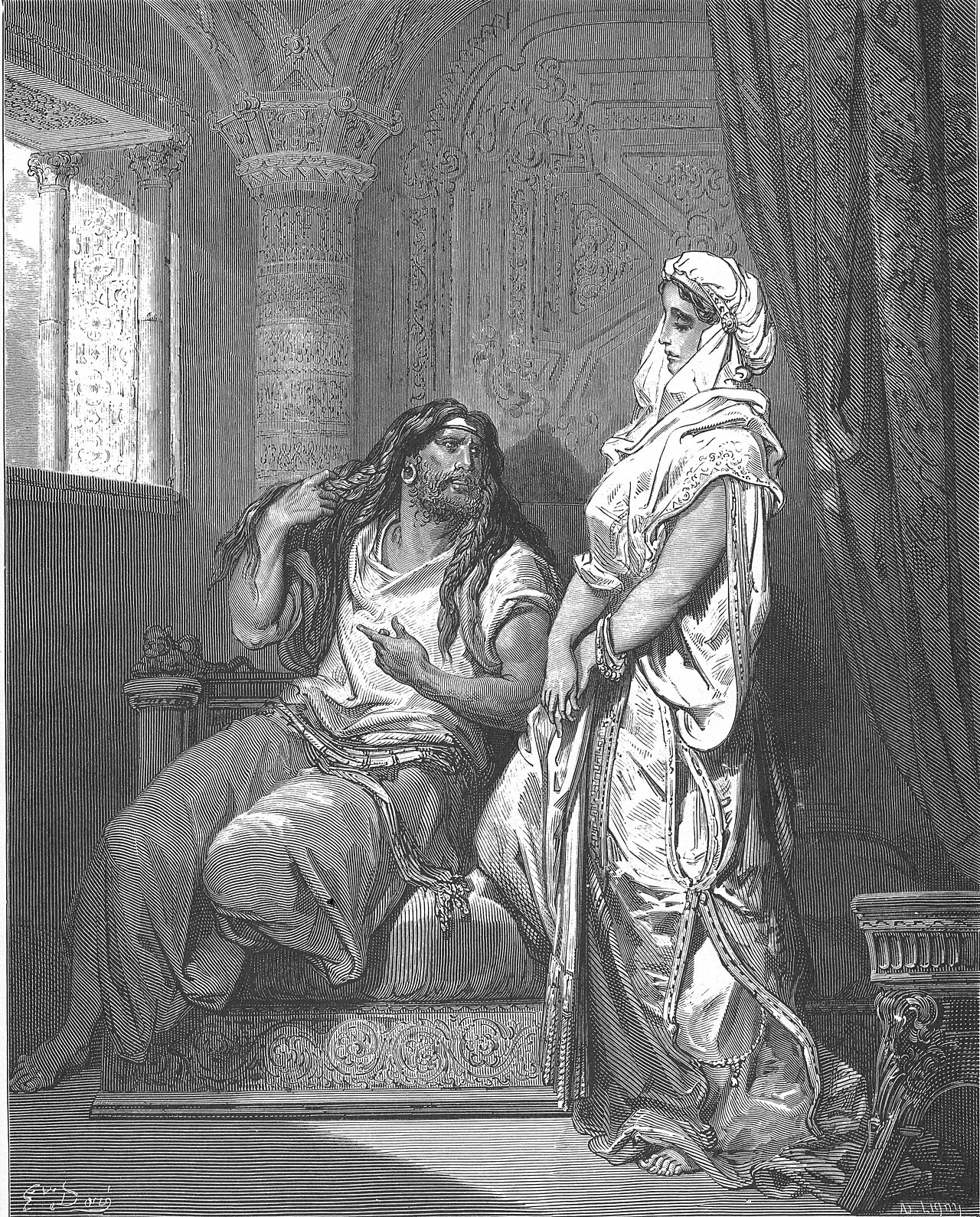
Samson and Delilah, Gustave Doré, Doré's English Bible (1866), public domain
Key verse
Then the Philistines seized him, gouged out his eyes, and brought him down to Gaza, where he was bound with bronze shackles and forced to grind grain in the prison.
It stands in scene B of the chapter, verses 4 to 22.
The chapter
Chapter summary
The strength that cannot be bound is undone by a woman's persistence. At Gaza Samson carries off the city gates, posts and bar, to the top of the mountain before Hebron. Then Delilah, paid eleven hundred pieces of silver by each Philistine lord, works through green withes, new ropes, and the seven locks woven into the web, pressing him daily, how canst thou say, I love thee, when thy heart is not with me? He tells her all his heart, the razor does its work, and the terrible line follows: he awoke and wist not that Jehovah was departed from him. Blinded and grinding in the prison, his hair begins to grow again; his last prayer at Dagon's pillars kills more than his life had.
Context
History · Samuel · Judges overview
Where the chapter sits
Judges 16 falls in The twelve judges (chapters 3–16). Othniel, Ehud, Shamgar, Deborah, Gideon, Tola, Jair, Jephthah, Ibzan, Elon, Abdon, Samson (and Abimelech as anti-judge). Seven oppression-deliverance cycles.
Samson's end. Delilah, the mill, the feast; ‘the dead which he slew at his death were more than they which he slew in his life.’
Before it: Incomplete conquest; programmatic cycle, chapters 1–2. After it: Appendix: diagnosis of Israel, chapters 17–21.
The whole shape of Judges→The world behind this chapter
Judges 16The history
A walled city's gates were its life. The doors were massive timber-and-bronze leaves hung on posts set deep into stone sockets, with a crossbar dropped into slots to lock them. Carrying the whole assembly, doors, posts, and bar, up a long hill was an act of public mockery aimed at Gaza's defenses themselves.
The rest of the history, and what it meant to them
The money offered to Delilah is enormous. Eleven hundred pieces of silver from each of the five Philistine lords is a sum no ordinary person would see in a lifetime, and it explains her persistence better than affection ever could. Note also that all five rulers act together, this was a coordinated state operation against one man.
Grinding at the mill was the lowest labor there was, normally women's work at a household hand mill, or in a prison a heavy rotary stone pushed in a circle. A blinded prisoner walking that circle is the picture of a man reduced to an animal turning a wheel.
Dagon was the chief god of the Philistine cities, with temples excavated at several sites, and the celebration was a thanksgiving festival crediting him with the capture. Excavated Philistine temples at Tell Qasile were built with a roof supported on two central pillars set on stone bases close enough together for one man to reach both, which is precisely the architecture the chapter describes.
What it meant to them
The saddest line in the book is that he did not know the LORD had left him. He had spent his strength so long as a personal possession that he could not tell when the gift was gone.
And the last prayer is his second and final one: remember me, strengthen me just this once, that I may be avenged. Hearers were left with a deliverer who killed more at his death than in his life, and who never once led Israel anywhere. The book is arguing, chapter by chapter, that this is what happens with no king and no covenant faithfulness.
Sources cited
- John H. Walton, Victor H. Matthews, and Mark W. Chavalas, The IVP Bible Background Commentary: Old Testament
- Yigael Yadin, The Art of Warfare in Biblical Lands in the Light of Archaeological Study
A. The gates of Gaza carried up the hill
1. (vv. 1-3)
a.Gaza is the far southern city of the Philistine coast, and Joshua 11:22 had named it as one of three towns where the Anakim were left standing after the conquest. The chapter opens the way chapter 14 opened, with what Samson saw, and those two sightings frame everything up to verse 21. He carries the gate, both posts and the bar uphill toward Hebron, which stands roughly forty miles inland and some three thousand feet above the sea, and the text records the load and the distance without giving the errand.
Judges 16:1, 1 voiceWhat preachers and commentators have said about this verse, in their own words.
Judges 16:1
“Then went Samson to Gaza, and saw there a harlot - The Chaldee, as in the former case, renders the clause thus: Samson saw there a woman, an inn-keeper. Perhaps the word זונה zonah is to be taken here in its double sense; one who keeps a house for the entertainment of travelers, and who also prostitutes her person. Gaza was situated near the Mediterranean Sea, and was one of the most southern cities of Palestine.”
Adam Clarke· Commentary on the Bible (1810-1826)evangelical
Judges 16:3, 2 voices
Judges 16:3
“Instead of forcing the doors open, he tore the posts up, as it were, by the roots, with the barred doors attached to them. The word rendered “went away with them,” means “to pluck up the tent-pins,” and hence, “to remove.” The present town of Gaza (Ghuzzeh) is an open town, without gates or walls, but the sites of the ancient gates still remain visible. One of these, on the southeast, is shown as the gate carried off by Samson.”
Judges 16:3
“The city of Gaza was, in those days, probably not less than three-quarters of an hour distant from El-Montar. To have climbed to the top of this hill with the ponderous doors and their bolts on his shoulders, through a road of thick sand, was a feat which none but a Samson could have accomplished [VAN DE VELDE].”
Jamieson, Fausset & Brown· Commentary Critical and Explanatory on the Whole Bible (1871)reformed
B. Delilah's fourth try, and the seven locks shorn
1. (vv. 4-5)
a.in the Valley of Sorek: Delilah is the only woman in the Samson account given a name, since his mother, the woman of Timnath and the woman of verse 1 all go unnamed. This is the first time the text says Samson loved anyone, and it says nothing of her loving him. The word the lords give her, entice, is the word used against the woman of Timnath at 14:15, where the lever was fire rather than money. Eleven hundred pieces of silver apiece is the fee, and the same sum turns up once more in Scripture, at Judges 17:2-3, as the money Micah took from his mother.
Judges 16:4, 1 voice
Judges 16:4
“He loved a woman in the valley of Sorek - Some think Samson took this woman for his wife; others, that he had her as a concubine. It appears she was a Philistine; and however strong his love was for her, she seems to have had none for him. He always matched improperly, and he was cursed in all his matches. Where the valley or brook of Sorek was, is not easy to be ascertained. Eusebius and Jerome say it lay southward of Eleutheropolis; but where was Eleutheropolis?”
Adam Clarke· Commentary on the Bible (1810-1826)evangelical
Judges 16:5, 2 voices
Judges 16:5
“And the lords of the Philistines - See Jdg 3:3 note. His great strength lieth - Rather, “wherein his strength is great.” Eleven hundred pieces of silver - The greatness of the bribe offered to Delilah, 5,500 shekels of silver, nearly two talents (Exo 38:24, note), shows the importance attached to Samson’s capture.”
Judges 16:5
“Entice him, and see wherein his great strength lieth--They probably imagined that he carried some amulet about his person, or was in the possession of some important secret by which he had acquired such herculean strength; and they bribed Delilah, doubtless by a large reward, to discover it for them.”
Jamieson, Fausset & Brown· Commentary Critical and Explanatory on the Whole Bible (1871)reformed
2. (vv. 6-9)
a.Four attempts run to one shape: she asks, he answers, men wait in the chamber, and she cries that the Philistines are upon him. Seven runs through the chapter and lands on his head at the end, seven withs here and seven locks at verses 13 and 19. His answers move inward by stages, from green withs to new ropes to the hair woven into a loom and at last to the hair itself, so the fourth answer is reached by three steps he took himself.
Judges 16:7, 1 voice
Judges 16:7
“Seven green withs - That is, any kind of pliant, tough wood, twisted in the form of a cord or rope. Such are used in many countries formed out of osiers, hazel, etc. And in Ireland, very long and strong ropes are made of the fibres of bog-wood, or the larger roots of the fir, which is often dug up in the bogs or mosses of that country.”
Adam Clarke· Commentary on the Bible (1810-1826)evangelical
3. (vv. 10-12)
a.New ropes that never were occupied is exactly what the men of Judah used at 15:13, where they bound him with two new cords, and 15:14 says the cords became as flax that was burnt with fire. He is handing Delilah the record of his own deliverances as a game. The liers in wait are in the chamber for this attempt as for the first, so the third answer is given with armed men in the room and the second trap already sprung.
Judges 16:11, 1 voice
Judges 16:11
“If they bind me fast with new ropes - Samson wishes to keep up the opinion which the Philistines held; viz., that his mighty strength was the effect of some charm; and therefore he says, Seven green withs which had not been dried; new ropes that were never occupied; weave the seven locks of my hair with the web, etc.; the green withs, the new ropes, and the number seven, are such matters as would naturally be expected in a charm or spell.”
Adam Clarke· Commentary on the Bible (1810-1826)evangelical
4. (vv. 13-14)
a.The seven locks are named here, and the hair enters the bargaining while the vow behind it stays hidden. The Hebrew of verse 13 stops at the web and gives no instruction about the pin, so the King James reader meets an act at verse 14 that verse 13 never proposed. The Septuagint carries a longer reading that supplies the missing clause, and it is the largest textual difference in the chapter. Adam Clarke sets the longer reading out in full, and Keil and Delitzsch treat the shorter Hebrew as usable as it stands.
Judges 16:13, 2 voices
Judges 16:13
“The seven locks of my head - Probably Samson had his long hair plaited into seven divisions, and as his vow of a Nazarite obliged him to wear his hair, so, seven being a number of perfection among the Hebrews, his hair being divided into seven locks might more particularly point out the perfection designed by his Nazarite state. Every person must see that this verse ends abruptly, and does not contain a full sense.”
Adam Clarke· Commentary on the Bible (1810-1826)evangelical
Judges 16:13
“If thou weavest the seven locks of my head--braids or tresses, into which, like many in the East, he chose to plait his hair. Working at the loom was a female employment; and Delilah's appears to have been close at hand. It was of a very simple construction; the woof was driven into the warp, not by a reed, but by a wooden spatula.”
Jamieson, Fausset & Brown· Commentary Critical and Explanatory on the Whole Bible (1871)reformed
Judges 16:14, 1 voice
Judges 16:14
“And she fastened it with the pin ... - The meaning of the verses seems to be that the seven long plaits, in which Samson’s hair was arranged, were to be woven as a woof into the threads of a warp which stood prepared on a loom in the chamber, which loom Delilah fastened down with a pin, so as to keep it firm and immoveable. But Samson, when he awoke, tore up the pin from its socket, and went away with the loom and the pin fastened to his hair.”
5. (vv. 15-17)
a.Her complaint answers the one made at 14:16, thou dost but hate me, and lovest me not, and the pressure is the same, since 14:17 says the woman of Timnath wept before him the seven days of the feast. What the text gives as the reason he spoke is that his soul was vexed unto death, and it names no other. Verse 17 is the one place Samson says Nazarite of himself, since at 13:5 the word came from the angel to his mother, and he recites the terms of the vow correctly in the act of giving them away.
Judges 16:17, 1 voice
Judges 16:17
“If I be shaven, then my strength will go from me - The miraculous strength of Samson must not be supposed to reside either in his hair or in his muscles, but in that relation in which he stood to God as a Nazarite, such a person being bound by a solemn vow to walk in a strict conformity to the laws of his Maker. It was a part of the Nazarite’s vow to permit no razor to pass on his head; and his long hair was the mark of his Nazirate, and of his vow to God.”
Adam Clarke· Commentary on the Bible (1810-1826)evangelical
6. (vv. 18-19)
a.The lords come up themselves this time and bring the money with them, which the three earlier attempts never mention. She calls for a man to do the shaving while Samson sleeps on her knees, so the act that ends the vow is done by a hired hand and he is asleep for it. The word afflict has run through the whole bargain, from the lords at verse 5 to her request at verse 6, and verse 19 says she began to afflict him, which is the errand finished.
Judges 16:19, 2 voices
Judges 16:19
“But the one who has taken root as "a fruitful olive tree in the house of God" composes those words against the tyrant which we have heard in the psalm, saying, "Why do you glory in evil, you who are mighty in iniquity," whose "tongue" is "like a sharp razor." It was by means of these two things that [Samson] was led off, after [Delilah] had removed the beauty of his hair and cut off the "seven locks of curls" in which our strength lies.”
Gregory of Nyssa· written before 395· ON THE INSCRIPTIONS OF THE PSALMS 2.13.183patristic
Judges 16:19
“She began to affect him - She had probably tied his hands slyly, while he was asleep, and after having cut off his hair, she began to insult him before she called the Philistines, to try whether he were really reduced to a state of weakness.”
Adam Clarke· Commentary on the Bible (1810-1826)evangelical
7. (v. 20)
a.He rises and shakes himself as at other times, and the sentence the chapters have been moving toward is that he did not know. The Spirit of the LORD comes or moves on a man seven times in Judges, at 3:10, 6:34, 11:29, 13:25, 14:6, 14:19 and 15:14, and four of the seven are Samson, so the departure falls on the most gifted man in the book. Keil and Delitzsch read the hair as the badge of the vow rather than the seat of the power, and other readers have put the strength in the hair itself; the verse states a departure and leaves the mechanism alone. Hebrews 11:32 names Samson among the faithful and leaves this verse standing where it is.
Judges 16:20, 2 voices
Judges 16:20
“The possession of his extraordinary strength is ascribed (e. g. Jdg 13:25) to the presence of the Spirit of the Lord. Now the Lord, or the Spirit of the Lord, had departed from him, and so his strength had gone too. The practical lesson against the presumption of self-dependence, and the all-importance of a hearty dependence upon God’s Holy Spirit, must not be overlooked.”
Judges 16:20
“He soon found in himself some change, we have reason to think so, and yet wist not that the Lord had departed from him: he did not consider that this was the reason of the change. Note, Many have lost the favourable presence of God and are not aware of it; they have provoked God to withdraw from them, but are not sensible of their loss, nor ever complain of it.”
Matthew Henry· Commentary on the Whole Bible (1707-1721)puritan
8. (vv. 21-22)
a.His eyes go first, and they are the organ the account has tracked from the start: 14:1 says he saw a woman, 14:3 has him answer that she pleaseth me well where the Hebrew reads that she was right in his eyes, and 16:1 says he saw an harlot in Gaza. That pairing of right and eyes is the book's own closing sentence at 17:6 and 21:25. Grinding at the mill was the work of slaves and of women, as Exodus 11:5 and Isaiah 47:2 show, and he is set to it in the town whose gate he once carried away. Verse 22 turns on the word howbeit and reports the hair growing without saying what will come of it.
Judges 16:21, 3 voices
Judges 16:21
“Put out his eyes - Thus effectually, as they thought, preventing any future mischief on his part, while they prolonged their own triumph and revenge. (Compare Num 16:14; 2Ki 25:7; Jer 39:7.) They applied to the two feet fetters of brass 2Sa 3:34; Jer 52:11, and made him “grind” - the special task of slaves and captives Exo 11:5; Isa 47:2; Lam 5:13.”
Judges 16:21
“His security was made doubly sure by his being bound with fetters of brass (copper), not of leather, like other captives. he did grind in the prison-house--This grinding with hand-millstones being the employment of menials, he was set to it as the deepest degradation.”
Jamieson, Fausset & Brown· Commentary Critical and Explanatory on the Whole Bible (1871)reformed
Judges 16:21
“If we sleep in the lap of our lusts, we shall certainly wake in the hands of the Philistines. It is probable they had promised Delilah not to kill him, but they took an effectual course to disable him. The first thing they did, when they had him in their hands and found they could manage him, was to put out his eyes, by applying fire to them, says the Arabic version.”
Matthew Henry· Commentary on the Whole Bible (1707-1721)puritan
Judges 16:22, 2 voices
Judges 16:22
“Howbeit the hair of his head began to grow again--It is probable that he had now reflected on his folly; and becoming a sincere penitent, renewed his Nazarite vow. "His hair grew together with his repentance, and his strength with his hairs" [BISHOP HALL].”
Jamieson, Fausset & Brown· Commentary Critical and Explanatory on the Whole Bible (1871)reformed
Judges 16:22
“The hair - This circumstance, though in itself inconsiderable, is noted as a sign of the recovery of God's favour, and his former strength, in some degree, upon his repentance, and renewing his vow with God, which was allowed for Nazarites to do.”
John Wesley· Explanatory Notes upon the Old Testament (1765)evangelical
C. Between the pillars in the house of Dagon
1. (vv. 23-24)
a.to offer a great sacrifice: Dagon is named in three places in Scripture, here, in 1 Samuel 5 where the image falls twice before the ark and breaks at the threshold, and at 1 Chronicles 10:10 where Saul's head is fastened in his temple. The Philistines say our god hath delivered, which is the sentence Judges keeps using of the LORD giving enemies into Israel's hand at 3:10, 7:9 and 11:32. Albert Barnes derives the name from dag, a fish, and reads the broken image of 1 Samuel 5:4 alongside the fish figures found at Khorsabad; others derive it from dagan, corn, and make him a god of grain. Verse 24 gives the crowd's own account of the prisoner, the destroyer of our country, which slew many of us.
Judges 16:23, 1 voice
Judges 16:23
“Dagon was the national idol of the Philistines 1Ch 10:10, so called from Dag, a fish. The description of Dagon, in his temple at Ashdod 1Sa 5:4, exactly agrees with the representations of a fish-god on the walls of Khorsabad, on slabs at Kouyunjik, and on sundry antique cylinders and gems. In these the figures vary.”
2. (vv. 25-27)
a.A lad leads him by the hand, which is how a blind man moved, and the request to feel the pillars sounds like a tired man asking for something to lean on. Verse 27 counts the house full below and about three thousand on the roof, so the building had a roof used as a gallery and a span carried from the middle. A Philistine temple dug at Tell Qasile has two central pillar bases set close enough for one man to reach both, which matches the arrangement the verse describes; the report is Amihai Mazar, Excavations at Tell Qasile. The text says nothing about what the lad understood.
Judges 16:25, 1 voice
Judges 16:25
“That he may make us sport - Rather, “that he may play for us,” i. e. dance and make music. At an idolatrous feast, dancing was always accompanied with vocal and instrumental music.”
Judges 16:26, 1 voice
Judges 16:26
“More literally, “let me rest, and let me feel the pillars, that I may lean upon them.” He feigned weariness with his dancing and singing, and asked to recover himself by leaning against the pillars. The flat roof, from the top of which, as well as under it, spectators could see what was being done on the stage in front, was mainly supported by two pillars. The lords and principal persons sat UNDER the roof, while the people, to the number of 3,000, stood ON the flat roof.”
Judges 16:27, 2 voices
Judges 16:27
“Now the house was full of men - It was either the prison-house, house of assembly, or a temple of Dagon, raised on pillars, open on all sides, and flat-roofed, so that it could accommodate a multitude of people on the top.”
Adam Clarke· Commentary on the Bible (1810-1826)evangelical
Judges 16:27
“In the middle there are two large beams, on which the whole weight of the structure lies, and these beams are supported by two pillars placed almost close to each other, so that when these are unsettled or displaced, the whole pile must tumble to the ground.”
Jamieson, Fausset & Brown· Commentary Critical and Explanatory on the Whole Bible (1871)reformed
3. (vv. 28-30)
a.This is the second recorded prayer of Samson, and the first was at 15:18, when he asked for water after the slaughter at Lehi. He stacks three names of God into one sentence and asks to be avenged for his two eyes, which is the reason he gives and the only one the verse records. Verse 30 counts the dead and says those he slew at his death were more than those he slew in his life, and the book passes no judgment on the act. Augustine took the question up in The City of God, book one, chapter twenty-one, and Hebrews 11:32 lists Samson with Gideon, Barak and Jephthah without settling it.
Judges 16:28, 2 voices
Judges 16:28
“Samson called unto the Lord - It was in consequence of his faith in God that he should be strengthened to overthrow his enemies and the enemies of his country, that he is mentioned, Heb 11:32, among those who were remarkable for their faith.”
Adam Clarke· Commentary on the Bible (1810-1826)evangelical
Judges 16:28
“Samson called unto the Lord--His penitent and prayerful spirit seems clearly to indicate that this meditated act was not that of a vindictive suicide, and that he regarded himself as putting forth his strength in his capacity of a public magistrate.”
Jamieson, Fausset & Brown· Commentary Critical and Explanatory on the Whole Bible (1871)reformed
Judges 16:29, 1 voice
Judges 16:29
“The two middle pillars upon which the house stood - Much learned labor has been lost on the attempt to prove that a building like this might stand on two pillars. But what need of this? There might have been as many pillars here as were in the temple of Diana at Ephesus, and yet the two center pillars be the key of the building; these being once pulled down, the whole house would necessarily fall.”
Adam Clarke· Commentary on the Bible (1810-1826)evangelical
Judges 16:30, 2 voices
Judges 16:30
The Spirit, therefore, "asks" and "intercedes," but we "pray." And Joshua's words commanding the sun to stand over [Gibeon] seem to me to be an intercession also.… And in Judges, Samson in my opinion said in intercession: "Let me die with the foreigners—when he bent in his strength and the house fell upon the princes and all the people that were there."
Origen of Alexandria· written before 253· ON PRAYER 14.5patristic
Judges 16:30
“However, we have good reason to hope that though Samson died with the Philistines he had not his everlasting portion with them. The Lord knows those that are his. [4.] Christ was plainly typified. He pulled down the devil's kingdom, as Samson did Dagon's temple; and, when he died, he obtained the most glorious victory over the powers of darkness.”
Matthew Henry· Commentary on the Whole Bible (1707-1721)puritan
4. (v. 31)
a.between Zorah and Eshtaol: Zorah and Eshtaol is where 13:2 placed Manoah and where 13:25 says the Spirit of the LORD began to move him, so he is buried between the two towns he began between. The brethren and all the house of his father come down for the body, and this is the first the narrative says of any family beyond his parents. His term is given twice, at 15:20 and here, and both times it is twenty years, which makes him the one judge whose years are counted before his death and again after it. The land had rest formula that closed 3:11, 3:30 and 5:31 never comes back, and it does not come back for him.
Judges 16:31, 2 voices
Judges 16:31
“All the house of his father,” in connection with “his brethren,” must mean the whole tribe of Dan, aiding his nearer relations. The Danites, taking advantage of the consternation of the Philistines, and of the death of their lords and chief men, went down in force to Gaza, and recovered the body of their great captain and judge, and buried him in his father’s sepulchre.
Judges 16:31
“Thus the Israelitish hero rendered by his strength and courage signal services to his country, and was always regarded as the greatest of its champions. But his slavish subjection to the domination of his passions was unworthy of so great a man and lessens our respect for his character. Yet he is ranked among the ancient worthies who maintained a firm faith in God (Heb 11:32).”
Jamieson, Fausset & Brown· Commentary Critical and Explanatory on the Whole Bible (1871)reformed
The text of this chapter
This page carries no textual note on Judges 16. Where this site has examined a place the manuscripts differ, the examination is in the manuscripts room. Every place this site examines →
This page draws on 9 works. Open for the list.
This page draws on Adam Clarke; Albert Barnes; Gregory of Nyssa, ON THE INSCRIPTIONS OF THE PSALMS 2.13.183; Jamieson, Fausset & Brown, Commentary Critical and Explanatory on the Whole Bible (1871); John Gill, Exposition of the Old Testament; John Wesley, Explanatory Notes upon the Old Testament (1765); Keil and Delitzsch, Biblical Commentary on the Old Testament: Joshua, Judges, Ruth; Matthew Henry and Origen of Alexandria, ON PRAYER 14.5.
Keep studying
On this page
Studies1