
Jonahchapter 3
10 verses · Jonah, by tradition · 8th century BC · The Twelve
Key verse
And God saw their works, that they turned from their evil way; and God repented of the evil, that he had said that he would do unto them; and he did it not.
It stands in Sackcloth from the throne down, and God relents, verses 5 to 10.
The chapter
Chapter summary
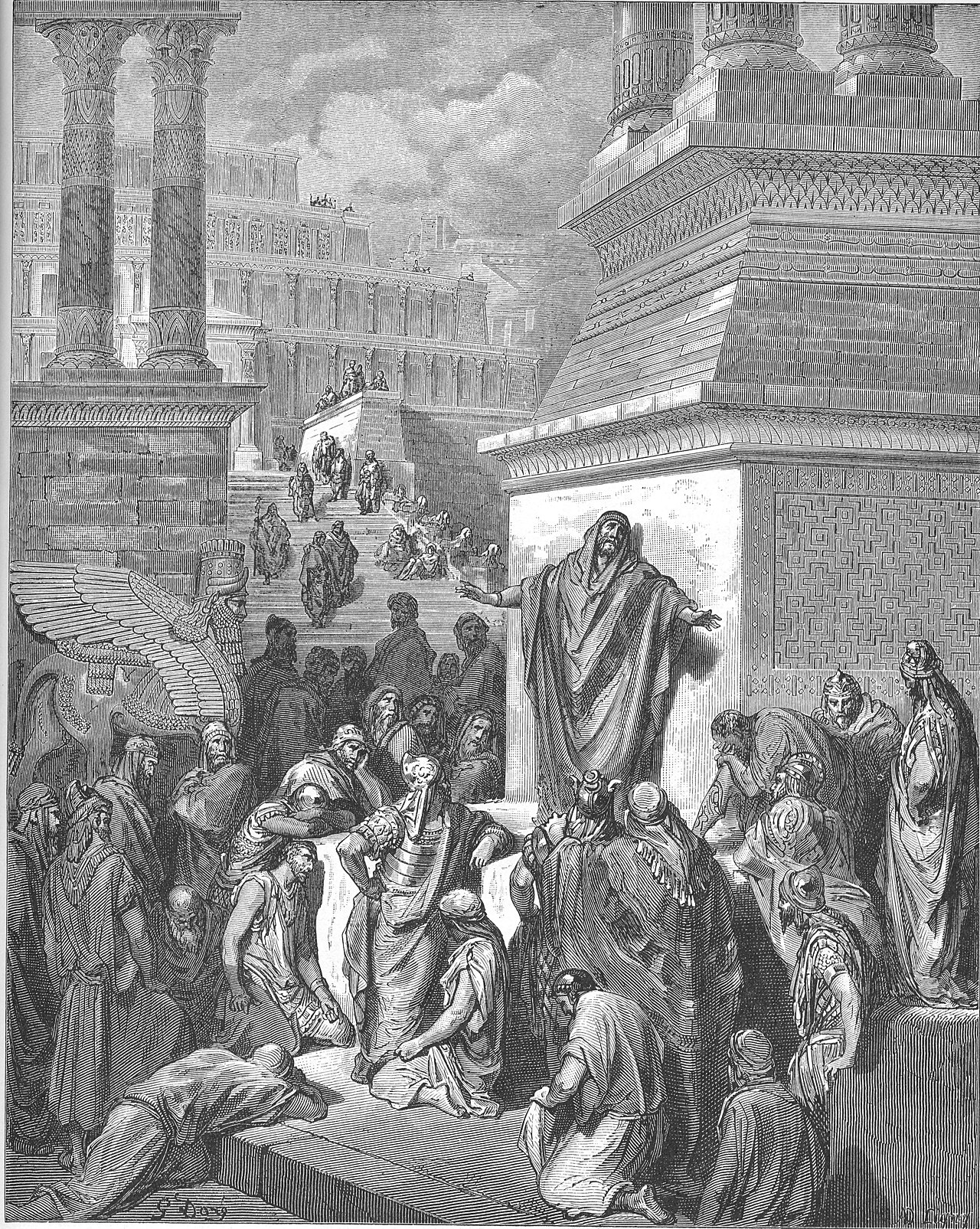
'And the word of Jehovah came unto Jonah the second time': the same commission to the same city, and this time he goes. Nineveh is an exceeding great city of three days' journey; Jonah walks one day in and preaches eight words: 'Yet forty days, and Nineveh shall be overthrown.' No promise of mercy is offered, and mercy comes anyway. 'The people of Nineveh believed God,' fasted, and put on sackcloth from the greatest to the least; the king rose from his throne, sat in ashes, and decreed that every man turn from the violence in his hands. God saw their works and relented. Jesus says these men will rise in the judgment (Matthew 12).
Context
Prophecy · Jonah · Jonah overview
The world behind this chapter
Jonah 3The history
Nineveh was one of the great cities of the ancient world. Excavations on the mounds at Kuyunjik and Nebi Yunus have uncovered enormous palaces, a wall circuit of roughly eight miles, and the library of Ashurbanipal with tens of thousands of tablets. The city was described as "an exceeding great city of three days' journey," which likely takes in the whole built-up district and its surrounding towns rather than the walled core alone.
The rest of the history, and what it meant to them
Assyria's reputation was not exaggerated by its enemies; the Assyrians advertised it themselves. Royal inscriptions and palace wall reliefs boast in detail about flaying captives, impaling prisoners outside besieged towns, and stacking heads. This was deliberate policy, terror as a cheaper alternative to fighting every city twice.
Assyria went through a rough stretch in the first half of the eighth century: military setbacks, plague, and a total solar eclipse recorded in 763 BC, an omen a Mesopotamian court would have taken with deadly seriousness. Whether any of that lies behind the city's readiness to listen, the text does not say, and it should not be pressed.
The response follows Mesopotamian mourning practice, sackcloth, ashes, fasting, and a royal decree, with the king coming down off his throne and out of his robe. The animals fasting in sackcloth strikes modern readers as odd; ancient mourning could indeed include a household's livestock, and Greek writers describe similar customs among Persians.
The message Jonah preaches is one sentence long: yet forty days, and Nineveh shall be overthrown. No promise of mercy is attached. The king reasons his way to it, "who can tell if God will turn?"
What it meant to them
For an Israelite audience this was almost unbearable. The city that would later deport the northern kingdom fasts, and God relents.
The chapter says plainly what God did: He saw their works, that they turned from their evil way, and He repented of the evil He had said He would do. Warning is itself mercy. A prophet announcing forty days is giving a city forty days.
Sources cited
- Austen Henry Layard, Nineveh and Its Remains (public domain)
- K. A. Kitchen, On the Reliability of the Old Testament
- Herodotus, Histories (public domain)
Where the chapter sits
Jonah 3 falls in The preaching (chapters 3). Nineveh repents, king and cattle fasting in sackcloth.
Nineveh repents. ‘Who can tell if God will turn and repent?’
Before it: The fish and the prayer, chapters 2. After it: The complaint, chapters 4.
The whole shape of Jonah→The structure of this chapter
People1
Places1
The heads below are this chapter's scenes. The numbered points under each are its verses.
A. The word of the LORD comes a second timevv. 1-2
Jonah 3:1-3
And the word of the Lord came unto Jonah the second time, saying: , repeats the commission of 1:2 almost word for word, the second time marking mercy renewed toward the very prophet who had run from the first calling. This time Jonah arose and went unto Nineveh according to the word of the Lord, the same verb that once carried him toward Tarshish now carrying him where he was sent. Nineveh is described as an exceeding great city of three days across, and Henry and Keil both read the phrase as the time needed to cover the city's full extent or its districts rather than a straight-line crossing, since the site of ancient Nineveh does not stretch that far.
Jonah 3:1
“He neither endeavored to avoid hearing the command, nor did he decline obeying it; he made no objections, as he had done, that the journey was long, the errand invidious, the delivery of it perilous, and, if the threatened judgment did come, he should be reproached as a false prophet, and the impenitence of his own nation would be upbraided, which he had objected, ch. iv.”
Matthew Henry· Commentary on the Whole Bible (1707-1721)puritan
Jonah 3:2
“And preach unto it the preaching - וקרא את הקריאה vekera eth hakkeriah, “And cry the cry that I bid thee.” Be my herald, and faithfully deliver my message. The word κηρυξ in Greek answers to the Hebrew קורא kore: both signifying a crier, a herald, a preacher; one that makes proclamation with a loud and earnest cry. Such was John Baptist, Isa 40:3; such was Jesus Christ, John 7:18-37; and such were all his apostles.”
Adam Clarke· Commentary on the Bible (1810-1826)evangelical
1 more voice on this verse
Jonah 3:2
“There is here set before us a remarkable proof of God's grace, -- that he was pleased to bestow on Jonah his former dignity and honor. He was indeed unworthy of the common light, but God not only restored him to life, but favored him again with the office and honor of a prophet. This, as I have said, Jonah obtained through the wonderful and singular favor of God.”
John Calvin· Commentaries (1554)reformed
B. Yet forty days, and Nineveh shall be overthrown
1. (v. 3)
Jonah 3:3
“Exceeding great - The greatest city of the known world at that day, it was then in its flourishing state greater than Babylon, whose compass was three hundred eighty-five furlongs, but Nineveh was in compass, four hundred and eighty.”
John Wesley· Explanatory Notes upon the Old Testament (1765)evangelical
3 more voices on this verse
Jonah 3:3
“And Jonah arose and went unto Nineveh - , ready to obey, as before to disobey. Before, when God said those same words, “he arose and fled;” now, “he arose and went.” True conversion shows the same energy in serving God, as the unconverted had before shown in serving self or error. Saul’s spirit of fire, which persecuted Christ, gleamed in Paul like lightning through the world, to win souls to Him.”
Jonah 3:3
“However, Christ's resurrection, typified by that of Jonah's, served for the confirmation of his gospel, and contributed abundantly to their great success who in his name preached repentance and remission of sins to all nations, beginning at Jerusalem. They brought word to the king of Nineveh, who, some think, was at this time Sardanapalus, others Pul, king of Assyria.”
Matthew Henry· Commentary on the Whole Bible (1707-1721)puritan
Jonah 3:3
“They looked for a Messiah gloriously coming in the clouds of heaven; the Messiah, on the contrary, is to pass through a like, though a deeper, humiliation than Jonah; He is to lie "in the heart of the earth." Jonah and his Antitype alike appeared low and friendless among their hearers; both victims to death for God's wrath against sin, both preaching repentance.”
Jamieson, Fausset & Brown· Commentary Critical and Explanatory on the Whole Bible (1871)reformed
2. (v. 4)
Jonah 3:4
“Yet forty days - Both the Septuagint and Arabic read three days. Probably some early copyist of the Septuagint, from whom our modern editions are derived, mistook the Greek numerals μ forty for γ three; or put the three days’ journey in preaching instead of the forty days mentioned in the denunciation.”
Adam Clarke· Commentary on the Bible (1810-1826)evangelical
1 more voice on this verse
Jonah 3:4
“It is no longer a cry against the sins of Nineveh, but an announcement of its ruin in forty days. This number is in Scripture associated often with humiliation. It was forty days that Moses, Elijah, and Christ fasted.”
Jamieson, Fausset & Brown· Commentary Critical and Explanatory on the Whole Bible (1871)reformed
Yet forty days, and Nineveh shall be overthrown: is the whole of Jonah's recorded preaching, a handful of words with no call to repent stated in the sermon itself and no naming of the God who sent him. Gill and Calvin both note that Jonah offers this after entering only one day into a city the text measures at three days across, a fraction of the ground the message needed to cover, so that the report of his own recent deliverance may have carried further than his words did. The sentence names no condition and no way of escape, yet the chapter's next verse records the whole city treating it as a warning rather than as a fixed decree already passed.
C. Sackcloth from the throne down, and God relents
1. (v. 5)
Jonah 3:5
“So the people of Nineveh believed God,.... Or "in God" (r): in the word of the Lord, as the Targum; they believed there was a God, and that he, in whose name Jonah came, was the true God; they believed the word the prophet spake was not the word of man, but, the word of God; faith came by hearing the word, which is the spring of true repentance, and the root of all good works. Kimchi and R.”
3 more voices on this verse
Jonah 3:5
“And the people of Nineveh believed God; - strictly, “believed in God.” To “believe in God” expresses more heart-belief, than to “believe God” in itself need convey. To believe God is to believe what God says, to be true; “to believe in” or “on God” expresses not belief only, but that belief resting in God, trusting itself and all its concerns with Him. It combines hope and trust with faith, and love too, since, without love, there cannot be trust.”
Jonah 3:5
“If what the Apostle has said is not enough, let them hear the Prophet saying, I chastened myself with fasting. He therefore who fasts not is uncovered and naked and exposed to wounds. And if Adam had clothed himself with fasting he would not have been found to be naked. Nineveh delivered itself from death by fasting. And the Lord Himself says, This kind goeth not out but by prayer and fasting.”
Ambrose of Milan· written before 397· Letters, Letter 44patristic
Jonah 3:5
“The wearing of sackcloth, especially to those who were used to fine linen, was a very uneasy thing, and they would not have done it if they had not had a deep sense of their sin and their danger by reason of sin, which hereby they designed to express.”
Matthew Henry· Commentary on the Whole Bible (1707-1721)puritan
So the people of Nineveh believed God, and proclaimed a fast: , and put on sackcloth, from the greatest of them even to the least of them, records a repentance moving through the city from the ordinary people upward, before verse 6 shows the throne itself responding. The Lord Jesus later held this repentance against his own generation's unbelief, saying the men of Nineveh shall rise in judgment against it, for they repented at the preaching of Jonas, his own words at Matthew 12:41 and Luke 11:32 treating the episode as a real event rather than an illustration. Wesley and Barnes both note that Nineveh believed God, not merely feared destruction, the same word used elsewhere in Scripture of a settled trust rather than passing alarm.
2. (v. 6)
Jonah 3:6
“Word came unto the king - This, some think, was Pul; others, Sardanapalus his son, king of Assyria, who flourished in the reign of Jeroboam the Second: but it seems more probable that the monarch here alluded to was a king of Assyria contemporary with Joash, king of Judah. It was by the decree of the king that the fast was instituted, and became general.”
Adam Clarke· Commentary on the Bible (1810-1826)evangelical
For word came unto the king of Nineveh: shows the repentance reaching the throne only after it has already spread through the city, the king following his people's example rather than issuing the first order. He arose from his throne, laid his robe from him, and covered himself with sackcloth, sitting in ashes, every mark of royal dignity set aside for the clothing of mourning. Clarke and Jamieson, Fausset & Brown both weigh the identity of this king, whether Adad-nirari the third or another Assyrian ruler of the period, without any Assyrian record naming the episode directly, and note that the text itself is content to call him simply the king of Nineveh.
3. (vv. 7-9)
Jonah 3:7
“And he caused it to be proclaimed and published through Nineveh; - literally, “And he cried and said, etc.” The cry or proclamation of the king corresponded with the cry of Jonah. Where the prophet’s cry, calling to repentance, had reached, the proclamation of the king followed, obeying. “By the decree of the king and his nobles.” This is a hint of the political state of Nineveh, beyond what we have elsewhere. It was not then an absolute monarchy.”
1 more voice on this verse
Jonah 3:7
“Taste any thing - Man and beast are to forbear to eat and drink, that the fast might be most solemn, that the cry of man, seconded with the cry of hungry cattle, might enter the ears of God, who preserveth man and beast.”
John Wesley· Explanatory Notes upon the Old Testament (1765)evangelical
Jonah 3:8
“Let man and beast be covered - This was done that every object which they beheld might deepen the impression already made, and cause them to mourn after a godly sort. Virgil tells us that the mourning for the death of Julius Caesar was so general, that the cattle neither ate nor drank: - Non ulli pastos illis egere diebus Frigida, Daphni, boves ad flumina: nulla neque amnem Libavit quadrupes, nec graminis attigit herbam. Ecl. 5:24. “The swains forgot their sheep, nor near the brink Of running waters brought their herds to drink.”
Adam Clarke· Commentary on the Bible (1810-1826)evangelical
1 more voice on this verse
Jonah 3:8
“And beast - Their horses and camels, both which they adorned with rich and costly clothing, they must now in testimony of an hearty repentance, clothe with sackcloth; the clothing of beasts must witness for men. The violence - Oppression and rapine. In their hands - Which are practiced by them.”
John Wesley· Explanatory Notes upon the Old Testament (1765)evangelical
Jonah 3:9
“Who can tell if God will turn and repent? - The Ninevites use the same form of words, which God suggested by Joel to Judah. Perhaps He would thereby indicate that He had Himself put it into their mouths. “In uncertainty they repented, and obtained certain mercy” . “It is therefore left uncertain, that men, being doubtful of their salvation, may repent the more vehemently and the more draw down on themselves the mercy of God” . “Most certain are the promises of God, whereby He has promised pardon to the penitent.”
3 more voices on this verse
Jonah 3:9
Look here then, say you: I discover a self-incriminating case in the matter of the Ninevites, when the book of Jonah declares, "And God repented of the evil that He had said that He would do unto them; and He did it not." In accordance with which Jonah himself says unto the Lord, "Therefore I fled before unto Tarshish; for I knew that Thou art a gracious God and merciful, slow to anger, and of great kindness, and repentest Thee of the evil."
Tertullian· written before 220· Against Marcion Book IIpatristic
Jonah 3:9
“They cannot object against the equity of the judgment, they pretend not to set it aside by appealing to a higher court, but hope in God himself, that he will repent, and that his own mercy (to which they fly) shall rejoice against judgment.”
Matthew Henry· Commentary on the Whole Bible (1707-1721)puritan
Jonah 3:9
“The only ground which their ready faith rested on, was the fact of God sending one to warn them, instead of destroying them at once; this suggested the thought of a possibility of pardon. Hence they are cited by Christ as about to condemn in the judgment those who, with much greater light and privileges, yet repent not (Mt 12:41).”
Jamieson, Fausset & Brown· Commentary Critical and Explanatory on the Whole Bible (1871)reformed
Let neither man nor beast, herd nor flock, taste any thing: extends the fast even to the city's animals, a detail without parallel elsewhere in Scripture that the commentators read as eastern custom rather than an invented flourish, since classical writers record similar mourning practices among other Near Eastern peoples. The decree goes past ritual, commanding that man and beast cry mightily unto God and that every one turn from his evil way and from the violence that is in their hands, naming violence specifically as the sin Nineveh must abandon. The king's own uncertainty, who can tell if God will turn and repent, and turn away from his fierce anger, that we perish not, asks for mercy without presuming it, and Henry and Pusey both read this as the humility the book commends against Jonah's own presumption that he already knew how God would act.
4. (v. 10)
Jonah 3:10
“And Gods saw their works - They repented, and brought forth fruits meet for repentance; works which showed that they did most earnestly repent. He therefore changed his purpose, and the city was saved. The purpose was: If the Ninevites do not return from their evil ways, and the violence that is in their hands, within forty days, I will destroy the city. The Ninevites did return, etc., and therefore escaped the threatened judgment. Thus we see that the threatening was conditional.”
Adam Clarke· Commentary on the Bible (1810-1826)evangelical
1 more voice on this verse
Jonah 3:10
“Thus he spared Nineveh, and did not the evil which he said he would do against it. Here were no sacrifices offered to God, that we read of, to make atonement for sin, but the sacrifice of God is a broken spirit; a broken and contrite heart, such as the Ninevites now had, it what he will not despise; it is what he will give countenance to and put honour upon.”
Matthew Henry· Commentary on the Whole Bible (1707-1721)puritan
And God saw their works, that they turned from their evil way: , answers the king's own uncertain hope, the turning asked for at verse 8 met by God's own turning in the same chapter. The text says plainly that God repented of the evil that he had said he would do unto them, and he did it not, language the commentators take as describing a real change in God's dealing with Nineveh rather than any change in his character, since the destruction was always conditioned on the city's response to Jonah's warning. Calvin and Keil both note that this verse, not the fish, is the scandal the book was written to explore, mercy extended to Israel's own future destroyer on the strength of one day's unwilling preaching.
This page carries no textual note on Jonah 3. Where this site has examined a place the manuscripts differ, the examination is in the manuscripts room. Every place this site examines →
Sources for this chapter
The summary
Jamieson, Fausset & Brown, Commentary Critical and Explanatory; John Calvin, Commentaries; John Wesley, Notes on the Old Testament and Matthew Henry, Complete Commentary.
The exposition
Adam Clarke, Commentary on the Bible; Albert Barnes, Notes on the Old Testament; Carl Friedrich Keil, The Twelve Minor Prophets; Edward Bouverie Pusey, The Minor Prophets: A Commentary; Jamieson, Fausset & Brown, Commentary Critical and Explanatory on the Whole Bible; John Calvin, Commentaries on the Twelve Minor Prophets; John Gill, Exposition of the Old Testament; John Wesley, Explanatory Notes upon the Old Testament and Matthew Henry, Commentary on the Whole Bible.
Keep studying
On this page
Studies5
On this verse
On this book
People1
Places1