
Jonah 3:1
in Jonah 3Then the word of the LORD came to Jonah a second time:
BSB
The same verse in ASV and KJV ▾
ASV
And the word of Jehovah came unto Jonah the second time, saying,
KJV
And the word of the Lord came unto Jonah the second time, saying,
⋯
This verse in Jonah 3
Commentary
7 notes on this verseHe neither endeavored to avoid hearing the command, nor did he decline obeying it; he made no objections, as he had done, that the journey was long, the errand invidious, the delivery of it perilous, and, if the threatened judgment did come, he should be reproached as a false prophet, and the impenitence of his own nation would be upbraided, which he had objected, ch. iv.
This site's exposition
And the word of the Lord came unto Jonah the second time, saying
on Jonah 3:1-3
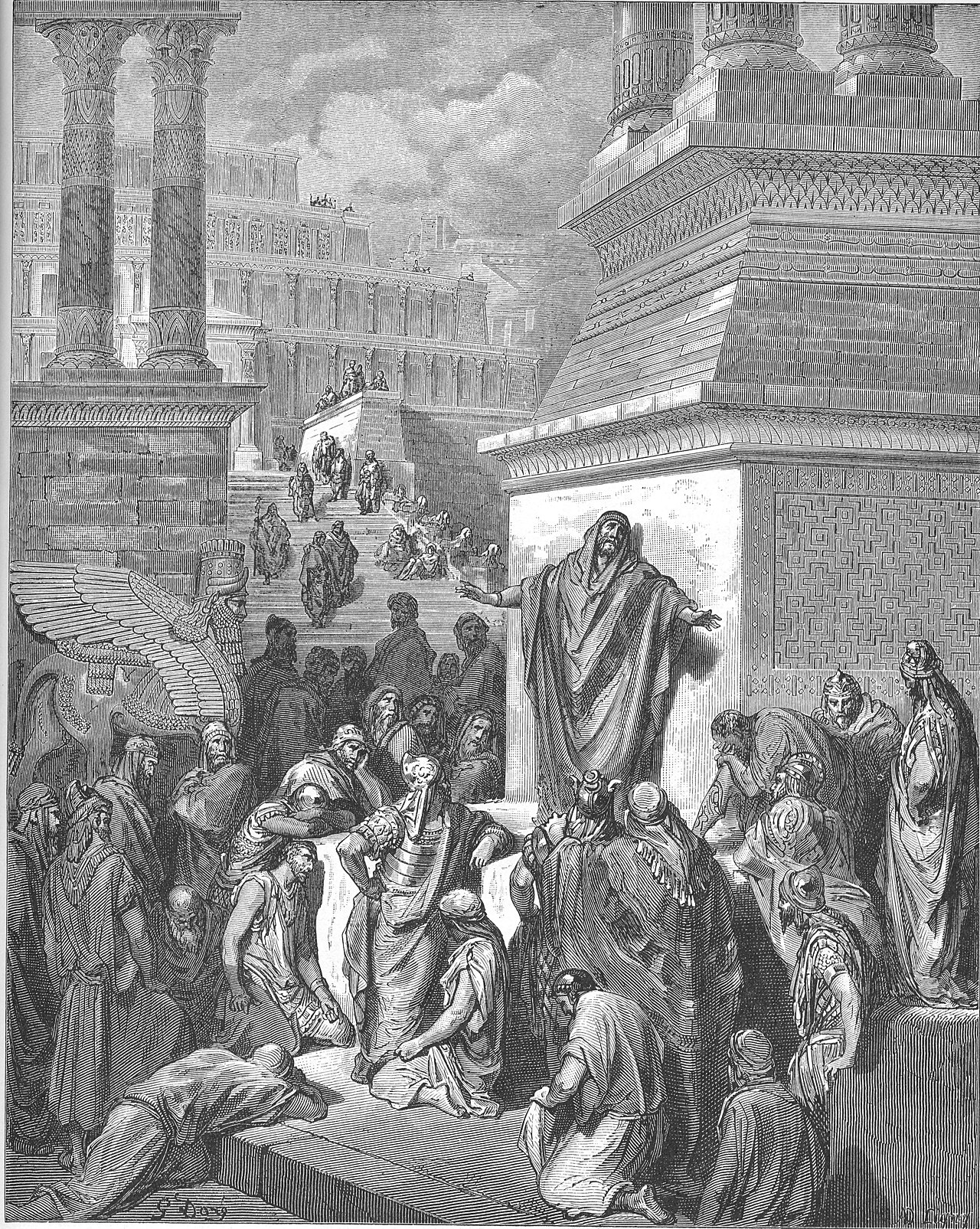
And the word of the Lord came unto Jonah the second time, saying, repeats the commission of 1:2 almost word for word, the second time marking mercy renewed toward the very prophet who had run from the first calling. This time Jonah arose and went unto Nineveh according to the word of the Lord, the same verb that once carried him toward Tarshish now carrying him where he was sent. Nineveh is described as an exceeding great city of three days across, and Henry and Keil both read the phrase as the time needed to cover the city's full extent or its districts rather than a straight-line crossing, since the site of ancient Nineveh does not stretch that far.
The record, by era
The Church Fathers1 voice
"And the word of the LORD came unto Jonah the second time, saying, arise, go unto Nineveh, that great city, and preach unto it the preaching that I bid you." LXX: 'and the message of God came to Jonah a second time, saying, arise, go to Nineveh, the great city, and preach there this message that I have told you'. He did not say to the prophet, "why have you not done what you were ordered to do?."
The Medieval Church1 voice
This is not uttered with reproach, nor is he asked, "Why did you not do what I commanded?" Indeed the hard correction of being shipwrecked and being swallowed was sufficient.
The Puritans and the Awakening1 voice
And the word of the Lord came unto Jonah the second time,....
The Nineteenth Century2 voices
And the word of the Lord - The same oracle as that before given; and which, from what he had felt and seen of the justice and mercy of the Lord, he was now prepared to obey.
A commentator
Albert Barnes1798–1870
Notes, Explanatory and Practical, on the Old and New Testaments (1832-1869)
proposed
And the word of the Lord came a second time to Jonah - o “Jonah, delivered from the whale, doubtless went up to Jerusalem to pay his vows and thank God there. Perhaps he hoped that God would be content with this his punishment and repentance, and that He would not again send him to Nineveh.” Anyway, he was in some settled home, perhaps again at Gath-hepher.
How the passage was read
What the Jewish commentators add
And this was the word of prophecy from before the LORD with Jonah again, saying:
1 more on this passage, in their own words ▾
"Get up..[call out] that which I speak"- [Meaning,] that I spoke to you already and also that which I am now speaking to you, that you should call out to it [the city] that it will be overturned because of their evil.
This section is reception history: how the passage was read and kept in the Jewish tradition. Where a reading parts from an essential of the Christian faith, the section says so at that point.
Texts and citation data: Sefaria; each excerpt follows its version’s licence. 2 further sources are cited on this chapter that carry no English text this site may quote or only restate the verse.
The words behind it
7 Hebrew wordsEvery Hebrew word of this verse in the order it stands, with what it means and the door to its own study. The last column counts the times a word stands in the whole Bible: the rarer the word, the more the places it appears belong together.
| Hebrew | Sound | Meaning | Word study | In the Bible |
|---|---|---|---|---|
| וַיְהִ֧י | vayhi | and it came | H1961 → | 3559 times |
| דְבַר־ | devar- | [the] word of | H1697 → | 1440 times |
| יְהוָ֛ה | yahweh | Yahweh | H3068 → | 6520 times |
| אֶל־ | ʾel- | to | H413 → | 5510 times |
| יוֹנָ֖ה | yonah | Jonah | H3124 → | 19 times |
| שֵׁנִ֥ית | shenit | a second [time] | H8145 → | |
| לֵאמֹֽר׃ | lemor | <to> saying | H559 → | 5305 times |
וַיְהִ֧יand it came
vayhiH1961 →3559 times
דְבַר־[the] word of
devar-H1697 →1440 times
יְהוָ֛הYahweh
yahwehH3068 →6520 times
אֶל־to
ʾel-H413 →5510 times
יוֹנָ֖הJonah
yonahH3124 →19 times
שֵׁנִ֥יתa second [time]
shenitH8145 →
לֵאמֹֽר׃<to> saying
lemorH559 →5305 times
A shaded row is a word that stands 400 times or fewer in the Bible.
The walk
5 stopsEach card is a verse this one points to, and under it the verses that one points to in turn. Where several paths arrive at the same place, that place is listed first: the text keeps returning to it.
Through
Jonah 1:1Now the word of the LORD came to Jonah son of Amittai, saying,
it leads to
- Luke 11:32
The men of Nineveh will stand at the judgment with this generation and condemn it; for they repented at the preaching of Jonah, and now One greater than Jonah is here.
- Luke 11:29–30
As the crowds were increasing, Jesus said, “This is a wicked generation. It demands a sign, but none will be given it except the sign of Jonah.
- 2 Kings 14:25
This Jeroboam restored the boundary of Israel from Lebo-hamath to the Sea of the Arabah, according to the word that the LORD, the God of Israel, had spoken through His servant Jonah son of…
- Matthew 16:4
A wicked and adulterous generation demands a sign, but none will be given it except the sign of Jonah.” Then He left them and went away.
- Matthew 12:39–41
Jesus replied, “A wicked and adulterous generation demands a sign, but none will be given it except the sign of the prophet Jonah.
- Luke 11:32
Where this verse is studied
About Jonah
Who and where
1 name in this verse with a page on the site.
This page draws on Adam Clarke, Commentary on the Bible; Albert Barnes, Notes, Explanatory and Practical, on the Old and New Testaments (1832-1869); Carl Friedrich Keil, The Twelve Minor Prophets; Haimo of Auxerre, Commentary (church-history corpus); Jerome, Commentary on Jonah, Chapter 3; John Gill, Exposition of the Old Testament (1748-1763) and Matthew Henry, Commentary on the Whole Bible.