
Jonah 3:7
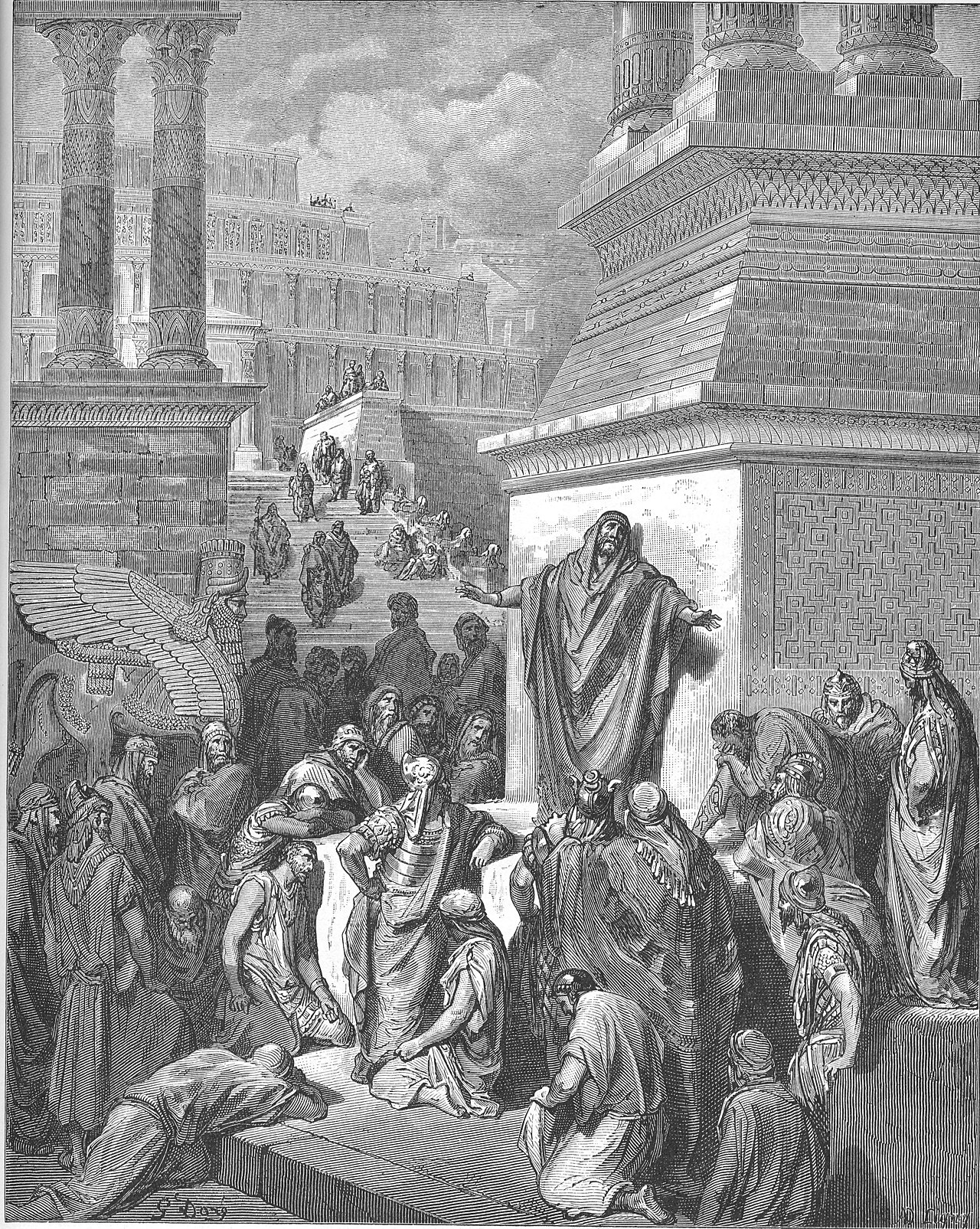
in Jonah 3Then he issued a proclamation in Nineveh: “By the decree of the king and his nobles: Let no man or beast, herd or flock, taste anything at all. They must not eat or drink.
BSB
The same verse in ASV and KJV ▾
ASV
And he made proclamation and published through Nineveh by the decree of the king and his nobles, saying, Let neither man nor beast, herd nor flock, taste anything; let them not feed, nor drink water;
KJV
And he caused it to be proclaimed and published through Nineveh by the decree of the king and his nobles, saying, Let neither man nor beast, herd nor flock, taste any thing: let them not feed, nor drink water:
⋯
This verse in Jonah 3
Commentary
10 notes on this verseA commentator
Albert Barnes1798–1870
Notes, Explanatory and Practical, on the Old and New Testaments (1832-1869)
And he caused it to be proclaimed and published through Nineveh; - literally, “And he cried and said, etc.” The cry or proclamation of the king corresponded with the cry of Jonah. Where the prophet’s cry, calling to repentance, had reached, the proclamation of the king followed, obeying. “By the decree of the king and his nobles.” This is a hint of the political state of Nineveh, beyond what we have elsewhere. It was not then an absolute monarchy.
This site's exposition
Let neither man nor beast, herd nor flock, taste any thing
on Jonah 3:7-9
Let neither man nor beast, herd nor flock, taste any thing extends the fast even to the city's animals, a detail without parallel elsewhere in Scripture that the commentators read as eastern custom rather than an invented flourish, since classical writers record similar mourning practices among other Near Eastern peoples. The decree goes past ritual, commanding that man and beast cry mightily unto God and that every one turn from his evil way and from the violence that is in their hands, naming violence specifically as the sin Nineveh must abandon. The king's own uncertainty, who can tell if God will turn and repent, and turn away from his fierce anger, that we perish not, asks for mercy without presuming it, and Henry and Pusey both read this as the humility the book commends against Jonah's own presumption that he already knew how God would act.
The record, by era
The Church Fathers4 voices
Now why should the little children, who had committed no sin, fast? Evidently, the innocent fasted in order that sinners might escape punishment; the little child cried out that the older man might not perish. But even if the fasting of infants was necessary, why …
The king conquered enemies with a display of valor. He conquered God, however, by humility. He is a wise king who, in order to save his people, owns himself a sinner rather than a king. He forgets that he is a king, fearing God the …
"For word came unto the king of Nineveh, and he arose from his throne, and he laid his robe from him, and covered him with sackcloth, and sat in ashes.
Let us see then how the Ninevites fasted, and how they were delivered from that wrath—"Let neither man nor beast, herd nor flock, taste anything," saith (the prophet). What sayest thou? Tell me—must even the irrational things fast, and the horses and the mules be covered with sackcloth? "Even so," he replies. For as when, at the decease of some rich man, the relatives clothe not only the men servants and maid servants, but the horses also with sackcloth, and give orders that they should follow the procession to the sepulchre, led by their grooms; thus signifying the greatness of the calamity, and inviting all to pity; thus also, indeed, when that city was about to be destroyed, even the irrational nature was enveloped in sackcloth, and subjected to the yoke of fasting. "It is not possible," saith he, "that irrational creatures should learn the wrath of God by means of reason; let them be taught by means of fasting, that this stroke is of divine infliction. For if the city should be overturned, not only would it be one common sepulchre for us, the dwellers therein, but for these likewise. Inasmuch then as these would participate in the punishment, let them also do so in the fast."
The Puritans and the Awakening1 voice
Taste any thing - Man and beast are to forbear to eat and drink, that the fast might be most solemn, that the cry of man, seconded with the cry of hungry cattle, might enter the ears of God, who preserveth man and beast.
3 more voices on this verse
The Puritans and the Awakening2 voices
And he caused it to be proclaimed and published through Nineveh,....
In prayer we must cry mightily, with a fixedness of thought, firmness of faith, and fervour of pious and devout affections. By crying mightily we wrestle with God; we take hold of him; and we are concerned to do so when he is not only departing from us as a friend, but coming forth against us as an enemy. It therefore concerns us in prayer to stir up all that is within us.
The Nineteenth Century1 voice
A commentator
Jamieson, Fausset & Brown1802–1910
Commentary Critical and Explanatory on the Whole Bible (1871)
proposed
neither . . . beast . . . taste any thing--The brute creatures share in the evil effects of man's sin (Jon 4:11; Ro 8:20, 22); so they here according to Eastern custom, are made to share in man's outward indications of humiliation.
quarantine:debris (2026-07-29) — starts-lowercase
The words behind it
19 Hebrew wordsEvery Hebrew word of this verse in the order it stands, with what it means and the door to its own study. The last column counts the times a word stands in the whole Bible: the rarer the word, the more the places it appears belong together.
| Hebrew | Sound | Meaning | Word study | In the Bible |
|---|---|---|---|---|
| וַיַּזְעֵ֗ק | vaiyazek | and he had a proclamation made | H2199 → | |
| וַיֹּ֙אמֶר֙ | vaiyomer | and he said | H559 → | 5305 times |
| בְּנִֽינְוֵ֔ה | benineveh | in Nineveh | H5210 → | 17 times |
| מִטַּ֧עַם | mitaam | from [the] decree of | H2940 → | |
| הַמֶּ֛לֶךְ | hamelekh | the king | H4428 → | |
| וּגְדֹלָ֖יו | ugedolav | and great [people] his | H1419 → | 526 times |
| לֵאמֹ֑ר | lemor | <to> saying | H559 → | 5305 times |
| הָאָדָ֨ם | haadam | the people | H120 → | 551 times |
| וְהַבְּהֵמָ֜ה | vehabehemah | and the livestock | H929 → | 190 times |
| הַבָּקָ֣ר | habakar | the cattle | H1241 → | |
| וְהַצֹּ֗אן | vehatzon | and the flock[s] | H6629 → | |
| אַֽל־ | ʾal- | may not | H408 → | 724 times |
| יִטְעֲמוּ֙ | yitamu | they taste | H2938 → | |
| מְא֔וּמָה | meumah | anything | H3972 → | |
| אַ֨ל־ | ʾal- | may not | H408 → | 724 times |
| יִרְע֔וּ | yiru | they graze | H7462 → | |
| וּמַ֖יִם | umayim | and water | H4325 → | |
| אַל־ | ʾal- | may not | H408 → | 724 times |
| יִשְׁתּֽוּ׃ | yishtu | they drink | H8354 → |
וַיַּזְעֵ֗קand he had a proclamation made
vaiyazekH2199 →
וַיֹּ֙אמֶר֙and he said
vaiyomerH559 →5305 times
בְּנִֽינְוֵ֔הin Nineveh
beninevehH5210 →17 times
מִטַּ֧עַםfrom [the] decree of
mitaamH2940 →
הַמֶּ֛לֶךְthe king
hamelekhH4428 →
וּגְדֹלָ֖יוand great [people] his
ugedolavH1419 →526 times
לֵאמֹ֑ר<to> saying
lemorH559 →5305 times
הָאָדָ֨םthe people
haadamH120 →551 times
וְהַבְּהֵמָ֜הand the livestock
vehabehemahH929 →190 times
הַבָּקָ֣רthe cattle
habakarH1241 →
וְהַצֹּ֗אןand the flock[s]
vehatzonH6629 →
אַֽל־may not
ʾal-H408 →724 times
יִטְעֲמוּ֙they taste
yitamuH2938 →
מְא֔וּמָהanything
meumahH3972 →
אַ֨ל־may not
ʾal-H408 →724 times
יִרְע֔וּthey graze
yiruH7462 →
וּמַ֖יִםand water
umayimH4325 →
אַל־may not
ʾal-H408 →724 times
יִשְׁתּֽוּ׃they drink
yishtuH8354 →
A shaded row is a word that stands 400 times or fewer in the Bible.
The walk
8 stopsEach card is a verse this one points to, and under it the verses that one points to in turn. Where several paths arrive at the same place, that place is listed first: the text keeps returning to it.
Through
Ezra 8:21And there by the Ahava Canal I proclaimed a fast, so that we might humble ourselves before our God and ask Him for a safe journey for us and our children, with all our…
it leads to
- Joel 1:14
Consecrate a fast; proclaim a solemn assembly! Gather the elders and all the residents of the land to the house of the LORD your God, and cry out to the LORD.
Reached by 3 separate paths from here.
- 2 Chronicles 20:3
Jehoshaphat was alarmed and set his face to seek the LORD. And he proclaimed a fast throughout Judah.
- Isaiah 30:21
And whether you turn to the right or to the left, your ears will hear this command behind you: “This is the way. Walk in it.”
- 1 Samuel 7:6
When they had gathered at Mizpah, they drew water and poured it out before the LORD. On that day they fasted, and there they confessed, “We have sinned against the LORD.” And Samuel judged…
- Jonah 3:5
And the Ninevites believed God. They proclaimed a fast and dressed in sackcloth, from the greatest of them to the least.
- Joel 1:14
Through
2 Chronicles 20:3Jehoshaphat was alarmed and set his face to seek the LORD. And he proclaimed a fast throughout Judah.
it leads to
- Daniel 9:3
So I turned my attention to the Lord God to seek Him by prayer and petition, with fasting, sackcloth, and ashes.
Reached by 2 separate paths from here.
- Daniel 9:3
Through
Jonah 3:5And the Ninevites believed God. They proclaimed a fast and dressed in sackcloth, from the greatest of them to the least.
it leads to
- Luke 11:32
The men of Nineveh will stand at the judgment with this generation and condemn it; for they repented at the preaching of Jonah, and now One greater than Jonah is here.
- Joel 2:12–17
“Yet even now,” declares the LORD, “return to Me with all your heart, with fasting, weeping, and mourning.”
- Luke 11:32
Where this verse is studied
About Jonah
Who and where
1 name in this verse with a page on the site.
This page draws on 10 works. Open the list of works
This page draws on Albert Barnes, Notes, Explanatory and Practical, on the Old and New Testaments (1832-1869); Caesarius of Arles, Commentary (church-history corpus); Edward Bouverie Pusey, The Minor Prophets: A Commentary; Jamieson, Fausset & Brown, Commentary Critical and Explanatory on the Whole Bible; Jerome, Commentary on Jonah, Chapter 3; John Chrysostom, Concerning the Statues, Homily 3; John Gill, Exposition of the Old Testament (1748-1763); John Wesley, Explanatory Notes upon the Old Testament; Matthew Henry, Commentary on the Whole Bible and Maximus of Turin, COMMENTARY ON JONAH.