
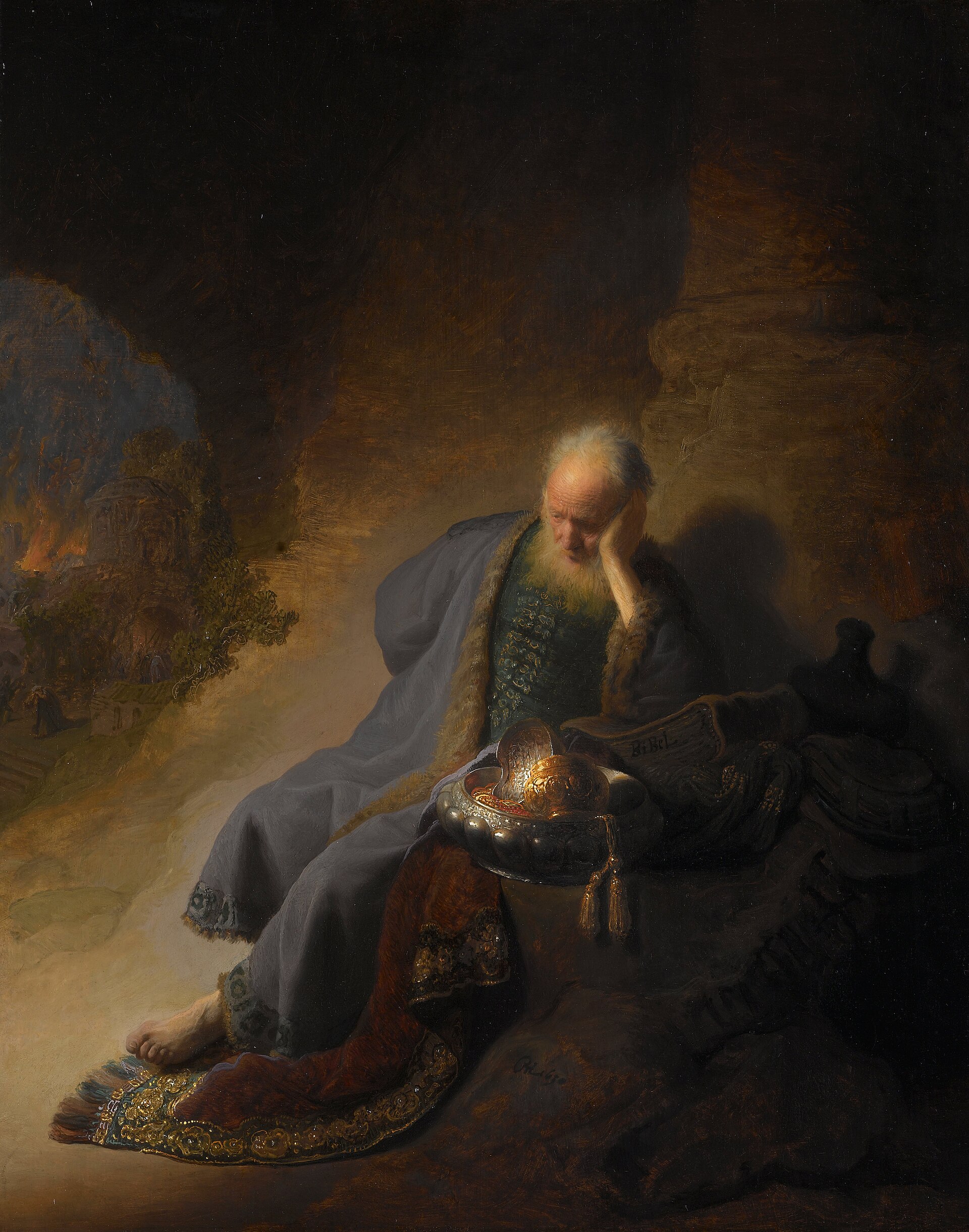
Jeremiahchapter 15
21 verses · Jeremiah, written by Baruch · 7th to 6th century BC · The Prophets
Then the LORD said to me: “Even if Moses and Samuel should stand before Me, My heart would not go out to this people. Send them from My presence, and let them go.
Introduction
Jeremiah, written by Baruch, The Prophets, Jeremiah Overview.
Jeremiah spoke this chapter in Judah's last decades, to a people who believed a great man of prayer could turn any sentence of God aside. They remembered Moses, who pleaded for Israel after the golden calf, and Samuel, who prayed for the nation in the days of its first king. The first half of the chapter is God's reply to the prayers of chapter 14. The second half is the prophet's own complaint, spoken out of loneliness and pain. Listen for the change of speaker in the middle. Then listen for the condition God sets before He promises to restore him.
Context
- Who
- People who had always assumed a great intercessor could turn any verdict
- What
- God's refusal to relent over Judah, followed by Jeremiah's lament over his calling and God's answer to him.
- Where
- Jerusalem, a city still carrying the guilt of Manasseh's reign.
- When
- The last decades of the kingdom of Judah, about 609 to 597 BC.
- Why
- To show that the time for turning aside the judgment had passed, and to call the prophet himself back to his task.
Historical context
Moses and Samuel are named because they were the two men in the national memory who had talked God out of judgment. Moses stood between God and the nation after the golden calf; Samuel prayed and thunder came in the wheat harvest. Saying that even those two standing before him would not move him is the strongest possible way of saying the case is closed.
Show the rest of the historical context, 3 more paragraphs
The four destroyers listed, sword, dogs, birds and beasts, form a curse that appears almost word for word in Assyrian treaty documents of that century. The horror is not just death but what follows: the body torn by scavenging dogs in the street, and the birds and wild animals finishing what is left, with no burial at all.
The guilt is pinned on Manasseh, the king who had reigned fifty-five years, filled Jerusalem with innocent blood, and set up altars inside the temple courts. He had died decades earlier. A whole generation was being told it was living in the wreckage of an old man's choices.
Then the chapter turns inward. Jeremiah says he never sat in the circle of merrymakers, that he was under God's hand alone, and that his pain is unceasing. He accuses God of being like a brook that runs in the rains and dries up in summer, the deceitful stream that fails a traveller who counted on it.
Significance
The first hearers learned that intercession has a limit. That was new. Their whole religious instinct was to find the right man to pray, and they are told there is no such man left.
Show the rest of the significance, 1 more paragraph
The prophet's own complaint is preserved without being cleaned up. He calls God unreliable to his face, and the answer he gets is not comfort but a condition, if you return, I will restore you, and a renewed promise that he will be a fortified bronze wall the nation cannot break.
This chapter in Jewish lifeWhat this chapter is in Jewish life and reading.
What is done
No part of this chapter is read in the synagogue. Probed for this lane, the site's own table in src/lib/hebraic/readings.ts printed parashot 0 and haftarah uses 0 for Jeremiah 15, and no festival reading for the book. Across chapters 1 to 26 of Jeremiah the same probe found a Haftarah only in chapters 1, 2, 3, 4, 7, 8, 9, 16 and 17.
How it is read
Rashi is the one commentator on this chapter whose English the corpus carries, quoted here from The Judaica Press complete Tanach with Rashi, translated by A. J. Rosenberg, which Sefaria reports as CC-BY.
On Moses and Samuel Rashi reads their intercession as coming after repentance. Both first turned the people back, and only then prayed for them. "But you cannot bring them back to Me, therefore do not pray for them" (Rashi on Jeremiah 15:1:1). He reads each calamity of the second verse as harsher than the one before it, and gives the reasons from Psalms and Lamentations (Rashi on Jeremiah 15:2:1).
On the cry of woe to his mother he reads the prophet's complaint that his own townsmen hated him for his rebukes (Rashi on Jeremiah 15:10:1). On the eleventh verse he sets Menahem's reading against Dunash's and follows the second, reading it as the release from chains Jeremiah received at the fall of the city (Rashi on Jeremiah 15:11:1).
The corpus carries four further notes on this chapter without an English text, each marked linked because Sefaria holds no English version of the ref. They stand cited and unquoted at Radak on Jeremiah 15:2:1, 15:14:1, 15:20:1 and 15:21:1.
What the rabbis say
The corpus carries 40 rabbinic locators on the verses of this chapter, 7 in the Talmud and 33 in the Midrash. It carries the text of none, so each is cited by ref here and never quoted or paraphrased. The verse numbers are the Hebrew ones the corpus prints.
On verse 1 it holds Bamidbar Rabbah 7:10, Bereshit Rabbah 19:9, Bereshit Rabbah 68:13, Eikhah Rabbah, Petichta 26 and Eikhah Rabbah, Petichta 4. On verse 2 it holds Bava Batra 8b:2, Bereshit Rabbati, Parashat Vayishlach 26, Eikhah Rabbah, Petichta 23 and Ein Yaakov (Glick Edition), Bava Batra 1:8. On verse 4 it holds Ein Yaakov (Glick Edition), Sanhedrin 11:77, Jerusalem Talmud Sanhedrin 10:2:13 and Sanhedrin 102b:20.
On verse 7 it holds Midrash Lekach Tov, Deuteronomy 17:16:1, Midrash Lekach Tov, Exodus 32:20:2, Midrash Tanchuma, Masei 13:1 and Sifra, Bechukotai, Chapter 6 6. On verse 8 it holds Bereshit Rabbah 65:20, Jerusalem Talmud Yevamot 16:3:3 and Ruth Rabbah (Lerner) 7:12:4. On verse 9 it holds Aggadat Bereshit 49:4, Bereshit Rabbah 68:10, Bereshit Rabbati, Parashat Vayetze 12 and Eikhah Rabbah 1:50. On verse 10 it holds Eikhah Rabbah, Petichta 15. On verse 12 it holds Otzar Midrashim, Midrashim of Rabbi Akiba, Aleph Bet of Rabbi Akiba (Version 2) 17.
On verse 15 it holds Midrash Tehillim 119:24, Midrash Tehillim 74:1 and Otzar Midrashim, Midrash on Psalms, Addendum to Psalm 118 34. On verse 16 it holds Vayikra Rabbah 12:2. On verse 17 it holds Bereshit Rabbati, Parashat Toldot 13, Eikhah Rabbah, Petichta 3, Pesikta DeRav Kahana 15:2 and Sifrei Devarim 356:5. On verse 18 it holds Bereshit Rabbati, Parashat Bereshit 28, Bereshit Rabbati, Parashat Bereshit 82 and Midrash Aggadah, Genesis 4:26:1.
On verse 19 it holds Avot DeRabbi Natan, Recension B 26:6, Bava Metzia 85a:16, Bava Metzia 85a:17 and Ein Yaakov (Glick Edition), Bava Metzia 7:9.
Sources: Rashi, Rashi on Jeremiah 15:1:1 to 15:19:1, The Judaica Press complete Tanach with Rashi, translated by A. J. Rosenberg, reported CC-BY; Radak, Radak on Jeremiah 15:2:1, 15:14:1, 15:20:1 and 15:21:1, cited by ref because the corpus carries no English text; The Sefaria corpus, scripts/data/sources/sefaria/jeremiah/15.json, the 40 Talmud and Midrash locators on the verses of this chapter; The site's own files, src/lib/hebraic/readings.ts, probed for Jeremiah 15: parashot 0, haftarah uses 0, and no festival reading for the book.
The heads below are this chapter's scenes. The numbered points under each are its verses.
Though Moses and Samuel Stood Before Me
Jeremiah 15:1-4
The chapter answers the plea of 14:19-22: “Even if Moses and Samuel should stand before Me, My heart would not go out to this people”. The LORD appoints “four kinds of destroyers” and lays the cause on Manasseh, whose sins recorded in 2 Kings 21 still bear fruit generations later.
Jeremiah 15:1
“Cast them out of my sight - Rather, “send them out of My presence, and let them go away.” The prophet is to dismiss them, because their mediators, Moses and Samuel, whose intercession had been accepted in old times (marginal references), would intercede now in vain.”
1 more voice on this verseWhat preachers and commentators have said about this verse, in their own words.
Jeremiah 15:1
“The putting of this as a case, Though they should stand before me, supposes that they do not, and is an intimation that saints in heaven are not intercessors for saints on earth. It is the prerogative of the Eternal Word to be the only Mediator in the other world, whatever Moses, and Samuel, and others were in this. He condemns them all to one destroying judgment or other.”
Matthew Henry · Commentary on the Whole Bible (1707-1721)puritan
If they ask you: The question has four answers, and each is a judgment. Adam Clarke takes death here as the plague, set beside the sword, famine and captivity. Matthew Henry pictures the people fleeing one judgment only to meet another, with no place left to be safe.
Jeremiah 15:2
“Whither shall we go forth? - Such as are for death, to death - Some shall be destroyed by the pestilence, here termed death. See Jer 18:21. Others shall be slain by the sword in battle, and in the sackage of cities. Others shall perish by famine, shall be starved to death through the mere want of the necessaries of life; and the rest shall go into captivity. There shall be different sorts of punishments inflicted on them according to the nature of their transgressions. Some shall be punished in one way, and some in another.”
Adam Clarke · Commentary on the Bible (1810-1826)evangelical
I will appoint over them four kinds: Barnes notes that the sword kills the living, and the dogs, birds and beasts devour and shame the dead. The word for the work of the dogs means to drag along the ground. The Targum, Gill reports, calls these four destroyers four evil punishments.
Jeremiah 15:3
“And I will appoint over them four kinds, saith the Lord,.... Or four families (x), and these very devouring ones; that is, four sorts of punishment; and so the Targum, "four evil punishments;'' which are after mentioned.”
1 more voice on this verse
Jeremiah 15:3
“Kinds - literally, as the margin, i. e., classes of things. The first is to destroy the living, the other three to mutilate and consume the dead. To tear - literally, “to drag along the ground.” It forcibly expresses the contumely to which the bodies of the slain will be exposed.”
I will make them a horror to all: The sins of Manasseh still stand in the account. Barnes notes that naming his godly father Hezekiah deepens the horror of the son's evil. Jamieson, Fausset and Brown add that Manasseh himself repented, and the people kept following his example after him.
Jeremiah 15:4
“Manasseh - Manasseh is here named as the son of Hezekiah for his shame, because of his degeneracy from so good a parent; it is expressly said, 2 Kings xxiii, 26, that not withstanding Josiah's reformation, yet the Lord turned not from the fierceness of his wrath, kindled against Judah, for the provocations of Manasseh.”
John Wesley · Explanatory Notes upon the Old Testament (1765)evangelical
2 more voices on this verse
Jeremiah 15:4
“I will cause them to be removed into an kingdoms of the earth - This seems to have respect to the succeeding state of the Jews in their different generations; and never was there a prophecy more literally fulfilled; and it is still a standing monument of Divine truth. Let infidelity cast its eyes on the scattered Jews whom it may meet with in every civilized nation of the world; and then let it deny the truth of this prophecy, if it can.”
Adam Clarke · Commentary on the Bible (1810-1826)evangelical
Jeremiah 15:4
“The greatest part of a generation was worn off since Manasseh's time, yet his sin is brought into the account; as in Jerusalem's last ruin God brought upon it all the righteous blood shed on the earth, to show how heavy the guilt of blood will light and lie somewhere, sooner or later, and that reprieves are not pardons.”
Matthew Henry · Commentary on the Whole Bible (1707-1721)puritan
Jeremiah 15:5-9
Who will have pity on you, O Jerusalem?: The questions of verse 5 picture a city so friendless that no one will “turn aside to ask about your welfare”. The words “I am weary of showing compassion” follow the charge “You have turned your back”. Widows and “a destroyer at noon” describe a ruin that comes in daylight.
Jeremiah 15:5
“Who shall go aside to ask how thou doest? - Perhaps there is not a more despised nor a more degraded people under the sun. Scarcely any one thinks himself called upon to do a kind office for a Jew. Their character is bad in society, and they are not at all solicitous to redeem it.”
Adam Clarke · Commentary on the Bible (1810-1826)evangelical
2 more voices on this verse
Jeremiah 15:5
“For who shall have pity upon thee, O Jerusalem?....”
Jeremiah 15:5
“He will set their acquaintance, as he did Job's at a distance from them; and his hand, his righteous hand, is to be acknowledged in all the unkindnesses of our friends, as well as in all the injuries done us by our foes. The Prophet Assured of His Safety. 10 Woe is me, my mother, that thou hast borne me a man of strife and a man of contention to the whole earth!”
Matthew Henry · Commentary on the Whole Bible (1707-1721)puritan
You have forsaken Me, declares the LORD: Judah has forsaken the LORD and turned its back. Adam Clarke reads the LORD as weary of holding back the punishment again and again, and he will hold it back no longer. Barnes adds that the long delay had made Judah turn further from the LORD.
Jeremiah 15:6
“I am weary with repenting - With repeatedly changing my purpose. I have often, after purposing to punish, showed them mercy. I will do it no longer; it is useless. I took them often at their promise, and in every instance they have failed.”
Adam Clarke · Commentary on the Bible (1810-1826)evangelical
I will scatter them with a winnowing fork: Winnowing parts grain from chaff in the wind. Wesley reads this fork as one that scatters, and Adam Clarke says no pure grain is left. Barnes takes the gates of the land as the ways out through which the people are driven in every direction.
Jeremiah 15:7
I will fan them ... - Or, “I have winnowed them with a winnowing shovel.” The “gates of the land” mean the places by which men enter or leave it. As God winnows them they are driven out of the land through all its outlets in every direction. I will bereave - Rather, “I have bereaved, I have destroyed my people.” Omit “of children.” Since they return not ... - Rather, “from their ways they have not returned.”
1 more voice on this verse
Jeremiah 15:7
“A fan - Not a purging fan by affliction, to separate their chaff and dross from them, but a scattering fan. In the gates - This is added in pursuit of the metaphor of fanning, men usually chusing barn-doors to fan at, that they may have the advantage of the wind.”
John Wesley · Explanatory Notes upon the Old Testament (1765)evangelical
I will make their widows more numerous: Matthew Henry recalls the promise that the men of Israel would be as many as the sand of the sea. Now the widows reach that count. Wesley places this in the siege under Zedekiah, and Adam Clarke reads the mother of young men as Jerusalem, the mother city.
Jeremiah 15:8
Translate, “I have brought upon them, even upon the mother of the young man, a spoiler etc.” The word rendered “young man” means a picked warrior. The mother has borne a valiant champion; but neither his prowess nor the numerous offspring of the other can avail to save those who gave them birth; war bereaves both alike. At noonday - i. e., unexpectedly, as armies used to rest at noon (see Jer 6:4 note). I have caused him ... - Rather, “I have brought suddenly upon her,” the mother of the young warrior, “anguish and terrors.”
3 more voices on this verse
Jeremiah 15:8
“A dreadful slaughter is here described. First, The wives are deprived of their husbands: Their widows are increased above the sand of the seas, so numerous have they now grown. It was promised that the men of Israel (for those only were numbered) should be as the sand of the sea for multitude; but now they shall be all cut off, and their widows shall be so.”
Matthew Henry · Commentary on the Whole Bible (1707-1721)puritan
Jeremiah 15:8
“Their widows--My people's (Jer 15:7). have brought--prophetical past: I will bring. mother of the young men--"mother" is collective; after the "widows," He naturally mentions bereavement of their sons ("young men"), brought on the "mothers" by "the spoiler"; it was owing to the number of men slain that the "widows" were so many [CALVIN].”
Jamieson, Fausset & Brown · Commentary Critical and Explanatory on the Whole Bible (1871)reformed
Jeremiah 15:8
“Their widows are increased to me above the sand of the seas,.... Their husbands being slain; not in the times of Ahaz, when a hundred and twenty thousand men were slain in one day in Judah, by Pekah the son of Remaliah, 2Ch 28:6, as Kimchi thinks; but in the times of Zedekiah, at the siege of Jerusalem, and the taking of it, and in the Babylonish captivity before predicted.”
The mother of seven will grow faint: Adam Clarke takes seven as a full number, and Wesley reads it as many children. Barnes explains that a childless mother bore disgrace in Israel. Her sun sets while it is still day, and Jamieson, Fausset and Brown read it as fortune leaving her at the height of her prosperity.
Jeremiah 15:9
“Seven being the perfect number indicates full fruitfulness. languisheth--because not even one is left of all her sons (Jer 15:8). sun is gone down while . . . yet day--Fortune deserts her at the very height of her prosperity (Am 8:9). she . . . ashamed--The mothers (she being collective) are put to the shame of disappointed hopes through the loss of all their children.”
Jamieson, Fausset & Brown · Commentary Critical and Explanatory on the Whole Bible (1871)reformed
1 more voice on this verse
Jeremiah 15:9
“She hath been ashamed - Or, “is ashamed.” To a Hebrew mother to be childless was a disgrace. Many consider that Jer 15:7-9 refer to the battle of Megiddo, and depict the consternation of Jerusalem at that sad event. If so, in the sun going down while it was day, there will be a reference to the eclipse on September 30, 610 b.c.”
Woe Is Me, My Mother, That Thou Hast Borne Me
Jeremiah 15:10-11
Woe to me, my mother, that you have borne me: Jeremiah’s complaint breaks in without transition, “Woe to me, my mother, that you have borne me”, a cry against his birth. He has “neither lent nor borrowed, yet everyone curses me”. The LORD’s answer brings no rebuke, only a promise, “Surely I will deliver you for a good purpose”.
Jeremiah 15:10
“A man of contention to the whole earth! - To the whole Land, to all his countrymen; though he had done nothing to merit their displeasure.”
Adam Clarke · Commentary on the Bible (1810-1826)evangelical
1 more voice on this verse
Jeremiah 15:10
“He was a peaceable man, gave no provocation to any, nor was apt to resent the provocations given him, and yet a man of strife, not a man striving, but a man striven with; he was for peace, but, when he spoke, they were for war. And, whatever they pretended, that which was the real cause of their quarrels with him was his faithfulness to God and to their souls.”
Matthew Henry · Commentary on the Whole Bible (1707-1721)puritan
The LORD answers the complaint with an oath to deliver him for good, as Matthew Henry reads the Hebrew. Barnes reads the enemy as coming to him in a time of trouble and distress to ask for prayer, citing 21:1-2 and 37:3. Adam Clarke sees the promise kept by Nebuchadnezzar.
Jeremiah 15:11
“Shall be well with thy remnant - Or, thy loosing shall be for good; in the sense of being set free, deliverance. To entreat thee well ... - Rather, “to supplicate thee in the time of evil etc.;” fulfilled in Jer 21:1-2; Jer 37:3; Jer 42:2.”
1 more voice on this verse
Jeremiah 15:11
“It is in the original expressed in the form of an oath: " If I take not care of thee, let me never be counted faithful; verily it shall go well with thy remnant, with the remainder of thy life" (for so the word signifies); "the residue of thy days shall be more comfortable to thee than those hitherto have been." Thy end shall be good; so the Chaldee reads it.”
Matthew Henry · Commentary on the Whole Bible (1707-1721)puritan
Jeremiah 15:12-14
The question “Can anyone smash iron” names the northern power, iron from the north. Verses 13 and 14 repeat what Judah has heard, treasures given up “as plunder, without charge” and slavery “in a land you do not know”. Gill notes the Hebrew of this passage is hard to read.
Jeremiah 15:12
“Shall iron break the northern iron and the steel? - Shall our weak forces be able to oppose and overcome the powers of the Chaldeans? נחשת nechasheth, which we here translate steel, property signifies brass or copper united with tin, which gives it much hardness, and enables it to bear a good edge.”
Adam Clarke · Commentary on the Bible (1810-1826)evangelical
3 more voices on this verse
Jeremiah 15:12
“The northern iron - As the northern iron and steel is the hardest, and no iron could break that, so God having edged and hardened their enemies, the Chaldeans, all opposition to them would signify nothing.”
John Wesley · Explanatory Notes upon the Old Testament (1765)evangelical
Jeremiah 15:12
"Can one break iron, (even) the northern iron, and brass," on the ground that English Version makes ordinary iron not so hard as brass. But it is not brass, but a particular mixture of iron and brass, which is represented as harder than common iron, which was probably then of inferior texture, owing to ignorance of modern modes of preparation.
Jamieson, Fausset & Brown · Commentary Critical and Explanatory on the Whole Bible (1871)reformed
Jeremiah 15:12
“They were continually clashing with him, and were rough and hard as iron; but Jeremiah, being armed with power and courage from on high, is as northern iron, which is naturally stronger, and as steel, which is hardened by art; and therefore they shall not prevail against him; compare this with Ezek. ii.”
Matthew Henry · Commentary on the Whole Bible (1707-1721)puritan
Your wealth and your treasures I will give: The treasures go to the enemy for nothing in return. Barnes reads the phrase as God giving them away as things of no value to him, on account of Judah's sins. Matthew Henry notes that every border shared the guilt, so every part of the land shares the loss.
Jeremiah 15:13
“Jeremiah is personally addressed in the verse, because he stood before God as the intercessor, representing the people. (1) God would give Judah’s treasures away for nothing; implying that He did not value them. (2) the cause of this contempt is Judah’s sins. (3) this is justified by Judah having committed them throughout her whole land.”
1 more voice on this verse
Jeremiah 15:13
“And it is their own iniquity that herein corrects them: It is for all thy sins, even in all thy borders. All parts of the country, even those which lay most remote, had contributed to the national guilt, and all shall now be brought to account. Let not one tribe lay the blame upon another, but each take shame to itself: It is for all thy sins in all thy borders.”
Matthew Henry · Commentary on the Whole Bible (1707-1721)puritan
Then I will enslave you to your enemies: Barnes renders the clause as Judah made to serve its enemies, the reading the Berean follows. Jamieson, Fausset and Brown follow Maurer, who makes the treasures of verse 13 the plunder carried to the enemy. Gill names the land they do not know as Babylon.
Jeremiah 15:14
“And I will make thee to pass with thine enemies,.... Not Jeremiah, but the Jews, to whom these words are continued. The meaning is, that they should go along with the Chaldeans out of their own land into theirs: into a land which thou knowest not; the land of Babylon; and there is another reading of the words in the margin, "I will cause thee to serve thine enemies (o), in a land that thou knowest not"; which is followed by the Targum, Septuagint, Syriac, and Arabic versions.”
Thy Words Were Found and I Did Eat Them: a Brazen Wall
Jeremiah 15:15-18
remember me and attend to me: The complaint opens with a plea, “Avenge me against my persecutors”, then turns to gratitude, “Your words were found, and I ate them”. The turn in verse 18 is sudden, “Why is my pain unending”, and he says the LORD has become “like a mirage to me”.
Jeremiah 15:15
“Contrast in this the law with the gospel (Lu 23:34; Ac 7:60). take me not away in thy long-suffering--By Thy long-suffering towards them, suffer them not meanwhile to take away my life. for thy sake I have suffered rebuke--the very words of the antitype, Jesus Christ (Ps 69:7, 22-28), which last compare with Jeremiah's prayer in the beginning of this verse.”
Jamieson, Fausset & Brown · Commentary Critical and Explanatory on the Whole Bible (1871)reformed
1 more voice on this verse
Jeremiah 15:15
“This is the prayer of a man in bitter grief, whose human nature cannot at present submit to the divine will. God’s long-suffering toward the wicked seemed to the prophet to be the abandonment of himself to death; justice itself required that one who was suffering contumely for God’s sake should be delivered. Rebuke - i. e., reproach, contumely. Jer 15:16 Thy words were found - Jeremiah’s summons to the prophetic office had not been expected or sought for by him. I did eat them - i. e., I received them with joy.”
Your words were found, and I ate them: Gill likens the words of the LORD to food for a hungry man, received and stored in the heart. Jamieson, Fausset and Brown read bearing the name of the LORD as belonging to him. Adam Clarke notes that the same faithfulness made the people his enemies.
Jeremiah 15:16
"And your word shall be to me for gladness." It is not now, but "shall be"; for since at present your word is to me for imprisonments, for trials, for troubles, for defamations, for pains — yet the end of these shall be gladness. "And your word shall be to me for gladness and joy of my heart, because your name has been called upon me, Lord Almighty." And if Christ says it, the name of the Father has been called upon him.
Origen of Alexandria · written before 253 · Homilies on Jeremiah 14patristic
1 more voice on this verse
Jeremiah 15:16
“The Keri reads, "Thy word." thy word . . . joy-- (Job 23:12; Ps 119:72, 111; compare Mt 13:44). called by thy name--I am Thine, Thy minister. So the antitype, Jesus Christ (Ex 23:21).”
Jamieson, Fausset & Brown · Commentary Critical and Explanatory on the Whole Bible (1871)reformed
I never sat with the band of revelers: Jeremiah stayed away from the mockers, and his joy in verse 16 was a different joy from theirs. Jamieson, Fausset and Brown read the hand of God as his inspiration, and his faithful prophecies cut him off from company. He sat alone.
Why is my pain unending: The cry stands against the joy. Jamieson, Fausset and Brown read the pain as the constant persecution and the feeling of being left by God. Adam Clarke explains the mirage as the look of water a desert traveler sees and never reaches, or a spring that dries in summer.
Jeremiah 15:18
Now the so-called gods of the Greeks, unworthy of the name, are faithful neither in their essence nor in their promises, because they are not everywhere. The local deities amount to nothing over the course of time and undergo a natural extinction. For these reasons, the Word cries out against them, that "faith is not strong in them," that they are "waters that fail" and "there is no faith in them." But the God of all, who is indeed truly faithful, who is ever the same, says, "See now that I, even I am he," and "I change not."
Athanasius of Alexandria · written before 373 · Discourses Against the Arians 2.14.10patristic
2 more voices on this verse
Jeremiah 15:18
“Wilt thou be altogether unto me as - waters that fail? - Leaning either springs, which in the height of summer grow dry; or, like that phenomenon in the sandy desert, where, by a peculiar action of the air on the rising vapors, the resemblance of water is produced, so that the traveler, deceived, rejoices that he is come, in the sandy desert, to the verge of a beautiful lake; but the farther he travels, it is still at the same distance, and at last vanishes; and he finds the whole was an illusion, for the waters have failed.”
Adam Clarke · Commentary on the Bible (1810-1826)evangelical
Jeremiah 15:18
"Pain," namely, the perpetual persecution to which he was exposed, and his being left by God without consolation and "alone." Contrast his feeling here with that in Jer 15:16, when he enjoyed the full presence of God, and was inspired by His words.
Jamieson, Fausset & Brown · Commentary Critical and Explanatory on the Whole Bible (1871)reformed
Jeremiah 15:19-21
The LORD calls Jeremiah back to his post, “If you return, I will restore you”. The rule of his office follows, “It is they who must turn to you, but you must not turn to them”. The promise returns to chapter 1, “a fortified wall of bronze”.
Jeremiah 15:19
“Therefore thus saith the Lord, if thou return,.... From thine unbelief, diffidence, and impenitence, and repent of them; expressed in the preceding verses: then will I bring thee again; or, "restore thee (s)"; pardon his sin, and return him to his post and place, to his office and ministry in it, and confirm and establish him therein: and thou shalt stand before me; not only as a petitioner for the people; see Jer 15:1, but as a servant of the Lord, attending to his word, and waiting his orders, and ready to execute them.”
2 more voices on this verse
Jeremiah 15:19
“It is obvious that the text above was said not by Jerusalem but by a prophet. To him the Lord responds, "If you turn from the sins of the people, I likewise will turn you from tribulation toward joyfulness, and you will stand before my face like the angels stand in the presence of God daily, beholding his face." Also, if you separate the precious from the vile, you will become like my mouth.”
Jerome · written before 420 · Six Books on Jeremiah 3:59patristic
Jeremiah 15:19
“Jeremiah had questioned God’s righteousness (see Jer 12:1 note); he is told, “If thou return,” if thou repent thee of thy doubts, and think only of thy duty, “then will I bring thee again, then will I cause thee again to stand before Me.” To stand before a person means to be his chief officer or vicegerent. It implies therefore the restoration of Jeremiah to the prophetic office. If thou take forth the precious from the vile - i. e., if thou cause the precious metal to come forth from the dross.”
Then I will make you a wall: The wall of bronze stands against the people who fight it. Matthew Henry pictures a wall the storm beats on and cannot shake, and ties it to the call of verse 19 to stand firm. Adam Clarke reads the promise to save and deliver as standing while Jeremiah stays faithful.
Jeremiah 15:20
“I will make thee - a fenced brazen wall - While thou art faithful to me, none of them shall be able to prevail against thee.”
Adam Clarke · Commentary on the Bible (1810-1826)evangelical
I will deliver you from the hand: Gill names the wicked as Zedekiah and his court, who put Jeremiah in prison. Adam Clarke reads the ruthless as the Chaldean armies. The LORD promises to deliver and redeem him from both, and Clarke records that it came about as the LORD said.
Jeremiah 15:21
“And I will deliver thee out of the hand of the wicked,.... The wicked Jews, Zedekiah and his courtiers, who imprisoned him: and I will redeem thee out of the hand of the terrible; as kings and great men of the earth seem to be; or, "the violent", or "strong" (t), and mighty; that were stronger than he, that would use him with violence, and inject terror into him. (t) עריצים "violentorum", Junius & Tremellius, Piscator, Cocceius, Schmidt; "fortium", V. L.”
2 more voices on this verse
Jeremiah 15:21
“I will deliver thee out of the hand of the wicked - From the power of this evil people. And I will redeem thee out of the hand of the terrible - Out of the power of the Chaldean armies. Every thing took place as God had promised, for no word of his can ever fall to the ground.”
Adam Clarke · Commentary on the Bible (1810-1826)evangelical
Jeremiah 15:21
“God will so deliver them as to preserve them to his heavenly kingdom ( 2 Tim. iv. 18 ), and that is deliverance enough. There are many things that appear very frightful that yet do not prove at all hurtful to a good man.”
Matthew Henry · Commentary on the Whole Bible (1707-1721)puritan
Keep studying
Places1
Sources for this chapter
The summary
Jamieson, Fausset & Brown, Commentary Critical and Explanatory; John Calvin, Commentaries; John Wesley, Notes on the Old Testament and Matthew Henry, Complete Commentary.
The exposition
Adam Clarke, Commentary on the Bible; Albert Barnes, Notes, Explanatory and Practical, on the Old and New Testaments (1832-1869); Carl Friedrich Keil, The Prophecies of Jeremiah; Jamieson, Fausset & Brown, Commentary Critical and Explanatory on the Whole Bible; John Calvin, Commentary on Jeremiah and Lamentations; John Gill; John Wesley, Explanatory Notes upon the Old Testament and Matthew Henry, Commentary on the Whole Bible.