
Isaiahchapter 27
13 verses · Isaiah · 8th century BC · The Prophets
In that day: “Sing about a fruitful vineyard.
Introduction
Isaiah, The Prophets, Isaiah Overview.
This chapter closes the section on the judgment of the whole earth that began in chapter 24. It speaks to a people who had heard Isaiah call Israel a failed vineyard in chapter 5 and remembered how that song ended. It moves from the defeat of a sea monster to a new song of the vineyard, then to the cost of pardon and the gathering of the scattered. Listen for how each complaint of the earlier vineyard song is answered. It ends with a great trumpet calling the exiles home.
Context
- Who
- Judeans who had heard the vineyard song in chapter 5 and remembered how it ended
- What
- The defeat of Leviathan, a new song of the LORD's guarded vineyard, the purging of Israel's idolatry, and the gathering of the exiles to Jerusalem.
- Where
- The sea of the serpent, the vineyard of Israel, and the road home from Assyria and Egypt to the holy mountain in Jerusalem.
- When
- Spoken most likely between about 715 and 700 BC, looking ahead to the day of the great trumpet.
- Why
- To promise Israel that the God who judged His vineyard would keep it, forgive it and bring its scattered people home to worship.
Historical context
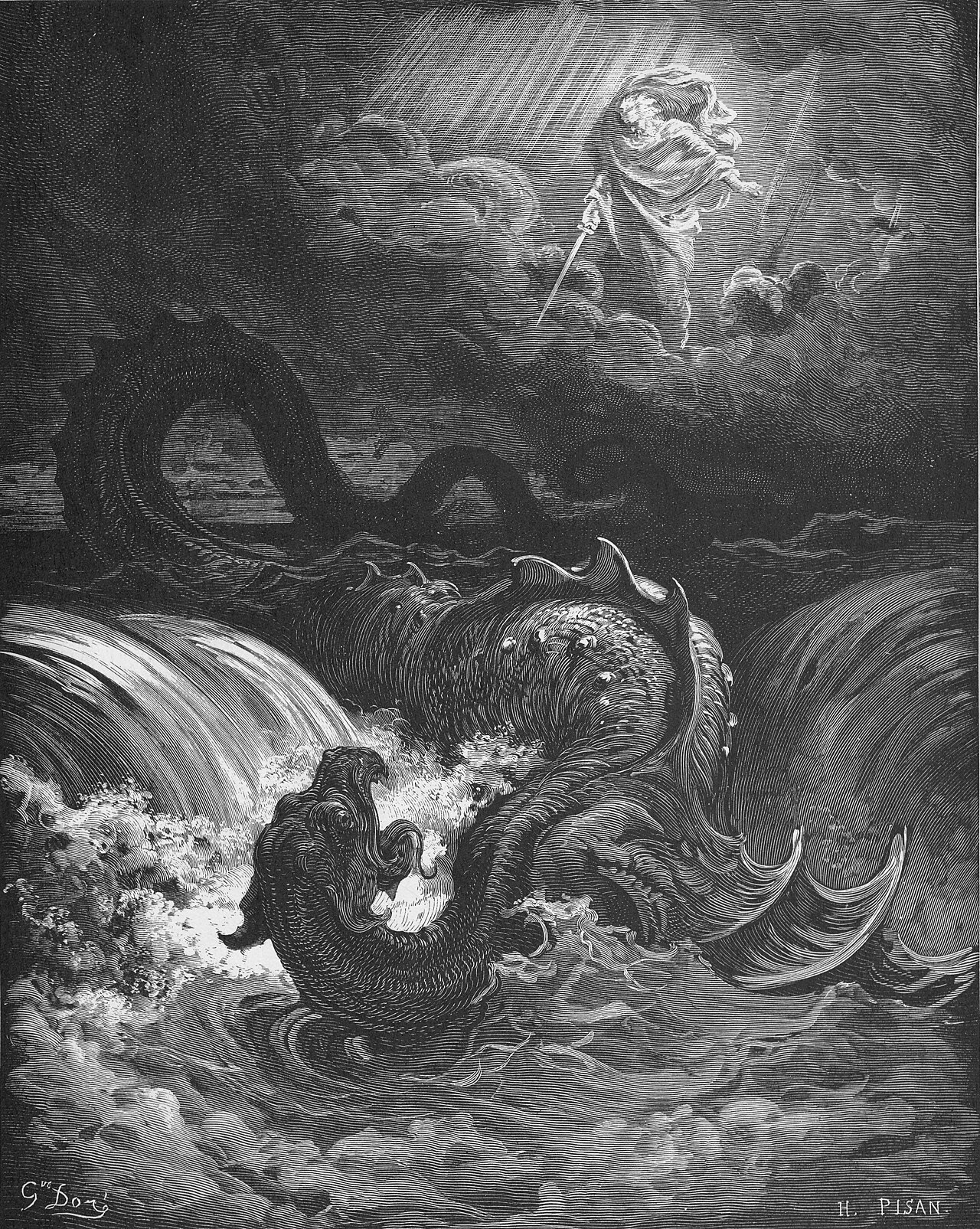
Leviathan is named with three descriptions: the fleeing serpent, the twisting serpent, and the dragon in the sea. Those exact phrases turn up in the Canaanite poems recovered at Ugarit, where a seven-headed twisting sea monster is the enemy the storm god fights. Isaiah's hearers knew the creature from the stories around them. He does not argue about the mythology; he simply says that on that day the LORD will take his sword and kill it, the chaos everyone else worships or fears is on the list of things God ends.
Show the rest of the historical context, 4 more paragraphs
Then the vineyard returns, and every complaint of chapter 5 is answered item by item. That vineyard had its hedge taken away and its wall broken and was given to briers; this one God waters every moment and guards night and day so no one harms it, and if briers come up he goes to war with them himself. The one condition offered to the briers is startling: let them take hold of my strength and make peace with me.
The threshing image in the last section is exact. God is described as beating out the grain from the river of the Euphrates to the brook of Egypt, the whole span of the land Israel was promised, and gathering his people one by one, the way grain is picked out of the chaff by hand rather than swept up.
The gathering signal is a trumpet. In Israel, a ram's horn called the assembly, announced the new moon and the holy days, and rallied a scattered militia. The great trumpet blown here brings back those who were perishing in Assyria and those driven out to Egypt, and they come to worship at the holy mountain in Jerusalem.
One detail shows what forgiveness cost. The condition of pardon is that Israel grinds the stones of her pagan altars to chalk, and the sacred poles and incense altars do not stand back up. Chalk-crushing was demolition work.
Significance
For hearers who had heard God call Israel a failed vineyard, this was the reversal: the same owner, the same field, and now a guard posted around the clock.
Show the rest of the significance, 1 more paragraph
The horn that gathers the lost from the two empires that ate them was a promise to a people already being carried away. It is not a promise that the exile will not happen. It is a promise about who blows the recall.
This chapter in Jewish lifeWhat this chapter is in Jewish life and reading.
What is done
A Jewish congregation hears the second half of this chapter aloud. In the Ashkenazi rite the Haftarah of the portion Shemot, which reads Exodus 1:1 to 6:1, is Isaiah 27:6 to 28:13 and 29:22 to 29:23, as the site's table in src/lib/hebraic/readings.ts records it. The same table records that the Sephardi rite reads Jeremiah 1:1 to 2:3 with that portion, so a Sephardi congregation does not hear this chapter on that Sabbath. The reading opens at the sixth verse, which Rashi reads of the sons of Jacob who came to Egypt, and it is read with the opening portion of Exodus.
How it is read
Rashi is quoted here from The Judaica Press complete Tanach with Rashi, translated by A. J. Rosenberg, which Sefaria reports as CC-BY, and Ibn Ezra from the Commentary of Ibn Ezra on Isaiah translated by M. Friedlander in 1873, which Sefaria reports as public domain. The leviathan of the first verse is read three ways in one note. Jonathan renders the two serpents as Pharaoh, the first king, and Sennacherib, the second. Rashi adds his own reading: "these are three important nations: Egypt, Assyria, and Edom" (Rashi on Isaiah 27:1:1 and 27:1:2). The vineyard of the second verse is Israel at the redemption, sung over as a vineyard that has yielded its good wine (Rashi on Isaiah 27:2:1).
At the fourth verse Rashi gives Jonathan's reading, which turns God's wrath on the nations, and then the reading of the Sages, which turns it back on the vineyard. God cannot pour out His wrath to destroy it "because of the oath I swore to their forefathers" (Rashi on Isaiah 27:4:2). The two readings stand together, and he chooses neither.
The sixth verse is where the Haftarah of Shemot begins, and Rashi's note on it looks back to the opening of Exodus. "Those who came to Egypt which Jacob caused to take root, flourished and blossomed there until they filled the face of the world with fruitage" (Rashi on Isaiah 27:6:1). The measure of the eighth verse is measure for measure: Egypt drowned Israel's sons in water and was drowned in water (Rashi on Isaiah 27:7:1 and 27:8:2). At the eleventh verse he reports the dispute of Menahem and Dunash over one word, and the ruling of the Sages in Bava Batra 10b against taking charity from the nations (Rashi on Isaiah 27:11:2). The lost of the last verse are the tribes scattered "within the Sambatyon River" (Rashi on Isaiah 27:13:1).
What the rabbis say
The corpus carries forty rabbinic locators on this chapter and the text of none, so each is cited by ref here and none is quoted or paraphrased. On the first verse it holds Bava Batra 74b:5, Bava Batra 74b:6, Ein Yaakov (Glick Edition), Bava Batra 5:19 and Ein Yaakov (Glick Edition), Bava Batra 5:20. On the second verse it holds Bamidbar Rabbah 10:2, Midrash Lekach Tov, Numbers 21:17:1, Midrash Sekhel Tov, Shemot 1:21:1 and Midrash Tanchuma, Mishpatim 5:11. On the third verse it holds Bereshit Rabbah 13:17, Jerusalem Talmud Avodah Zarah 3:5:6-7 and Jerusalem Talmud Berakhot 9:2:24. On the fourth verse it holds Avodah Zarah 4a:5, Ein Yaakov (Glick Edition), Nedarim 3:8 and Ein Yaakov, Nedarim 3:13. On the fifth verse it holds Bamidbar Rabbah 13:16, Mekhilta DeRabbi Shimon Ben Yochai 14:19 and Otzar Midrashim, Tractate of Emanations 1:7.
On the sixth verse it holds Ein Yaakov (Glick Edition), Shabbat 22:2, Ein Yaakov, Shabbat 22:2 and Midrash Aggadah, Exodus 1:1:1. On the seventh verse it holds Midrash Sekhel Tov, Bereshit 34:31:1, Pesikta DeRav Kahana 11:4 and Yalkut Shimoni on Torah 226:1. On the eighth verse it holds Bamidbar Rabbah 9:24, Ein Yaakov (Glick Edition), Sanhedrin 11:62 and Ein Yaakov (Glick Edition), Shabbat 13:2. On the ninth verse it holds Avodah Zarah 54a:1, Eikhah Rabbah 2:3 and Jerusalem Talmud Avodah Zarah 4:4:10. On the tenth verse it holds Mekhilta DeRabbi Yishmael, Tractate Vayehi Beshalach 5:16, Midrash Tanchuma, Shemot 8:3 and Midrash Tanchuma, Tazria 8:1.
On the eleventh verse it holds Bava Batra 10b:13, Berakhot 33a:19 and Ein Yaakov (Glick Edition), Berakhot 5:10. On the twelfth verse it holds Shemot Rabbah 30:1. On the thirteenth verse it holds Bamidbar Rabbah 13:20, Bamidbar Rabbah 13:5 and Berakhot 56b:11.
The corpus files one further locator under a verse number this chapter does not reach. The site's table in src/data/bible/chapter-verse-counts.json counts the chapter at 13 verses in the Berean Standard Bible. The corpus files Ein Yaakov (Glick Edition), Sanhedrin 11:58 at the number 15. It is cited as the corpus files it, and the anchor is left for a check against the source. What each of them teaches is a saying of the rabbis, and it is reported as theirs wherever this site quotes one. The quotations wait on a fetch that carries the text.
Sources: Rashi, Rashi on Isaiah 27:1:1 to 27:13:1, The Judaica Press complete Tanach with Rashi, translated by A. J. Rosenberg, reported CC-BY; Ibn Ezra, Ibn Ezra on Isaiah 27:2:1 to 27:6:1, Commentary of Ibn Ezra on Isaiah, translated by M. Friedlander, 1873, reported public domain; The Sefaria corpus, scripts/data/sources/sefaria/isaiah/27.json, the 40 Talmud and Midrash locators of this chapter; The site's own files, src/lib/hebraic/readings.ts, the Haftarah of Shemot (Ashkenazi, Isaiah 27:6 to 28:13 and 29:22 to 29:23), and src/data/bible/chapter-verse-counts.json for the verse count.
The heads below are this chapter's scenes. The numbered points under each are its verses.
Leviathan Slain, and a Vineyard of Red Wine
The LORD takes "His sharp, great, and mighty sword" against "Leviathan the fleeing serpent" and "Leviathan the coiling serpent". He will "slay the dragon of the sea". Job 41 and Psalm 74 give the same creature these names, and Gill notes that Revelation 12 uses the same imagery of Satan.
Isaiah 27:1
“It is emphatically expressed in the original: The Lord with his sword, that cruel one, and that great one, and that strong one, shall punish this unwieldy, this unruly criminal; and it shall be capital punishment: He shall slay the dragon that is in the sea; for the wages of his sin is death.”
Matthew Henry · Commentary on the Whole Bible (1707-1721)puritan
2 more voices on this verseWhat preachers and commentators have said about this verse, in their own words.
Isaiah 27:1
“In that day - In that future time when the Jews would be captive in Babylon, and when they would sigh for deliverance (see the note at Isa 26:1). This verse might have been connected with the previous chapter, as it refers to the same event, and then this chapter would have more appropriately commenced with the poem or song which begins in Isa 27:2. With his sore - Hebrew, הקשׁה haqāshâh - ‘Hard.’ Septuagint, Τὴς ἁγίαν Tēn hagian - ‘Holy.’ The Hebrew means a sword that is hard, or well-tempered and trusty.”
Isaiah 27:1
“Re 12:3, &c., potentates hostile to Israel are similarly described; antitypically and ultimately Satan is intended (Re 20:10). piercing--rigid [LOWTH]. Flying [MAURER and Septuagint]. Long, extended, namely, as the crocodile which cannot readily bend back its body [HOUBIGANT]. crooked--winding. dragon--Hebrew, tenin; the crocodile. sea--the Euphrates, or the expansion of it near Babylon.”
Jamieson, Fausset & Brown · Commentary Critical and Explanatory on the Whole Bible (1871)reformed
Isaiah 27:2-6
This vineyard song answers the vineyard of chapter 5, which was laid waste. The LORD is its keeper, "I water it continually", "I guard it night and day". In the days to come "Jacob will take root", and "Israel will bud and blossom and fill the whole world with fruit".
Isaiah 27:2
“In that day when leviathan shall be destroyed, the vineyard (Ps 80:8), the Church of God, purged of its blemishes, shall be lovely in God's eyes; to bring out this sense the better, LOWTH, by changing a Hebrew letter, reads "pleasant," "lovely," for "red wine." sing--a responsive song [LOWTH]. unto her--rather, "concerning her" (see on Isa 5:1); namely, the Jewish state [MAURER].”
Jamieson, Fausset & Brown · Commentary Critical and Explanatory on the Whole Bible (1871)reformed
3 more voices on this verse
Isaiah 27:2
“Sing to the vineyard of redness. He now shews that all this will promote the salvation of the Church; for the Lord attends to the interests of his people, whom he has taken under his guardianship and protection. In order, therefore, that the Church may be restored, Satan and all his kingdom shall be utterly destroyed.”
John Calvin · Commentaries (1554)reformed
Isaiah 27:2
“Here is a great deal of mercy mixed with this judgment; for there are good people mixed with those that are corrupt and degenerate, a remnant according to the election of grace, on whom God will have mercy and to whom he will show favour: and these promises seem to point at all the calamities of the church, for which God would graciously provide these allays.”
Matthew Henry · Commentary on the Whole Bible (1707-1721)puritan
Isaiah 27:2
“Sing ye unto her - אנו לה anu lah. Bishop Lowth translates this, Sing ye a responsive song; and says that ענה anah, to answer, signifies occasionally to sing responsively; and that this mode of singing was frequently practiced among the ancient Hebrews. See De Poes. Sac. Hebrews Prael. xix., at the beginning. This, indeed, was the ancient method of singing in various nations. The song was divided into distinct portions, and the singers sang alternately.”
Adam Clarke · Commentary on the Bible (1810-1826)evangelical
I, the LORD, am its keeper: The keeper waters the vineyard continually and guards it night and day, the title of Psalm 121, and Barnes points there. Calvin sees behind the promise the years when the vineyard lay neglected. The LORD guards it now.
Isaiah 27:3
“I the Lord do keep it - There is understood here or implied an introduction; as ‘Yahweh said’ (compare Psa 121:3-5). I will water it every moment - That is, constantly, as a vinedresser does his vineyard.”
2 more voices on this verse
Isaiah 27:3
“Yet we must supply an implied contrast with the intermediate period, during which God appeared to have laid aside all care of it, so that at that time it differed little from a wilderness. This then is the reason why the Lord's vineyard was plundered and laid waste; it was because the Lord forsook it, and gave it up as a prey to the enemy.”
John Calvin · Commentaries (1554)reformed
Isaiah 27:3
You have in Isaiah the speech made by the soul of a just man or of the church: "I am a strong city, I am a city besieged," defended by Christ and besieged by the devil. But one whom Christ aids ought not to be fearful of a siege. [Such a person] is defended by spiritual grace and is besieged by the perils of this world. Hence also it is said in the Song of Songs, "I am a wall, and my breasts are as a tower."
Ambrose of Milan · written before 397 · The Six Days of Creation 6.8.49patristic
I am not angry: The anger that laid the vineyard waste in 5:6 is over, and Barnes reads the line as correction finished. There thorns and briers overran the vineyard, and here the LORD would march on them and burn them. Clarke notes a variant reading, wall for anger.
Isaiah 27:4
“Fury is not in me “I have no wall” - For חמה chemah, anger, the Septuagint and Syriac read חומה chomah, wall. An ancient MS. has חימה cheimah. For בה bad, in her, two MSS. read בם bam, in them, plural. The vineyard wishes for a wall and a fence of thorns - human strength and protection, (as the Jews were too apt to apply to their powerful neighbors for assistance, and to trust to the shadow of Egypt): Jehovah replies, that this would not avail her, nor defend her against his wrath.”
Adam Clarke · Commentary on the Bible (1810-1826)evangelical
Even the briers may lay claim to the protection of the LORD and make peace with Him. Barnes reads the opening word as unless, so the fire falls unless they flee to God. Gill, following Jerome, sees that protection in Christ.
Isaiah 27:5
“Or let him take hold of my strength,.... Not on the law, as the Targum and Kimchi; but on Christ, as Jerom rightly interprets it; who is the strength and power of God, the man of his right hand he has made strong for himself; a strong tower, as the word signifies, a rock of defence, to whom saints may betake themselves, and be safe; in him they have righteousness and strength; in him is everlasting strength.”
2 more voices on this verse
Isaiah 27:5
“Or let him - The Hebrew word rendered here or (או 'ô) means “unless;” and the sense is, the enemies of the Jewish people shall be completely destroyed as briers are by fire, “unless” they flee to God for a refuge. Take hold of my strength - That is, let the enemy take hold of me to become reconciled to me. The figure here is taken probably from the act of fleeing to take hold of the horns of the altar for refuge when one was pursued (compare 1Ki 1:50; 1Ki 2:28).”
Isaiah 27:5
“Or - Or if at any time fury seem to be in me against my people. Take hold - Which he may by humble prayer not only restrain from doing him hurt, but engage to do him good.”
John Wesley · Explanatory Notes upon the Old Testament (1765)evangelical
Jacob will take root: Jacob takes root like a vine, and Barnes draws the picture from the cuttings of the vine that root and flourish. Jerome reads the fruit that fills the world as offspring. Hosea 14:5 and 6 promise the same rooting and spreading.
Isaiah 27:6
“To take root “From the root” - For ישרש yashresh, I read, with the Syriac, משרש mishshoresh. And for יציץ ופרח yatsits uparach, יציצו פרח yatsitsu parach, joining the ו vau to the first word, and taking that into construction with the first part of the sentence, Israel shall bud forth. I suppose the dialogue to be continued in this verse, which pursues the same image of the allegory, but in the way of metaphor.”
Adam Clarke · Commentary on the Bible (1810-1826)evangelical
Grain Beaten Out, and the Great Trumpet Blown
Isaiah 27:7-9
Has the LORD struck Israel: Verse 7 asks, "Has the LORD struck Israel as He struck her oppressors?" and the answer is no, for "By warfare and exile You contended with her". Verse 9 names the purpose: "Jacob’s guilt will be atoned for" when he makes "all the altar stones like crushed bits of chalk".
Isaiah 27:7
“Has God punished His people as severely as He has those enemies whom He employed to chastise Israel? Israel, after trials, He will restore; Israel's enemies He will utterly destroy at last. the slaughter of them that are slain by him--rather, "Is Israel slain according to the slaughter of the enemy slain?" the slaughter wherewith the enemy is slain [MAURER].”
Jamieson, Fausset & Brown · Commentary Critical and Explanatory on the Whole Bible (1871)reformed
1 more voice on this verse
Isaiah 27:7
“If God find any thing amiss among them, he will lay them under the tokens of his displeasure for it. Judgment shall begin at the house of God, and those whom God has known of all the families of the earth he will punish in the first place.”
Matthew Henry · Commentary on the Whole Bible (1707-1721)puritan
By warfare and exile You contended with her: By warfare and exile the LORD contended with Israel and removed her, and the King James renders the opening in measure. Henry reads that as a physician's dose. The fierce east wind is the desert wind of Hosea 13:15.
Isaiah 27:8
“Contend - God is said to contend with men, when he executes his judgments upon them, Amos vii, 4. Stayeth - He mitigates the severity of the judgment. In the day - In the time when he sends forth his east-wind; which he mentions because that wind in those parts was most violent and most hurtful.”
John Wesley · Explanatory Notes upon the Old Testament (1765)evangelical
1 more voice on this verse
Isaiah 27:8
“He will deal out afflictions to them as the wise physician prescribes medicines to his patients, just such a quantity of each ingredient, or orders how much blood shall be taken when a vein is opened: thus God orders the troubles of his people, not suffering them to be tempted above what they are able, 1 Cor. x.”
Matthew Henry · Commentary on the Whole Bible (1707-1721)puritan
Therefore Jacob’s guilt will be atoned for: Barnes calls the verse the whole design of the exile, a people taken away from the altars and groves of their idolatry. Henry names idolatry as the sin that most easily beset Israel. Asherah poles were wooden emblems of a Canaanite goddess.
Isaiah 27:9
“By this - This verse states the whole design of the punishment of the Jews. They were taken away from their temple, their city, and their land; they were removed from the groves and altars of idolatry by which they had been so often led into sin; and the design was to preserve them henceforward from relapsing into their accustomed idolatry. The iniquity of Jacob - The sin of the Jewish people, and particularly their tendency to idolatry, which was their easily besetting sin. Be purged - (see the note at Isa 1:25).”
2 more voices on this verse
Isaiah 27:9
“When - Which sin of Jacob's shall be purged, when he shall truly repent of all his sins, and especially of his idolatry. Altar - Their idolatrous altars. Possibly he may say the altar, with respect to that particular altar, which Ahaz had set upon the place of God's own altar; and this prophecy might be delivered in Ahaz's time, while that altar stood.”
John Wesley · Explanatory Notes upon the Old Testament (1765)evangelical
Isaiah 27:9
“The particular sin which the affliction was intended to cure them of was the sin of idolatry, the sin which did most easily beset that people and to which they were strangely addicted. Ephraim is joined to idols. But by the captivity in Babylon they were not only weaned from this sin, but set against it.”
Matthew Henry · Commentary on the Whole Bible (1707-1721)puritan
Isaiah 27:10-11
In contrast to the strong city of 26:1, "the fortified city lies deserted". The reason is given, "for this is a people without understanding", and "their Maker has no compassion on them". Jamieson, Fausset and Brown set this withheld compassion beside the atonement for Jacob's guilt in verse 9.
Isaiah 27:10
“Yet the defensed city - Gesenius supposes that this means Jerusalem. So Calvin and Piscator understand it. Others understand it of Samaria, others of Babylon (as Vitringa, Rosenmuller, and Grotius), and others of cities in general, denoting those in Judea, or in other places. To me it seems plain that Babylon is referred to. The whole description seems to require this; and especially the fact that this song is supposed to be sung after the return from captivity to celebrate their deliverance.”
2 more voices on this verse
Isaiah 27:10
“Yet - Yet before this glorious promise be fulfilled, a dreadful and desolating judgment shall come. The city - Jerusalem and the rest of the defensed cities in the land.”
John Wesley · Explanatory Notes upon the Old Testament (1765)evangelical
Isaiah 27:10
"God having tried a variety of methods with them for their reformation, which, as to many, have proved ineffectual, he will for a time lay their country waste," which was accomplished when Jerusalem was destroyed by the Chaldeans; then that habitation was for a long time forsaken. If less judgments do not do the work, God will send greater; for when he judges he will overcome.
Matthew Henry · Commentary on the Whole Bible (1707-1721)puritan
When its limbs are dry: Wesley notes that women gather the dry limbs for kindling, the men being gone. A people without understanding echoes 1:3, where the ox knows its owner and Israel lacks understanding. Their Maker withholds favor.
Isaiah 27:11
“Broken - That there may be no hopes of their recovery. Women - He mentions women, because the men would be destroyed. Not understanding - They know not the things which concerns their peace, but they blindly and wilfully go on in sin.”
John Wesley · Explanatory Notes upon the Old Testament (1765)evangelical
1 more voice on this verse
Isaiah 27:11
“When the boughs thereof are withered - This is a further description of the desolation which would come upon Babylon. The idea is, that Babylon would be forsaken until the trees should grow and decay, and the branches should fall to be collected for burning. That is, the desolation should be entire, undisturbed, and long continued The idea of the desolation is, therefore, in this verse carried forward, and a new circumstance is introduced to make it more graphic and striking.”
Isaiah 27:12-13
gathered one by one: The gathering is personal, from "the flowing Euphrates to the Wadi of Egypt", and Israel "will be gathered one by one". A "great ram’s horn will sound". Exiles come from both lands Israel had been driven to, Assyria and Egypt, to "worship the LORD on the holy mountain in Jerusalem".
Isaiah 27:12
“And it shall come to pass in that day, that the Lord shall beat off - The word which is used here (חבט châbaṭ) means properly “to beat off with a stick,” as fruit from a tree Deu 20:20. It also means to beat out grain with a stick Jdg 6:11; Rth 2:17 The word which is rendered in the other member of the sentence, ‘shall be gathered’ (לקט lâqaṭ), is applied to the act of “collecting” fruit after it has been beaten from a tree, or grain after it has been threshed.”
2 more voices on this verse
Isaiah 27:12
“Beat out - It is a metaphor from grain which was beaten out with a rod or staff, and then carefully gathered and laid up. From - From Euphrates to the Nile, which were the two borders of the land of promise. All the Israelites who are left in the land.”
John Wesley · Explanatory Notes upon the Old Testament (1765)evangelical
Isaiah 27:12
“This is applicable both to the preaching of the gospel, by which sinners are gathered in to the grace of God, such as were outcasts and ready to perish (those that were afar off are made nigh; the gospel proclaims the acceptable year of the Lord), and also to the archangel's trumpet at the last day, by which saints shall be gathered to the glory of God, that lay as outcasts in their graves.”
Matthew Henry · Commentary on the Whole Bible (1707-1721)puritan
a great ram’s horn will sound: The great ram's horn gathers the perishing from Assyria and the exiles from Egypt, and Barnes reads it as the LORD collecting His scattered people. Clarke hears it again in Matthew 24:31. The Jubilee also opened with the ram's horn.
Isaiah 27:13
“The great trumpet shall be blown - This verse is designed to describe in another mode the same fact as that stated in Isa 27:12, that Yahweh would re-collect his scattered people. The figure is derived from the trumpet which was blown to assemble a people for war (Grotius); or from the blowing of the trumpet on occasion of the great feasts and festivals of the Jews (Vitringa). The idea is, that God would summon the scattered people to return to their own land.”
Keep studying
People and groups1
Sources for this chapter
The summary
Jamieson, Fausset & Brown, Commentary Critical and Explanatory; John Calvin, Commentaries; John Wesley, Notes on the Old Testament and Matthew Henry, Complete Commentary.
The exposition
Adam Clarke, Commentary on the Bible; Albert Barnes; Franz Delitzsch, Biblical Commentary on the Prophecies of Isaiah; Jamieson, Fausset and Brown, Commentary Critical and Explanatory on the Whole Bible; Jerome, Commentary on Isaiah; John Calvin; John Gill; John Wesley, Explanatory Notes upon the Old Testament and Matthew Henry, Commentary on the Whole Bible.