
Isaiah 27:2
in Isaiah 27In that day: “Sing about a fruitful vineyard.
BSB
The same verse in ASV and KJV ▾
ASV
In that day: A vineyard of wine, sing ye unto it.
KJV
In that day sing ye unto her, A vineyard of red wine.
⋯
This verse in Isaiah 27
Commentary
11 notes on this verseSing ye unto her - אנו לה anu lah. Bishop Lowth translates this, Sing ye a responsive song; and says that ענה anah, to answer, signifies occasionally to sing responsively; and that this mode of singing was frequently practiced among the ancient Hebrews. See De Poes. Sac. Hebrews Prael. xix., at the beginning. This, indeed, was the ancient method of singing in various nations. The song was divided into distinct portions, and the singers sang alternately.
This site's exposition
Sing about a fruitful vineyard
on Isaiah 27:2-6
This vineyard song answers the vineyard of chapter 5, which was laid waste. The LORD is its keeper, "I water it continually", "I guard it night and day". In the days to come "Jacob will take root", and "Israel will bud and blossom and fill the whole world with fruit".
The record, by era
The Church Fathers1 voice
(Verse 2, 3.) On that day, the vineyard of wine will sing for him. I am the Lord who tends it, and I will suddenly water it, lest anyone harm it. LXX: On that day, her desire will be a good vineyard, that she may be a prince. I am a strong city, a city that is besieged: in vain will I give her drink. For they will be captured at night, but the wall will fall during the day.
The Medieval Church1 voice
621. In that day. Here correction by their own scourges is set out. Hence he first describes the chastisement; second, the consolation: and it shall come to pass, that in that day (Isa 27:13). Concerning the first, he does two things: first, he foretells the …
The Reformation1 voice
Sing to the vineyard of redness. He now shews that all this will promote the salvation of the Church; for the Lord attends to the interests of his people, whom he has taken under his guardianship and protection. In order, therefore, that the Church may be restored, Satan and all his kingdom shall be utterly destroyed.
The Puritans and the Awakening2 voices
Here is a great deal of mercy mixed with this judgment; for there are good people mixed with those that are corrupt and degenerate, a remnant according to the election of grace, on whom God will have mercy and to whom he will show favour: and these promises seem to point at all the calamities of the church, for which God would graciously provide these allays.
In that day - When this enemy shall be destroyed. A vineyard - My church and people, of red wine, of the choicest and best wine, which in those parts was red.
4 more voices on this verse
The Puritans and the Awakening2 voices
In that day sing ye unto her,.... The congregation of Israel, as the Targum; or rather the church of Christ; for after, and upon the destruction of his and her enemies, there will be great rejoicing and singing alternately, and by responses, as the word signifies; see Rev 15:
She is, in God's eye, a vineyard of red wine. The world is as a fruitless worthless wilderness; but the church is enclosed as a vineyard, a peculiar place, and of value, that has great care taken of it and great pains taken with it, and from which precious fruits are gathered, wherewith they honour God and man.
The Nineteenth Century2 voices
A commentator
Jamieson, Fausset & Brown1802–1910
Commentary Critical and Explanatory on the Whole Bible (1871)
In that day when leviathan shall be destroyed, the vineyard (Ps 80:8), the Church of God, purged of its blemishes, shall be lovely in God's eyes; to bring out this sense the better, LOWTH, by changing a Hebrew letter, reads "pleasant," "lovely," for "red wine." sing--a responsive song [LOWTH]. unto her--rather, "concerning her" (see on Isa 5:1); namely, the Jewish state [MAURER].
A commentator
Albert Barnes1798–1870
Notes, Explanatory and Practical, on the Old and New Testaments (1832-1869)
proposed
Sing ye unto her - That is, sing unto, or respecting the vineyard. The word rendered ‘sing’ (ענוּ ‛anû) signifies properly, “answer, respond to;” and then, sing a responsive song, where one portion of the choir responds to another (see Exo 15:21). This has been well expressed here by Lowth in his translation: ‘To the beloved Vineyard, sing ye a responsive song.’ It is the commencement of a song, or hymn respecting Judea, represented under the image of a vineyard, and which is probably confirmed to the close of the chapter. A vineyard - (see the notes at Isa 5:1 ff) The Hebrew phrase rendered ‘a vineyard of red wine’ is the title to the song; or the responsive song respects the ‘vineyard of red wine.’ Of red wine - (חמר chemer). Lowth proposes to read instead of this, חמד chemed, pleasantness, beauty, or beloved.” He observes that many manuscripts have this meaning, and that it is followed by the Septuagint and the Chaldee. The Septuagint reads it: Ἀμπελών καλλὸς Ampelōn kallos - ‘Beautiful vineyard.’ This would well suit the connection, and this slight error in transcribing might have easily occurred. But the authority in the manuscripts for the change is not conclusive. The word which now occurs in the text denotes properly “wine,” from חמר châmar, to “ferment.” The word חמר châmar also has the signification “to be red” Psa 75:9; Job 16:16; and according to this, our translators have rendered it ‘of red wine.’ Bochart (Geog. Sac. ii. 1, 29) renders it, ‘A vineyard fertile in producing wine.’ The correct translation would be one that would not seem very congruous in our language, ‘a vineyard of wine,’ or ‘a wine-vineyard.’
How the passage was read
What the Jewish commentators add
On that day At the time of the redemption, they shall sing to Israel, “This is a wine producing vineyard. It has yielded its good wine.” חֶמֶר vinos in O.F., winish.
2 more on this passage, in their own words ▾
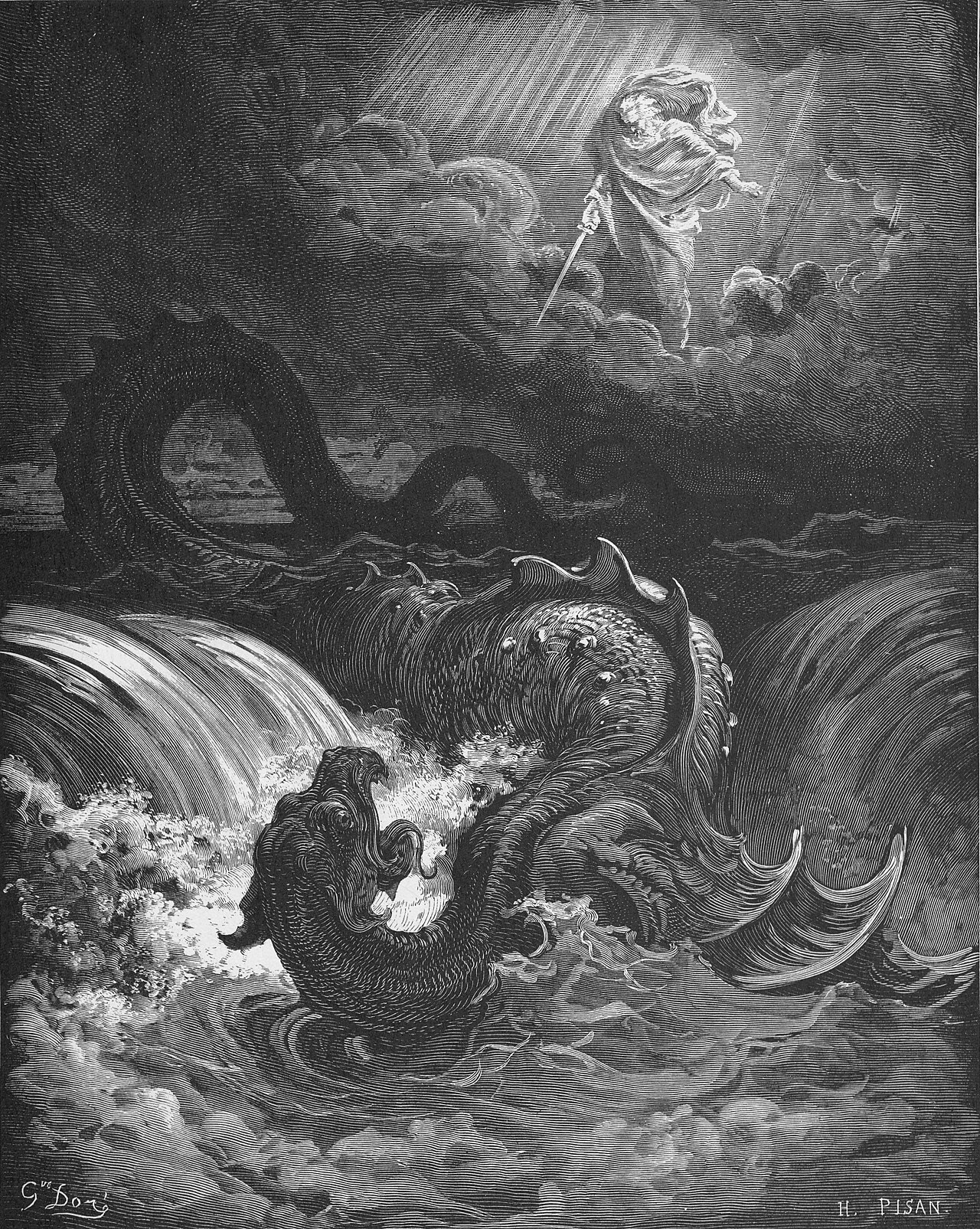
on leviathan the barlike serpent Jonathan renders: On the king who aggrandized himself like Pharaoh the first king, and upon a king who was as haughty as Sennacherib the second king. בָּרִיחַ is an expression of ‘straight’ like a bar, since he is the first.
At that time the Lord shall punish with his great, mighty, and strong sword the king, who has magnified himself as Pharaoh the first, and the king who has exalted himself as Sennacherib the second; and he shall slay the king that is strong as the dragon that is in the sea.
This section is reception history: how the passage was read and kept in the Jewish tradition. Where a reading parts from an essential of the Christian faith, the section says so at that point.
Texts and citation data: Sefaria; each excerpt follows its version’s licence. 1 further source is cited on this chapter that carry no English text this site may quote or only restate the verse.
The words behind it
6 Hebrew wordsEvery Hebrew word of this verse in the order it stands, with what it means and the door to its own study. The last column counts the times a word stands in the whole Bible: the rarer the word, the more the places it appears belong together.
| Hebrew | Sound | Meaning | Word study | In the Bible |
|---|---|---|---|---|
| בַּיּ֖וֹם | baiyom | in the day | H3117 → | 2304 times |
| הַה֑וּא | hahu' | <the> that | H1931 → | 1879 times |
| כֶּ֥רֶם | kerem | a vineyard of | H3754 → | 92 times |
| חֶ֖מֶד | chemed | delight | H2531 → | |
| עַנּוּ־ | ʾanu- | sing | H6030 → | 331 times |
| לָֽהּ׃ | lah | of it |
בַּיּ֖וֹםin the day
baiyomH3117 →2304 times
הַה֑וּא<the> that
hahu'H1931 →1879 times
כֶּ֥רֶםa vineyard of
keremH3754 →92 times
חֶ֖מֶדdelight
chemedH2531 →
עַנּוּ־sing
ʾanu-H6030 →331 times
לָֽהּ׃of it
lah
A shaded row is a word that stands 400 times or fewer in the Bible.
The walk
8 stopsEach card is a verse this one points to, and under it the verses that one points to in turn. Where several paths arrive at the same place, that place is listed first: the text keeps returning to it.
Through
Jeremiah 2:21I had planted you like a choice vine from the very best seed. How could you turn yourself before Me into a rotten, wild vine?
it leads to
- Isaiah 5:4
What more could I have done for My vineyard than I already did for it? Why, when I expected sweet grapes, did it bring forth sour fruit?
- John 15:1
“I am the true vine, and My Father is the keeper of the vineyard.
- Exodus 15:17
You will bring them in and plant them on the mountain of Your inheritance—the place, O LORD, You have prepared for Your dwelling, the sanctuary, O Lord, Your hands have established.
- Psalms 80:8
You uprooted a vine from Egypt; You drove out the nations and transplanted it.
- Psalms 44:2
With Your hand You drove out the nations and planted our fathers there; You crushed the peoples and cast them out.
- Isaiah 5:4
Through
Numbers 21:17Then Israel sang this song: “Spring up, O well, all of you sing to it!
it leads to
- Isaiah 12:5
Sing to the LORD, for He has done glorious things. Let this be known in all the earth.
- Exodus 15:1–2
Then Moses and the Israelites sang this song to the LORD: “I will sing to the LORD, for He is highly exalted. The horse and rider He has thrown into the sea.
- Judges 5:1
On that day Deborah and Barak son of Abinoam sang this song:
- Isaiah 12:5
Where this verse is studied
On this page
Studies2
On this verse
On this chapter
About Isaiah
This page draws on 10 works. Open the list of works
This page draws on Adam Clarke, Commentary on the Bible; Albert Barnes, Notes on the Book of Isaiah; Albert Barnes, Notes, Explanatory and Practical, on the Old and New Testaments (1832-1869); Jamieson, Fausset & Brown, Commentary Critical and Explanatory on the Whole Bible; Jerome, Commentary on Isaiah; John Calvin, Commentaries; John Gill, Exposition of the Old Testament (1748-1763); John Wesley, Explanatory Notes upon the Old Testament; Matthew Henry, Commentary on the Whole Bible and Thomas Aquinas, Commentary on Isaiah.