
Isaiah 27:1
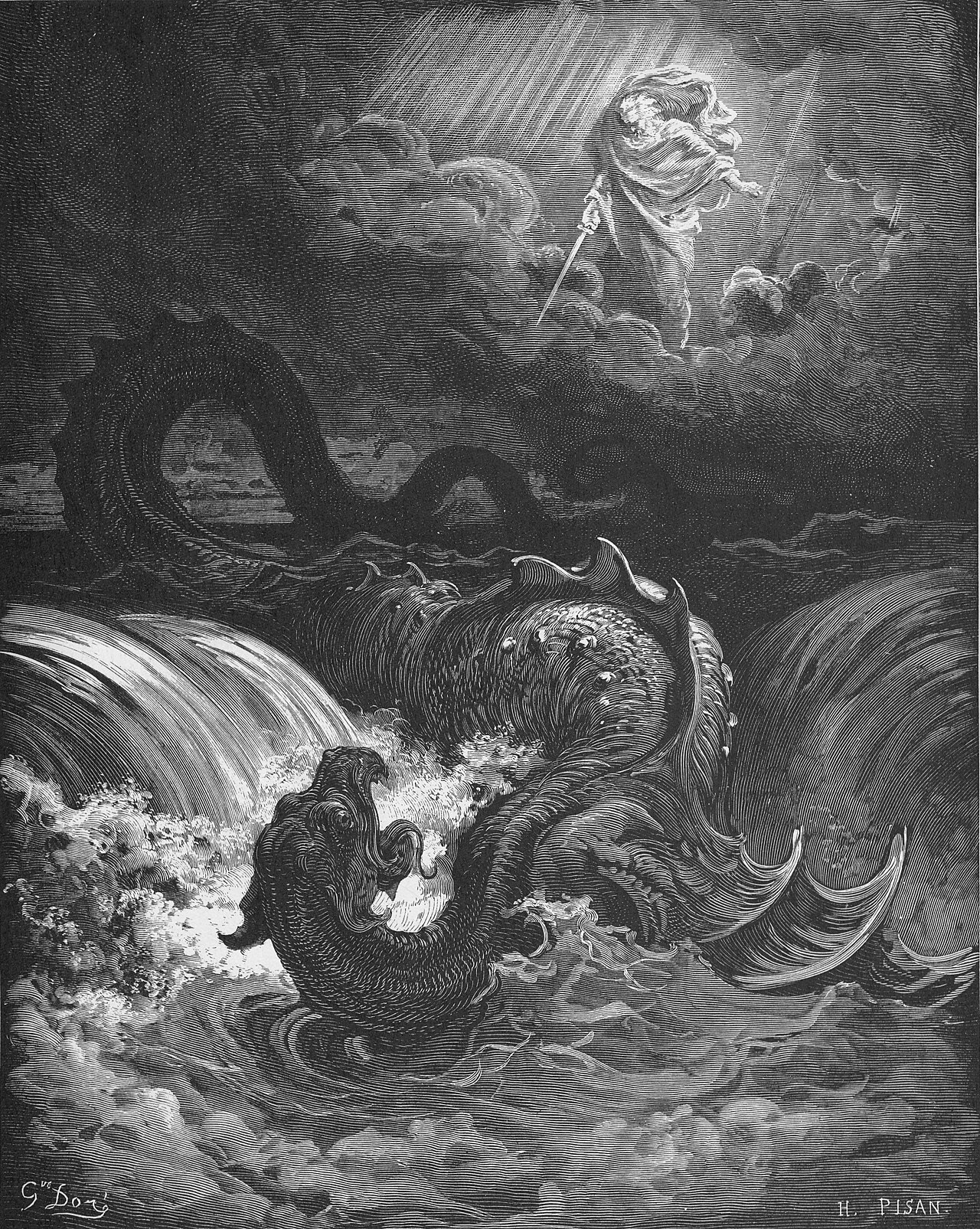
in Isaiah 27In that day the LORD will take His sharp, great, and mighty sword, and bring judgment on Leviathan the fleeing serpent—Leviathan the coiling serpent—and He will slay the dragon of the sea.
BSB
The same verse in ASV and KJV ▾
ASV
In that day Jehovah with his hard and great and strong sword will punish leviathan the swift serpent, and leviathan the crooked serpent; and he will slay the monster that is in the sea.
KJV
In that day the Lord with his sore and great and strong sword shall punish leviathan the piercing serpent, even leviathan that crooked serpent; and he shall slay the dragon that is in the sea.
⋯
This verse in Isaiah 27
Commentary
11 notes on this verse(Chapter 27 - Verse 1) On that day the Lord will visit with His hard, great, and strong sword Leviathan, the twisted serpent, and Leviathan, the fleeing serpent, and He will slay the sea monster that is in the sea. LXX: On that day God will bring forth His holy, great, and strong sword against the fleeing dragon, against the twisted dragon, and He will slay the dragon that is in the sea. The Hebrews understand the devil, that is, the accuser, whose Greek name is Satan (), to be called in Hebrew Satan (), which means adversary.
This site's exposition
Leviathan the fleeing serpent
The LORD takes "His sharp, great, and mighty sword" against "Leviathan the fleeing serpent" and "Leviathan the coiling serpent". He will "slay the dragon of the sea". Job 41 and Psalm 74 give the same creature these names, and Gill notes that Revelation 12 uses the same imagery of Satan.
The record, by era
The Church Fathers1 voice
Let us earnestly endeavor, therefore, to flee every crooked and tortuous act, and let us keep our mind and the judgment of our soul as straight as a rule, in order that the praise of the Lord may be permitted to us since we are upright. In the same way the serpent, which is the author of sin, is called crooked, and the sword of God is drawn against the dragon, the crooked serpent, which makes many twists and turns in its progress.… Therefore one who follows the serpent shows that his life is crooked, uneven and filled with contrarieties; but one who follows after the Lord makes his paths straight and his footprints right.
The Medieval Church3 voices
A commentator
Gregory the DialogistMorals on the Book of Job, Book 17, Section 51 · Written before 604.
proposed
For who is described by the designation of the "serpent" but our old enemy, at once slippery and crooked, who for the deceiving of humankind spoke with the mouth of a serpent? Of whom it is said by the prophet, "Leviathan the serpent, the crooked one"; who was for this reason allowed to speak with the mouth of a serpent, that by Leviathan's vessel humanity might learn what he was that dwelt within. For a serpent is not only crooked but slippery as well; and so because he stood not in the uprightness of truth, he entered into a crooked animal.… He spoke to man by means of a slippery animal because if one does not resist him, he secretly slips into the interior of the heart. Now "the dens" of this serpent were the hearts of wicked people.
620. In that day. In this part he recalls divine and paternal correction, and first, by foreign scourges, second, by their own scourges: in that day (Isa 27:2); hence it said in Wisdom 11:11: for you didst admonish and try them as a father. Concerning …
A commentator
Gregory the DialogistMorals on the Book of Job, Book 4, Sections 15-16 · Written before 604.
proposed
For "Leviathan" is interpreted to be "their addition." Whose "addition," then, but the "addition" of people? And it is properly styled "their addition," for since by his evil suggestion he brought into the world the first sin, he never ceases to add to it day by day by prompting to worse things.Or indeed it is in reproach that he is called Leviathan, that is, styled "the addition of men." For he found them immortal in Paradise, but by promising the divine nature to immortal beings, he as it were pledged himself to add somewhat to them beyond what they were. But while with flattering lips he declared that he would give what they did not have, he robbed them cunningly even of what they had. And hence the prophet describes this same Leviathan in these words, "Leviathan, the serpent: even Leviathan that crooked serpent." For this Leviathan crept near to people with tortuous windings through the false promise of what he would give them; for while he falsely promised things impossible, he really stole away even those which were possible.
The Puritans and the Awakening1 voice
It is emphatically expressed in the original: The Lord with his sword, that cruel one, and that great one, and that strong one, shall punish this unwieldy, this unruly criminal; and it shall be capital punishment: He shall slay the dragon that is in the sea; for the wages of his sin is death.
4 more voices on this verse
The Puritans and the Awakening1 voice
In that day the Lord with his sore and great and strong sword,....
The Nineteenth Century3 voices
A commentator
Albert Barnes1798–1870
Notes, Explanatory and Practical, on the Old and New Testaments (1832-1869)
In that day - In that future time when the Jews would be captive in Babylon, and when they would sigh for deliverance (see the note at Isa 26:1). This verse might have been connected with the previous chapter, as it refers to the same event, and then this chapter would have more appropriately commenced with the poem or song which begins in Isa 27:2. With his sore - Hebrew, הקשׁה haqāshâh - ‘Hard.’ Septuagint, Τὴς ἁγίαν Tēn hagian - ‘Holy.’ The Hebrew means a sword that is hard, or well-tempered and trusty.
A commentator
Jamieson, Fausset & Brown1802–1910
Commentary Critical and Explanatory on the Whole Bible (1871)
Re 12:3, &c., potentates hostile to Israel are similarly described; antitypically and ultimately Satan is intended (Re 20:10). piercing--rigid [LOWTH]. Flying [MAURER and Septuagint]. Long, extended, namely, as the crocodile which cannot readily bend back its body [HOUBIGANT]. crooked--winding. dragon--Hebrew, tenin; the crocodile. sea--the Euphrates, or the expansion of it near Babylon.
Leviathan - The animals here mentioned seem to be the crocodile, rigid by the stiffness of the backbone, so that he cannot readily turn himself when he pursues his prey; hence the easiest way of escaping from him is by making frequent and short turnings: the serpent or dragon, flexible and winding, which coils himself up in a circular form: and the sea monster, or whale. These are used allegorically, without doubt for great potentates, enemies and persecutors of the people of God: but to specify the particular persons or states designed by the prophet under these images, is a matter of great difficulty, and comes not necessarily with in the design of these notes. R. D. Kimchi says, leviathan is a parable concerning the kings of the Gentiles: it is the largest fish in the sea, called also תנין tannin, the dragon, or rather the whale. By these names the Grecian, Turkish, and Roman empires are intended. The dragon of the sea seems to mean some nation having a strong naval force and extensive commerce. See Kimchi on the place.
How the passage was read
What the Jewish commentators add
on leviathan the barlike serpent Jonathan renders: On the king who aggrandized himself like Pharaoh the first king, and upon a king who was as haughty as Sennacherib the second king. בָּרִיחַ is an expression of ‘straight’ like a bar, since he is the first.
2 more on this passage, in their own words ▾
At that time the Lord shall punish with his great, mighty, and strong sword the king, who has magnified himself as Pharaoh the first, and the king who has exalted himself as Sennacherib the second; and he shall slay the king that is strong as the dragon that is in the sea.
On that day At the time of the redemption, they shall sing to Israel, “This is a wine producing vineyard. It has yielded its good wine.” חֶמֶר vinos in O.F., winish.
This section is reception history: how the passage was read and kept in the Jewish tradition. Where a reading parts from an essential of the Christian faith, the section says so at that point.
Texts and citation data: Sefaria; each excerpt follows its version’s licence. 1 further source is cited on this chapter that carry no English text this site may quote or only restate the verse.
The words behind it
21 Hebrew wordsEvery Hebrew word of this verse in the order it stands, with what it means and the door to its own study. The last column counts the times a word stands in the whole Bible: the rarer the word, the more the places it appears belong together.
| Hebrew | Sound | Meaning | Word study | In the Bible |
|---|---|---|---|---|
| בַּיּ֣וֹם | baiyom | in the day | H3117 → | 2304 times |
| הַה֡וּא | hahu' | <the> that | H1931 → | 1879 times |
| יִפְקֹ֣ד | yifkod | he will visit [judgment] | H6485 → | 303 times |
| יְהוָה֩ | yahweh | Yahweh | H3068 → | 6520 times |
| בְּחַרְב֨וֹ | becharvo | with sword his | H2719 → | 413 times |
| הַקָּשָׁ֜ה | hakashah | <the> fierce | H7186 → | 36 times |
| וְהַגְּדוֹלָ֣ה | vehagedolah | and <the> great | H1419 → | 526 times |
| וְהַֽחֲזָקָ֗ה | vehachazakah | and <the> mighty | H2389 → | 56 times |
| עַ֤ל | ʾal | on | H5921 → | 5755 times |
| לִוְיָתָן֙ | livyatan | Leviathan | H3882 → | |
| נָחָ֣שׁ | nachash | a snake | H5175 → | 31 times |
| בָּרִ֔חַ | bariach | fleeing | H1281 → | 4 times |
| וְעַל֙ | veal | and on | H5921 → | 5755 times |
| לִוְיָתָ֔ן | livyatan | Leviathan | H3882 → | |
| נָחָ֖שׁ | nachash | a snake | H5175 → | 31 times |
| עֲקַלָּת֑וֹן | akalaton | twisting | H6129 → | |
| וְהָרַ֥ג | veharag | and he will slay | H2026 → | 167 times |
| אֶת־ | ʾet- | <obj.> | H853 → | 10935 times |
| הַתַּנִּ֖ין | hatanin | the sea monster | H8577 → | 28 times |
| אֲשֶׁ֥ר | ʾasher | which | H834 → | 5497 times |
| בַּיָּֽם׃ ס | baiyam | [is] in the sea | H3220 → | 396 times |
בַּיּ֣וֹםin the day
baiyomH3117 →2304 times
הַה֡וּא<the> that
hahu'H1931 →1879 times
יִפְקֹ֣דhe will visit [judgment]
yifkodH6485 →303 times
יְהוָה֩Yahweh
yahwehH3068 →6520 times
בְּחַרְב֨וֹwith sword his
becharvoH2719 →413 times
הַקָּשָׁ֜ה<the> fierce
hakashahH7186 →36 times
וְהַגְּדוֹלָ֣הand <the> great
vehagedolahH1419 →526 times
וְהַֽחֲזָקָ֗הand <the> mighty
vehachazakahH2389 →56 times
עַ֤לon
ʾalH5921 →5755 times
לִוְיָתָן֙Leviathan
livyatanH3882 →
נָחָ֣שׁa snake
nachashH5175 →31 times
בָּרִ֔חַfleeing
bariachH1281 →4 times
וְעַל֙and on
vealH5921 →5755 times
לִוְיָתָ֔ןLeviathan
livyatanH3882 →
נָחָ֖שׁa snake
nachashH5175 →31 times
עֲקַלָּת֑וֹןtwisting
akalatonH6129 →
וְהָרַ֥גand he will slay
veharagH2026 →167 times
אֶת־<obj.>
ʾet-H853 →10935 times
הַתַּנִּ֖יןthe sea monster
hataninH8577 →28 times
אֲשֶׁ֥רwhich
ʾasherH834 →5497 times
בַּיָּֽם׃ ס[is] in the sea
baiyamH3220 →396 times
A shaded row is a word that stands 400 times or fewer in the Bible.
The walk
8 stopsEach card is a verse this one points to, and under it the verses that one points to in turn. Where several paths arrive at the same place, that place is listed first: the text keeps returning to it.
Through
Isaiah 51:9Awake, awake, put on strength, O arm of the LORD. Wake up as in days past, as in generations of old. Was it not You who cut Rahab to pieces, who pierced through the…
it leads to
- Psalms 74:13–14
You divided the sea by Your strength; You smashed the heads of the dragons of the sea;
Reached by 2 separate paths from here.
- Isaiah 52:1
Awake, awake, clothe yourself with strength, O Zion! Put on your garments of splendor, O Jerusalem, holy city! For the uncircumcised and unclean will no longer enter you.
- Psalms 89:10
You crushed Rahab like a carcass; You scattered Your enemies with Your mighty arm.
- Isaiah 30:7
Egypt’s help is futile and empty; therefore I have called her Rahab Who Sits Still.
- Ezekiel 29:3
Speak to him and tell him that this is what the Lord GOD says: Behold, I am against you, O Pharaoh king of Egypt, O great monster who lies among his rivers, who says,…
- Psalms 74:13–14
Through
Revelation 12:3Then another sign appeared in heaven: a huge red dragon with seven heads, ten horns, and seven royal crowns on his heads.
it leads to
- Revelation 17:12
The ten horns you saw are ten kings who have not yet received a kingdom, but will receive one hour of authority as kings, along with the beast.
- Revelation 12:9
And the great dragon was hurled down—that ancient serpent called the devil and Satan, the deceiver of the whole world. He was hurled to the earth, and his angels with him.
- Daniel 7:24
And the ten horns are ten kings who will rise from this kingdom. After them another king, different from the earlier ones, will rise and subdue three kings.
- Revelation 17:12
Where this verse is studied
On this page
About Isaiah
This page draws on 12 works. Open the list of works
This page draws on Adam Clarke, Commentary on the Bible; Albert Barnes, Notes, Explanatory and Practical, on the Old and New Testaments (1832-1869); Basil of Caesarea, HOMILIES ON THE PSALMS 32:1; Franz Delitzsch, Biblical Commentary on the Prophecies of Isaiah; Gregory the Dialogist, Morals on the Book of Job, Book 17, Section 51; Gregory the Dialogist, Morals on the Book of Job, Book 4, Sections 15-16; Jamieson, Fausset & Brown, Commentary Critical and Explanatory on the Whole Bible; Jerome, Commentary on Isaiah; John Gill, Exposition of the Old Testament; John Gill, Exposition of the Old Testament (1748-1763); Matthew Henry, Commentary on the Whole Bible and Thomas Aquinas, Commentary on Isaiah.