
Genesischapter 33
20 verses · Moses, by tradition · 15th to 13th century BC · The Law
In Jewish life
The reading
Weekly portion 8 of 54
וַיִּשְׁלַח Vayishlach, Genesis 32:4 to 36:43
Read with it: Obadiah 1:1 to 1:21.
The verse numbers here are the ones a Hebrew Bible carries, which differ from an English Bible by a verse or two in several places. The Sephardi reading is named only where this site records a difference; communities vary beyond what is listed. What these books are, and how a Christian reader meets them →
How it is read
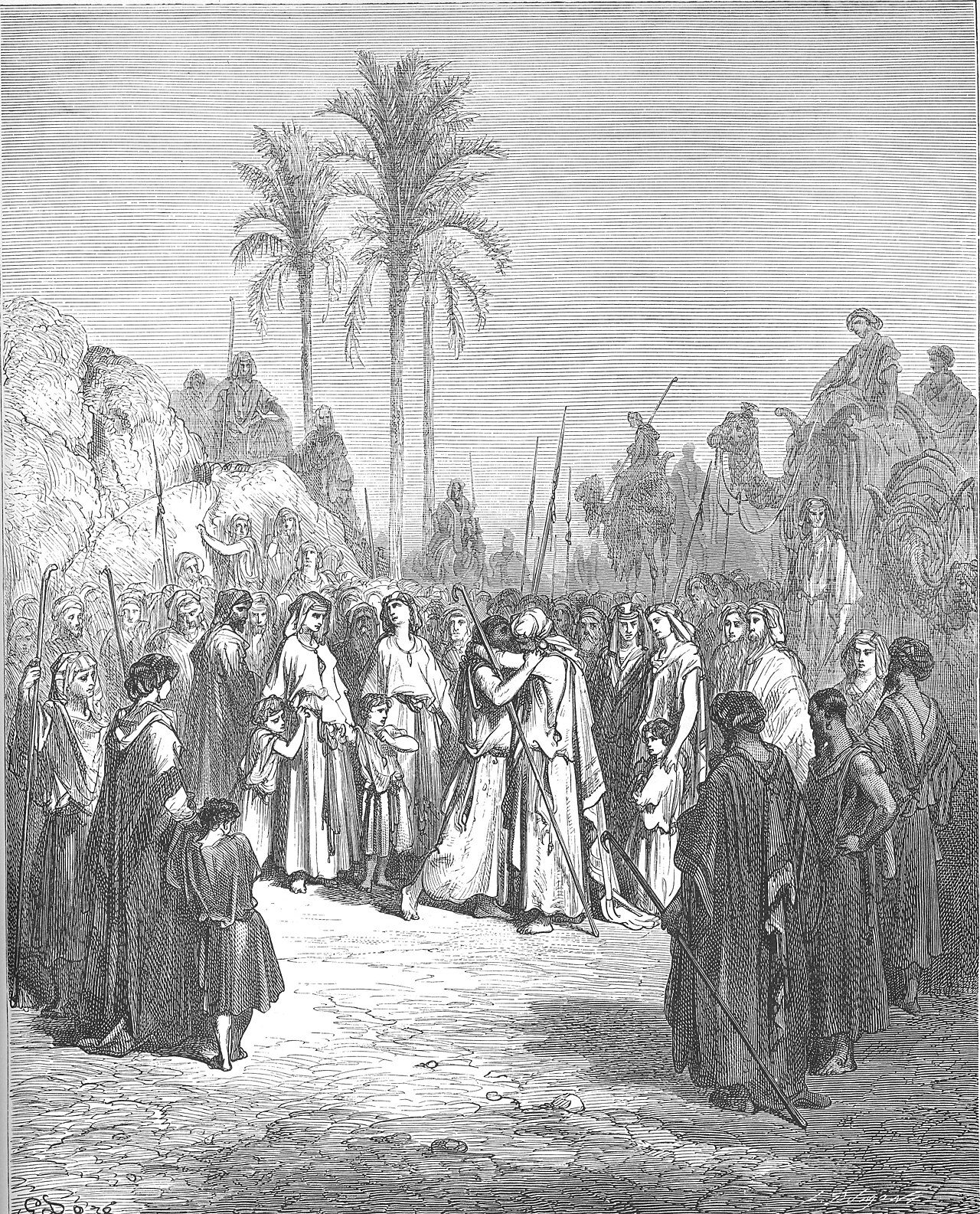
The meeting of the brothers is the chapter where the classical readers part company most visibly, and the place they part is the kiss. Rashi records that the scribal tradition puts dots above that word, and hands on the dispute rather than settling it: "Dots are placed above the letters of this word, and a difference of opinion is expressed in the Baraitha of Sifré" as to what the dots mean, one view being that the kiss was not wholehearted (Rashi on Genesis 33:4:2, the Pentateuch with Rashi's commentary by M. Rosenbaum and A. M. Silbermann, 1929 to 1934, public domain). On the embrace itself he is warmer, "His pity was aroused when he saw him prostrating himself so many times", on Genesis Rabbah 78:8 (Rashi on Genesis 33:4:1). He reads the ordering of the families as a ranking of love, and Jacob going first as a father putting himself in the way: "He thought: if that wicked man comes to fight let him fight me first" (Rashi on Genesis 33:2:1 and 33:3:1). Esau's refusal of the gift he takes as a legal concession, "In these words he admitted his right to the blessings", on Genesis Rabbah 78:11 (Rashi on Genesis 33:9:1). He reads the booths of the seventeenth verse as a stay of eighteen months, a summer, a winter and a summer, on Megillah 17a, and the word for Jacob's arrival at Shechem as three kinds of wholeness, among them "unimpaired in body (health) because he was cured of his lameness" (Rashi on Genesis 33:17:1 and 33:18:1). On the price paid for the field he quotes Rabbi Akiba on a coin he had met in the field: "When I visited the coast-towns I found that they called a Meah a Kesittah", on Rosh Hashanah 26a (Rashi on Genesis 33:19:1). Radak and Sforno read the scene as diplomacy under threat. Radak says Jacob divided the children among their mothers because "Each mother would naturally have stronger concern for her own children", and that Jacob went ahead of them all as a father who has compassion on his children: "He offered himself as the butt of Esau's anger hoping thereby to save the lives of his children" (Radak on Genesis 33:1:1 and 33:3:1, translated by Eliyahu Munk, HaChut Hameshulash, CC-BY). Sforno reads the four hundred men as evidence that the gift had failed, "To tell us that he had not been appeased even by the substantial gift Yaakov had sent him" (Sforno on Genesis 33:1:1, Munk translation, CC-BY). Ibn Ezra comments here at 33:2:1 and Malbim at 33:6:1, and the corpus holds no English of either under a licence permitting quotation, so they stand as citations.
What the rabbis say
The corpus records forty rabbinic locators on this chapter, thirty-one of them Midrash and nine Talmud, and the Talmud count is the highest of any chapter in this half of the book. Bereshit Rabbah runs through the meeting at 78:7, 78:8, 78:10, 78:11, 78:13, 78:14 and 78:15, and on to the field at Shechem and the altar at 79:7 and 79:8. Bereshit Rabbati is cited at Parashat Vayishlach 11, 12 and 49, Midrash Aggadah at Genesis 32:4:1, 33:13:1 and 33:15:1, Devarim Rabbah at 1:17 and 1:18, and Aggadat Bereshit at 42:1, 54:2 and 69:2. The nine Talmud locators cluster at the kiss and at Jacob's refusal to travel with Esau: Avot DeRabbi Natan 34:5 and 34:6 at the embrace, Bava Batra 17a:1 at the gift, Avodah Zarah 8b:9 and Chagigah 5b:6 at Esau's offer to go along, Avodah Zarah 25b:8 and 25b:9 at Jacob's answer and at the booths, Jerusalem Talmud Yevamot 1:6:2 at Esau's return, and Chullin 91a:22. Rashi hands on further sayings with their locators, among them Genesis Rabbah 78:8 and 78:11, the Baraitha of Sifré on the dotted word, Megillah 17a and Rosh Hashanah 26a.
The text, verse by verse
Each word shows the Hebrew, the English under it, how it sounds and its Strong’s number. A rule between verses marks where the Hebrew manuscripts end a paragraph.
The Brothers Embrace and Weep
Ramban on Genesis 33:11
I.e., the gift. Likewise, Make your blessing with me. II Kings:31. means “bring me a gift” or “make your peace with me.” So also, Take a blessing of thy servant. Ibid.,:15. means “take a present from thy servant.
Read it in full at Sefaria · Commentary on the Torah by Ramban (Nachmanides). Translated and annotated by Charles B. Chavel. New York, Shilo Pub. House, 1971-1976
Jacob Turns Aside to Succoth
Ibn Ezra on Genesis 33:12
Some say that nisah (let us take our journey) is an imperative.
Read it in full at Sefaria · Ibn Ezra's commentary on the Pentateuch, tran. and annot. by H. Norman Strickman and Arthur M. Silver. Menorah Pub., 1988-2004
Ramban on Genesis 33:13
Jacob said this in a compassionate manner for he should have said, “And they will all die,” but he would not express himself this way about the children.
Read it in full at Sefaria · Commentary on the Torah by Ramban (Nachmanides). Translated and annotated by Charles B. Chavel. New York, Shilo Pub. House, 1971-1976
Ramban on Genesis 33:14
In returning to his land Jacob could have gone by way of the land of Se’ir. Now Esau told him, And I will go before thee, 93 Verse 12 here.
Read it in full at Sefaria · Commentary on the Torah by Ramban (Nachmanides). Translated and annotated by Charles B. Chavel. New York, Shilo Pub. House, 1971-1976
An Altar Raised at Shechem
Hebrew words in this chapter
The 40 most used Hebrew words of the chapter, counted by lemma. The article, the object marker, the negatives and the common prepositions are left out.
| Word | Sense here | Uses | Strong’s |
|---|---|---|---|
| אָמַרʼâmar | and he said | 10 | H559 |
| יֶלֶדyeled | the children | 9 | H3206 |
| יַעֲקֹבYaʻăqôb | Jacob | 5 | H3290 |
| עַיִןʻayin | eyes his | 5 | H5869 |
| עֵשָׂוʻÊsâv | Esau | 5 | H6215 |
| בּוֹאbôwʼ | to come | 5 | H935 |
| אָדוֹןʼâdôwn | lord | 5 | H113 |
| נָאnâʼ | please | 5 | H4994 |
| רָאָהrâʼâh | to see | 4 | H7200 |
| שָׁחָהshâchâh | to bow | 4 | H7812 |
| נָגַשׁnâgash | to approach | 4 | H5066 |
| אֱלֹהִיםʼĕlôhîym | God | 4 | H430 |
| לֵאָהLêʼâh | Leah | 3 | H3812 |
| רָחֵלRâchêl | Rachel | 3 | H7354 |
| שִׁפְחָהshiphchâh | maidservant | 3 | H8198 |
| מָצָאmâtsâʼ | to find | 3 | H4672 |
| חֵןchên | favor | 3 | H2580 |
| לָקַחlâqach | to take | 3 | H3947 |
| פָּנִיםpânîym | face | 3 | H6440 |
| נָשָׂאnâsâʼ | to lift | 2 | H5375 |
| Word | Sense here | Uses | Strong’s |
|---|---|---|---|
| מֵאָהmêʼâh | hundred | 2 | H3967 |
| אַחֲרוֹןʼachărôwn | behind | 2 | H314 |
| יוֹסֵףYôwçêph | Joseph | 2 | H3130 |
| עָבַרʻâbar | to pass | 2 | H5674 |
| אֶרֶץʼerets | land | 2 | H776 |
| אָחʼâch | brother | 2 | H251 |
| חָנַןchânan | he has shown favor to | 2 | H2603 |
| עֶבֶדʻebed | servant your | 2 | H5650 |
| יֵשׁyêsh | there | 2 | H3426 |
| יָדyâd | hand | 2 | H3027 |
| נָסַעnâçaʻ | to set out | 2 | H5265 |
| הָלַךְhâlak | and let us go | 2 | H1980 |
| צֹאןtsôʼn | flock | 2 | H6629 |
| יוֹםyôwm | day | 2 | H3117 |
| רֶגֶלregel | foot | 2 | H7272 |
| שֵׂעִירSêʻîyr | Seir | 2 | H8165 |
| סֻכּוֹתÇukkôwth | Succoth | 2 | H5523 |
| קָרָאqârâʼ | to call | 2 | H7121 |
| עִירʻîyr | city of | 2 | H5892 |
| שְׁכֶםShᵉkem | Shechem | 2 | H7927 |
Keep studying
Sources for this chapter
The Hebrew text
STEP Bible, the tagged Hebrew text and its English glosses and James Strong, Strong's Exhaustive Concordance.
In Jewish life
Rashi, Rashi on Genesis 33:2:1, 33:3:1, 33:4:1, 33:4:2, 33:5:1, 33:7:1, 33:8:1, 33:9:1, 33:10:1, 33:11:1, 33:12:1, 33:13:1, 33:14:1, 33:15:1, 33:16:1, 33:17:1, 33:18:1, 33:19:1 and 33:20:1, the Pentateuch with Rashi's commentary by M. Rosenbaum and A. M. Silbermann, 1929 to 1934, public domain; Radak, Radak on Genesis 33:1:1 and 33:3:1, translated by Eliyahu Munk, HaChut Hameshulash, CC-BY; Sforno, Sforno on Genesis 33:1:1, translated by Eliyahu Munk, HaChut Hameshulash, CC-BY; Ibn Ezra, Ibn Ezra on Genesis 33:2:1, cited only, no English version in the corpus under a licence permitting quotation; Malbim, Malbim on Genesis 33:6:1, cited only; Midrash, Bereshit Rabbah 11:7, 43:8, 75:10, 77:3, 78:7, 78:8, 78:10, 78:11, 78:13, 78:14, 78:15, 79:7, 79:8, 90:4 and 98:18; Bereshit Rabbati, Parashat Vayishlach 11, 12 and 49; Midrash Aggadah, Genesis 32:4:1, 33:13:1 and 33:15:1; Devarim Rabbah 1:17 and 1:18; Aggadat Bereshit 42:1, 54:2 and 69:2; Bamidbar Rabbah 11:6; Midrash Sekhel Tov, Bereshit 33:7:1; Midrash Lekach Tov on Esther 3:4:2; Midrash Tanchuma Buber, Vayeshev 12:2; Ein Yaakov, Sukkah 3:9; Babylonian Talmud, Bava Batra 17a:1, Avodah Zarah 8b:9, 25b:8 and 25b:9, Chagigah 5b:6, Chullin 91a:22; Megillah 17a and Rosh Hashanah 26a as Rashi cites them; Jerusalem Talmud, Jerusalem Talmud Yevamot 1:6:2; Avot DeRabbi Natan, Avot DeRabbi Natan 34:5 and 34:6 and Sifre, the Baraitha of Sifre on the dotted word, as Rashi cites it at Rashi on Genesis 33:4:2.
The rabbinic texts
Ramban, Commentary on the Torah by Ramban (Nachmanides). Translated and annotated by Charles B. Chavel. New York, Shilo Pub. House, 1971-1976; Ibn Ezra, Ibn Ezra's commentary on the Pentateuch, tran. and annot. by H. Norman Strickman and Arthur M. Silver. Menorah Pub., 1988-2004 and Sefaria, texts and citation data.